Can Character be Taught?

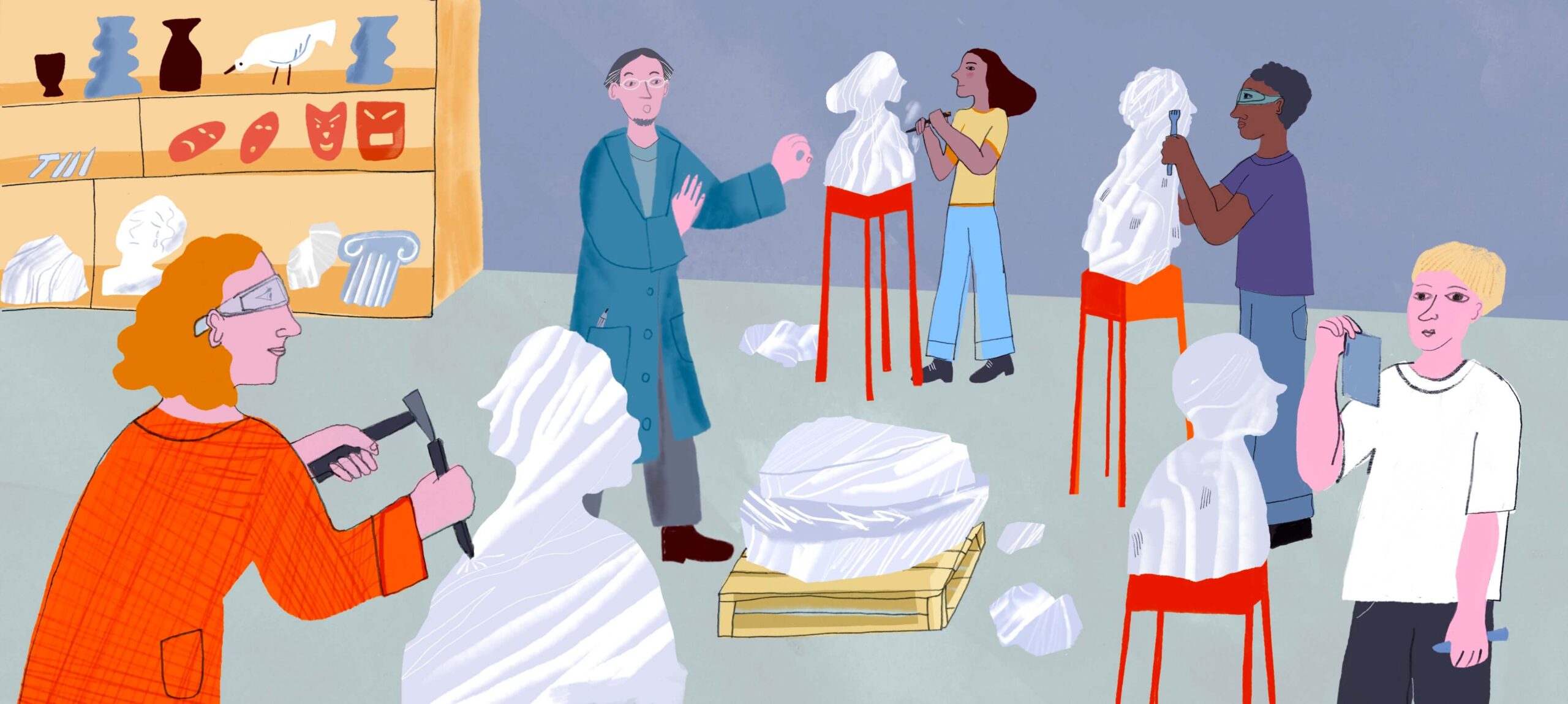
In his first-year seminar class, Commencing Character, Professor Michael Lamb asks his students to consider how seven strategies for character development are exemplified in some of history’s most memorable commencement speeches.  At the end of the semester, the students are asked to write their own addresses, revealing the virtues they have internalized, or at least found most salient. Lamb’s class is not about speechwriting.  It is about learning how to become a better person, a concept that may seem naïve, unattainable, or even inappropriate in 2023 America, but it is one Lamb believes students and society urgently need.  

“We’re facing a crisis of leadership in our country where we don’t have many leaders that are embodying the kind of virtues and values that we need to lead with courage, humility, justice and compassion,” said Lamb. “At the same time, institutions that once served as training grounds for moral formation are now playing less influential roles, leaving a gap for colleges and universities to shape the character of students, many of whom want guidance on how to live.”   

Lamb argues that college is an important time to teach character since emerging adults are already experiencing existential angst and self-discovery.  He and his colleague, Kenneth Townsend, run the Program for Leadership and Character at Wake Forest University, a multi-dimensional center of curricular and co-curricular activities, scholarship, training, and public engagement focused on creating leaders of good character in a range of disciplines and fields. While character education is not new (it was central to much American higher education in the past), Lamb, Townsend, and their team have revitalized a focus on character as they integrate it into leadership development, positing character as a catalyst for flourishing both within a person and for a community.  With early funding from the Kern Family Foundation and a recent infusion of $30 million from the Lilly Endowment, Inc., the program is poised to grow into a national center on character education.  To get there, it is focused on two key questions: Can character be taught? And if so, why aren’t we teaching it everywhere? 

“We’re facing a crisis of leadership in our country where we don’t have many leaders that are embodying the kind of virtues and values that we need to lead with courage, humility, justice and compassion.”

Pro Humanitate

It is no coincidence that Wake Forest is now among the country’s leading institutions in character-based leadership.  The founding motto of the liberal arts school in North Carolina is Pro Humanitate (“For Humanity”), connoting both a holistic approach to teaching and “a beyond the self” dimension. With a long tradition of study in this area, Wake Forest faculty like Christian B. Miller, Eranda Jayawickreme, William Fleeson, and R. Michael Furr are worldwide experts on character.  In 2017, then President Nathan Hatch, a longtime advocate of this work, cemented the distinction by launching the Program for Leadership and Character and recruiting Lamb to run it. 

Lamb grew up on a farm in Tennessee. Though his parents did not graduate from college, they taught him how to live with integrity. He did community service 10 hours a week in Memphis as part of his scholarship to college.  He later became a Rhodes Scholar and went to Princeton University for his doctorate.  “That experience of connecting deep exploration of how we ought to live with practical engagement in the community really helped me see the ways in which a liberal arts education could inform how I think and live,” he said.  

As a postdoctoral fellow at Oxford, Lamb helped launch the Oxford Global Leadership Initiative within the Oxford Character Project, where he gained recognition as an expert on the subject with a distinctively pragmatic approach. He argues that leadership steered by virtues of character has enormous benefits, including building trust among citizens and employees, making institutions stronger, and improving results. He cites research showing that, despite the current tolerance for disinformation, people value leaders who can make ethical decisions and are trustworthy. 

Like Lamb, Kenneth Townsend’s decision to teach character to the next generation of leaders is deeply personal.  Townsend also rose from humble roots in the rural south and went on to receive dual degrees in law and divinity at Yale University.  Townsend and Lamb met twenty years ago when Townsend was also a Rhodes Scholar, and the two became friends.  “My commitment to my work at Wake Forest is very much rooted in what I learned from my own education—the sense that students need to have an opportunity to live, think, and act in holistic sorts of ways; where their lives and work can be integrated and they’re not forced to separate who they are from what they do,” he said.

Townsend oversees the program’s work with the university’s professional schools and programs—law, medicine, engineering, and divinity—where the absence of character in leadership can have enormous consequences. He views what they teach in the program as far beyond ethics-as-compliance.  “For this to stick and for people not to just roll their eyes, we have to make the case for how having empathy, for example, will make law students better lawyers,” he said.  “If this is viewed as just another box to check, it won’t be taken seriously, and it won’t have as great of an impact in students’ lives.”

Two women speaking
Photo provided by Wake Forest University

Christopher Stawski, senior program director and senior fellow of the Kern Family Foundation, said the foundation had its eye on Wake Forest’s character work for some time, given its own mission “to build flourishing lives anchored in strong character.” After productive conversations with President Hatch, they arrived at supporting a new engineering program at the school that would explicitly integrate character into the curriculum.  In 2021, with strong support from the current Wake Forest President Susan R. Wente, Kern invested $8.6 million in the Program for Leadership and Character that would expand this approach into the professional schools and pre-professional programs at Wake Forest, reflecting a philosophy already underway at the Kern National Network for Flourishing in Medicine. 

“You want to embed character into the educational process early so people are considering this at the onset of their professional journeys,” said Stawski.  “‘What kind of lawyer, or doctor, or engineer do I want to be?’ And they need to have that vision of themselves when they confront difficult decisions, whether it’s in medical ethics or artificial intelligence.” 

Overall, Wake Forest’s Program for Leadership and Character is divided into three pillars that, taken together, create a prototype for how to teach, test, and scale character-based leadership.  The student experience includes courses within both undergraduate and graduate schools, discussion groups focused on topics such as the “purpose of college” and the “role of friendship,” and creative programming that explores leadership and character through art, athletics, and religious life. Rounding this out are the Leadership and Character Scholars, an annual cohort of students from diverse racial and socioeconomic backgrounds who have exhibited leadership and character in high school and receive merit and need-based scholarships to participate in the program’s activities throughout their four years at Wake Forest.

The second pillar is the curriculum development work that is done in a series of workshops and trainings of varying intensity with faculty. This allows interested faculty in every school or department within the university to incorporate character into what they are teaching, in some instances redesigning courses, be they in communication or computer science.  In many ways, this is the most transformative element of the program in that it puts character-based leadership in any domain, grounding it into the pedagogy.  

The third component involves a research and assessment team tasked with evaluating the strategies that are used to promote character growth in the programming and courses.  This involves continuously collecting data on student outcomes.  

Lamb’s Commencing Character course informs the faculty training and is where the foundational learning takes place for many undergraduates.  The course uses seven strategies that are consistent with an Aristotelian approach to character development and supported by research in education, philosophy, and psychology.  Each strategy gets unpacked with relatable language and comes with practical exercises that students apply to their own lives with the goal of attaining virtues such as purpose, justice, courage, and gratitude. 

“You want to embed character into the educational process early so people are considering this at the onset of their professional journeys. ‘What kind of lawyer, or doctor, or engineer do I want to be?’”

The course is proactive and self-reflective. The first strategy, “habituation through practice,” suggests you can’t just read about virtues, you must learn them by performing virtuous actions. “Engagement with virtuous exemplars” involves examining role models who have exhibited good judgment in challenging situations—the proverbial “What would Jesus/my mother/Ted Lasso do?” Another, “reflection on personal experience,” asks students how and why they act in a certain way under certain circumstances. With “increasing awareness of influence and biases,” students are shown examples of how to understand their own assumptions and develop curiosity about differences.  One of the weightier ones is “moral reminders”—psychological alerts that keep us from doing the wrong thing by recalling a commitment to important values or norms. 

The course is open to anyone but is a requirement for the Leadership and Character Scholars, the undergraduates who have been given the challenge and the privilege of becoming people of good character.  Here is also where the importance of embedding character development into leadership is personified.  “These students are the ones that, by and large, are going to have some measure of power and agency in the world,” said Ann Phelps, a trained jazz musician with a degree in theology and the arts from Yale, who runs the undergraduate program with Lamb and oversees the Scholars.  “We want them to understand that their choices will impact the lives of others and, at the very least, not to ignore the hard questions.”

Leaders in Training

While making a case for why an individual’s character growth benefits others, Phelps is witness to how this work can transform a person’s own life.  Her involvement with the Scholars includes everything from recruiting and onboarding students, to running programs and discussion groups, to supporting them personally when the growth gets hard.  She is perhaps best positioned to refute the notion that character is hardwired or only for those with proper upbringings.  “Anyone has the capacity to develop strong character,” she said. “These students arrive at college with limitations and opportunities for growth (like we all have), often covered by talent, work ethic, intelligence, or pure luck. They could easily thrive in life without trying to become kinder, more courageous, or more just, but in this space, they work on developing virtues anyway.”  On a Zoom call in late spring, she asked two of her students to discuss their experiences in the Leadership and Character Scholars program.

Sofia Ramirez Pedroza is in her junior year and is excited she still has a quarter of the program left. She said it has had a profound influence on her, both in terms of how she sees herself and what she would like to do with her life. “Whether it’s a big goal or a small goal, I just see the world differently now,” she said.

Sofia had a full ride to Wake Forest and didn’t think too much about the impact of what she had just been granted, but the intentionality of the program soon became evident.  “This was not a loose kind of thing,” she said.  “I came to understand that this was a place where they really cared about the cultivation of good people.  Ann and Dr. Lamb and the rest of the people involved were very much invested in who we were becoming.”  

At first, she didn’t know what that would look like for her.  Sofia is Hispanic and credits her loving family with a confidence that clearly shows in her outgoing personality. But despite her easy nature, she says she developed a tough exterior to shield her from a lifetime of feeling undeserving—the “quota girl,” she said, who wouldn’t have made it otherwise.  “I was very much a pessimistic person so I didn’t even know I had the capacity of understanding that I really could grow into the person I want to become.” 

Sofia said the virtues she most wanted to cultivate with the seven strategies were gratitude and hope, which she wrote about in her end-of-semester commencement speech and said she owes to the people in the program. A subtle but important clue to her character growth is revealed when she discusses her career, which she now views as not just about herself.   

“I’ve always wanted to do something in sports, but as a Hispanic female I didn’t really think there was a space for me,” she said.  “Then I thought, why not? I decided to go for it, not just for me, but for the sea of people that come behind me that didn’t get granted these opportunities.” 

Rachel Edwards just graduated and was among the program’s first cohort in 2019. When she first received the scholarship into the program, she said she was intrigued by the concept but didn’t really know what to expect.  “Maybe I’d become a leader of a club or something, but I had no idea the extent to which I, Rachel Edwards, would change as a person.” 

When Rachel came to Wake Forest, she was a pre-med major determined to fulfill her and her family’s dream of becoming a doctor.  Shortly after she arrived, she intervened in a sexual assault on behalf of her friend and was left “wrecked by it.”  Her mental health suffered, and she went to Phelps for advice, thinking she might transfer.  

“At the same time, we were reading Aristotle’s book, Nicomachean Ethics, and I was really curious about what this old white man had to say about justice,” she said. “It ended up being something I could hold onto and do something with instead of just going away, so I began to form a conception of justice as a virtue.” 

Group photo with C2C artwork
Photo provided by Wake Forest University

Rachel also began working at the school’s Title IX office where the staff was scrambling to adapt to then Education Secretary Betsy Devos’ new regulations on sexual assault. She dove into the work and remained involved throughout her four years at Wake Forest.  “This is what justice for my friend looked like for me,” she said.  She eventually found the courage to tell her parents she wasn’t going to become a doctor.  In the fall of 2023, she is headed to law school. 

When asked about her wellbeing, Rachel said, “I think when you develop your character, you’re simultaneously developing your wellbeing – you’re developing skills to approach the world. In every situation that took me to the lowest of lows, it was the program, and the people in it, that brought me back.  And it wasn’t a superficial thing like, ‘I get to hold Ann’s hand.’ It was what Ann was teaching me.  It was the content.” 

The Case for Character

While Rachel and Sofia’s stories anecdotally demonstrate what the program is capable of, Lamb and Townsend have more tangible evidence to show the academic community.  Numerous papers convey the results of the assessments they have done that show that students in Lamb’s course grew in seven targeted virtues compared to control groups; strengthened a sense of purpose including a “beyond the self” purpose that focused on flourishing within a community; and developed a growth mindset—a belief that self-improvement is possible if they try.  The faculty training workshops have proven to increase professors’ understanding of character education as well as their confidence in incorporating these ideas into their classes.  

​​When asked if all students should receive character and leadership training, Sofia said, “Of course. I mean, why wouldn’t you want to be a better person?”

Accompanying these materials are infographics showing that between all three pillars, and a fourth involving external-facing conferences and seminars, the program can count over 25,000 individual engagements in the last three years alone, including hundreds with faculty and staff at other colleges and universities.  This is an important metric as the program uses the new Lilly Endowment, Inc. grant money to make character education contagious throughout the country. 

Though not stated, these documents also serve to fend off the critics of this work, the “eye rollers” Townsend refers to who believe it’s “soft stuff,” or others who see it as preachy or patronizing. Lamb says the urgency for character-based education may be the strongest defense in a world where leadership is confused with celebrity and young people are hungry for something to believe in. 

When asked if all students should receive character and leadership training, Sofia said, “Of course.  I mean, why wouldn’t you want to be a better person?” 

Teaching Happiness in High School

Can today’s students, having grown up in this fast-paced, digital world, inundated by content capped at 60 seconds, learn to slow down? At The Noble and Greenough School in Dedham, Massachusetts, Jen Hamilton arranged for her high schoolers to try with the help of “savoring stations,” including sweet treats, rich smelling oils, a bucket of water beads and a lava lamp with green and blue floating goo. As the kids drifted between stops, Hamilton asked  them to consider the last time they’d savored a meal. “You ever notice that when you’re on your phone, all of a sudden the food is gone?” 

Hamilton is the director of counseling at The Noble and Greenough School, or Nobles, a private high school in suburban Boston, and the students are in a course called “Psychology and the Good Life,” which she co-teaches with Dr. LaTasha Sarpy. The class may sound familiar, given it’s a junior version of one by the same name made famous by professor Laurie Santos—the most popular class in the history of Yale University. The savoring stations were Hamilton and Sarpy’s idea but the rest of their curriculum tracks closely to the lectures Santos designed to teach her Ivy League undergraduates “a set of scientifically-validated strategies for living a more satisfying life.” More recently, teachers like Hamilton and Sarpy have set out to find whether this approach can work for high schoolers, many of whom are a mirror image of the Yale students’ younger selves.

Laurie Santos speaking
Laurie Santos, Professor of Psychology, Head of Silliman College, Yale University

Santos is strongly behind the idea. “When we first developed a course at Yale, it went viral on campus, and when we started getting press attention, I kept hearing from parents and educators who said, ‘This is so great that you have a class for college students, but I wish we could get something for students who [are] younger.’ So even when I first taught the class back in 2018, I was already thinking of ways that we could develop this content for younger learners.” 

Nearly 1,200 students gravitated to Santos’ class at Yale during its first semester in 2018 for the opportunity to learn what really makes humans happy, as opposed to what they think will make them happy, and how to apply that knowledge to better themselves and their communities. Its popularity is encouraging while also reflecting the unrelenting desire for today’s college students to “feel better.” In 2020-2021, the Healthy Minds Study found more than 60% of college students met criteria for one or more mental health problems—a 50% increase since 2013. Wary of increasing demand for psychological services, experts have emphasized the importance of preventing mental health problems before they come up, rather than only confronting them after the fact. Perhaps, pioneer professors like Santos considered, teaching students how to build healthy habits that stave off larger emotional problems could do just that.

As for the high school setting, Hamilton, too, is on the cutting edge. The seasoned counselor, going on 22 years at Nobles, was one of the first to work with Santos to bring her lessons to high schoolers, who, like their college peers, need significant mental health support. According to the 2021 Youth Risk Behavior Report from the Centers for Disease Control and Prevention (CDC), more than four in ten high school students (42%) reported feeling persistently sad or hopeless, while more than one in five (22%) reported considering suicide, and one in ten (10%) attempted suicide. Sixty percent of women and 70% of LGBTQ+ students also reported feeling persistently sad or hopeless. A quarter of women reported making a suicide plan and a quarter of the LGBTQ+ sample reported attempting suicide.

Still, the fate of wellness curricula in high school remains to be sealed. Teaching the material to teens touts the appeal of starting mental health detection and prevention sooner. Plus, the structured nature of high school means these classes stand to have a more comprehensive reach, as opposed to the opt-in basis of many college interventions. Could Santos and Hamilton’s work be a model for secondary schools interested in cultivating wellbeing for students before their next stage of life, whether in college or elsewhere? The question of scalability seems to hinge on not only the outcome of classes like Hamilton’s but the logistical feasibility of finding the resources they require—outside the gates of the nation’s most elite institutions.

Nearly 1,200 students gravitated to Santos’ class in its first semester for the opportunity to learn what really makes humans happy, as opposed to what they think will make them happy.

In January, 2018, Hamilton learned about “Psychology and the Good Life” with much of the rest of the world—from a feature in The New York Times. The article described the course’s unprecedented influence, surprising even Santos, who began to wonder whether the entire campus wasn’t on the brink of a wellness reformation. “With one in four students at Yale taking it, if we see good habits–things like students showing more gratitude, procrastinating less, increasing social connections–we’re actually seeding change in the school’s culture,” she told The Times about three weeks after the class made its astounding debut. Then, a promising teaser: Santos revealed she would be releasing a pre-recorded, seminar-style version of the content, called “The Science of Well-Being,” through the online course provider Coursera. 

Hamilton was hooked. “I was really intrigued reading the article that a course like this is even being taught,” she said. “So I just kind of kept watching Coursera, watching Coursera, and when it was available, I immediately took it.” After she completed the online offering, released in March, 2018, the Nobles counselor couldn’t stop thinking about the content and, in applying it to her own life, experienced first-hand the “huge difference” she said it can make for personal happiness. When she reached out to Santos to inquire about a version of the material tailored to high schoolers, she never expected to hear back. Santos responded right away, explaining she planned to develop a course for younger learners but hadn’t yet had the chance. 

“We actually received a grant to do that at the end of 2019 and we were planning to film that new class in the summer of 2020,” Santos said. “We all know what happened then, unfortunately.” Santos would eventually be able to release “The Science of Well-Being for Teens,” a high school version of her adult course, on Coursera in early 2023.

Hamilton felt the content was too valuable to shelve for future use. With the support of Santos and her team, she set out to preserve the key tenets of their original class, while adding her own flair. An elective for seniors and the occasional juniors, the Nobles class started meeting three times per week in the fall of 2019. Students watch and discuss the Yale lectures in class or watch them for homework and come into class to discuss and engage in practical activities. They focus on a number of scientifically-backed techniques, which Santos calls “rewirements,” to “rewire” their brains and help them feel happier. They receive a dynamic “toolkit” for not only dealing with life’s lows but appreciating its highs, Hamilton said. “It’s Psychology and the Good Life—how to enjoy the good life when it’s good, instead of just kind of being a zombie and marching through your life without paying attention.” 

The structured nature of high school means these classes stand to have a more comprehensive reach, as opposed to the opt-in basis of many college interventions.

Despite being designed for a college audience, the bulk of the original material didn’t need to change. High school students, like college students, tend to stress about factors like academics, social life, and the future, Santos said, so their wellness needs end up being aligned. One of the ways the content may be particularly helpful for younger learners, however, is by addressing their tendencies toward self-criticism. “Their thought patterns are filled with rumination and worry,” Santos said. “And so what we’ve seen is that a lot of the high schoolers who’ve taken the class that we’ve talked with say that the part of the class that’s really on changing your thought patterns was most beneficial to them. I think this is a set of skills that all high schoolers really need and that they’ve really appreciated.”

“We focus on this in the college class, but we really wanted to give even more strategies to high school students that they could use in the trenches to really regulate their emotions and change their thought patterns from being more self-critical to more self-compassionate or more sort of scattered and taken up with technology to being a little more present,” she added. 

Its ability to target self-critical thinking is also one of the main reasons Hamilton saw a future for the course at Nobles. At the prestigious prep school, where tuition exceeds $60,000 and almost a third of seniors matriculate at the Ivy League, perfectionism abounds. “I think about Nobles kids as being very similar in profile to kids that end up going to Yale,” Hamilton said. “They’re very, very high achieving. At times, they don’t know how to take their foot off the gas.” Hamilton said she often witnesses her students in a perpetual cycle of working intensely towards a goal, convinced they’ll be happy when they reach it. When the satisfaction ends up being fleeting, they start work toward the next promising thing. “What they’ve been doing is practicing being miserable.” She tells her students that taking care of their wellbeing doesn’t make them weak but can actually help them perform at their highest level.

It didn’t take long for Hamilton’s course to become popular, much like at Yale. After the first semester, a waitlist to enroll formed for the next one. Many of the students in her current class said they wanted to participate after hearing positive reviews from former students. “When we’re in a pressured situation and we have so much going on, we don’t really get to reflect and think about our mental health,” said Brian, who took the class in the spring of 2023. As a senior, he found the lessons particularly helpful for tackling some of the stressors that come with reaching the end of high school. “In this class, we learn that certain things don’t give you long term happiness, like the car you get or getting into the college of your dreams. I feel like that’s super helpful to learn, especially at this time where kids are getting accepted or not accepted into where they want to go.” 

Childrens' hands
Photo by Mollie Ames

Beyond the content, the class meetings themselves can provide welcome relief to students typically stressed by school activities. “We’re still learning science-y things but in a different way,” another student in the Class of 2023 said of the “break” the class offered her during a demanding senior spring. On the day of the savoring stations, almost no one brought their backpacks into the classroom. They started the session as usual, with meditation, this time set to a cover of Tracy Chapman’s “Fast Car.” After some self-conscious giggles, they settled into the song and eventually the rest of the class, chatting and relaxed. Hamilton traveled the room, surveying, but also engaging. She’s the kind of teacher that doesn’t need to try to form connections with students—she just does, one of her former students said. She asked students about the sports they were playing that season and whether they had attended their future colleges’ admitted students day. At times, she opened up about her own life and answered questions about her family. 

“Jen Hamilton has been such an ally in this quest to make sure we can help high school students get the right strategies that they can use to get more resilient and feel better,” Santos said. “The program she’s been able to develop at Nobles is so comprehensive. It really allows students to not only learn the scientific content that we teach in the class, but to really put it into practice in an excellent way.”

Young people get out of the class what they put in, Hamilton believes. “I say to kids, ‘If you’re taking this class because you think it’s going to be easy, it could be,’ but it also could be the hardest class you’re ever going to take because we’re really asking you to change your behavior,’” she said. For their final assignment, called the “Hack Yourself Project,” students choose a different wellness “hack” or habit and apply it to their own life. After tracking the hack’s impact on their happiness through weekly evaluations, they write a final paper on their findings and present it to the class. In Brian’s class, he said almost everyone recorded positive results.

Hamilton will be teaching the material as a required course for all 11th graders at the start of the 2023-2024 school year. In contrast to the senior elective she’s offered thus far, the junior class will meet once per week without homework. She called the opportunity to extend the reach of this content within her own campus “a dream.” Her hope for the future is that other educators investigate the Coursera offering and take it for themselves. “Even if you’re not going to teach it at your school, if you take it, you’ll probably incorporate a lot of these different techniques into your own life, which will make you a better teacher, first of all, but then you’ll also probably want to use a lot of them in the classroom.”

“I think in schools often we think, ‘Oh, this stuff is too soft. We really have to just focus on being rigorous with our academics and help our kids get to the next highest thing that they want to achieve,’” Hamilton said. “But I really think that if a school cares about their students and their students’ achievement, then they have to care about their wellbeing.”

“And if they care about their wellbeing, then they have to be willing to devote some time to it.” 

Anxious to Launch

Almost without exception, they felt ready to leave college. Notwithstanding all the nerves and nostalgia, of which there were plenty, the recent graduates, now between six months and five years out, could recall at least some part of themselves that had been looking forward to the next phase.

Many had outgrown the behaviors that used to excite them, like drinking and going to parties. For others, the tipping point came as social tensions, having bubbled up during the last few semesters, finally boiled over. One was exhausted after spending four years as a first-generation student navigating higher ed without a blueprint. Another was just eager to jump into his career.

As ready as they imagined themselves for the next chapter, these young graduates would all come to miss certain comforts of the college experience before long. The real world, they found, also without exception, could be a rude awakening. And while “commencement” has always brought its share of anxiety, Gen Z grads have faced a confluence of challenging dynamics, including untested pandemic-related norms and the financial pressures of an inflated, uncertain economy. Where they fall on the graduation preparedness scale may determine their ability to make it beyond the “bubble” of higher education.

Harvard College graduate Wiley Schubert-Reed felt like adulthood claimed him  overnight and without warning. “I felt pretty good about graduating, and I still feel pretty good about it,” he said, with an imminent “but” about to follow: He’s been finding himself weighed down by the transition from pursuing a physics degree to chasing solo musical aspirations in New York City, and yearning for the certainty and structure of Cambridge, Massachusetts’ hallowed halls. 

A year since leaving college, Wiley continues to grapple with the liminal space he occupies between childhood and adulthood and wonders what makes it so confusing for him and many of his friends. Maybe the COVID-19 pandemic distorted his generation’s sense of time, or maybe it’s that he’s still living at home in the same city and house where he grew up. “I feel like the line of growing up is a little bit more obscure now than it was before,” he said. “I think my parents graduated from school and moved to the city and became adults. I don’t feel that way.”

However different the anxieties of college are compared to those of the “afterlife,” the question stands as to whether soon-to-be-grads tend to leave school with an adequate understanding of what awaits them on the other side.

Wiley’s experience mirrors that of many of his peers. The end of college brought the end of a slew of academic and social-related stressors he was keen to shed. It also created space for a whole new set of issues to crop up, and fester. “It definitely ebbed and flowed,” Wiley said of his mental health in college. “But it was far less existential than I think the things influencing my mental health are now.” The forces that controlled the Brooklynite’s mood as recently as a year ago, like homesickness or disgruntlement with his major, seem silly to him at this point. After all, college, and all the problems that came with it, had an endpoint, unlike in “real life.” “Now, it’s like this chapter is ending when I die,” he explained. “Now, it’s like everything is for life. Or it feels that way.”

However different the anxieties of college are compared to those of the “afterlife,” the question stands as to whether soon-to-be-grads tend to leave school with an adequate understanding of what awaits them on the other side—the freedoms and uncertainty, excitement and discomfort, self-discovery and, especially, loneliness. Education is often the most consistent form of structure in these students’ lives before they lose it. For all the energy and resources colleges dedicate to teaching students how to conquer academic life, they may be less apt to focus on preparing them to cope with its absence.

While some institutions may dismiss the concept of emotional preparation as “not their job,” taking a hands-off approach could be risky in 2023. In a recent survey on the mental health of recent graduates by the Mary Christie Institute, more than half (51%) of respondents reported needing help for emotional or mental health problems in the past year. More than half (53%) reported feeling burnout at least once per week (where burnout is “a state of prolonged physical and psychological exhaustion, which is perceived as related to the person’s work”). More than one third (39%) said their college did not help them develop skills to prepare them for the emotional or behavioral impact of the transition to the workplace.

Finding Community 

“I don’t think it was the worst job in the world, but it certainly was a challenging office,” 27-year-old Ada (whose name has been changed) said of her first job post-college. After graduating from one of her state’s public universities she accepted a position working in a District Attorney’s office. The adjustment proved difficult as she struggled to fit in with her coworkers and find support among them. Actually, she admitted, it was miserable. “Three months, four months, five months after I graduated, I pretty much couldn’t get out of bed. So I had no choice but to seek help if I didn’t want the rest of my life to basically fall apart.”

For Ada, the toxic office environment was a product of some of the people as much as the work itself. By nature, the DA’s office can end up exposing its employees to “horrendous things,” Ada said, probably alluding to violent or disturbing criminal cases. But her stint there also coincided with a height of the Black Lives Matter movement, she said, opening up a dialogue among certain colleagues about police brutality and anti-Black racism. Their commentary didn’t strike Ada, who immigrated with her family from East Africa almost 20 years ago, as work-appropriate. “Being Black with all of these political conversations that are happening in office…” she drifted off. “I think sometimes it’s unfortunate how little people can actually articulate what their state of discomfort with you is.”

While Ada attributed the decline in her mental health after college only in part to her initial job, she experienced a drastic improvement once she’d left. “Surprisingly,” she added with dry amusement. After the DA’s office, she spent two years with a disability advocacy nonprofit, before becoming a program manager of the intercultural education office at a small liberal arts college. If the community at her old job drove her away, the one at her current office is why she sticks around. “I love my work. I love my students. The ones that I get to work with, they make the hard days easy.”

Now that she works in higher education, Ada’s understanding of the support, or lack thereof, for soon-to-be grads stems from her recent experiences as both student and staffer. “We ask students more about what they’re going to do and what their career goals are than if they have built any infrastructure to support themselves mentally when they leave college,” she said. “Because they’re not going to have quick access to their friends. They’re not going to have quick access to a meal, whereas college really does create a bubble and create this life that is really not in the real world.”

Hot air balloon

For young people at this vulnerable stage, hungry for the kind of social network they built in college, the community they find at work can make or break the larger job experience, especially for those from marginalized backgrounds. In 2022, 25-year-old Emma Womack graduated from Amarillo College, a community college in Amarillo, Texas, with two degrees in welding and machining and wary of being a woman in a male-dominated field. The Texan, hailing from Bushland, had been the only woman in her welding program and one of two in the machining program. When she started job searching, she remembered an unfortunate interview at what she called a “really cool” fabrication company in Austin. “They asked me questions like, ‘Are you aware that you’re going to sweat? Are you aware you’re going to be working outside?’ And then they didn’t even let me take a weld test, whereas if I were a male, they wouldn’t have asked those kinds of questions,” she said. She didn’t accept the job.

As for the position Emma did end up taking, a machinist apprenticeship at Los Alamos National Laboratory in New Mexico, positive social interactions have set it apart. “I have only male bosses, which was a little unnerving. But they’ve all been fantastic. I couldn’t have asked for better bosses honestly,” she said. She credits the ladies’ lunches organized by the company with nurturing a community of women even amid the male environment. There’s also a wellness center and a range of employee resource groups, including for LGBTQ+ people and those affected by addiction. “They have a lot of support here, which is super awesome, because I know a lot of places don’t have that.”

Wiley Schubert-Reed, the Harvard grad, has felt the absence of similar support as he pursues a career as an independent musician. Given the only structure in his life is what he constructs, he often questions whether he’s on the right path, wishing he could tap into the minds of those who charted the waters before him. “Harvard preaches to have this huge, wonderful network of people everywhere,” he said, “but unless it’s the finance world, they’re kind of impossible to get in touch with.” He’s reached out to alumni but rarely hears back, and laments that his alma mater doesn’t play a more formal role in facilitating mentorship opportunities for everyone. “Just to feel like you have some sort of authority figure offering you guidance, like when you have an academic advisor or mentor in school, that could be helpful. And I think that would be helpful for non-artistic people, too.”

Mentors have long been regarded as important influencers for students, particularly in readying them for career. According to Gallup, college graduates are almost two times more likely to be engaged at work if they had a mentor in college who encouraged them to pursue their goals and dreams. Alumni mentorships could be one way to soften the landing for young graduates by providing them the unique perspective of someone recently in their shoes. Given the paucity of formal mentor programs within higher education, the wide proliferation of this “add-on” remains a challenge. Additional research from Gallup shows that less than half of graduates (43%) said they had an undergraduate mentor who encouraged them to pursue their goals. The mentorship gap is even greater for minority graduates, who were 25 percentage points less likely to say they had a faculty mentor than their White peers.

“Oh my God,” he remembered thinking about his first job. “This just sucks. I don’t want to be here, but I have to be here. There’s nothing I can do about it.’”

The need for connection, whether with mentors or peers, became particularly, sometimes painfully apparent to those who started their first jobs during the COVID-19 pandemic. When 26-year-old Sophie (whose name has been changed) graduated from Texas A&M University, she kicked off her new job at an audit advisory firm online, living and working from her childhood home west of Houston. Her employer, whom she connected with through a career fair during her senior year, won her over thanks to an on-site visit. “The office visit was so cool, and all the people were so fun and nice,” she said. “Funny enough, I never got to go to the office until way later.” There were days in the first months of her job during which she never spoke to another employee.

Coming from college, which Sophie remembered as a hub of constant interaction, the self-proclaimed extrovert had expected to be more social when her job started. “It definitely affected me personally because I wanted more out of work than just sitting behind a computer creating massive Excel models.” Once she started working in-person, building relationships in the office became easier, not to mention valuable in the face of long hours, competitive coworkers, and high-pressure evaluations. Still, after three years, she said she’s considering a career shift, having grown tired of crunching numbers to make clients happy, rather than investing in a mission she truly believes in. “The only thing that really keeps you there is the connections you make at the company,” she explained.

What’s the Purpose?

The compounded effect of not being particularly interested in his line of work and not having a community to compensate was enough to send 25-year-old Michael running from his job in tech sales. “In my first job, there was a point where I dreaded waking up and logging on my computer just because I hated it so much. I hated everything about it,” he said. As a senior, Michael recalled being so focused on finding a job—intent on earning a salary, moving into his own apartment, and diving into the next chapter—that he didn’t think long or hard about what kind of job would suit him. He now encourages seniors to carefully consider who they are and what they’re passionate about before selecting a job for the sake of it or because their friends are pursuing something similar.

“Oh my God,” he remembered thinking about his first job. “This just sucks. I don’t want to be here, but I have to be here. There’s nothing I can do about it.’”

Even having moved on to a second job he enjoys more, Michael said he’s still coming to terms with the less-than-fuzzy reality of the corporate world. “I figured it was just going to be similar to college, but in a different, more mature way. That was not the case. It was very different. You’re just kind of a number.” He often only sees colleagues through his computer screen and imagines they only care about him insofar as he makes money for the company. Although his exhaustion has changed since the pandemic, when managing to get out of bed was a feat, he continues to worry about the sustainability of his career. “I wouldn’t say it’s burnout where I feel like, ‘ I can’t go on with this.’ I think it’s more of an existential, ‘What am I doing? How long am I gonna be doing this? At what point does this change?’”

Michael may have benefitted from more structured encouragement to contemplate what career would best suit him. Some colleges have begun providing these forums for students to figure out how to ‘align who they are with what they do.’ At Bates College, for example, the Center for Purposeful Work has pioneered helping students mull over their “purpose” and identify work that brings them meaning through curricular infusion models, practitioner-taught courses, internships, and job shadowing. Even if these experiences do not expose the students to promising fields of interest, they learn to pivot to new opportunities.

“Aligning your work with your interests, strengths, and values gives you the agency you need to make the right career decisions, those that will bring you meaning and purpose in your life, which we know is a significant driver of wellbeing,” Clayton Spencer, who recently stepped down as president of Bates, said.

In 2018, Bates partnered with Gallup on a survey in which 80% of college graduates said deriving a sense of purpose from their work was extremely important (43%) or very important (37%). Yet less than half of these graduates had succeeded in finding it. Likewise, the study showed that graduates with high purpose in work are almost ten times more likely to have high overall well-being.

“I think especially with a good college degree, it’s pretty easy to find ways to make money,” Wiley continued. “The question is more, can you find ways to make money via what you feel passionate about as well?”

The decision to abandon a promising career that becomes mentally or emotionally damaging isn’t always straightforward. The comparative culture and social pressures to make money often intensify outside of college, where many students had access to the same classes, dorms, and dining halls. Off campus, what gym friends belong to or even how much they spend on salads for lunch begins to reflect the kind of job they have and how well they do it, Michael said. “I would say, certainly after the first year and into the second and third, a big part of social connotations is frankly, and this is terrible, but how much money do you make?”

Spencer is quick to emphasize the practical dimensions of Purposeful Work, including financial considerations. “The reflection that lies at the heart of Purposeful Work helps students figure out what they are or are not interested in, what they are or are not good at, and what kinds of work experiences activate their strengths in ways that build excitement and a sense of momentum. Students also see adults in the workplace whose choices reflect a series of value-based judgments about how important financial concerns are to the kind of life they wish to live.”

Ada, who comes from a low-income background, said the promise of a higher salary swayed her decision to leave a job she loved. Learning to manage money continues to be an uphill climb for her. “I think coming from low income means you know how to stretch $20 into $200. So there’s that, but that’s not really money management, that’s just making do with what you’ve got,” she said. “To be honest, even at 27, I’m still learning about money. I don’t really know money.” Her basic approach involves ensuring all the necessities get paid for on time and “then dealing with the rest.”

“What people don’t really understand with first-gen is there isn’t anyone to turn to and be like, ‘Hey, how do I budget this?’ How do I create a spreadsheet?’ There isn’t anyone,” Ada continued. Whether from a first-generation background like Ada or supported by a mom who works for a tax filing company like Sophie, the path to financial literacy for young professionals can seem never-ending and discouraging. When the Mary Christie Institute polled young professionals about their mental health last year, nearly half (46%) reported their financial situation was always or often stressful. Financial stress also correlated with overall mental health, as nearly two-thirds (61%) of respondents with more financial stress said their mental health was fair or poor, compared to under one-third (31%) of those with less financial stress.

Many colleges offer financial literacy programs. Whether students have the foresight to seek them out before graduation or know they exist is an issue. At Stanford University, the Mind Over Money financial wellness program offers free financial coaching and online learning modules. At Texas Tech University, students pursuing personal financial planning degrees offer guidance to their peers through the Red to Black financial coaching program. Yet, Inside Higher Ed’s Student Voice survey last year indicates more than two-thirds (67%) of student respondents were “not sure what is offered” in the way of personal finance education at their institution.

Accepting a tighter budget is a compromise many who lead with their passion may be forced to make. Wiley has confronted this reality as he pursues a less secure line of work in the arts. Saving on rent by living with his parents and earning a salary from his second job keep him feeling like money-related concerns hold him back from socializing. Long-term uncertainty plagues him. “I’m happy to spend two or three years struggling and figuring stuff out, but what if in five years, my friends stay at their corporate companies and are making millions of dollars a year and my art doesn’t go anywhere and now I literally have zero income or prospects?” he asked aloud.

“I think especially with a good college degree, it’s pretty easy to find ways to make money,” Wiley continued. “The question is more, can you find ways to make money via what you feel passionate about as well?”

Working through questions with such life-altering consequences is ultimately up to the individual, as these young people have all acknowledged. The take-away for higher education may simply be providing the opportunities, the support, and the experiences to do so.