Inclusive Education 

In the spring of 2019, word reached the inmates at M.C.I.-Shirley, a medium security men’s prison in Shirley, Mass., that Boston College was starting a bachelor’s degree program inside the facility. 

The prospect seemed unlikely to Nurudeen Alabi, who had been incarcerated for more than a decade, beginning when he was 17. He was first acquainted with the carceral system even earlier as a child, and felt fairly confident he understood how it worked at this point. A bachelor’s degree, and certainly one from the likes of B.C., prestigious by any standards, was not in the cards for guys like him.

“Being somebody that’s incarcerated, you have limitations,” Alabi said. “You’re limited to what you’re capable of doing, even though you could possibly do more. Just being in that mindset, I never thought college was anywhere near my future.”

It’s this very narrative that B.C. aims to break down. The B.C. Prison Education Program (BCPEP) is designed to provide incarcerated people a second, or sometimes first, chance at recognizing and cultivating the value they still have to offer the world. Grounded in the university’s most central principles, Jesuit values, the initiative has quickly distinguished itself based on just how far it’s willing to go to affirm the humanity of those others would prefer to ignore. 

Degrees earned through BCPEP come with no asterisk. The students are considered B.C. students in full and promised the same level of rigor as their traditional peers. They take many of the same classes, taught by the same longstanding professors. What’s more, any students who complete their prison sentence before their studies are guaranteed to be able to continue their program, post-release, on B.C.’s main campus in Chestnut Hill, Mass. 

“By Boston College just going in there, offering not a certificate but a real degree, helping them to realize that they matter, we are taking care of the whole person,” said Sister Jeanmarie Gribaudo, a B.C. faculty member whom one colleague described as the “den mother” of BCPEP. “I think that this is like hand in glove with the Jesuit mission.” 

The director of BCPEP, Patrick Conway, took the helm in 2021 while wrapping up his doctorate at B.C. on prison education policy and practice. He knows how rare it is for an institution to commit to this work as deeply as B.C., which has rallied support from the highest levels of the administration, as well as faculty, staff, and students across schools and programs clamoring to participate. He’s currently fielding a waitlist of educators hoping to get involved.

“There is a desire to go into these spaces, and not be putting yourself above the students who are there, but recognize that there’s a mutuality and the learning process goes both ways,” Conway said. He, too, attributes this enthusiasm to the power of the Jesuit tradition at B.C. and its motto, “Being men and women for and with others.” “It’s more than a slogan,” he said. 

For Alabi, it would take becoming one of the first students in BCPEP to fully shake his skepticism. Among the nearly 100 who applied to the inaugural cohort, he was one of 16 admitted. By the fall of 2019, he found himself sitting in his first class, Russian literature, and understood quickly that the professions of academic rigor had not been exaggerated. 

Today, BCPEP is the largest provider of higher education in prison in Massachusetts. Since Alabi’s cohort, another five have followed, and the admissions process for a seventh is now underway. To apply, students must have a high school diploma or its equivalent, in addition to writing a personal essay, taking a reading analysis test, and completing an interview. This past semester, for the first time, the program expanded to a medium security women’s prison, M.C.I.-Framingham, in Framingham, Mass. 

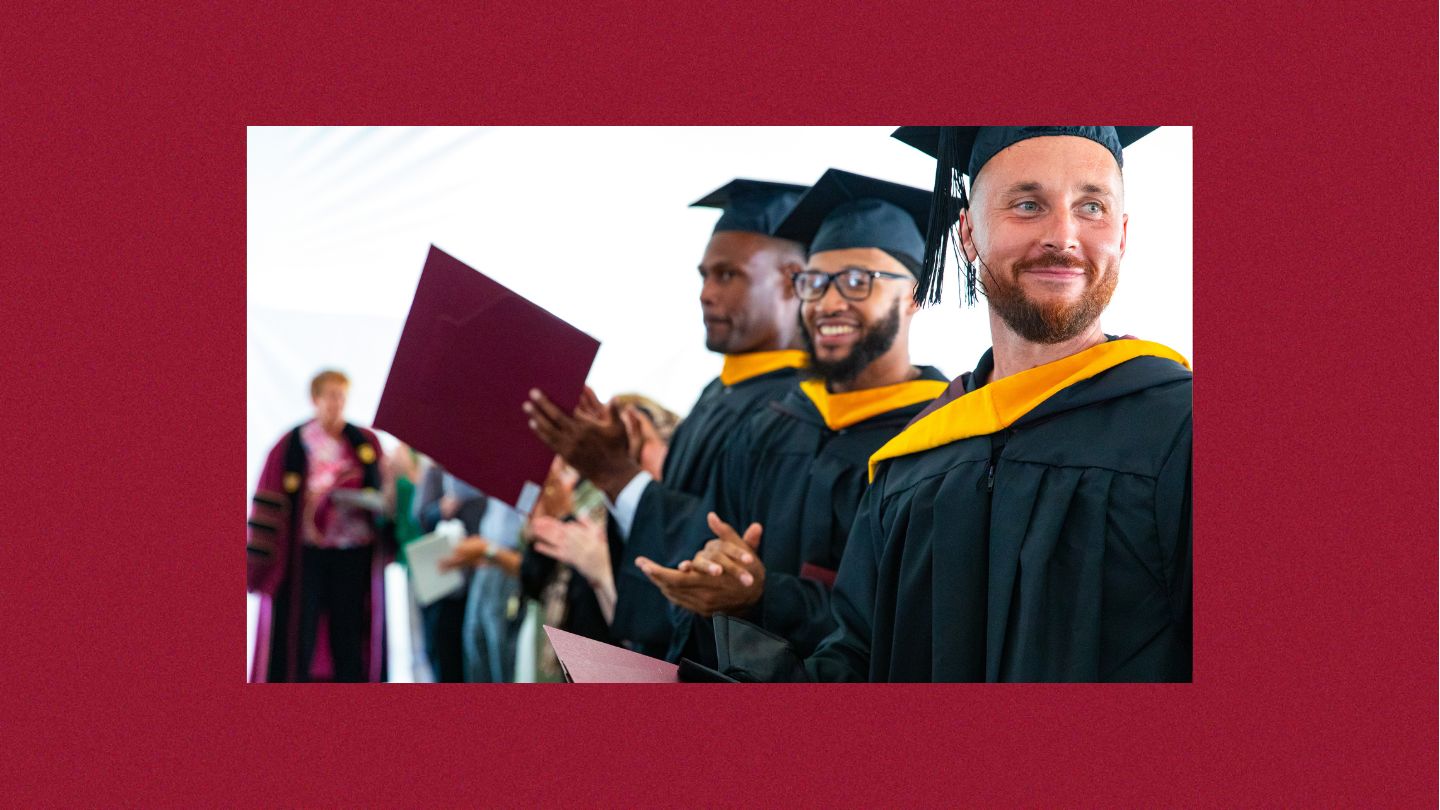
Of the 110 total students BCPEP has admitted so far, both men and women, around 20 have been released and moved over to the Chestnut Hill campus to continue (or complete) their degrees. In 2022, after 15 years in prison, Alabi became the first BCPEP student to go free. In 2025, he was the first to walk at commencement on the outside. This spring, he started a new job at the New England Board of Higher Education advocating for prison education expansion across the region. 

Granting opportunity

The road of prison education in America has been far from linear. Policy, like public perception, has had a tendency to flip flop on the question of whether education, and especially higher education, is a right or a luxury, as well as who is deserving of either. Is incarceration for punishment or rehabilitation? 

In the early 70s, incarcerated people became eligible for Basic Educational Opportunities Grants, now known as Pell Grants, for the first time. They could receive federal financial aid to put towards a higher education without taking out a loan or risking debt. And as students found a way to pay, the number of prisons with degree-granting programs shot up, from 237 in 1976 to 772 in 1990.

The boom didn’t last long. By 1994, President Clinton was ushering in a new period of restriction, eliminating Pell-eligibility for the incarcerated once again. Then, like now, many wondered why criminals should receive for free the kind of education many more lawful, middle-class folk couldn’t afford themselves. Rehabilitation for those who have committed heinous offenses can be a hard pill to swallow, especially for victims and their families. Programs started to shutter, like in New York, where nearly 1,100 incarcerated people earned a college degree in 1991, compared to 141 in 2011. 

At the same time, evidence was mounting for the most prevalently cited justification for prison education: reduced recidivism (and, thus, saved tax dollars). In 2013, the RAND Corporation published the definitive study on the matter, estimating those who participate in education programs to be 43 percent less likely to recidivate. By 2016, an Obama-era pilot effort had reinstated Pell grants for the incarcerated enrolled in certain partner colleges, or “experimental sites.” Those partnerships expanded under Trump, and in 2023, the Biden administration oversaw the return of Pell-eligibility for inmates across the board.  

As BCPEP wasn’t among the Pell-supported “experimental sites” when it began in 2019, it relied on other funding. The primary donors were an anonymous couple, who had ties to B.C. and were already supporting the Bard Prison Initiative (BPI) out of Bard College, a longtime leader in the prison education space. The couple helped engineer a relationship between B.C. and BPI, still affiliated today, which gave way to the original launch of BCPEP. 

As it stands, support for BCPEP continues to come from a mix of sources, including the anonymous donors who started it all, along with other individual contributors, private grants, and state and federal funding. Though more difficult, being forced to be self-sustaining from the beginning may have ultimately been a blessing. Even now, federal support is helpful but not the difference between the program’s survival and collapse. 

Patrick Conway, the BCPEP director, offered another benefit of more involved fundraising: It requires a greater investment of time and resources from the university, which in turn reinforces its value for the initiative. That buy-in, he said, keeps BCPEP from “being perceived as a very peripheral program, rather than part of the core mission.”

‘They read everything’

On the walls of the classroom at M.C.I.-Shirley hang all manner of B.C. swag. Photos of campus are posted beside pennants beside a picture one BCPEP student drew of the B.C. eagle. 

“I told them the first day that this was like an embassy,” said Susan Roberts, a veteran of the B.C. English department now dedicated to teaching at BCPEP in her retirement. “In this room, this is Boston College.” 

At the embassy, students all pursue an applied liberal arts degree, which involves two key components: a traditional liberal arts curriculum, with classic subjects like English, history, philosophy, and theology; and a “professional core,” spanning courses in entrepreneurship, design thinking, and strategic leadership, to map the liberal arts skills onto modern work environments. There are also non-academic offerings, including an annual 5K, reflective retreat, and classical music concert series. Soon, for the first time in Massachusetts, BCPEP will facilitate paid internships, with salaries of $25 per hour, for two students to work for the Alliance for Higher Education in Prison from inside M.C.I.-Shirley.

To ease the transition to college, students tend to take two classes their first term. From there, they’re guaranteed at least three per semester. In total, nine to 11 courses run usually any given fall or spring, Conway said, along with another three to five over the summer. Though pacing varies, the typical time to graduate sits around four and a half years, he added.

As advertised, the courses at BCPEP closely resemble those offered on the main B.C. campus. In the past, Roberts has taught Studies in Poetry and Apocalypse Narratives. She, like other colleagues, described basing the content on classes she’d taught in Chestnut Hill, while making adjustments to appeal more to potential interests of an incarcerated population.

Many BCPEP teachers reported being nervous, or at least uncertain, to be teaching in a prison for the first time. In the end, they were universally impressed with what they found. Intellectually, they said, the BCPEP students are on par with their traditional peers. In terms of their eagerness, the inmates tend to be legions beyond the reference point.

“They read everything. Everything you give them, they read,” said Brian Harrington, a B.C. alumnus and the former chief marketing officer of Zipcar. Now teaching entrepreneurship at BCPEP, he often brings guests into class to talk about their successful careers. Uniformly, he said, they tell him his students are the most engaged of any they’ve addressed.

Part of the students’ dedication to their education, Harington imagines, stems from their having the time for it. At the very least, prison is boring, BCPEP teachers and students agree. The hunger to learn is wrapped up in a desire, and a need, for engagement and stimulation of any kind.

“I believe my class gives them agency in a place where hopes and dreams are crushed most days.”

Of course, there’s something deeper going on, too. “I believe my class gives them agency in a place where hopes and dreams are crushed most days,” Harrington said. Especially given the practical aspect of his course, where students develop their own idea for a business, they might begin to imagine the possibilities for a future after prison. 

Anthony Baye graduated from BCPEP this spring and was released from M.C.I.-Shirley a few weeks later. Despite being free now, he spoke to a universal way the program, and particularly its professors, lift up students, no matter the length of their sentence.

“It’s just the level of care and respect that we get from faculty that matters most to me,” Baye said. “In prison, you feel like nothing you really have to say matters; you’re always going to be a second-class person. But when you’re in B.C., they treat you no different.”

It will come as no surprise to know there are still plenty of challenges with teaching and learning in prison. When BCPEP began, students had no access to technology and handwrote all their assignments. While there are now laptops that include Microsoft apps and a modified version of JSTOR, basic gaps in digital tools or knowledge remain a barrier. It’s difficult, Harrington said for instance, to teach modern marketing to students who have never seen or used Google Reviews. 

Susan Roberts added that students’ lives outside the classroom may impede their academic progress. One of hers was recently forced to withdraw after a prolonged period in solitary confinement. Others have missed class or been pulled out early because their lawyers came to visit. A few weeks ago, she submitted final grades for two students who never handed in the last assignment; she didn’t know why not. “There’s a whole infrastructure of the prison that we have no access to, and no interaction with, that can be very interruptive,” she said.

Tensions between the inmates can present another point of concern. In the early days of BCPEP, Baye said, those not involved or admitted could seem resentful of those who were and accuse them of thinking they were above the rest. In general, Nurudeen Alabi said being a BCPEP student made him feel vulnerable among the other incarcerated because they knew he needed to stay out of trouble. He didn’t want to be perceived as weak; he also couldn’t do anything to risk his spot in the program.

Over time, though, both Baye and Alabi reported feeling like BCPEP spurred a broad culture shift at M.C.I.-Shirley for the better. For one, as Alabi mentioned, wanting to be or remain in the program encouraged good behavior. For another, as the program grew, more and more students brought their education outside the classroom, continuing those conversations, and sharing content with others. 

“It went from guys talking about selling drugs or doing dumb stuff to, ‘Yo, what did you get on that paper? Oh, I’m so excited to talk about X, Y, and Z next week,’” Baye said. “It just changed the conversation and the tone and the mood around camp.” 

“Guys were talking about doing the right things — positive stuff — as opposed to all the B.S. that got guys there in the first place.”

Eagles Bridging the Gap

When Alabi was released in 2022, he was free but not unburdened.

He struggled in the transition back to a life on the outside that had changed drastically since he’d last known it as a teenager. He needed to find employment and housing. He needed to learn to drive and figure out how to afford a car and then insure it. He needed to learn how to pay taxes. He needed to learn how to use Google. “That Google helped a lot,” he recalled, with a laugh.

When it came to his education, a whole other host of specific changes and challenges emerged. He was still discovering Google, let alone mastering the whirlwind of online tools commonly used in college classes today. He needed to create an email address. He needed to know how to submit assignments through Canvas and post on discussion boards and take online classes and tests and search for library books. 

As the first of BCPEP’s students to make it onto the Chestnut Hill campus, Alabi navigated reentry largely on his own. B.C. had yet to build much in the way of infrastructure to support students’ transition, so he enrolled in a program at nearby Tufts University specializing in just that. 

Alabi recalled his hesitance to take full advantage of B.C. opportunities, even as Conway encouraged him to do so. “He’d always say, ‘This is your campus, too. This is your campus, too,’” Alabi said. “And I never understood why he’s saying [that]. In my head, I’m like, ‘This is not my campus. I’m just a visitor. I’m lucky to be here.’”

The arrival of one more student from M.C.I.-Shirley opened up Alabi’s experience. With a partner by his side, he felt more at ease using various resources, like the dining hall or the library. He started attending B.C. events, likes sports matches. “If it’s interesting, I’m gonna go and be part of the program, be part of the school,” he said.

As more BCPEP students have made their way over to Chestnut Hill, the structures and community of support have grown as well. Alabi serves as a mentor and guide to other formerly incarcerated students. There is a course dedicated in part to easing their transition, along with a team of BCPEP staff organized to look out for the students and ensure they’re on track. “I honestly think that what we do on campus is just as transformative as what we’re doing on the inside,” Conway said.

Deepening relationships between BCPEP and traditional B.C. students has been a particular focus of late. Alabi is one of the founders of a student group called Eagles Bridging the Gap, designed to connect the two groups. He said it’s been gratifying to see others seek to broaden their understanding of what the formerly incarcerated are really like.

Sister Jeanmarie Gribaudo described how having insight into the incarcerated experience will help all B.C. students help the world. “The kids from Boston College, they’re extraordinarily academically gifted, and they need to know about these issues because they’re going to be the ones in boardrooms and everything else, where they can speak up and make a difference,” she said. 

You can reach LearningWell Reporter Mollie Ames at mames@learningwellmag.org with comments, ideas, or tips.

Mental Health is Personal Health 

The Steve Fund is a non-profit organization that promotes the mental health and emotional wellbeing of young people, particularly those from underserved and under-resourced communities. Since its seminal report in 2016, identifying and addressing the unique mental health issues of this student population, the Steve Fund has been helping colleges, universities, and high schools strengthen cultures of belonging and build systems of care that support all students. Their Excellence in Mental Health on Campus framework has been utilized at 66 colleges and universities in 23 states, reaching over 1.1 million students. 

Part of the Steve Fund’s contribution to the field of college student mental health comes from the participation of a national network of Mental Health Experts, one of whom is Dr. Rae Lundy, the chief psychologist and director of counseling at Georgia State University. In this first article in a new content partnership series with the Steve Fund, LearningWell interviews Dr. Lundy about how her growth as a clinician aligns with the changing needs of her Black and Brown students. From her lived experience to her expansive body of work, Dr. Lundy explains why a culturally responsible framework for mental health and wellbeing is critical to helping all students flourish.  

LW: Tell us about your professional journey and how that tracks with the changing needs of students, particularly those from underserved and under-resourced communities? 

RL: I am currently at Georgia State University in Atlanta. We have about 54,000 students on six campuses. I’ve been in the role of chief psychologist and director of counseling for three years, managing psychiatry and what’s called student victim assistance. For me, and for many of my colleagues, this is a calling. I love college students. They’re in that developmental space where their identities are emerging, and they are kind of crystallizing who they are. 

I completed my training at the University of Notre Dame, where I studied identity and race, looking at how one’s racial identity serves as a buffer against discrimination. That was part of my lived experience, and I took that knowledge into my work. My first role was actually at a counseling center at a large P.W.I. (predominantly white institution), the University of North Carolina at Chapel Hill. As the only Black psychologist in the counseling center, all Black and Brown students were referred to me, and it was apparent that what I had studied in school, I was seeing in real time in terms of the concerns students were experiencing. On top of anxiety and depression, they were also experiencing issues of belonging and how the intersectionality of their identities impacted their academic functioning. It was a great training ground for this work, so after staying there several years, I went to North Carolina Central University, which was the start of a long stretch of me working at H.B.C.U.s (historically Black colleges and universities).

At North Carolina Central University, I found, like many of my fellow administrators at H.B.C.U.s, that I was carrying like five roles. My students were experiencing distress related to a number of different concerns, including financial concerns. Many of them were first-generation college students,and I felt this overwhelming need to be everything and all things to them. I was working in the counseling center, doing confidential work, but I was also doing a lot of outreach, meeting students where they were. I was an advisor for a student group. And in doing all of those things, it felt like there was this need to support mental health in a way that the institutions at the time didn’t understand. It was about stigma, which is looked at very differently today. 

The main thing we were doing is to try to get folks to have conversations about mental health. I was doing confidential one-on-one individual counseling, but really what I discovered was that expressive therapies and unique ways of reaching students were a better way of getting them to process and be open to having deeper conversations about how they were feeling. I had some tremendous success with that. We had an increase of students coming to the center. We did what we called interpersonal process groups: So maybe they didn’t want to talk about a specific thing, but they knew they needed and wanted to be around someone like my colleagues and me. 

It got me thinking about this idea I now lean into called C.R.I. — compassion, reflection, and intention. I began to share with folks that it’s okay to acknowledge and be compassionate towards yourself. We’re all compassionate towards our friends. Why would you not give yourself the same attention? This idea of C.R.I. was a way for me to have mental health in all spaces. Oftentimes, in the mental health field, we are going to our therapist location, or now we’re meeting virtually. For many college students, we need to bring down this barrier around the conversation, which is what I was really passionate and excited about. 

LW: Why was this engagement work particularly important for students, particularly those from underserved and under-resourced communities?  

RL: There is research to support that help-seeking behaviors of students, particularly those from underserved and under-resourced communities, are often psychologically and negatively reinforced. There is a sense that one might be punished for asking for help — or that it is a sign of weakness. For Black and Brown communities, asking for help can reinforce the idea that you’re not as smart as others. Did you really get here on your own? One might see why it would be more challenging to ask for support.

“For those from underserved and under-resourced communities, there is a sense that one might be punished for asking for help — or that it is a sign of weakness.”

Or if you think about it, if a student is a first-generation college student, if most in their family havenever had this experience before, who do they ask for help from? That’s true of all support in college. If you’re a first-generation college student and you’re asking about what you need to do to register for classes or find additional funding, but your parents and your grandparents have never done that, that becomes a barrier and a burden that they might internalize as something they have to handle on their own, while not really knowing what resources to turn to. That is why organizations like the Steve Fund are actively seeking to present themselves as resources for these students. 

When you talk about belonging and identity, so much of that is connected to performance, self-care, and wellness, but in some communities, you haven’t been given permission to take care of yourself because your identity is wrapped up in how much you’re doing for others. What emotional wellbeingand mental health ask of us is to be introspective, to connect, and to see what is going on internally within ourselves. Many times, Black and Brown students either haven’t been given that space, or we haven’t held space for them to do that. Another issue is exceptionalism, this idea that you’re articulate — for a Black or Brown person — or you’re smart — for a Black or Brown person. And that’s a lot to carry. 

Some of the most prevalent challenges you see are around anxiety. And that’s true of college students in general. But anxiety and depression manifest differently for Black and Brown students. Oftentimes, it presents as an irritable mood or what could be misinterpreted as the angry Black or Brown person. My recommendation has been for folks to ensure that we are being culturally responsive and informed as we are doing this work so that we have a good sense of: How does this particular mental health outcome manifest or look differently in varying settings? And then if we think about the concept of privilege, who gets to have emotional responses? Who gets to be expressive?  And if we think about your earlier question, you asked whether it’s okay for me to ask for help; if it’s not, then it’s probably not okay for me to appear sad. It’s probably not okay for me to appear uncomfortable.

LW: I can imagine that all of this experience was useful when you actually created a college counseling center from scratch, correct? 

RL: Yes. I was approached by the president of a smaller H.B.C.U. — Wiley College at the time, now Wiley University — in Marshall, Texas. They didn’t have a counseling center or any substantive mental health services for their students. After visiting the institution, I fell in love with the campus, with the students, and I thought, “No student should go without mental health support.” I soon discovered that Wiley was not unique. It was like many smaller institutions that just didn’t have funding. In years past, institutions may have thought they had the option of not investing in mental health. This was before universities realized that mental health is directly connected to retention. For smaller schools, retention is directly related to keeping the doors open.   

Once the link between retention and mental health was established, we were able to have open conversations around mental health, acknowledging that it’s not an afterthought or a second, third, or fourth priority when you’re thinking about academic success. If a student is not emotionally well, they can’t show up and be present in class. With that in mind, I was able to advocate for the students. I was initially a counseling center of one, and then we grew to be a fully functioning center. When I left, we had three additional staff, a training program, and a broad range of services.  

I eventually brought the knowledge gained from Wiley with me to Georgia State. I moved here for personal reasons, to become a caregiver to my elderly father. It was so interesting to end up here,which is his alma mater. 

LW: What have you found to be some of the most effective strategies to deal with the unique mental health challenges of Black and Brown students? 

NL: I believe leaning into forms of therapy and support outside of one-to-one individual counseling is particularly effective — things like group counseling, outreach experiences, ambassadorships, and opportunities for connection in what we call third spaces. We are creating other spaces outside of the classroom, outside of one’s home, that become brave and safe spaces for people to simply be and discover themselves. 

Group counseling demystifies, or challenges, the idea that I’m alone in experiencing things. Also, Black and Brown students have historically come from what we would consider collectivist cultures; these are backgrounds where you might have two or three generations living in a home. And so this idea around mental health is not just one-to-one individual counseling but also group counseling, some of which reinforces what has felt safe and healing and connecting for them in spaces that were safe,healing, and connecting before they got to college or university.

“I believe leaning into forms of therapy and support outside of one-to-one individual counseling is particularly effective.”

And then we think of expressive therapies. Movement is a beautiful way to release emotions and connect to oneself. In expressive spaces, the emphasis is not just on what clients are verbally saying but also how they are emoting. We look at somatic interventions, which really connect to the body, which again connect back to this idea of cultures where many Black and Brown communities use movement as a way to express themselves. 

I think a lot about meeting students and clients where they are. They may not be ready for traditional forms of treatment, but they are often on TikTok. Some of that information isn’t always accurate, but what if we have licensed, competent individuals who share it and can provide meaningful content onwellness strategies and wellbeing interventions? When this happens, students have agency to take in information in ways that are digestible for them. It’s true we have standardized, evidence-based treatments and a certain language within the mental health field, but by not engaging on platforms like TikTok, we miss a subset of the population in need of care, and often that population includes our Black and Brown students.

LW: That brings me to my next question. You are about to launch a new passion project, which is an app developed specifically for individuals of color. What is that all about?  

It’s called Amelia Sage, a wellbeing app for women of color. Amelia Sage combines artificial intelligence with the oversight of licensed clinicians. There will be wellness plans and daily interactions for participants to experience. And the app’s goal is to promote flourishing. I’ve been in the weeds recently, defining what it means to be well and recognizing that wellness is not without itschallenges. The work is grounded heavily in the dimensions of wellness. We look at social, intellectual, financial, and all areas of wellbeing; and within that framework, we promote whole wellbeing. We are currently finalizing details for a 14-day mental health wellness plan, and a primary goal is to share it with college students.  

All of this connects back to what the Steve Fund does by putting information and resources readily available at students’ fingertips. For good, bad, right, wrong, or indifferent — everything is at their fingertips. And so we want to make sure that what they are engaging with and really internalizing is information that’s going to help them be well and flourish.

You can reach LearningWell Editor Marjorie Malpiede at mmalpiede@learningwellmag.org with comments, ideas, or tips.

Posted in Q&A

“Disembodied” by Hwei-Shin Harriman

In this story, Olin student Hwei-Shin Harriman poignantly shares her lifelong dance with perfectionism. Hwei-Shin was on track to become a professional ballerina before shifting her attention to engineering. Her story is both unique and universal, as everyone encounters trade-offs in pursuit of excellence. In reflecting on her journey, Hwei-Shin now asks us all to consider what it means to be good enough.

To learn more about Storytelling, visit Olin College’s Story Lab website here.

Putting the Student in Student Affairs with George Abalekpor

On this episode of LearningWell Radio, George Abalekpor, a Georgetown graduate from the class of 2024, reflects on his experience over the last two years working inside the administration at his alma mater. As a Hoya Fellow, he has used his firsthand experience and insights into the Georgetown student experience to help guide the Division of Student Affairs.

In particular, Abalekpor has been focused on efforts and issues around student thriving. With LearningWell, he discusses some of the pressing concerns and potential solutions in this area, with an emphasis on the role of Hoya Fellows in bridging gaps between students and staff.

Listen now on Spotify or Apple Podcasts.

You can reach LearningWell Reporter Mollie Ames at mames@learningwellmag.org with comments, ideas, or tips.

Mattering at Michigan

Like most colleges and universities, the University of Michigan came out of the pandemic reeling, awash with a host of new and heightened community mental health concerns. True to Michigan’s culture, its response was to go big. 

In 2021, Michigan made wellbeing across campus an institutional priority by becoming one of the first eight U.S. universities to adopt the Okanagan Charter, a framework and commitment to infuse health promotion into policies and systems at every level. To serve and steer these goals, the administration founded the Well-being Collective, a hub for wellness efforts with university-wide infrastructure and influence.

Today, the work of the Well-being Collective continues, as leadership finds fresh and innovative ways to deepen the impact. One of the latest developments is the Mattering at Michigan Initiative, a push to expand three existing wellness interventions that have the promise of being particularly effective at “mattering” — a concept that is frequently misunderstood but increasingly recognized as critical to emotional and behavioral health.   

Mattering may sound familiar, thanks in large part to the work of journalist Jennifer Wallace. Earlier this year, around the same time that Mattering at Michigan launched, Wallace released her second best-seller, “Mattering: The Secret to a Life of Deep Connection and Purpose.” In it, she contends that feeling like we matter is one of our most fundamental human needs. But it’s not just about belonging or being part of a group; to matter means knowing we’re valued and that we add value. 

The timing of Wallace and Michgan’s work wasn’t just coincidental. The original idea to package and amplify mattering at Michigan came from the author, who has been studying and promoting mattering work at colleges and universities as an extension of her research. She’s currently collaborating with Harvard and realized, rather serendipitously, that Michigan might offer another model for evidence-based best practices in this area that could be implemented at scale.  

While attending a Michigan Wolverines football game, Wallace had looked out across the packed stadium and discovered the cheering sections were color-coded. Students had followed emailed instructions, she learned, to wear either maize or blue depending on their seat assignment and now formed vibrant stripes around the arena. To Wallace, this was mattering at work — intentional community building that invited everyone to play a role.

 “All different types of kids felt a deep sense of belonging there, whether they were former jocks or members of the marching band or really cerebral academics. It felt like everyone had a place to belong at Michigan,” Wallace said. She started talking to parents and faculty about why they thought Michigan was different. “What is this secret sauce?” she would ask them.

Michigan students wear their university’s signature maize. Photo courtesy of the Regents of the University of Michigan, via Nolan Bona

Wallace’s hunch that Michigan was ripe for mattering was met with enthusiasm from campus leaders in mental health. Lindsey Mortenson, Michigan’s inaugural chief mental health officer, said the university’s size and sprawling organization are often barriers to implementing services or fostering a wider culture around wellbeing. Mattering excited her as a framework and ethos that could unite and guide wellbeing on a broad scale. 

Mortenson also recognized mattering as a promising antidote to the achievement culture rampant on Michigan’s campus. Students often get caught up in the rat race of academic and other success, she said, so gaining perspective on what really matters — namely, connecting with and supporting others — might help right the ship. “Mattering felt like a way to be responsive to a focus on values, but in a secular way,” she said.

With funding from an anonymous donor, the Mattering at Michigan Initiative involves a build-out of three individual programs: wellness check-ins for large classes, a for-credit course on navigating wellbeing in college, and a new “social prescribing” effort to promote engagement in nature, the arts, and the wider community. The three interventions are not only among the most popular; they are specifically designed to give students a sense that “they matter.”  

Big Classes

An important question for students at Michigan is how to experience mattering when they are one of so many. The large course wellness check-ins are meant to help there. With an easy-to-implement protocol, the effort is a way of touching base with students enrolled in some of the university’s largest lecture classes. It’s part of a growing trend in higher education focused on personalizing the educational experience in settings that typically make students feel anonymous.  

Like the larger Well-being Collaborative, the check-ins emerged following observations about student mental health during and after the pandemic. Faculty concerned about their students, but busy fulfilling the traditional duties of teaching, wondered how they could best support these hundreds of adrift young people.

Part of the mattering is in the intention. As subtle as the nudge might be, even the quickest check-in can help students feel that their personal and academic success is valued.

Through a collaboration with the Wolverine Wellness, an implementating partner of the Well-being Collective, faculty can now work with a health promotion specialist, who will drop into classes mid-semester and present students with a digital form and the opportunity to seek help in three different ways. These include completing a brief survey on how they’re doing, signing up for a 20-minute check-in with a wellness coach, or requesting their professor to reach out to them. Wellness coaches will follow up with anyone who fills out the survey and indicates that their situation is “unmanageable.” They also share wellness resources with the class.

Part of the mattering is in the intention. As subtle as the nudge might be, even the quickest check-in can help students feel that their personal and academic success is valued. “We know that students who don’t even opt in for the faculty check-in or the wellness check-in respond that they feel like their faculty respects them, cares for their wellbeing, is looking out for them,” said Janet Jansen, one of the specialists from Wolverine Wellness. “Just showing up and naming it,” she added, can make a difference.

Currently, the wellness check-ins cover around 11 large courses and reach around 2,000 students each semester. In a survey assessing whether the check-in helped students “feel supported in this class,” 83 percent of first-gen students and 72 percent of non-first-gen students agreed. 71 and 65 percent, respectively, also agreed the check-in helped them “learn about wellness resources on campus.”

A Small Class

The second program in the Mattering at Michigan Initiative impacts fewer students but in an in-depth, semester-long way. ALA 240: Living Well in College & Beyond is a course designed to familiarize students with the major, wellbeing-related public health issues likely to impact the college experience and skills key to navigating them. The class is academic, and it’s personal.  

When it launched, the course was a two-credit, elective opportunity capped at 15 students. It met once a week for two hours with a lead instructor and two peer facilitators. But alongside the Mattering Initiative, the class is growing. Soon it will be worth three credits, in addition to now fulfilling a social science distribution requirement. Enrollment has been raised to 54, looking toward 72, with participants gathering first for a lecture and then in small, peer-facilitated discussion sections.

The topics covered in ALA 240 span top concerns from belonging and failure to substance use and sexual health. Through weekly readings, journaling, and conversation, students delve into these concepts both generally and in the context of their university. Discussions are especially important, encouraging the rich and varied perspectives of participants and peer facilitators from all four classes. Together students open up and break down shared challenges.

Timberlee Whiteus, a health promotion specialist, has been an instructor and involved in ALA 240 since 2023. She’s also a two-time Michigan graduate. To her, the class is really about general “campus culture” at Michigan, she said. Lately, she’s found the greatest or most pressing interest among students to revolve around social connectedness, or a lack thereof.

“It really is a shock sometimes to be in a room full of such bright people at such a great institution… to hear students saying that they really feel anxious to show up,” Whiteus said. “They feel like they’re the only one experiencing these problems or having these challenges, or they’re afraid that the person next to them is going to judge them.”

With students struggling in real time, the practical component of ALA 240 is as important as the theoretical. Major assignments are indeed experiential exercises in combatting the class’s central issues. The “Choose Your Own Adventure” series, for example, requires students practice four different skills, in whatever way they see fit: asking for help, being a buddy, perspective taking, and uncomfortable conversations. The final project asks them to go out into the community to bring the class content to at least 10 new people.  

Here, mattering is playing out on multiple fronts. The course’s existence, for one, signals to students that their school cares about them and their wellbeing. Participants also study mattering as a concept, contemplating how it functions at Michigan, and how to improve the culture around it. All along, they’re connecting with one another, working actively on their wellbeing, and helping others with theirs. 

Whiteus said students often tell her, “I don’t get this anywhere else. You all are really seeing me.” 

Beyond the Classroom

The newest of the Mattering at Michigan initiatives centers a fresh but increasingly popular practice in the wellbeing space: social prescribing. The basic idea is to connect people with opportunities to engage with others in the community. It’s a non-clinal approach to boosting mental and emotional health but with a clinical vibe that says this is serious. 

At Michigan, the effort is known as Experience Rx and involves wellness coaches or mental health counselors who refer students to a range of activities as if they were more traditional medical treatments. With the formal “prescription” of an authority and structure of an assignment, the thinking goes, young people may be more likely to actually get out there and seek the connection they need.

The origins of Experience Rx stem from Nature Rx, a student-led initiative launched at Michigan in 2019 to promote time in the outdoors for mental health relief. Nature Rx is still active, but now possible “prescriptions” also span experiences with the arts, service, exercise, and food. Some activities may be completed in a group; others could be done alone.

One of the critical elements of Experience Rx, and ideally social prescribing in general, is that the coaches and counselors do not assign experiences at random. The goal is to formulate a detailed profile of their students and then think intentionally about the type of engagement that would most benefit them. 

Lindsey Mortenson, who has been closely involved in the development of this project, explained the importance of getting this part right. She imagined the frustration a student could feel upon receiving a misaligned prescription: “You don’t know me at all,” they might think. “I’ve just told you I hate being outside with insects and bugs, and you just told me to get out into nature and go walk in the arboretum.” 

Mortenson added that the prescription-transaction model is another way to boost mattering. She reflected back to when doctors handed over a physical prescription to a patient, explaining that kind of verbal and physical exchange is, in itself health-promoting. Although the Experience Rx organizers hope to eventually increase accessibility by creating a way for the students to “self-refer” online, the activities themselves are only one part of the larger initiative’s endeavor towards mattering.

“I think one of the connections to mattering and [Jennifer Wallace’s] work in general is this desire that we all have to be seen and understood,” Mortenson said. “That’s where a really well-informed prescription or referral, that is really based on some attunement with the person in front of you, really matters.”

You can reach LearningWell Reporter Mollie Ames at mames@learningwellmag.org with comments, ideas, or tips.

Bridging Values with Suzy Welch

In September 2025, Suzy Welch made waves with an op-ed in the Wall Street Journal that asks a question many, it seems, were already asking themselves: “Is Gen Z Unemployable?

Welch is an author and professor at the NYU Stern School of Business, and widely known as the founder and C.E.O. of Becoming You Labs, a think tank and product design studio that helps disseminate Becoming You to schools and organizations around the world. Becoming You is a methodology — as well as an NYU class, a workshop series, and a best-selling book — she designed to help people land on their best-suited career path. The underlying premise of the methodology is that our purpose pathways lie at the intersection of our values, cognitive and emotional aptitudes, and economically viable interests. For the values-discovery piece, Welch invented the Values Bridge, a scientifically validated assessment that ranks individuals’ values from one to 16 and measures how fully they are living each one, or not.

Aggregate data from the Values Bridge unearthed the concern that led to Welch’s Journal article. In it, she describes discovering that the most-held values among Gen Z are: eudemonia (often referred to as self-care), voice (the expression of individuality), and non sibi (helping others). But when she surveyed a group of hiring managers about the value they most want in their employees, the answers instead prized: achievement (drive for success), workcentrism (desire for work to shape life), and scope (desire to learn and for adventure). Only 2 percent of Gen Zers — 154 out of more than 7,500 — identified the three values deemed most desirable by employers in their top five.

This priorities gap between employers and young staff gave evidence, and voice, to a common feeling among business leaders that Gen Z just didn’t seem to work all that hard. On the other hand, many praised the rising generation’s apparent sensibilities towards work-life balance and wondered aloud whether there was ever a time in which the older didn’t criticize the ways of the younger. 

In this candid interview with Welch, we zoom out to explore what motivated her work on values and how to interpret the data that continues to drive a national conversation. 

For more complete definitions of the 16 values, please see the Values Bridge index. Values discussed in this interview include the aforementioned eudemonia, voice, non sibi, achievement, workcentrism, and scope — as well as affluence (wealth), familycentrism (desire for family to shape life), and belovedness (romantic love).

LW: What inspired you to start the Values Bridge? I’m guessing it was an extension of Becoming You?

SW: Well, Becoming You is a methodology that helps students answer the question, “What should I do with my life?” It’s a 22-part methodology, and it excavates three data sets: your values, your cognitive and emotional aptitudes, and your economically viable interests. I used some of the very established psychometric instruments to help students identify their values. And while some of this work is incredibly renowned, I felt frustrated that it didn’t do exactly what I wanted. 

At the time, I was developing a new values inventory. I did this as part of my Ph.D. work. And then I set about working with psychometricians and behavioral scientists to create the Values Bridge. It was lucky I didn’t know what I didn’t know because that took about a year and a half of the hardest thing I’ve ever done in my life — but worth it. I introduced it in beta to my students at NYU and immediately realized that it could so broaden and deepen their understanding of values. So we pushed forward with the tool and finished it, and then were able to release it to the general public. And then of course, it immediately started getting adopted by a lot of schools and other institutions because of its efficacy and because of the conversations that it started and because of the understanding that it opened up. 

LW: Got it. So what would you say is the big difference between what you created and what existed in terms of value assessments?  

SW: The most frustrating thing about the other values assessments is that they don’t allow people to have conflicting values: If you have values that are conflicting, one cancels out the other. And that’s just not how life is. People walk around with conflicting values. They value affluence, and they value self-care. They value achievement, and they value familycentrism. And so the Values Bridge captures and reflects back to you these conflicts and allows you to then say, “Okay, well, how am I going to resolve them?” It doesn’t negate the reality of a personal experience. So I think it’s just a very subtle instrument because it’s the newest, and I had the benefit of all the great work that’s been done in the field of values over the past 150 years to help me create a new tool.

LW: And without asking you to go through your entire Ph.D., what is so important, especially for young people, about understanding or knowing what your values are? 

SW: I think that it’s every single human being; it has no age bracket to it. We all do better by understanding our values because our values are our whys. They are why we do things. And so I think the more we understand why we do things or why we want to do things, the better we operate in the world — the more compassionate self-awareness we can have, but also the more compassionate self-awareness we can have of others. I mean, the name of the tool is the Values Bridge. The idea of it is to build bridges so that people can talk to each other about their values. We have to stop judging each other. The Values Bridge is completely agnostic. It’s like, if you’re not hurting anybody, your values are your values to live. 

But also, to be quite practical about it, you need to know your values so you can figure out what to do with your life. The premise of the Becoming You methodology is that the most aligned career is one that’s at the intersection of your values, your aptitudes, and your interests. So I have a singular purpose with this process, which is to get you to the right job. And you need to know your values because to work in a field or to have a job that doesn’t align with your values is actually quite a painful thing. It’s kind of a dull ache. And anybody who’s done it can tell you, “Yeah, it hurt.” I don’t want anybody to be in that kind of job. That’s what it’s all about.

“You need to know your values because to work in a field or to have a job that doesn’t align with your values is actually quite a painful thing. It’s kind of a dull ache.”

LW: The op-ed you wrote on the top values of Gen Z was definitely a conversation-starter. Do you often get put on the spot to explain Gen Z and why they are the way they are?

SW: I do. And I say it’s not my area. I’m always asked, “Oh, can you please explain why Gen Z has eudemonia as their number one value?” And I say, “I have no idea.” My hypothesis is just like yours: They went through the pandemic. They found out that anything could fall out the bottom at any time. They decided they didn’t want to postpone joy. They decided they didn’t like the bargain their parents had that you waited to have joy. And they said, “We vote no.” That’s my theory. It’s a hypothesis, but I am not saying this in any way as an authority. My area of focus is not values formation; it’s values expression. I don’t try to figure out why you are the way you are. I take you as you are and say, “Given that, what should you do with your life?”

LW: One of the both really interesting and also challenging pieces about the top three values for Gen Z, I could see, is that they have voice and eudemonia — and then they also have non sibi, or wanting to help people.

SW: And those are not in conflict.

LW: They’re not?

SW: They’re not in conflict. The problem is when number four is affluence, as it typically is. Taking care of yourself, having a lot of individuality, and helping other people — on a one-to-one basis — are completely doable all in the same hour, with no conflict whatsoever. It’s then, again, when you get affluence and achievement up there in the top five, too. Even if achievement keeps coming up with Gen Z — which it appears to be in early, early, early data — it’s going to bump into eudemonia. It may be rising, but it’s still going to hit a ceiling when it hits eudemonia because really there’s a big conflict between achievement and self-care.

LW: Remind me, do other generations, older generations, share eudemonia and voice, or are those very specific to Gen Z?

SW: It’s not very specific to Gen Z, but it’s absolutely age correlated. The older you get, the lower eudemonia goes. By the time you get to my generation, eudemonia is peripheral — in the bottom five. You can almost draw a line; every generation, eudemonia goes slightly down. Same thing with voice. Non sibi is a generally strong American value. It’s very high across all generations. 

LW: With the Gen Z findings, did you find people’s reactions leaned more toward “Why is Gen Z like this? How do we fix them?” versus “They’re telling us something; let’s find out what it is”? 

SW: When I talk to business leaders, which I do a lot as a board member and a person who is in the corporate world, they are not surprised by the data findings. They say, “This is what we’re experiencing.” And then, depending on the hiring power of the company, they have different reactions. 

If they’re Goldman Sachs or if they’re Meta, they say, “This is not our problem because we get this 2 percent [of Gen Z with achievement, workcentrism, and scope in their top five values]. Those are our people. They want to work for us, and it’s easy for us to find them.” Some companies have less hiring power. They don’t have as good brands. They’ve had financial troubles. They want the 2 percent, but they can’t get them, and they express frustration. Then there are other companies that have no hiring power, and they are like, “Well, this is just a problem that individual managers are going to have to handle on a one-by-one basis.”

Gen Z’s reaction to the data was varied. There were some Gen Z people who said things like, “Why would I want the values of the older generations? Why would I want the values of hiring managers? I don’t like their lives. I don’t like what they’ve done to the world.” But some Gen Zers see the results, and they see themselves, and they think, “Oh God, this is tough because I do have affluence at number four or I do have achievement at number five. What am I going to do about this?” And that’s a real conversation. 

I don’t believe people should try to repress their values. I think that’s very painful. I don’t think that people should not be who they are. At the same time, sometimes when I have students who are really conflicted, I say, “Is there a possibility you look at your life as seasons, where maybe you are going to be in a season where values that are not your top values are going to be more expressed?” But look, I can’t tell them what to do. The only ones who I could really give strong advice to were my own four children, but even with them, it was a dialogue. 

LW: There’s something that feels sort of aspirational about values. So, if my values are X, Y, and Z, does that mean that I actually fulfill those in the way that I act?

SW: Actually, this is a point I should have made earlier — thank you for jogging my brain on it — which is that one of the things that I really wanted to do is test what your values are and how much you’re living them. That is one of the most important pieces of data the Values Bridge gives you. We give you your authenticity gap score.

Here’s an example: Scope is the value of how much action you want, how much activity, how much learning, how much growth, how much travel, how much adventure. What we see all the time is that women in their 30s and 40s who have high scope have a huge authenticity gap. It can be 90 percent. And what’s the reason? Typically, these are your childbearing years, and when you are raising little children, you just don’t get to have a lot of action and activity and travel and adventure and learning. You’re not able to express your scope. You’re going to do it later, and you know that. Sometimes the kids go away, and your authenticity gap closes. 

So for all of the people who take the Values Bridge, you do get those gaps. A lot of times my students will get back their results, and they’ll see that eudemonia is their top value, and they’ll see a gigantic authenticity gap. And then they’ll see achievement is down at number eight, and it has no authenticity gap because they’re fully expressing it. In fact, sometimes they have a negative authenticity gap because they’re overexpressing it. So one of the things I like about the tool is that it’s like a report card. It’s almost like a doctor’s report on how much you’re living each value. And a lot of times my students are not as shocked about their rank-order values as they are about their authenticity gaps. Because they look at it, and they go, “Oh no, this is absolutely a self-portrait. This is exactly where I’m feeling pain.”

“One of the things I like about the tool is that it’s like a report card. It’s almost like a doctor’s report on how much you’re living each value.”

LW: You have an idea of what your values might be, but once you’re faced with the fact that you’re not fulfilling them, that could be very distressing.

SW: Yes, it can be distressing, and then illuminating. They want to know how to fix it. I can’t tell you the number of times — this happens to me every single class — the kids get their results back, and then at the break, there’s a stampede of young women down the stairs because what they’re all getting is voice as a top value and an authenticity gap of 60-plus percent. And they’re like, “I am clearly not using my voice.” I’ve seen students literally in tears saying, “This is putting words and numbers to my daily experience.” It’s very poignant. And my female students say to me, “Can you please teach a class on how I can have no authenticity gap with my voice?” And I say, “I wish I could.” Right now, I’m teaching as many classes as you can humanly teach. But we’re trying to create curricular materials so that we can walk them through that process.

LW: Bridging authenticity gaps almost feels like a class that is life in some ways.

SW: Yeah, it is. I often say, “Welcome to life.” I say it all the time when they talk to me about their gaps and their disconnects. There’s this function where you can check a box and your values come up next to your partners — because many of my students are married, because I teach MBAs. And then they do it, and their partner takes it, and they see where their gaps are. And they say, “Well, I have belovedness at number one, and my partner’s belovedness is at number 16.” And I say, “Welcome to life.” This is the work of our life.

LW: So from the hiring perspective, is it possible that a hiring manager who thinks they most want achievement and workcentrism actually has a favorite employee whose top values are eudemonia and voice? But maybe with an authenticity gap? I wonder if those kinds of things have come up for you.

SW: They come up all the time because we work with so many companies. It’s very, very interesting to see how the Values Bridge is being used in organizations. And look, some of it’s kind of out of our control. Companies take it, and they use it as they want. Some companies use it as a team building exercise. People can just learn about each other’s values so that they can have more compassionate awareness of each other and more words to speak to each other. 

But definitely, we see, all the time, organizations using it to hire. Many times, people who are coming to my company take it, and I see their values as part of the interview process. But for me, it’s always just a conversation. I would never say, “Oh, I’m not taking somebody because their top value is X.” 

LW: Do you think that what different hiring managers look for might vary depending on the industry that they’re in?

SW: I don’t think so. Not with values. Maybe between nonprofit and for-profit. But in any for-profit environment, hiring managers generally want people who want to win and work hard.

LW: What do you think this all means for the future of work? It sounds like at top companies, they’re going to hire who they’re going to hire. For the rest of Gen Z and for the rest of the companies, how might things change? Will Gen Z not be hired? 

SW: Oh, I don’t know. Look, regardless of their values, Gen Z’s having a very hard time being hired right now. I was just at the Wall Street Journal the other day going over the data with them. This is a tough job market. And values may be playing a role in it, but there’s a decrease in entry-level jobs, and there’s an increase in the amount of experience that is being expected for entry-level jobs. This is not about values. And how this plays out, I don’t know. 

I think we’re in a great moment of holding our breaths because if you have 10 economists in the room, five think that A.I. is going to actually start creating many more jobs and this great flourishing; and the other five are going to say we’re going to be working three days a week and most people will not be employed and we’re going to have to go to universal income. There’s no accepted narrative about what’s about to happen. The jury’s out.

LW: And for people working in colleges, do you find that this values work is impacting their job? Or how do you guide them in terms of what students today need to be prepared for?

SW: We’re just so amazed by the interest in the Values Bridge at the college level. Every kid entering Wharton is taking the Values Bridge. This is a new thing. It’s beautiful. And there are many other schools — 170 schools or something like that — right now using the Values Bridge with undergraduates to create a common language, to build bridges. 

Look, career offices are trying to get kids into jobs that make sense, and the Values Bridge is another tool for them. More than ever, given the price of college, parents are saying, “My kid’s got to have a job coming out.” So I think any tool that can help kids figure out what their job paths should be and help kids get employed coming out of college is going to get a good hard look by colleges. And I think, more than just the Values Bridge, colleges are interested in the entire Becoming You methodology because values are not enough. If you just get a job based on your values, but you don’t have the aptitudes or the interests, it’s not as sustainable. 

LW: Right. Well, I like the idea, too, of creating this language for students. So if they’re all coming in and taking this test, they can then have conversations about it outside of class. It might just come up, and it contributes to their knowing better what they want and what they don’t want. 

SW: I know. And what you seek when you are in any kind of community, like a college community, is a common language — a shared language that increases compassion instead of polarization. I love it when I see my students using language to talk to each other, and it’s just fun. It excites me because it’s doing what it’s supposed to be doing.

You can reach LearningWell Reporter Mollie Ames at mames@learningwellmag.org with comments, ideas, or tips.

Posted in Q&A

Why Students Go to College and What They Gain

Going to college is a fate-determining decision that is often driven by external factors such as family expectations or securing a good paying job. Indeed, given the cost of tuition, knowing that your degree will lead to employment is one reason the value of higher education is increasingly being measured in metrics, namely first-year earnings. But does that mean that intrinsic gains like intellectual growth and finding your purpose in life are no longer part of the equation? 

A new survey asking students why they went to college and what experiences they value indicates otherwise. The survey, “What Students Value in College,” co-sponsored by the LearningWell Coalition* and the American Association of Colleges and Universities (AAC&U), shows that students go to college to get a good job and to grow as a person — in equal measure. The survey of 872 undergraduate students, conducted by Morning Consult, found that while more than a third of students cited career outcomes as the main reason they chose to go to college, a similar share (38 percent) cited factors related to intellectual and personal growth, identity formation, and giving back to their community as their number one reason. 

“Students continue to recognize higher education as one of the most important pathways to economic opportunity, but this survey reminds us that their aspirations extend well beyond career preparation alone,” said AAC&U President Lynn Pasquerella. “They are seeking a sense of purpose, opportunities for self-discovery, and experiences that help them understand who they are and how they can contribute to their communities and the broader world.”

When asked to name their primary reason for attending college, 38.5 percent reported it was “to get a good job.” 38 percent named other personal growth-oriented factors (17 percent for learning and gaining knowledge; 10 percent “to grow as a person;” and 2 percent “to give back to the community”) as their primary motivation. An additional 15 percent reported their number one priority was to support their family. 

“Students continue to recognize higher education as one of the most important pathways to economic opportunity, but this survey reminds us that their aspirations extend well beyond career preparation alone.”

The survey also shows that lower-income and first-generation students were less likely to prioritize career motivations than their higher income peers (32 percent of students from households earning under $50,000, versus 48 percent of students from households earning over $100,00.) This finding challenges an assumption that the less-resourced students are more inclined toward specialized certifications as opposed to a broader learning experience, a narrative that has driven higher education policy in the last several years. 

“What I see in the survey is that students want holistic experiences, and they want to be prepared for a career, and this extends to low-income and first-generation students, as well,” said Peter Felton, the executive director of the Center for Engaged Learning at Elon University and an author of “Relationship-Rich Education.” “But there is a narrative out there that holistic education is for privileged kids, and we need to remind ourselves that this is not true, particularly when we start designing programs or putting forth certain expectations about what students need.”

Relationships, Experiences, and Wellbeing 

The survey also explored student engagement in high-impact practices such as mentorships and internships and the effect of those experiences on their wellbeing. According to the survey, relationships with faculty and staff are among the most powerful elements of the undergraduate experience, with 76 percent of students saying having a mentor was “very” or “extremely” valuable. 

Students reported that applying their learning to the real world, like through internships, was important, with 78 percent rating those experiences as “very” or “extremely” valuable. Of note, the most highly rated college experiences — at 79 percent — were those that exposed students to people with backgrounds, viewpoints, or cultures different from their own. 

“If we’re thinking about what students perceive to be the value of college, a key driver of that is who they are connected to, so we know that relationships are really instrumental,” Felton said. “They help students stay motivated and connected, but they also give students a sense that all of this is purposeful; this is time and money well spent.” 

Felton called experiential learning opportunities “relationship accelerators.” “If you think about internships, service learning, student employment,” he said, “all of those things immerse students in relationships.” 

According to the survey, the effect of these experiences on improving student wellbeing is consistent with the literature. Using the PERMA framework for wellbeing, the survey shows that students with a faculty or staff mentor reported higher wellbeing (average score of 7.12) than those without one (6.62). Students who had participated in internships reported significantly higher wellbeing (7.22 vs. 6.65 for those without). 

Similar patterns emerge across other forms of applied learning. Students engaged in service learning reported higher wellbeing compared to students who had not engaged in service learning (7.15 vs. 6.59). 74 percent of those who did engage said these experiences were valuable. 

“These findings add to the evidence that relationships and experiences that promote connections are strongly connected to student wellbeing,” said Keith Buffinton, the executive director of the LearningWell Coalition. “At a time when students are struggling with mental health, loneliness and disengagement, higher education has the opportunity to tailor interventions inside and outside the classroom that can foster these experiences.”

But despite the evidence, the survey suggests a participation gap exists. The experiences students reported to find most valuable and have the strongest wellbeing outcomes are often the least accessible. This pattern applies to all students regardless of socioeconomic or first-generation status. Only 39 percent of students reported participating in an internship, and while 53 percent reported having a faculty or staff mentor, that leaves nearly half of all students not participating in one of the most influential experiences in college. 

“The findings underscore the transformative power of high-impact practices such as mentorship, internships, undergraduate research, and community-engaged learning,” Pasquerella said. “Yet they also reveal a troubling gap between what students value most and what too many actually experience. Institutions committed to educating for work, citizenship, and flourishing lives must ensure that every student has access to the relationships and real-world learning opportunities that foster belonging, wellbeing, and long-term success.”

Felton said that fostering relationships among faculty and students is critical but challenging given the numbers and suggests we need to think differently about what “relationship” means in the classroom. “If we imagine that the only way we can build meaningful relationships with students is one on one, it feels impossible. But I think what most students want is a professor who they think cares about them enough to challenge and support them, and I think we can do that at scale. We can make ourselves human. We can make ourselves approachable.”  

Felton said that even in online teaching and large lecture classes, professors can be relatable, as opposed to robotic. “That matters a lot to students.” 

“I think what most students want is a professor who they think cares about them enough to challenge and support them, and I think we can do that at scale.”

Motivation and Engagement in High-Impact Practices 

The case for expanding high-impact practices is made stronger with a separate brief culled from the survey that shows why students go to college influences how they go through it — and what that means for their wellbeing. “Motivation, Engagement, and Student Wellbeing in College” found that students who enter college with community and growth-oriented motivations are more likely to participate in high-impact practices. These experiences, in turn, are associated with higher wellbeing. 

The report groups students into three motivation categories. “Community-oriented” students are those who reported attending college to give back to their community. “Growth-oriented” students are motivated by learning, personal growth, and identity development, including gaining knowledge and developing a sense of who they are and what they are good at. “Career-oriented” students named getting a job as their primary motivation. 

At one end of the spectrum, community-oriented students indicate the highest levels of participation across nearly all high-impact practices. These students demonstrate especially high engagement in internships (74 percent), mentorship (86 percent), service learning (78 percent), research with faculty (67 percent), and study abroad (46 percent), far exceeding other groups. However, only 2 percent of respondents listed giving back to the community as a top reason for being in college; 23 percent ranked it in the top three reasons.

Growth-oriented students also reported engaging at relatively high levels across many experiences, though somewhat less consistently than their community-oriented peers. Participation remains strong in areas such as mentorship (71 percent, 51 percent, and 55 percent, respectively), service learning (62 percent, 45 percent, and 53 percent), and learning communities (71 percent, 65 percent, and 71 percent), suggesting that internally driven motivations are tied to engagement across high-impact practices.

Students that named career as their primary motivation show somewhat more moderate and uneven participation in high-impact practices. While many still said they engaged in key practices like internships (39 percent), their participation rates lag behind community- and growth-oriented students, particularly in mentorship (49 percent), learning communities (64 percent), and service learning (43 percent).

Motivation for being in college is also associated with student wellbeing. Using the PERMA framework, students reported an overall average wellbeing score of 6.88, with meaningful variation across motivation types.

Community-oriented students reported the highest average wellbeing (7.95), followed by those motivated to grow as a person (7.02) and to support their family (7.00). Students motivated by learning and gaining knowledge reported an average wellbeing score of 6.93, while those who named “getting a good job” as their primary motivation reported 6.90. 

Implications for Higher Education

The insights gained from this survey strengthen the argument that career development and human development are not competing priorities but rather interdependent goals for higher education that are often mutually reinforcing. Young people are not a monolith, and how colleges and universities balance students’ varied motivations and communicate those through messaging and policies will be important. 

The data is consistent, however, that relationships are one of the most valuable dimensions of college life, with faculty mentors and relationship-rich experiences reported to be highly sought after. This is another crucial point to keep in mind when formulating new programs and policies in the age of A.I. Finally, the findings, which align with other research on the benefit of high-impact practices, support working towards closing the access gap for these experiences with curriculum and/or financial accommodations that allow more students to participate.  

*The LearningWell Coalition is the publisher of LearningWell magazine.

You can reach LearningWell Editor Marjorie Malpiede at mmalpiede@learningwellmag.org with comments, ideas, or tips.