
This story, from Georgia Tech student Alexis Seith, explores how we can pursue feelings of wholeness by noticing fragments of ourselves – regardless of whether those fragments can be pieced back together. Alexis finds both pain and beauty in the pieces of her life as well as a way to hold both at once. This story was produced in partnership with The Narrative Engineer conference through The Georgia Institute of Technology.
Month: April 2026
Jumping In
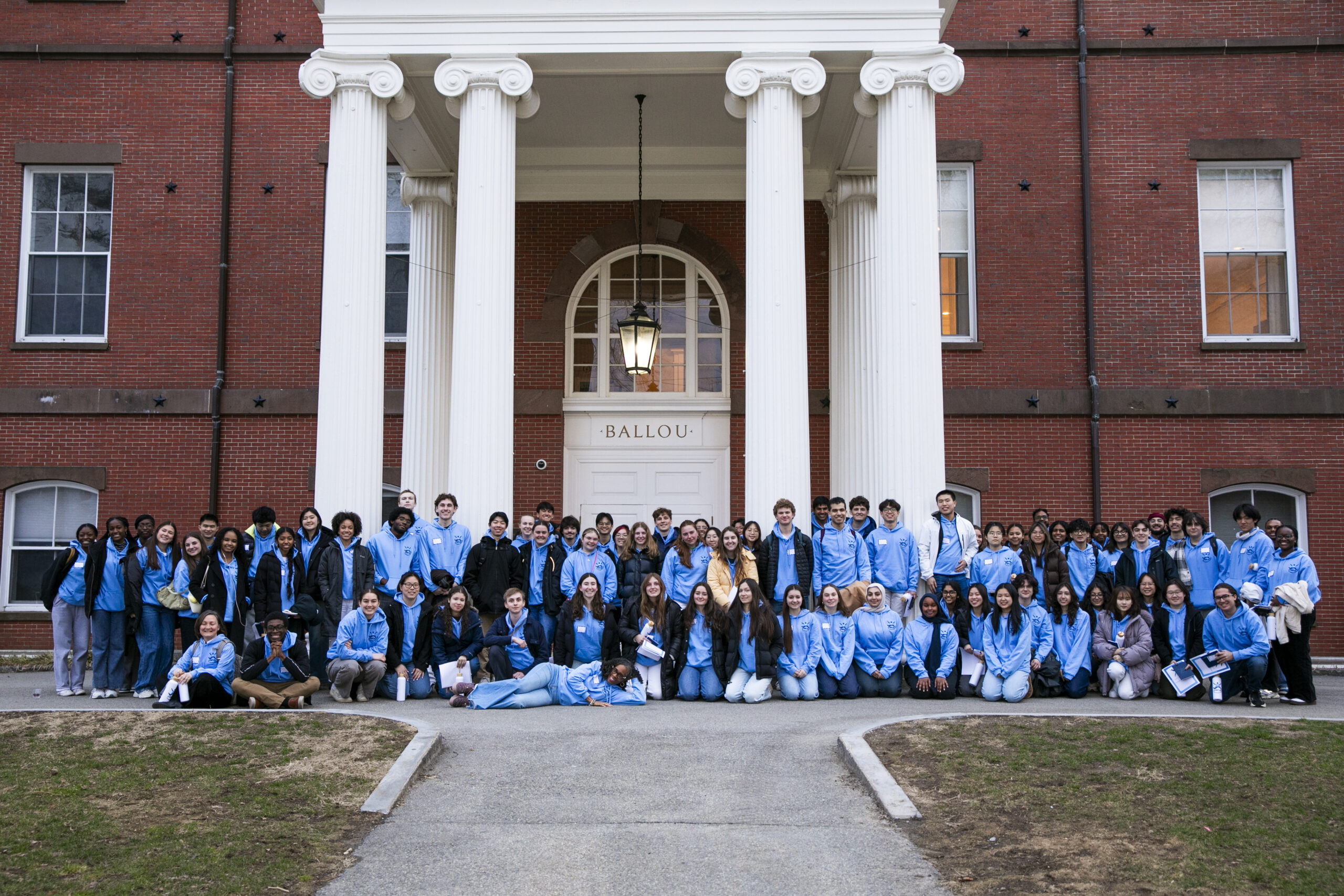
On a weekday morning during spring break, a group of first-year and second-year college students gathered around a patient whose condition began to change. The patient’s blood pressure was rising, breathing growing shallow. Sudden drooling.
It wasn’t a real patient. Behind the scenes, an instructor controlled the simulation using a mannequin. But the patient’s recovery wasn’t the point. The students’ introductory glimpse to the field of medicine was.
For some students, this might have been a confirmation: Yes, this is exactly what I want to do. For others, the realization could have been a cooler response, which would be just as important: Maybe this isn’t for me.
That moment — of clarity, uncertainty, or recalibration — is what Tufts University hoped to spark with its new JUMP-IN pilot program, a weeklong, immersive experience designed to help primarily first-year and some second-year students step, however briefly, into the lives they think they want. Ask a room full of first- and second-year college students what they want to do after graduation, and many will have an answer: Doctor. Lawyer. Engineer. Ask them what those jobs actually look like, day to day, and the answers may resemble vague impressions, a composite of jobs observed on television and heard about through friends and relatives.
This gap — between aspiration and understanding — is not just anecdotal. Surveys from organizations like the National Association of Colleges and Employers (NACE) and Gallup have consistently found that while students feel pressure to choose a career path early, many lack meaningful exposure to what those careers entail. At the same time, research suggests that students who engage in experiential learning — internships, simulations, project-based work — are significantly more likely to feel confident in their career choices and to secure employment aligned with their interests after graduation. In other words, it’s not just about choosing a path. It’s about trying it on to see how it feels.
“We wanted students to begin to think about linking their interests to their academic learning to their career goals,” said Ellise LaMotte, the associate provost for student success at Tufts. The goal is not to arrive at definitive answers in a single week, but to develop the tools — and the self-awareness — to start asking better questions.
And just as importantly, students are encouraged to recognize when the answer might be, no thank you. “We did not want this program to just confirm what students already thought,” LaMotte said. “If someone came in thinking, ‘I want to be a doctor,’ and left realizing they didn’t —that was just as powerful.”
Learning by Doing
Each JUMP-IN participant spends the week in one of five tracks, including pre-med and dental pathways as well as global policy, nutrition, and engineering-focused design. What unites them is a commitment to experiential learning. “The charge was that this needed to be hands-on,” LaMotte said. “The majority of the time was spent with them doing something.”
In the Design Problem Solving (D.P.S.) track, that meant building structures out of melting Oreos — an exercise in material constraints and creative thinking. It meant working with modeling software, experimenting with 3D printing, and tackling real-world challenges. An open deck on top of the Tufts library was enclosed in glass so that it would be a safe place for students. But that design choice had an unexpected consequence: Birds were now flying into the glass. “One of the design flash challenges was: How can these students in this D.P.S. program for the week help to give some solutions to this problem?” LaMotte said. “So, it was a little tech heavy. But if you are somebody curious about how to solve problems, it would be appealing.”
For some, the experience was exhilarating. For others, it was clarifying in a different way. “There were students who realized, ‘This is harder than I thought,’ or ‘This isn’t what I imagined,’” LaMotte said.
In Global Policy Lab, students became senators in a climate policy simulation, debating legislation on a mock Senate floor at the Edward M. Kennedy Institute for the United States Senate in Boston. They explored the role of drones in international security and engaged with local officials on immigration policy.
In the Pre Med Connect track, students practiced suturing and patient care, responding to dynamic simulations that required quick thinking and teamwork. In the Dental Bridge track, students performed tooth wax-up modeling, simulation shadowing, suturing, and align impressions. In the Beyond the Plate track, students conducted “nutrition myth labs,” explored food systems, and visited facilities researching lab-grown meat. Across all tracks, students were asked not just to absorb information, but to apply it — to make decisions, test ideas, and reflect on outcomes.
For some, the experience was exhilarating. For others, it was clarifying in a different way. “There were students who realized, ‘This is harder than I thought,’ or ‘This isn’t what I imagined,’” LaMotte said. “And that’s valuable.”
Building Belonging through Shared Exploration
If JUMP-IN is about career exploration on the surface, it is equally about something deeper: connection. The program, piloted this spring break with 94 first-year students, was intentionally designed to reach those who may not yet have found their place on campus.
“Some of them knew each other,” LaMotte said. “But there were some who didn’t know anybody — and those are the folks we really, really wanted to get in touch with.” The challenge is a familiar one. The first year of college is often framed as a time of discovery and belonging, but for many students, that sense of connection doesn’t come easily. Social circles can feel closed, academic interests uncertain, and the path forward unclear.
From the moment students arrive, the program nudges them toward interaction. They are encouraged to sit with people they don’t know. They work in teams. They share meals, experiences, and, by the end of the week, reflections.
Even small moments matter. On the first day, one student resisted moving from a table where he sat alone, confident that others would eventually fill the space, and they did. Over the course of the week, LaMotte watched him gradually open up — participating more, volunteering, engaging in ways he hadn’t at the start.
Those shifts, while subtle, are central to the program’s purpose. By the end of the week, 96 percent of participants said they would recommend JUMP-IN to a friend, citing connection and community as key reasons. And perhaps more significantly, 84 percent reported feeling more comfortable reaching out to mentors, advisors, or faculty — a critical step in navigating both academic and career pathways.
Measuring What Matters
By traditional academic standards, a weeklong program like JUMP-IN might be difficult to evaluate. There are no grades, so the metrics that matter are different: curiosity satisfied, realism gleaned. It’s hard to measure some shifts in attitude because they might only appear downstream later — in the form of keeping one’s eyes open more keenly or an increased willingness to make inquiries of someone who does something you just might want to know more about.
At the most immediate level, student feedback has been overwhelmingly positive. In addition to the 96 percent recommendation rate, students reported gains in career clarity, networking skills, and confidence in seeking support.
Thirty-two percent said the program led them to change their academic plans — a striking figure for a cohort just beginning their college journey. Another 38 percent reported feeling better equipped to leverage networks and support systems. Even exposure to research — a domain often reserved for upperclassmen — emerged as a meaningful outcome, with 17 percent of students reporting new experience in that area.
But the longer-term measures may prove even more significant. Tufts plans to track JUMP-IN participants and their progress over time, examining retention rates, academic trajectories, and career outcomes. Do students who participate feel more connected to the institution? Are they more likely to persist, to pivot when needed, to engage with mentors and opportunities? “We want to follow them along their path to figure it out,” LaMotte said. “They were in the JUMP-IN program and were interested in engineering; now they’re in political science. Why did that happen? Without surveying them to death, we would like to determine if JUMP-IN helped them make that change. Did they get support they need to be successful?”
Lessons from the Pilot
Like any new initiative, JUMP-IN’s first iteration revealed areas for growth. The first was critical: using faculty to design and lead the program. “It took us a minute to figure out that faculty needed to run this and not staff. And once we made that decision, it made more sense because this is their area of expertise. Once we got faculty involved, we were able to really develop programming.”
The most consistent feedback from students was the need for more unstructured time. The schedule, while engaging, was also intense. By midweek, small signs of fatigue had set in. “It was too structured,” LaMotte said. Future versions of the program will likely include more downtime and social activities — opportunities for students to build relationships outside of formal programming. “We need to give them more time to just connect and be with each other.”
There were also logistical challenges, from coordinating transportation between campuses to managing meals while the campus is closed. But these are solvable problems, LaMotte noted, and, in some ways, evidence of the program’s scale and ambition.
Demand exceeded expectations, with 124 students applying for 100 spots. Plans are already underway to expand the number of tracks and increase capacity.
Perhaps the most ambitious aspect of JUMP-IN is what comes next. The program is envisioned not as a standalone experience but as the first step in a four-year developmental arc. Tufts plans to introduce sophomore, junior, and senior versions of JUMP-IN, each tailored to students’ evolving needs.
The first-year program focuses on exploration and connection. Future iterations may emphasize deeper skill-building focused on leadership, entrepreneurship, negotiation, navigation, along with civic impact and career development.
“We want it to grow with students,” LaMotte said, “and integrate JUMP-IN into the ethos of the undergraduate experience at Tufts.”
In that sense, JUMP-IN reflects a broader shift in higher education — from viewing career development as a late-stage concern to embedding it throughout the undergraduate experience.
Capping the week, LaMotte was gratified to find the best evidence of the program’s success: In a session at the end where participants broke into sub-groups to share experiences, there was a buzz of animation in the room as students reflected on: what brought them joy, if their career focus changed, what skills they need to learn next, and how Tufts can further support them. For some, the experience reinforced a sense of purpose. For others, it raised new questions. But for all of them, it transformed an abstract idea — being this thing — into something tangible, complex, and real.
That transformation may be the most valuable outcome of all. Because the goal of programs like JUMP-IN is not to provide answers but to create encounters with possible futures and versions of themselves. In a higher education landscape increasingly defined by uncertainty, that kind of clarity — earned, and personal — may be just what students need to begin.
Experiencing Sadness with Bob McGrath

On this episode of LearningWell Radio, Bob McGrath, a clinical psychologist and professor at Fairleigh Dickinson University, offers his thoughts on an increasing debate over whether there is a problem in the United States with overstating or over-diagnosing mental illness, particularly among young people. McGrath’s perspective is informed by his expertise in human character research, suggesting people may be more emotionally attuned, sensitive, and distressed than ever. The question is: As we change, should the way we talk about our challenges change, too?
(For the full article mentioned in reference to the change, or stabilization, of depression rates globally, see here.)
You can reach LearningWell Reporter Mollie Ames at mames@learningwellmag.org with comments, ideas, or tips.
Keeping it Real

A new research update from the Human Flourishing Program at Harvard poses an instructive question on the use of A.I.: Do large language models (L.L.M.s) promote or impede flourishing? This seemingly simple question, if taken seriously, could prove to be an effective lens in considering how these technologies are designed and produced and how they are ultimately used.
“Flourishing Considerations for A.I.” applies the Human Flourishing Program’s six domains of flourishing — happiness, health, meaning, character, relationships, and financial security — to five sets of considerations. Two pertain to A.I. product developers on the nature of the output provided by L.L.M.s and the specific design and packaging of particular A.I. products. The other three sets pertain to the user of A.I. products concerning decisions about the extent and nature of use, the effects of A.I. use on human knowledge, and the effects of A.I. on persons and communities.
In identifying the players, motivations, and risks of L.L.M. technologies, the paper provides a guide, complete with guardrails and benefits, that brings us back to basics: Is our use of A.I. helping or hindering us when it comes to our ability to flourish as individuals and as a society? While the authors suggest ways to better build or use what currently exists, they do recommend eliminating one erroneous offering: the chat bot companion. They conclude that, for humans to flourish, we need to interact with other (real) humans.
The following is an op-ed on the subject from Tyler J. VanderWeele, the lead author of the report and director of the Human Flourishing Program. The article originally appeared in Psychology Today.
Can We Remain Human in the Age of A.I.?
By Tyler J. VanderWeele
Artificial intelligence technologies have been rapidly rising. Their potential applications are extraordinary, from information synthesis to robotic surgery, statistical analysis, civil engineering, and more. By leveraging and re-packaging vast quantities of existing knowledge, they seem to open endless possibilities for their use, but also for abuse.
Like any tool, A.I. can be used for good or for ill. If these technologies are to enhance human flourishing, rather than impede it, then we need to consider whether the design of A.I. technologies and our engagement with them are oriented towards our own flourishing. Of particular concern is how our use of these technologies is affecting our capacities for reason, for relationship, for transcendence, which go to the heart of our human nature. Are we finding a greater fulfilment through these tools? Or do they threaten to diminish and constrict our lives?
A Flourishing Lens
In a recent paper from the Human Flourishing Program at Harvard published in the journal Information, we have put forward a set of Flourishing Considerations for A.I., discussing how a “flourishing lens” can guide decisions on the design and use of A.I. technologies related to: (i) the type of output provided; (ii) the specific A.I. product design; (iii) our engagement with those products; the effects this is having on (iv) human knowledge; and on (v) the self-realization of the human person.
Are we finding a greater fulfilment through these tools? Or do they threaten to diminish and constrict our lives?
We’ve made use of our general framework for conceptualizing and assessing human flourishing, oriented around six domains: happiness, health, meaning, character, relationships, and financial resources. We argue in our new paper that whenever an A.I. product is developed, and whenever we are deciding whether to use it, we should consider how it will affect our happiness, health, meaning, character, relationships, and financial security, among other aspects of a good life. If the effect on some of these outcomes is likely detrimental, developers should consider whether it can be redesigned to mitigate these negative effects. Whenever it is clear that our own use would have negative effects on these outcomes, we should question whether we would be better off without it.
Respecting and Fulfilling Human Nature
Of particular concern is what these technologies might be doing to our nature as human persons. For instance, there is evidence that substantial use of A.I. tools such as “large language models” (L.L.M.s) can hinder users’ cognitive abilities. If we become weaker in our reasoning, we are flourishing less, not more, as human persons.
Given that L.L.M.s also get things wrong (so-called “A.I. hallucinations”), we should not place any absolute reliance on them or their products as sources of knowledge. They might be helpful in searches or in pointing us to relevant source material. However, knowledge fundamentally requires justified true beliefs, the justifying evidence that cannot be overturned. Evaluating evidence and searching for truth are fundamentally human activities. A.I. technologies may require a yet greater (not lesser) scrutiny of evidence than before if the web of human knowledge is not to be damaged.
Perhaps of yet greater concern is the potential effect of A.I. technologies on human relationships and our capacity to love. Various studies have indicated that roughly one-third or more of American teenagers are using A.I. agents for companionship, as friends, or romantic partners. While these might sometimes temporarily alleviate loneliness, the longer-term effects on flourishing are likely detrimental. They decrease the motivation and time available for engaging in face-to-face interactions. Furthermore, because A.I. chatbots are designed to be exceedingly agreeable and supportive, they also create unrealistic expectations as to the sort of interactions, sympathy, and comfort one may hope for in a real romantic partner or a friendship. They thereby also alter the broader social environment and our capacities to engage with one another. When our capacities to engage in real relationships are weakened, we are flourishing less, not more.
Certainly, there are cases in which A.I. chatbot applications can be helpful, from user-tailored educational opportunities (perhaps replacing Massive Open Online Courses – MOOCs) to skill-building programs for autistic children, to civil discourse training for college students. However, in each of these cases, the technologies should ultimately point us back to real human relationships. A human teacher, for example, not only helps in acquiring knowledge, but also in forming the whole person, in modeling the integration of knowledge into life and emotion, and in developing capacities for mutual understanding.
Such considerations as to the effects of A.I. technologies on human fulfillment also pertain to our artistic pursuits, our experience of beauty, and our search for meaning and purpose in life. Ultimately, we cannot outsource our meaning and our joy in relationships, our freedom and our responsibility, our reasoning and our understanding, our appreciation of beauty and our capacity for awe and wonder, or, in total, our flourishing, to technology. These things are a part of what it means to be human.
Practical Next Steps
Navigating all of this can undoubtedly be challenging. To help address these matters, we have recently launched a Flourishing and A.I. Initiative. We need to develop practical wisdom to determine which uses are beneficial and which are not. We should work together as individuals, as parents, and as communities, to develop the discipline needed to choose not to make use of these technologies when they are going to impede our flourishing. When we use A.I. technologies, we should ask ourselves how we might carry out such tasks better ourselves, to enhance our minds, not weaken them. We should limit use to ensure sufficient time to be with other people and in communities. We should continually question, with each use, whether it is enhancing or inhibiting our capacities as human persons.
These flourishing considerations also have implications for developers. Developers of A.I. technologies using chatbot interfaces should ensure they provide regular reminders that they are not human; that their outputs might be wrong; and that users might want to consider alternative activities or in-person human interactions. This could all be implemented immediately, with all A.I. chatbot products, and could considerably improve users’ decision-making.
Moreover, as noted above, while some chatbot products may indeed be beneficial, we believe developers should entirely discontinue the development of relational chatbots given the negative long-term effects these likely will have on human relationships. The detrimental effects of social media on youth flourishing may be only the tip of the iceberg if A.I. companions replace real relationships. Developers should ultimately spend their effort on designing products that will more likely have unambiguously beneficial or neutral effects on flourishing, and prioritize those over products that might be more mixed or detrimental, even if profitable. The development and promotion of these products carry with them moral commitments and responsibilities. We should hold developers morally and legally accountable for the foreseeable harms their products bring to users and society.
While any new technology comes with new opportunities and new challenges, including those that may affect possibilities for human fulfillment, the potential for A.I. technologies to severely alter, damage, and replace relationships is arguably unprecedented. We need to take these matters seriously if we are to flourish. The use of a flourishing lens in evaluating A.I. technologies is essential.
You can reach LearningWell Editor Marjorie Malpiede at mmalpiede@learningwellmag.org with comments, ideas, or tips.
Learning from Despair

On a Monday evening in March, a few dozen students at the University of Pennsylvania trickled into a darkened classroom. Their professor, Justin McDaniel, greeted them at the front of the small lecture hall with two reminders: to pass in their phones and pick up the books they’d be reading that night. As the group traded in their tech for texts, McDaniel introduced their first author: Carson McCullers, a literary prodigy who wrote her first masterpiece at 23 and was dead by 50 following lifelong illness and chronic alcoholism. McDaniel said she was his “biggest crush” growing up.
This is the tenth year that McDaniel, the chair of Penn’s religions department, has taught Existential Despair, a literature course that meets once per week for seven hours straight. Between roughly 5 p.m. and midnight, students typically hear a lecture on that day’s writers before settling in to read a book (or three) about human despair and concluding with group discussion. The lights in the room go off during those 11 p.m. conversations. No devices are allowed, ever. Only McDaniel knows what the reading will be before class starts. The rest can only expect it to be depressing.
Those skeptical that any students would be drawn to this dark experience will be shocked to learn it’s one of the most sought-after classes at Penn. This semester, McDaniel said, he fielded more than 500 requests — 80 more than last year — to fill 45 spots. The course’s general mystique no doubt contributes to its appeal, as would the lack of graded assignments. Arguably the most discussed reason for the class’s success has been its format forcing Gen Zers, with their ever-shrinking attention spans, to “read again.” But the urge to reclaim a childhood love of reading may offer only a partial explanation. By embracing a new and unusual approach to learning, and maybe even living, students are participating in an intensely present and explicit quest for meaning.
Choosing Despair
Students in Existential Despair read provocative texts from around the world and across time periods — from McCullers’ “The Ballad of the Sad Café” to contemporary French novelist Marie NDiaye’s “Self-Portrait in Green” — whose central experiences with despair compel readers to turn inward. In contemplating characters’ struggles with isolation, anxiety, and grief, McDaniel’s students end up questioning what they themselves want from this short and often cruel life. What really matters to them? And who do they want to be?
When he first started teaching Existential Despair, McDaniel was already well aware of young people’s hunger for meaning. For one, he’d devoted part of his own 20s to living in remote Thailand as a Buddhist monk. More recently, over the last 24 years and across three universities, he’s taught another unconventional but highly popular course, Living Deliberately, which is an introduction to monasticism. In addition to weekly lectures, the class requires students adopt certain elements of the ascetic lifestyle, like waking up at 5:30 a.m. and adhering to restrictions in their dress, drinking, and communication. For one month, they make a vow of silence, meaning no speaking or technology use whatsoever.
The last time McDaniel ran Living Deliberately, there were 200 people vying for 14 openings. He characterized the applicants as typically non-religious but envious of those who are, and looking for “something real and something dedicated” to guide their lives. “In a chaotic world, in a very highly competitive world,” McDaniel said, “students often seek order; they seek predictability.”
Young people don’t want to simply settle for a fate that’s defined by “joining this club, aiming for this promotion, deciding on the Lexus versus the Acura.”
Increasingly, students’ reasons for enrolling in Existential Despair seem to mirror those for Living Deliberately. In the beginning, McDaniel said, he chalked up the interest in Despair mostly to its “weird and cool” structure — the midnight meetings, the lack of syllabus or tests or papers. But lately, he’s noticed a particular drive among students to be better read and to get off their screens. They seem eager for a new and more purposeful way of engaging with the world.
Kayla, a senior taking Existential Despair this semester, said she was first pulled toward the class because it was as different a learning experience as she could imagine. With an eye toward her impending graduation, the engineering major had been feeling herself “grinding away” and wondering whether there wasn’t more she might want from her life. For the last year and a half, she’s gone as far as to embark on what she called a “personal crusade,” trying to rediscover old hobbies, including reading, and reduce her technology dependency. “Just because school is a little soul crushing,” she said. She’s just recently traded in her iPhone for a flip phone.
Existential despair, as a phenomenon, is one way of framing this kind of restlessness with the status quo. We all confront the precarity of our mortality at some point, McDaniel said, adding that Buddhists believe life is just a series of distractions to avoid that most fundamental and disturbing truth. “Because we know it’s just getting up, eating, and going to sleep. We kind of know it,” McDaniel said. “And that’s why we’re desperate for gossip or we’re desperate for award shows.”
But the Kaylas of the world aren’t ready to cede their lives to the distractions. She, like many of McDaniel’s students, would rather pull back the curtain on the darkness of being alive and learn to sit with those feelings. Because, however unsettling, wading in promises something elusively more meaningful than turning away. Especially as they move further into adulthood, McDaniel said, young people don’t want to simply settle for a fate that’s defined by “joining this club, aiming for this promotion, deciding on the Lexus versus the Acura.”
Technology is of course one of the most obvious distractions for college students. And with the rise of A.I., they’re seeing the online universe expand at the same time that it seems to be becoming less trustworthy. “I’m not disturbed because I don’t trust it at all,” McDaniel said of the internet. “But they actually do trust it. And so for them, it’s like you’re taking away the world.” That’s part of the reason he thinks they want to invest more in their physical reality. “I think it’s really, really hard on them, and they’re craving, craving for something genuine.”
At Penn specifically, many who come into McDaniel’s class are also contending with the weight of an omnipresent achievement culture. Kayla spent the last four years devoted to her studies and chasing success in preparation for a career she isn’t sure will make her happy anymore. Grace Burke, a current first-year in Existential Despair, had been struggling to adapt to what she called Penn’s East Coast focus on “what you do,” as opposed to her own Mid-Western mindset that prioritizes “who you are.” In her first semester, she was rejected from all the extracurriculars she hoped to join and watched as her nice new friends seemed to be consistently more successful. “I just was very confused — found myself very lost — in what’s important about my identity in a very new place and environment,” she said. She’d started to question whether she was even at the right school.
Finding Humanity
In many ways, Justin McDaniel could be a character in one of the novels he teaches, starting with the fact that he’s, well, complicated. At first glance, his all-black uniform, resistance to eye-contact, and intense intellectuality might make him seem the quintessential brooding Ivy League philosopher. But as is so often the case, there’s more to uncover from there. His office door, for example, is the only one in its hallway covered in a colorful smattering of sticky notes, printed-out poems, even an endearing meme. Inside, his space overflows with floor-to-ceiling books and art. As a lecturer, he walks around the room engaging his audience in an excitable manner that often involves cursing about authors and/or students. “I see blank faces,” he said after introducing one writer in particular. “Oh fuck. Oh my fucking God. I’m about to get so angry.” He wasn’t, really.
For some, McDaniel’s unapologetic, unfiltered way of being and teaching is refreshing; for others, it’s off-putting. In Existential Despair, his irreverent commentary tended to elicit chuckles from his audience that sounded torn between entertained and uncomfortable. “I think he’s a very controversial person in general,” Grace said. For her, McDaniel was a main draw to the class because he struck her from the beginning as a professor worth learning from. “He’s very flawed, and we all are, but he’s very candid about it. And I think he would like to show us authors and people who are also very flawed and also very candid.”
Several students commented on how McDaniel’s authenticity helps build an environment where everyone can let their guard down — where there’s not as much pressure to be or act the smartest. In interviews with course applicants, for example, he doesn’t seem interested in assessing their intellectual prowess. Instead, he asks them to create a drawing based on a poem he reads to them or to write a poem on the spot themselves. The general unpredictability of the class — the fact that students don’t know what they’ll be reading — also means they couldn’t prepare if they wanted to. They just have to be. Sometimes McDaniel makes other changes without notice. Once he held the entire session in silence. Another class they spent in a cemetery.
The books, though, are the primary teacher in this course. McDaniel’s bet is that by delving into the experiences of some of the most troubled characters in some of the darkest literature, students will gain perspective on themselves and the world. He’s not suggesting that the novels or authors he selects offer good life advice, just that there’s insight to be found in the human condition. “You learn from when things go wrong, and that’s what good fiction will give you. Film does it well, too, and music does it well. Art does it well. So it doesn’t matter the medium as much. It matters that it’s complex and thoughtful.”
In McDaniel’s world, the places young people typically seek guidance — like their friends or the internet — will simply never measure up to the wisdom of a whole human history’s worth of art and literature. “I have no idea why you would spend $92,000 in tuition to get life advice from another 19-year-old,” he said. A similar way of thinking can apply to online content. “I can’t trust a video I see on the internet, but I can trust James Baldwin,” he said. “I mean, Somerset Maugham or Sheila Heti on relationships is much better than any junk advice you would get in the manosphere. It’s just better advice, even though it’s a hundred years old.”
“I can’t trust a video I see on the internet, but I can trust James Baldwin.”
Grace said one of her favorite reads in the class so far has been “In Grand Central Station I Sat Down and Wept” by the poet Elizabeth Smart. (Others mentioned “The Passion According to G.H.” by Clarice Lispector, “The Book of Illusions” by Paul Auster, and “A Sheltering Sky” by Paul Bowles.) In “Grand Central Station,” Smart details her obsession with her lover and fellow poet George Barker, with whom she had four children but never married. In total, he had 15 children with four different women, just one of whom was his wife. “It kind of knocks you flat, in terms of who are you to judge?” Grace said of Smart’s book. “She really committed to a path that she felt was right, and she carried that conviction every single day. And there’s just this sort of unwavering intensity to the book that I find really compelling.”
One common outcome for students in the class seems to be a sense of gratitude. For senior Gabe Agüero, the breadth of new experiences and perspectives he’s been exposed to have opened up a range of new possibilities to think about when it comes to his own life. Studying finance and A.I. at the Wharton School, Gabe had been accustomed to defining himself based on the career path, and ideally success, he was headed towards. “This is almost making me realize that there’s more to life and there’s more to appreciate,” he said. “It just kind of made me think more about what do I want for my life? And I still don’t have that answer, but it’s definitely making me reconsider, and it’s allowing me to see what I want my life to be in a completely new lens.”
For the most part, McDaniel said, he has no interest in what, precisely, his students learn. “I have no learning goals. I’m consciously against them,” he explained. Instead of outcomes, he’s focused on the learning process. That’s what education is all about, he insists. “It is about complexity. It is about negative capabilities. It is this conscious and unforgiving and unapologetic exploration of things we don’t know and the desire to keep unknowing.”
At the same time, McDaniel does have a vision whereby his middle-aged, former students better withstand their inevitable struggles. “I want my students, when they’re 45 or 55, when they’re dealing with a lot of these really existential problems, not to turn towards bourbon or hitting their spouse or screaming at their kids or storming out of a job or getting addicted to opiates,” he said. He imagines when they end up dealing with life’s least comfortable moments, his students might turn to books, or other resources, to move forward.
The most paradoxical aspect of McDaniel’s course may be that the distressing material his students read isn’t making them prone to hopelessness, or worse, defeatism. The effect is quite the opposite. “Some of the books we’ve read are quite disturbing in really sad ways. I’ve cried at some of the books,” Kayla said. “But no, I don’t find it depressing at all, and I don’t know if anyone actually does.”
“I leave each class either reflective and pensive, or happy.”
You can reach LearningWell Reporter Mollie Ames at mames@learningwellmag.org with comments, ideas, or tips.
Supporting Student Mental Health Requires a Whole-Campus Approach
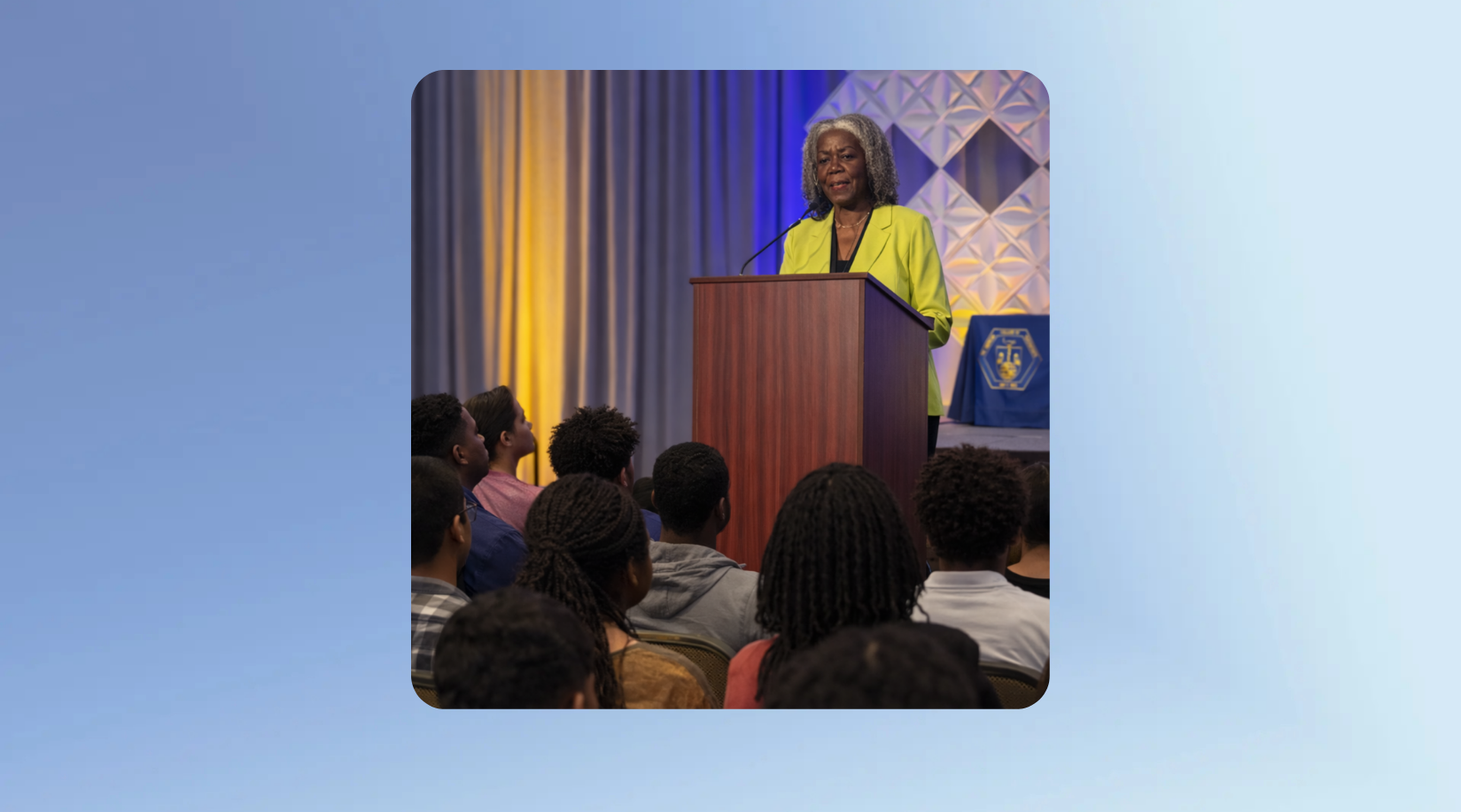
More than 60 percent of college students meet the criteria for at least one mental health problem, according to the national Healthy Minds Study. Yet only about 12 percent receive care through campus counseling centers.
That gap tells us something important.
When students are struggling, they are not always walking into counseling offices. Research shows they are far more likely to turn to family, friends, or peers first. They also confide in professors, advisors, coaches, mentors, and resident assistants, people they see regularly and trust.
This raises a simple question: Are our campuses set up to meet students where they are?
Too often, they are not.
At many institutions, student mental health is still treated as the responsibility of counseling centers. These centers are essential, but they were never meant to carry this work alone, especially as the world students are navigating has grown more complex and the ways they seek support have evolved.
As a psychiatrist and senior medical director at The Steve Fund, I have spent much of my career focused on improving mental health care for young people, particularly those from underserved and under-resourced communities. Through The Steve Fund’s Excellence in Mental Health on Campus initiative (E.M.H.C.), we have worked with colleges and universities across the country to better understand what it takes to create campuses where students can thrive.
What we have learned is both encouraging and instructive: When institutions treat mental health as a shared responsibility across the campus community, meaningful change becomes possible. Since 2016, The Steve Fund has partnered with 66 colleges and universities across 23 states, reaching more than one million students. Across these campuses, mental health has gradually shifted from being seen as a clinical issue to a broader institutional priority.
That shift shows up in practical ways, as campuses implement strategies to strengthen awareness of mental health resources and integrate student wellbeing into the broader campus environment.
Some campuses embedded mental health resources directly into course syllabi, so students encounter support information within their academic environments. Others incorporated counseling center information into the institution’s Simple Syllabus template and added counseling resources under the “Student Resources” section of the campus website, making support easier for students to find. Institutions expanded outreach efforts to increase awareness and trust in counseling center services. Examples included featuring counseling center staff on the student radio station, creating a “What to Expect from the Counseling Center” video in partnership with the marketing department, and placing counselors in academic buildings rather than solely in separate health centers.
When students are struggling, they are not always walking into counseling offices. Research shows they are far more likely to turn to family, friends, or peers first.
Student engagement and leadership teams hosted events designed to foster connection, inclusion, and belonging — protective factors that support student mental health and persistence. Some campuses introduced breakout sessions for parents and caregivers during new student orientation to help families better understand student mental health challenges and available campus resources.
Institutions have also launched coordinated campaigns to increase awareness of counseling services using multiple communication channels, including campus flyers, digital displays on campus TV screens, and targeted outreach to departments, student clubs, and organizations.
These changes may seem modest on their own. Together, they reflect a broader shift in how campuses think about student wellbeing, and it sends a powerful message: Student wellbeing matters everywhere on campus.
Just as importantly, campuses are beginning to recognize that student voices must be central to shaping mental health solutions.
Through listening sessions and peer-led discussions, institutions gained deeper insight into the realities students face, from academic pressure and financial stress to impostor phenomenon and experiences of exclusion or isolation. When students were invited to participate in the decision-making process, institutions were better able to design programs that felt relevant, accessible, and culturally responsive.
Another important lesson has been the value of collaboration across institutions.
Too often, colleges attempt to solve mental health challenges in isolation. But through the E.M.H.C. learning network, participating campuses are sharing strategies and innovations, accelerating progress across institutions.
One campus convened a district-wide mental health summit that brought together students, faculty, and staff to discuss wellness and belonging. Another embedded mental health priorities into its institutional strategic plan. Others developed faculty training programs focused on trauma-informed leadership and how to recognize and respond to student distress.
These examples point to something important: Improving campus mental health does not always require entirely new programs. Often, it begins with rethinking how existing systems, from orientation and advising to faculty development and campus communications, can better support student wellbeing.
This shift is particularly critical for students from underserved and under-resourced communities. Many students of color, first-generation students, and students from low-income backgrounds face additional barriers when seeking mental health care, including stigma, lack of culturally responsive providers, and feelings of isolation on campus.
When institutions intentionally center belonging and cultural responsiveness, students are more likely to seek help and remain engaged.
Ultimately, the lesson from our work is straightforward. Mental health must be embedded in the environments where students learn, live, and connect. Counseling centers remain essential, but they cannot carry this responsibility alone.
Faculty shape classroom experiences. Student affairs leaders create spaces designed to foster belonging and peer connection. Administrators set priorities and allocate resources. Each has a role to play. When those efforts come together, campuses move from reacting to creating conditions that support wellbeing from the start.
And that shift matters, not only for student mental health, but for student success.
Students who feel supported are more likely to persist in college, engage in campus life, and reach their academic and professional goals. Mental health is not separate from student success; it is foundational to it.
The challenges facing today’s college students are real and complex. But across the campuses we have worked with, one thing is clear: meaningful progress is possible when institutions commit to building environments grounded in trust, belonging, and culturally responsive care.
The path forward is not about doing more in one place.
It is about making sure students are supported wherever they are.
Colleges must move beyond viewing mental health as an isolated service and begin treating it as a core element of the campus experience. That shift is underway, but far from complete.
The lessons from this work are outlined in The Steve Fund’s Excellence in Mental Health on Campus retrospective report, which highlights strategies campuses are using to embed mental health into institutional culture and student success initiatives. The full report can be accessed here: Excellence in Mental Health on Campus (EMHC): A Retrospective Report – The Steve Fund
Dr. Annelle Primm is senior medical director of The Steve Fund, a leading nonprofit dedicated to promoting the mental health and emotional wellbeing of young people from underserved and under-resourced communities.
Study Abroad Is Not for Everyone

Adding three to the “staying” side and another three to the “going” side, I recently opened a spreadsheet to keep track of the friends who I will (not) see as often around campus throughout junior year. It was only once I began to record my friends’ impending study abroad adventures that I accepted the truth about my own college life: I will not sacrifice a semester at school in order to go abroad.
I feel this looming sadness as a sophomore at Georgetown University, which has a particularly global-minded student body. Studying abroad at Georgetown feels more like a rite of passage than the right opportunity for a certain kind of student. About 16 percent of bachelors-earning undergraduates nationally will study abroad, while Georgetown boasts a 57 percent abroad rate. In our School of Foreign Service, the percentage hovers around 80 percent. For this reason, many Georgetown students no longer waste their precious breath to ask if a peer plans to study abroad. Rather, students ask each other where they are traveling and for how long.
Whichever way the conversation goes, the student staying on campus becomes accustomed to bearing the burden of proof for his own decision. For some, foreign travel is just so obviously enriching for their career paths that they could hardly imagine it not applying as clearly to their friends’ journey. Others just cannot fathom how anyone could opt out of taking a semester-long adventure.
Sometimes pursuing an unconventional path for the sake of being true to oneself actually requires as big a leap — as much self-introspection and reliance — as chasing adventures on the other side of the world.
The typical student who chooses not to go abroad is one familiar with hearing that he will regret it for the rest of his life. The language of regret is hardly unique to studying abroad. So many decisions to abstain from what others are doing are vulnerable to self-doubt when they are expressed. What was once an assured decision sounds uncertain in the voice of a student who has lost his confidence. Sometimes pursuing an unconventional path for the sake of being true to oneself actually requires as big a leap — as much self-introspection and reliance — as chasing adventures on the other side of the world. There is more than one way to realize our full selves in college, including by learning to trust our own instincts.
Especially at Georgetown, it is no coincidence that most students study abroad during their junior year. When I saw the peak of academic rigor, my junior fall, in the distance, I promised myself that I would instead opt for the rolling hills of Florence, Italy. Little could be better than escaping dining hall food for cacio e pepe, all while augmenting my pre-law G.P.A. with classes that past villa dwellers had told me were a breeze.
But the longer I waited for my once-in-a-lifetime study abroad experience to begin, I realized that college itself was a life-altering experience. The opportunity to live abroad for such an extended period of time may never come again, but college also feels quite precious. Friends, classmates, and professors are an inevitable part of student life, but they only form a community when they live and work in close proximity. Study abroad professors offer valuable knowledge, but they are still unlikely mentors when compared to a professor whose office is just a short walk away from a residence hall back on campus.
Even if abroad coursework covers major or general education requirements, there may be more that a student wants out of their degree. A degree can become more than an arrangement of words on a diploma since unique classes can imbue a student’s coursework with personal significance. Many college students still remember the drag of taking obligatory classes in high school and revel in realizing the academic freedom that was long withheld from us.
The opportunity to live abroad for such an extended period of time may never come again, but college also feels quite precious.
That abroad coursework even covers major or general education requirements is also never guaranteed. For up to a week before new semester class registration, thousands of students are piecing together the right classes with the best professors, to fit the right requirements at the right time. For students like me who double major with a minor, a good semester schedule is already almost as puzzling as it gets in college. Nothing kills a good study abroad plan quite like discovering that two required classes conflict timing-wise and that overloading credits is the only excruciating solution.
Students can find themselves studying abroad despite these constraints, but the pain tolerance should be higher for students whose course of study necessitates a journey abroad. If I was a Classics major, my degree path would feel incomplete without a semester abroad in Italy. As of now, I remain convinced that Washington D.C. is the right place to further my education and experience in American politics.
Leading with what convinces me is enough to feel satisfied with my own decision to stay, even as so many people I care about are going. There is some irony here: the study abroad decision that I would most likely regret would have been prompted by an exogenous fear of regret itself. If I ever go abroad, I want it to be because I led myself there, not because I mistook someone else’s path for my own.
Aaron Polluck is a sophomore at Georgetown University studying government. He writes for The Georgetown Voice.
Knowing What We Seek
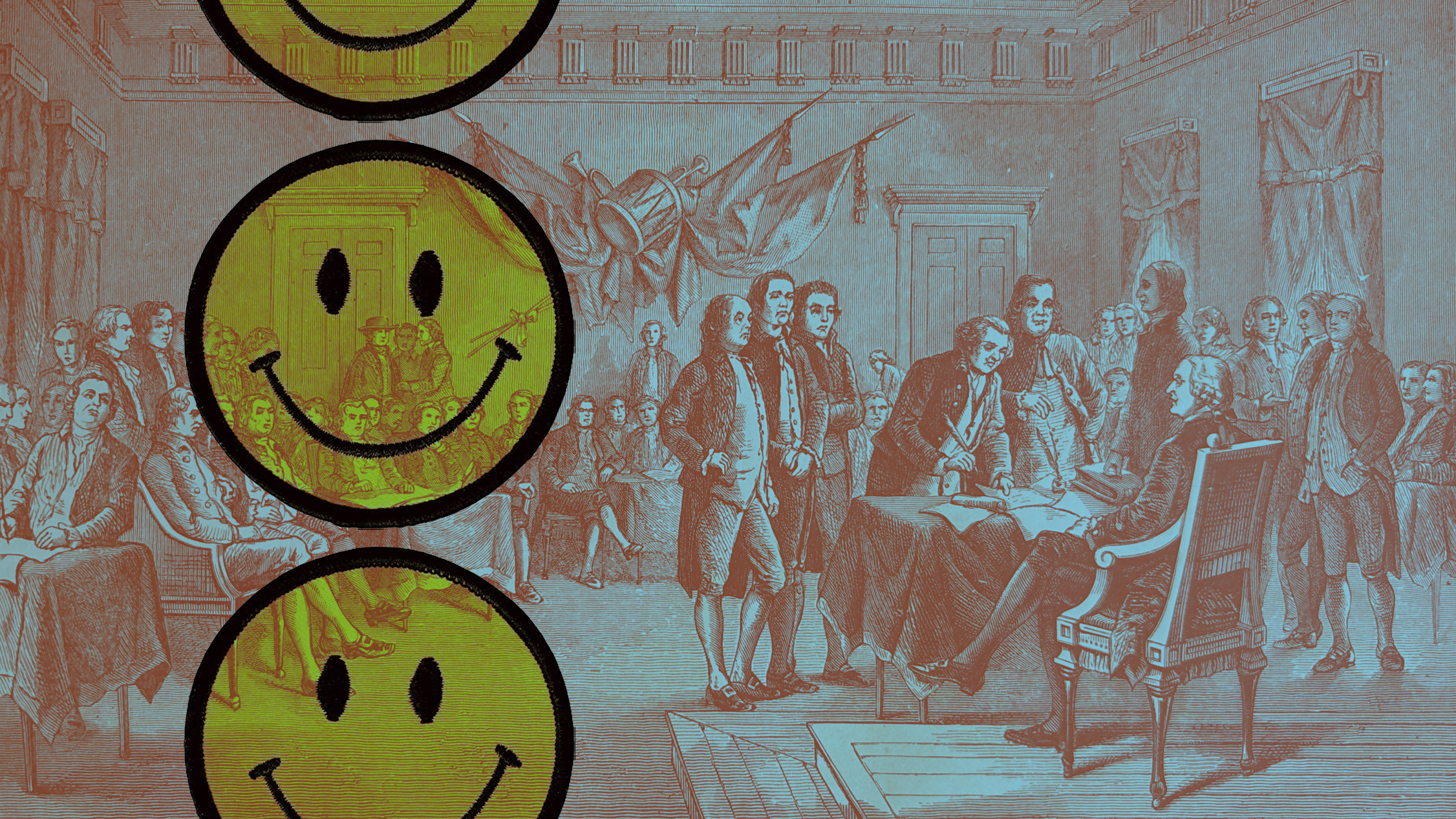
Happiness today is most often associated with comfort, or momentary pleasure, but our founders envisioned something very different when they drafted the Declaration of Independence. Indeed, “the pursuit of happiness” may be the most misunderstood phrase in the national vocabulary.
As we approach our 250th anniversary as a country, a new course at Arizona State University aims to clarify the term “happiness” and, in doing so, remind us of the virtuous ideals on which our nation was founded. “What the Founders Meant by Happiness: A Journey Through Virtue and Character” is a partnership between A.S.U. and the National Constitution Center, and course co-creators Ted Cross of A.S.U. and Jeffrey Rosen, the center’s C.E.O. emeritus.
Based on Rosen’s book, “The Pursuit of Happiness: How Classical Writers on Virtue Inspired the Lives of the Founders and Defined America,” the course explores how the study of classical virtue shaped the founders’ understanding of happiness, character, and civic duty. But in creating the course, Rosen and Cross hoped to do far more than correct an interpretation that has been misconstrued over time. The course engages students in getting to know our founding fathers and mothers who, despite their flaws, made the pursuit of virtue something that would guide the growth of the country.
The course’s title, “What the Founders Meant by Happiness,” is revealed in the first part of the course, stemming directly from Rosen’s body of work as a constitutional scholar. “The founder’s happiness did not mean ‘feeling good,’ but ‘being good’ — not the pursuit of immediate pleasure, but the pursuit of long-term virtue — meaning self-mastery, character improvement, and lifelong learning,” Rosen said.
The course draws reflection from learners about how the original meaning of happiness can be held for individuals and society today.
“We hope that students and learners become reflective on not only what happiness means to them but which of those values and virtues they would like to adopt in their own lives and what implications that may have on how we interact with one another,” said Ted Cross, who leads Principled Innovation,a character education initiative at A.S.U. that places character and virtue at the center of decision-making.
The open access, online course has 12 modules and is currently available at A.S.U. without credit (though Cross hopes that will change over time) and on the National Constitution Center’s website. Those who complete all 12 modules receive a certificate. The co-creators describe the course as “providing a framework to cultivate civic identity and character at scale, modeling how institutions can democratize character education while reinforcing civic flourishing.”
Rosen said the aim of this course is to shed light on a critical pillar of our democracy: holding dear a common understanding of what it is we stand for.
The second part of the course revisits the founders’ stories — from Thomas Jefferson to Benjaman Franklin to Phyllis Wheatley — revealing their moral sources for recovering happiness as the pursuit of virtue and self-control. Key to this telling is their humanness in borrowing their insights from philosophers like Aristotle and Cicero and their admission that their quest for moral fortitude often eluded them. It was the pursuit that mattered most. Explained in this context, Cross said, the content becomes relatable.
While it stands on its own from a content perspective, the course itself reinforces the missions of both its founding organizations. As part of A.S.U.’s Principled Innovation, it fits nicely within the character education framework, which has been adopted by A.S.U. President Michael Crow as a foundational design aspiration of the university. The school is promoting the course not just to students but to educators at A.S.U. Prep, the university’s preparatory charter school, and other K-12 educators.
As the nation’s only institution dedicated to increasing awareness and understanding of the constitution, the National Constitution Center has been marketing the course throughout the country, hoping to attract students and life -long learners alike to engage with all or some of the modules. The course is the latest addition to the center’s growing suite of educational resources initiated by Rosen when he was the president and C.E.O.
Rosen said the aim of this course is to shed light on a critical pillar of our democracy: holding dear a common understanding of what it is we stand for.
“People should think as they will and speak as they will, but we need models to inspire us,” Rosen said. “We need exemplars. Without a consensus about our heroes, it’s difficult to invite people to envision happiness in this once familiar but now forgotten way.”
The course underscores another important tenant of democracy in America by examining the juxtaposition of freedom and self-control, once again illustrated through the intentions and practices of our founders. “I’ve always believed that democracy depends on political self-government,” Cross said. “Our founders set up a system that has many degrees of freedom, but it depends on individual citizens being able to manage themselves and interact with each other in virtuous ways.”
The course was launched in February 2026, and the response thus far has been positive, in part due to an engaging storytelling format (a hook Cross said was intentional for younger learners). But time will tell if deeper meaning about virtue and self-control will come through for a generation often criticized as being isolated and self-absorbed. The co-creators believe the lack of moral exemplars this generation has experienced, both in popular culture and leadership, may actually increase the course’s appeal.
“We know that young people want to be happy,” said Cross, who has taught courses in positive psychology. “My contention is if you learn to be good, you will also feel good, that there is a root to feeling good that comes through character development, purpose, and meaning.”
Rosen agrees and sees the course as an example of a renaissance of character education in the U.S.
“We’ve had a tremendous reaction to the course thus far and we are hoping that this will be part of the movement for the cultivation of virtue that is increasingly strong in America today,” Rosen said. “There’s a hunger for this right now in this country.”
You can reach LearningWell Editor Marjorie Malpiede at mmalpiede@learningwellmag.org with comments, ideas, or tips.