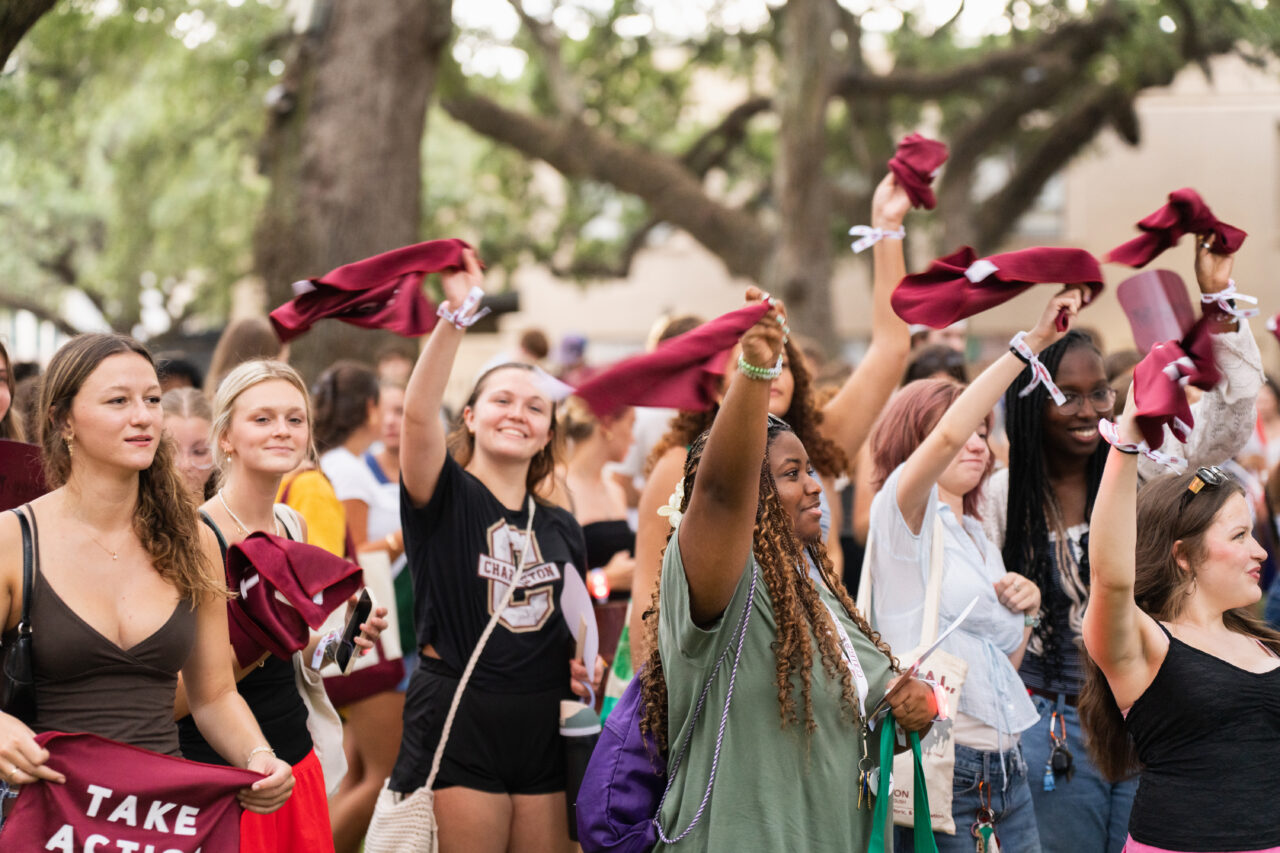
In some ways, this year’s opening days at the College of Charleston might have resembled those of the last 20—or even the last 200. At the 13th oldest college in the country, this fall’s convocation drew the perennial throng of new students who mingled with nervous excitement under the willowy live oak trees on the historic Cistern Yard.
But this time, there was a notable addition. All around, students held, or waved, rally towels of different colors, printed with one of five encouragements: “Be Curious,” “Radically Collaborate,” “Take Action,” “Reframe,” and “Be Mindful.”
These weren’t just typical words of wisdom for launching the year, or a college career. They are the core mindsets of Life Design, a life coaching model that CofC has decided to implement university-wide with a focus on first-year students. Over the last six years, Life Design’s expanding influence on campus has highlighted its potential to fortify students’ self-efficacy and optimism and, ideally, better position them for personal and professional success. Now leadership is on a mission to center these concepts in the student experience, introducing them early and often.
Life Design, in essence, offers students a framework to plot multiple alternate futures for themselves and then encourages them to explore those options. The approach originated with two Stanford engineers who decided to apply their field’s design principles to regular life planning. For students, they asked, what would it look like to consider not one but three different majors, or extracurricular focuses, or career paths? Where would they take you, and would you be satisfied with each?
Kristen McMullen, the executive director of student success at CofC’s School of Business Student Success Center, was among the university’s first to embrace the practice. Her journey began in 2019 when, along with two colleagues, she flew out to Stanford for a Life Design training program. Over four days, they were immersed in the methodology and prepared to implement the work on their campus. Come the new academic year, they launched a one-credit Life Design course that drew about two dozen underclassmen in the fall and a similar cohort of upperclassmen in the spring.
As they mapped their different life paths, they seemed freed from the pressure of fulfilling a single destiny and the fear of falling short.
An assessment of this first Life Design experiment affirmed McMullen’s budding faith in the practice. Compared to control groups, students in both her classes demonstrated an improved sense of hope for the future, greater self-efficacy, and reduced career anxiety. Anecdotally, McMullen said, she could sense the change in her students. As they mapped their different life paths, they seemed freed from the pressure of fulfilling a single destiny and the fear of falling short. “They were actually starting to believe that they could take control of their lives,” she said. “They could make decisions, it was in their hands, and they just felt better about themselves.”
Over subsequent years, McMullen extended Life Design to new corners of campus, and others took notice. There were coaching sessions for individuals and then small groups of students, and the number of other staff trained to be coaches and classes featuring the content grew. Then, around two years ago, CoC President Andrew Hsu issued a directive for all students to receive some kind of life coaching. The provost approached McMullen about whether Life Design might be the way to go about it. “Do you think we could do this college-wide?” she remembered being asked. “That’s my dream,” she replied.
Today McMullen finds herself updating a document she’s titled “My Ecosystem,” which charts all the different people and areas on campus where Life Design has made its way so far. The goal, she said, is to reach “every single department, office—everywhere we can.”
Design Your Charleston
It was still fairly early in McMullen’s Life Design efforts when she started teaching an elective first-year seminar pulling in some of the key concepts. She was particularly impressed by just how far these very young students were able to progress in a short amount of time.
“I get goosebumps,” she said, describing how their final presentations would reflect their transformation into organized, forward-thinking, open-minded college students. They seemed to mature so quickly and fully, she added, that she would find herself thinking of them as graduating seniors, rather than rising sophomores.
When she got the presidential green light to expand Life Design, McMullen set her sights on the First Year Experience program. As of this fall, she and Jessica Zuber, the senior director of student success and engaged learning, have launched what is perhaps the school’s most prominent Life Design effort yet: FYSS 101 Design Your Charleston, a weekly, required course for first-years combining an introduction to student life and resources with Life Design content. There are currently more than 100 sections of the class in progress, reaching a total of around 2,700 students, nearly the entire grade.
Every week, the students in Design Your Charleston receive information and complete exercises pertaining to different facets of college life. Week two on “Design Your Support System,” for example, provided an overview of various support offerings and tasked students with mapping out which they “would actually use,” according to the syllabus. Other weeks have homed in on “Design Your Community” or “Design Your Academic Path,” requiring more detailed plotting of events to attend, organizations to try out, fields of study that seem interesting, or advising questions to ask. Those five mindsets from the convocation towels —“Be Curious,” “Radically Collaborate,” etc.— are integrated continuously to give students a common language for navigating the first year, and beyond.
Another central element of Design Your Charleston is that it’s peer-facilitated. While McMullen and Zuber create the course lesson plans and PowerPoint slides for each week, older students bring the content to life in the classroom. “Not only are we growing professionals for the workforce past graduation, but also the students that they’re working with are receiving information from a peer,” Zuber said. “We find that students generally receive that information better than they do from adults just telling them what to do all the time.”
McMullen believes this information really can transform the student experience. “Design Your Charleston is to intentionally design the years—whether it’s three, four, five—that you’re at the college so that you’re getting every little thing out of the experience that you possibly can,” she said. She likes to think about the course as building a parachute for students made up of all the experiences and knowledge gained along the way. So by the time they’re jumping out of the college plane, dropping down into the real world feels like floating, rather than crashing. “This is great. I can see the view,” she hopes they are able to say. “I know where I want to go.”
A New Generation
Christopher Korey, the associate provost for student success at CofC, doesn’t subscribe to generational stereotyping. When he looks at his own children, for one, he doesn’t find the supposed Gen Z mold, which seems almost synonymous these days with some combination of fearfulness and fragility.
But Korey is willing to note that today’s college students, like many of all ages, appear to struggle with the task of taking the first step—putting themselves out there, trying something new, and risking failure in the process.
It was this recognition, in part, that Korey said inspired the request for universal student coaching in the first place. The high-level strategic vision, which Life Design helps deliver on, is for CofC to provide a truly holistic style of education: advising that goes beyond academics to help students grow as human beings, career preparation that goes beyond landing students jobs to developing their understanding of what they want to do and the skills they already have to help them succeed.
The CofC administration is currently eyeing an advancement campaign, of which one priority is boosting the university’s national prominence. Striving to become a leader in the student support and development space seems like a promising approach. “We’ll learn things that we can bring to a national audience about [how this work fits] into thinking more broadly about supporting students and this generation of students,” Korey said.
Should its steady course of Life Design expansion continue, CofC just might become as famous for its work on student wellbeing as it is for its centuries-old oaks.
You can reach LearningWell Reporter Mollie Ames at mames@learningwellmag.org with comments, ideas, or tips.
The University of Dayton and Sinclair Community College are just two miles away from one another, but in many ways, they are worlds apart. UD is a private Catholic university providing a four-year undergraduate experience. Sinclair, a public community college, offers the most affordable associate’s degree in the state of Ohio. And yet, when a group of educators from both institutions held a retreat to explore a partnership around character education, an infectious energy emerged.
“It was like we fell in love with each other over three days,” said Nancy McHugh, the executive director of the Fitz Center for Leadership in Community at UD. “We went in as two separate groups and came out as one.”
At the end of the retreat, they named themselves “the dream team,” and it stuck. This eclectic group of educators are now the driving force behind an unusual partnership in higher education based on what unites them, not what sets them apart. Funded by the Educating Character Initiative (ECI) out of Wake Forest University’s Center for Leadership and Character, UD and Sinclair will now embed character instruction into curricular and co-curricular initiatives at both schools, with a particular focus on community-engaged learning. At the heart of the initiative is the UD-Sinclair Academy (UDSA), one of the country’s most promising examples of a two-year/four-year transfer collaboration.
They named themselves “the dream team,” and it stuck.
Using character as the bridge, the team believes the work will produce a number of positive outcomes, including expanding the work of personal formation to all students, infusing belonging into the transfer pathway between the schools, and deepening each institution’s commitment to the community. In this sense, the UD/Sinclair character education initiative promises to be a national model for how institutions of different profiles and student populations can create beneficial relationships while deepening their respective missions.
Breaking New Ground
The initial retreat that brought the team together was part of an ECI capacity building grant meant to help institutions do the groundwork for their character education aspirations. Oftentimes, these planning stages bring into focus existing assets, and in some cases barriers, that can be addressed through a larger effort. Always, it is the people behind the initiatives who ultimately shape how the work takes root.
The UD/Sinclair partnership is led by two academics who, their colleagues say, represent the best of each institution: UD’s Nancy McHugh and Sinclair’s Myra Bozeman. McHugh is a philosopher by training, though she calls herself a “weird one,” spending as much time outside the classroom working with students in the community as she does inside it. The Fitz Center, where she is director, is one of several centers at UD that focuses on community-engaged learning — a form of experiential education in which students apply what they are learning in class to the needs of the community.
“I’ve always tried to help students understand that the work we do internal to higher ed travels out into the world,” she said. “The skills we are learning in the humanities, in the liberal arts, have this strong external-facing component that helps us understand how to live better in the world and also develop our personal and professional lives in ways that are really important.”
Myra Bozeman, the dean of liberal arts, communication and social sciences at Sinclair, was born and raised in Dayton. “I have a deep connection to Sinclair,” she said. “I was the first child in their day care because my mother was a student here. I have a real love for the students, and moreover, the community.”
Bozeman said that while most faculty at four-year colleges have an expectation about research, the expectation at Sinclair is to be out doing work in the community. This mirrored UD’s Catholic Marianist mission, advanced by its current president, Eric Spina, who in 2017 declared UD the “university of the common good.”
A year earlier, Spina worked closely with Sinclair’s president Steven Johnson to create the UDSA, an affordable pathway for transfer students from Sinclair to UD. USDA students are representative of Sinclair’s population: Most are Pell-eligible, first generation, and/or students of color. For their first two years, USDA students pay Sinclair tuition (around $5,500 annually) rather than UD tuition (around $50,000), while gaining full access to UD’s campus experience and student organizations, as well as co-curricular opportunities at both institutions. When Sinclair students transfer to UD after receiving their associate’s degree, they get a deep discount on tuition.
Realizing the program’s full potential involves educators from both schools continuing to learn about each other and reflecting on the perceptions they bring to the work. Fortunately, the trust and candor the dream team members built has enabled them to address issues head on.
“UD is a fantastic institution, but they haven’t, in the past, been the most welcoming platform for students of color,” Bozeman said. “Many Blacks just didn’t feel like they belonged on that campus. I personally believed UD has wanted to welcome our students, but perhaps they didn’t understand how to do it. And now we can help figure that out.”
UD’s 2024 Culturally Engaging Campus Environments survey revealed that UDSA students experience lower community connection and sense of belonging compared to traditional four-year UD students. However, UDSA students do experience strong educator support at UD and find they have abundant opportunities for positive regional contribution. The dream team sees this as an opportunity for growth and collaboration across institutions, with character-education tied to community-engaged learning as a vehicle to increase the sense of belonging for students in both their curricular and co-curricular lives.
For McHugh, the belonging gap for the UDSA students sparked an “aha moment” that would lead to a larger inter-institutional effort funded by an ECI institutional impact grant of a little under a million dollars. She told the team, “Let’s use community-engaged learning as a vehicle for character education and then use that to create a common language for character for both institutions to drive forward this sense of belonging for all students.”
Understanding and communicating what that looks like is an ongoing conversation, both within regular meetings of the dream team and at brainstorming sessions called “charettes.” The project materials describe character as a set of dispositions, or virtuous habits, that shape how we think, feel, and act. The overlay of community-engaged learning means that these habits are shaped by community participation and geared toward the benefit of the community.
“For me, character is about enlarging my students, not making them smaller.”
While the benefits of experiential learning are well established, leaders advocate that when implemented with intentional attention to character education, these benefits compound, as student gain not just knowledge and skills but the moral and epistemic dispositions to use them wisely in service to others. In creating a common language and commitment to these principles, the project is guided by nine virtues: joyfulness, curiosity, resilience, hope, integrity, mindfulness, empathy, justice, and community belonging.
While the foundation of the initiative is rather philosophical, the proposed plan is a tangible list of specific initiatives with deliverables, including work within the community-facing centers and in co-curricular activities for students on both campuses. Much of the energy and resources are pointed inside the classroom. Among the project’s goals are to strengthen cross-institutional collaboration and to empower educators at both institutions to implement character education into their courses. This is happening on many levels, starting with faculty who now teach or guest lecture on both campuses, with many planning to infuse character into their coursework.
A newly launched faculty fellows program will train 10 new faculty a year from both institutions to use a character pedagogical framework, resulting in a cohort of 70 or so over time. These will include senior character fellows who will act as mentors to other faculty members.
To improve the UDSA experience for students, “all of Sinclair and all of UD would need to be involved,” McHugh said. “We need to know that when a UDSA student goes into a class in engineering, they will feel a sense of belonging because those educators will have the same sort of language.” Many Sinclair professors, who were unaware of even having UDSA students in their classrooms, are learning how to use a character framework to get to know them.
Dair Arnold, a professor of English at Sinclair, is now running a character pilot in her first-year composition course. While keeping with her standard syllabus, she now adds a character lens to each of her units. In the introduction to writing section, the theme is “know yourself.” Instead of one week of introductory work before the first assignment, Arnold took two weeks where she talked about what character means for students.
The character “cheat sheet” she gives her students defines it as “who you are becoming and how we choose to act — especially when situations are difficult, uncertain or require us to think beyond ourselves.”
Arnold said the students are embracing the revised format and feel excited to be a part of something intentional and different. “For me, character is about enlarging my students, not making them smaller, and giving them the skills so they can make informed choices that are good for them, as well as large groups of people.”
Helping Sinclair students explore their personal growth through character education is a big part of the effort to increase belonging. “I think this project is going to enable the two-year students, and their faculty, to have opportunities they wouldn’t have had otherwise,” said Katherine Rowell, a retired full faculty member at Sinclair who has moved her office down the street to UD and is now heading up faculty development and assessment on the character education initiative.
Rowell believes the character education will help counterbalance the national narrative about the purpose of community college which has been skewed almost exclusively towards workforce development. “We need both. You can’t do workforce development without also talking about integrity and ethics and resilience,” she said. “Community college students need the opportunity to work on these things, not just students at elite liberal arts colleges.”
The commitment UD has made to partner with Sinclair on formative education has Rowell hopeful and excited about the work ahead. “I think just the conversations — the faculty from both institutions talking about these things and making sure students are cared for — it is good to be a part of. In all my time working in community college settings, I have never had a four-year institution reach out or make any overture until now.”
Another dream team member, Danielle Boone, reiterates the importance of character education to the regional workforce missions of both schools, particularly Sinclair. Boone is a UD staff member who runs a program called Professional and Applied Learning (PAL) that supports UDSA students. She is also an adjunct faculty member at UD and Sinclair in psychology and is building character education into these courses.
Much of her work is aimed at preparing students for jobs in the community — one of the goals within the community-engaged learning framework of the initiative. Of the UDSA graduates from 2023 to 2024, 80 percent of those who are employed, have jobs in the Dayton region. Boone sees a through line from the UD/Sinclair character initiative and the needs of the regional workforce. She calls the work “employer-informed character.”
“This is about making sure our students show up at work as whole people and have the skills they need to persist through adversity and be successful,” she said. “That to me is character. And if we are going to argue about the relevancy of higher education than this is what we’ve got to do.”
Given UD and Sinclair’s shared commitment to personal growth and community, the dream team’s character initiative may well come full circle, reinforcing what the two institutions had always had in common, yet might not have known. Bozeman recalled an epiphany she had early on in the first dream team retreat: “I remember thinking to myself, ‘This is going to change our community. This is going to change it all.’”
At the University of Vermont last spring, a business undergraduate student took a hiatus from the classroom and stepped into a full-time job at BETA Technologies, an electric aviation company based near Burlington. The placement was part of the first cohort of a new co-op program at U.V.M.’s Grossman School of Business. At first, the student wasn’t confident, or even sure this was the kind of work he wanted to do. But over several months in financial planning and analysis at BETA, he began leading projects, making presentations, and eventually even training other employees. Now back at U.V.M. for his senior year, the placement was such a success that he continues to work 10 to 20 hours a week for the company.
UVM’s new program is one example of a larger rethinking of where workforce experience meets undergraduate education. Internships and co-ops are not new to higher ed. But today’s A.I.-disrupted workforce gives them new gravity. As employers increasingly look for evidence that applicants are work-ready — and as student families eye R.O.I. — more colleges are expanding internships, co-ops, and apprenticeships to show results with more direct on-ramps into careers.
Some higher-education thinkers are imagining more fundamental changes, with aspirational models that envision students looping repeatedly between classrooms and the working world, making experiential learning part of the architecture of college rather than one of its offerings.
Beyond the undergraduate years lies an even bigger question about lifelong learning. Will technological and workforce changes require workers to learn and relearn throughout increasingly long careers? If ongoing retraining is in the cards, should colleges be preparing students to move back and forth between work and ongoing education for life?
Shrinking the Experience Gap
The question of whether new graduates are adequately prepared to join the workforce has become more urgent as the entry-level labor market changes. A.I. can increasingly perform tasks once assigned to junior employees, while employers are asking new hires to arrive with skills — and experience — that previous generations would acquire on the job.
Dan Hatch is a professor of web design and user experience at Utah Valley University who spent about 25 years in the field before entering academia. Yet for seven summers, he has returned to technology companies as a faculty “extern,” brushing up on industry skills and learning firsthand what his students will need to break into the field. This past summer, he went back with a particular question: How is A.I. changing what students will need to know and removing the entry-level work through which they traditionally gain experience?
Entry-level employees have traditionally gotten their start doing the kinds of basic tasks that allow them to accumulate experience and judgment. Now, Hatch told Inside Higher Ed, “A.I. can eat that stuff for breakfast.” The dilemma he sees is how students break into the business if some junior-level work disappears.
“What if you could get the skills you needed and then seamlessly re-enter the workforce highway — if you could enter and exit as needed?”
The familiar complaint is that college graduates aren’t prepared for work, but the picture is more nuanced than that. In the National Association of Colleges and Employers’ Job Outlook 2026 survey, 71 percent of employers considered new graduates somewhat well prepared, but only 22 percent considered them very well prepared. Similarly, 42 percent said graduates’ skills were very closely aligned with their hiring needs, while 56 percent called them only partially aligned. Communication, professionalism, and critical thinking remained particular areas for improvement. But in teamwork and technology, students’ experience aligned well with employer expectations.
Ryan Craig, author of “Apprentice Nation,” sees a shift in expectations from the employer side. As managing director of Achieve Partners, he connects young adults with early-career apprenticeships in technology, healthcare, and other industries, and has a front-row seat on the experience gap. “Colleges are doing as good a job as they’ve ever done at equipping students with the cognitive skills and critical thinking skills and communication skills and durable skills,” Craig said. “The problem is that the goalposts have moved.”
Craig calls one of those changes “experience inflation:” Employers increasingly expect applicants for entry-level positions to arrive with relevant work experience. His preferred solution is paid apprenticeships, often as an alternative pathway to traditional higher education, and his firm invests in companies that build such pathways in fields that benefit from a staffing pipeline.
For colleges, that model presents a direct challenge to remain relevant. Could more of that on-the-job experience be built into higher education itself? And what should it look like?
Putting Work Directly into the Degree
Cooperative education has been doing some version of work-integrated learning for more than a century. The University of Cincinnati pioneered co-op in 1906; Northeastern followed soon afterward, and Drexel and Rochester Institute of Technology developed major programs of their own.
At established co-op universities, students can move repeatedly between substantial stretches of academic study and professional work, and new programs suggest fresh interest in the structure. U.V.M.’s Grossman School sent its first business co-op students to employers in early 2026. The University at Albany’s Massry School of Business also launched a program this year, built around four-to-five-month paid, full-time placements during an academic semester, after which students return to classes. Rowan University in New Jersey is expanding engineering co-ops that can span six to nine months and earn academic credit. The scale varies dramatically, but the core idea is similar: Give students enough time in a workplace to move beyond observation and begin doing consequential work.
That distinction matters to Stephanie Meunier, director of the Grossman Co-op. U.V.M.’s optional placements run four to six months, rather than the eight or ten weeks typical of many summer internships. In that time, she said, students can get through onboarding, become independent, and take ownership of projects.
Yet U.V.M. also demonstrates how awkwardly substantial work experiences can fit inside a degree still structured primarily around semesters spent in classrooms. Grossman students currently receive a notation on their transcript but no academic credit for the co-op, despite stepping away from classes for the placement. Staying on a four-year path may require students to arrive with A.P. or dual-enrollment credits, carry heavier course loads, or take summer classes. Meunier wants that to change. Her longer-term goal is to integrate co-op into the curriculum and eventually make it a requirement of the business degree.
That raises a strategic question: If students are learning important things while working, how should colleges recognize that learning?
Connie Yowell, the executive director of Northeastern’s Center for the Future of Higher Education and Work, has spent much of her career examining that recognition. In earlier work on digital credentials and the learning network LRNG, she challenged a system in which, as she explained in a 2017 Education Week interview, “the only learning that counts is what happens in school.” Education, she said, instead needs to “allow learning to happen in a variety of places, and for it to count.”
Her work on digital badges — a proposed way to document skills learned outside traditional coursework — grew partly from that problem. If learning occurs at an employer or somewhere else outside a classroom, learners need ways to make what they know visible and portable. Imagine the scouting mindset for careers, minus the sash: This student has achieved this skill through this experience. It could also mean redesigning the relationship between education and work, rather than simply adding a better internship program to a conventional degree.
The Cloverleaf University
Michelle Weise, author of “Long Life Learning: Preparing for Jobs That Don’t Even Exist Yet,” has spent much of her career studying the intersection of postsecondary education and work. Her fundamental question is how an education system built largely around learning first and working afterward can serve people facing repeated job and career transitions over much longer working lives.
“When I wrote the book, I was struck by the idea of needing to learn for changing jobs going on indefinitely. Early boomers were having 12 job changes by the time they retired. So with all of these technological advancements, we could easily imagine having to do 20 or 30,” Weise said. “How in the world are we going to somehow keep up with this many transitions over a lifetime? We need the university to adjust to this with a new approach. What if you could get the skills you needed and then seamlessly re-enter the workforce highway — if you could enter and exit as needed?”
She has developed those ideas into a model she calls the Cloverleaf University. A learner leaves the workforce on an exit ramp into education, gains knowledge or skills, and then takes an on-ramp back into work. Later, the learner may exit again. Repeated over time, those looping ramps begin to resemble a highway cloverleaf, or a series of them.
For undergraduates, the concept could mean multiple loops between school and work rather than one transition at graduation or one summer internship near the end of college. Students might study, spend substantial time working, and then return to school with a better understanding of what they know and don’t know, and go out again.
Weise’s Cloverleaf idea is broader than an expanded co-op program. It combines several strands of her thinking: work-based experiences; interdisciplinary learning, organized around complex real-world problems; and a university capable of serving learners not only at 18 or 22 but repeatedly across their working lives.
One reason work experiences matter, she argues, is that they develop something difficult to acquire from instruction alone: practical judgment. With A.I. increasingly capable of performing some technical and entry-level tasks, Weise worries about what happens if young workers lose opportunities to develop judgment by doing the kinds of work beginners have traditionally done. She invokes the Aristotelian concept of phronesis: practical wisdom, or the ability to weigh competing considerations and decide what to do when a problem doesn’t have a tidy answer. That involves technical knowledge but also what are sometimes called soft skills — what Weise prefers to call human skills — developed in the real world and given expansive context by looping in and out of a liberal education.
“It’s not simply about the technical skills,” Weise said. Students confronting a real problem have to weigh different kinds of information and consider the second-, third- and fourth-order consequences of their decisions. “All of that is the liberal arts. It’s just that it’s in context of a real problem to be solved.”
Opening the Loop
More than a decade ago, designers at Stanford University asked a question that Weise found inspiring: Why should a university education be consumed all at once in sequential classes on campus? In 2013 and 2014, amid the growth of online learning as a disrupter of residential-based education, a Stanford d.school team spent a year imagining possible futures for the university, called Stanford 2025.
Kelly Schmutte, now the director of undergraduate studies in design at Stanford’s d.school, worked on Stanford 2025 and said the resulting project was intentionally speculative, creating models designed to be thought-provoking — not literally implemented.
“The project suggested that it would be much more effective to have these periods of learning on campus interspersed with loops of learning that happens out in the world, whether doing research or apprenticing or working,” Schmutte said. “Those perspectives and experiences inform how you approach your education and make you more intentional.”
One proposal was called Open Loop University. Instead of four consecutive undergraduate years followed by graduation, Open Loop imagined students receiving six years of access to Stanford residential learning that could be distributed over a much longer period. Students might study, leave for work or research, return, leave again — and potentially reserve some of that university experience for much later in life.
Schmutte still sees value in that movement. There is value, she said, in “getting off the track and out of your bubble and comfort zone.” Being in a different environment, among different people and ways of working, can “wake up” students, she said, helping them bring better questions back to their education. A loop can focus a student more sharply on an existing interest — or send that student somewhere unexpected.
Another part of Open Loop seems more relevant than ever: lifelong learning. When the concept was developed, its designers could not have anticipated today’s generative A.I. boom. Now, Schmutte said, she can imagine the value of saving a year or two of one’s educational allotment for one’s 50s or 60s, when the technology — and what a worker needs to know — could look dramatically different. Being able to dip back into one’s educational pool would be especially useful at critical junctures of personal flux and industry change.
Who Builds the Ramps, and When Do You Hang the Degree?
It is easy to draw loops on a diagram. It is considerably harder and more disruptive to redesign a university around them. U.V.M.’s modest new co-op program already encounters questions involving credits, housing, scheduling, and degree completion. A Cloverleaf or Open Loop model would challenge assumptions embedded much more deeply in accreditation, financial aid, university finances, and academic departments, not to mention the question of when, exactly, one’s “education” is considered “earned.”
Existing apprenticeships offer opportunities from diverse arrangements, including many well outside of university degree programs. The number of registered apprenticeships grew by 65 percent between 2014 and 2024, according to the U.S. Department of Labor, to nearly 680,000, but expanding them requires infrastructure that can be expensive and labor-intensive. Employers must provide training and supervision; learners may need advising and other support; and intermediaries are often needed to connect employers, programs, and students.
Then there is a surprisingly basic problem: What happens if a loop works too well? If a student leaves college for a work experience, fits in effectively, and is offered a good job, what draws that student back to campus to finish the degree? A desirable job on the table now is quite a bird in the hand. At Roger Williams University, for example, the well-connected degree program in Construction Management proves so effective at linking students with workforce experiences that the school boasts a nearly 100 percent graduate employment track record. One administrator at the school jokes that their challenge is luring students back on campus and completion after a lucrative junior summer spent in the field.
For Stanford’s Schmutte, the onus is on colleges to make what happens on campus compelling enough to merit the return. Universities need to help students recognize that they are acquiring more than “discrete pockets of knowledge,” she said. They are acquiring broader capacities and ways of thinking that can transfer across many kinds of work.
Weise responds to the question a bit differently. Perhaps students don’t always need to return immediately. “Why do we need them to get it all on the front end of their work lives?” she asked. A young person might leave, work for several years, and discover both what they like and the ceiling imposed by what they don’t yet know. That moment — recognizing the gap between what you can do and what you want to do — could itself become the reason to return to education. But that only works if returning is worth it.
“The only incentive for someone to come back is to really believe that that learning experience has the signal power that an employer wants,” Weise said. Universities cannot design these systems alone. Employers have to walk the talk that they value the additional learning and allow people to learn without sacrificing income and stature. “There also has to be an implicit promise on the part of employers that if you leave and get ‘trained up,’ they’re going to value that and be open to hiring people who’ve been out of the workforce to pursue that.”
The complexity helps explain why century-old co-op programs aren’t ubiquitous. They also put today’s smaller experiments in perspective. What they demonstrate is that repeated crossing of the boundary between academic and professional life can become part of the structure of a degree. But it requires sophisticated, savvy planning, employer buy-in, and university willingness to step away from the traditional, established way of doing things.
When it works, it can be revolutionary. “A higher education institution might have a separate arm that is functioning as an intermediary with the employer, saying, ‘What is the unmet need in your company? Let’s backward map from there to what you need, and I’m going to build you that talent pipeline to be able to do your work,’” Weise said. “This has been going on for a long time. It’s just not been very nimble and requires a different way of thinking about partnering with employers, and employers have to have skin in the game.”
Mirroring the Real World
What these models share is an increasing open-mindedness to seeking work experiences early and often, a resourcefulness of where to turn for ongoing learning, and resilience to pivot when things don’t go as planned. This is perhaps a key part of the experiential learning that can be foundational in higher education. U.V.M.’s Meunier believes a meaningful co-op doesn’t have to end with a career commitment to be successful. “One of the biggest learning outcomes could be finding out what you don’t want to do, and what a great way to do it within your academic setting,” she said. “You have the safety of returning to your degree and then trying out something else.”
In the big picture, a successful work experience is one that allows a student to communicate professionally, exercise judgment, solve problems, and demonstrate how they have used those abilities in the field under the tutelage of a real-world employer.
For undergraduates like U.V.M.’s student at BETA Technologies, that has already happened on a small scale. When he graduates, he won’t have to convince a prospective employer that he might be able to do that kind of work. To some extent, he already has.
As a first-year student at the University of Wisconsin–Madison, Lamont Johnson decided to take a chance on a class called The Art and Science of Human Flourishing. He thought the elective might be an interesting, if not particularly relevant, addition to his coursework in the Wisconsin School of Business. Now in his senior year, Johnson credits the class with providing the scaffolding he needed to make it through college.
“I was an 18-year-old kid who had just arrived on a campus of 50,000 students,” he said. “The skills I gained in that class helped me navigate every aspect of college life over these past years including creating and fostering relationships with my peers, my professors, even the co-workers at my internship.”
The Art and Science of Human Flourishing (A.S.H.F) is an interdisciplinary, credit-bearing course that combines science, philosophy, contemplative practices, and experiential learning to teach students how to flourish. It was developed at U.W.’s Center for Healthy Minds, a neuroscience research center that is world-renowned for its examination of wellbeing. The course grew out of the work of the center’s founder, Richard Davidson, and John Dunne, along with colleagues David Germano of the University of Virginia and Robert Roeser and Mark Greenberg, who were at the University of Pennsylvania. (Roeser is now at Emory University.)
The scientists and scholars developed the course in the mid-2010s in response to the rising rates of mental health issues students were reporting and colleges and universities were struggling to treat. The theory was that by bringing evidence and practices on the concept of flourishing directly to the students, all would benefit, including those that had either preventable or typical problems.
What began as an antidote to a national mental health problem has become somewhat of a phenomenon in teaching and learning. The course at U.W. was launched as a pilot in 2017 with around 50 students and has grown into a lecture-style class with a cap of 300. But it’s not just the students who are clamoring to participate. Faculty from throughout the university, and throughout the country, have consistently reached out to the center hoping to learn how to teach it.
What began as an antidote to a national mental health problem has become somewhat of a phenomenon in teaching and learning.
After four years of hosting in-person “train-the-trainer” workshops, the Center for Healthy Minds has recently made the course available on edX, an online learning platform that provides university-level courses and programs. The 14-week course called The Art and Science of Human Flourishing: Essentials for Educators mirrors the student-facing curriculum in an effort to give educators anywhere a digital front-row seat to how transformative the program can be. The course’s growth from laboratory to universal learning platform reflects the fact that when high demand meets good science, anything is possible.
“What they were doing in Madison was really quite extraordinary,” said Kate Mondloch, a professor of art history at the University of Oregon.
Scaling flourishing
The A.S.H.F. course at U.W. may have remained limited to a small, curious cohort had it not been for Susan Huber. In 2019, Huber was hired by the Center for Healthy Minds to be the program manager for what was then the pilot version. Her job was to bring the course through the campus process that would allow it to become permanent. By 2020, it was offered by design to first-year students as a credit-bearing elective.
Huber said the A.S.H.F. course’s enduring appeal is the science and evidence-based practices within — what its architects call the psychological wellbeing framework. The acronym is A.C.I.P. — awareness, connection, insight and purpose — reflecting the four, core dimensions of human flourishing the center determined can be cultivated.
“It’s really an academic approach to supporting student mental health so students can understand the science behind their own wellbeing,” Huber said.
The course itself is a combination of didactic and procedural learning — both listening to lectures and participating in experiential exercises. These include meditative and contemplative practices, journal writing, and activities like “the values exercise,” where students narrow down a list of 100 or so values until they choose the one or ones that most resonate for them.
In participating in the activity, Nicholas Shashko, now a senior at U.W., chose integrity. “I learned something about myself in that 10-minute exercise,” he said. “When I figured out my value, it changed how I acted the rest of that first year — who I made friends with, the clubs I wanted to join. It shaped my whole college experience, and I don’t think I can say that about a lot of courses.”
Shashko, and Lamont Johnson, are student ambassadors at the Center for Healthy Minds and work with Huber and others in promoting the course on campus and beyond. Anecdotes directly from students on how they were impacted by the course may be the best qualitative evidence the center can provide. Student testimonial videos are included in the new edX course, not so much to pitch the program but to illustrate the different ways it influences students’ development.
Both Shashko and Johnson said they appreciated the fact that instructors established early on that flourishing would mean something different for every student who participated. “It is not like they say, ‘Here’s what flourishing is — go do this,’” Shashko said. “It is more of a guide for you to find your own definition, to find your own place on campus. They give you the tools and the skills to discover your own community.”
Johnson recalled how during one lesson on resilience, the instructor introduced a new term, “transilience,” which means a state of becoming or moving forward. “He told us we need to recognize that not everyone comes from a background of flourishing and that many people have significant roadblocks. I was struck by that because it showed me they were looking at this from an equity perspective.”
Johnson, who is African American, had come to U.W. from a high school with fewer resources and less rigorous curricula, adding a layer of both emotional and academic challenges. “There were times when I felt as though I didn’t belong here,” he said. “The course really helped me navigate all of that, and here I am a senior. I never thought I would make it.”
Asked whether he thinks of A.S.H.F. as a mental health course, Shashko said, “I generally don’t use the word mental health in describing it because it’s meant to be about flourishing, which is more about finding yourself. But when you go through that process, you gain a lot of skills that might prevent mental health problems.”
“That research report showed that you could teach this course at three different institutions with different instructors, and the results were consistent. After that, things really started to explode.”
While the students might not identify the program as a mental health intervention, research conducted on the course provides evidence of its efficacy in that realm. A 2022 multi-university study published in Mindfulness showed that A.S.H.F. participants reported improved mental health, flourishing, attention, social-emotional skills, and pro-social attitudes compared to the control group.
“That research report showed that you could teach this course at three different institutions with different instructors, and the results were consistent,” Huber said. “After that, things really started to explode.”
By 2023, Huber and her team were bombarded with requests from schools throughout the country hoping to bring the course to their campuses. They decided early on not to make an online version of the student-facing course so as not to restrict its community-building element. Instead, they chose to scale the faculty training — first by opening it up to anyone who could come to U.W.–Madison to take the faculty workshop, and then, this year, by making it available on edX.
After four years of experimentation at U.W. and other schools, Huber and her team are confident the course is universally adaptable. Faculty can either teach A.S.H.F. as is or incorporate its elements into existing courses, as many faculty have done. Katie Pavek, a professor of nursing at U.W., took the faculty workshop to learn how to help her students adjust to the stressors of the profession — something she, as a nurse, had been challenged with.
“Because it is based on science and had been developed at the Center for Healthy Minds, I was immediately sold,” she said. “They gave us tangible tools and resources to take back to our classrooms and adapt to our own disciplines.” Pavek took the building blocks — the modules, units and concepts — and developed a course called U-Flourish designed specifically for health sciences students.
Like Pavek, University of Oregon’s Kate Mondloch participated in the faculty workshop to understand how to support her students who she observed to be increasingly despondent, particularly after the pandemic. Mondloch then decided to teach A.S.H.F. as a first-year elective satisfying the Introduction to the Liberal Arts requirement. Where A.S.H.F. is held in a large lecture hall at U.W., Mondloch teaches it as a small seminar of 20 or so students.
“I really know my students well,” she said. “They are really hungry to talk about issues that matter, like how to be human in today’s world.”
Huber sees The Art and Science of Human Flourishing: Essentials for Educators edX course as a critical juncture in the center’s effort to help students anywhere thrive in an increasingly complex world. But the choice to offer it online, and the year-long effort it took to develop that option, did not come easily, particularly for advocates of human interaction and community connection.
Huber’s response was to make the course as true to the actual experience of students and faculty as possible. “We have seven or eight modules, and we essentially mirror the student-facing course with topics like what does it mean to be part of a community — giving them examples, live events with experts, and lots of opportunity to talk with instructors and each other.”
Elizabeth Morse, the director of interprofessional flourishing and an associate professor of nursing at Belmont University in Nashville, has just finished the course’s first offering. She said she was struck by how interpersonal and authentic it felt.
“It was like we got back-stage passes to everything they had done, including what worked well and what didn’t,” she said. “We got to experience the content through multiple different faculty and student perspectives and were repeatedly encouraged to infuse our own voice, perspective, and experience to the students in our unique contexts — to keep it authentic and impactful for students. This was empowering.”
In explaining what she liked most about the course, Morse identified a benefit even its original designers may not have anticipated. “The community that emerged through this course was unexpectedly impactful. Engaging with creative and dedicated educators from across the country reminded me why I entered academic healthcare in the first place. The experience brought fresh energy, inspiration, and purpose to my work in healthcare education ”
At the opening ceremony of Emory University’s ADVANCE program, students are asked to write down two things: something they want to gain from the experience and something they want to leave behind. After taking what is called “a walk of intentionality” at the camp where the program is held, students dispose of thing two — literally, by throwing the paper away — while sharing thing one aloud with their peers. And thus begins their five-day adventure in learning to live purposefully.
The ADVANCE program is part of the Emory Purpose Project, which, in turn, is a major component of Emory’s Student Flourishing Initiative, one of higher education’s most explicit efforts to graduate students who thrive personally as well as academically. At Emory, the initiative is as transparent about what it discourages as what it promotes. For a highly selective university where a significant portion of the students choose “pre-health” majors, the Student Flourishing Initiative encourages students to see their college experience as more than just a credentialing exercise.
“The initiative was a recognition that college shouldn’t only be about gaining knowledge, but also gaining wisdom,” said Ira Bedzow, the executive director of the Emory Purpose Project and one of the original creators of the Student Flourishing Initiative. “This involves having an understanding of who you are, who you want to be, and how you can achieve those possible selves in a way where success is internally measured as opposed to being based on societal or external expectations.”
Launched in 2021 under then-President Gregory Fenves, the Student Flourishing Initiative became a university-wide imperative as well as the flagship effort of a capital campaign of the same name. Spearheaded by then-Provost Ravi Balakanda (now president of Ohio State University), it was a demonstration of Emory’s commitment to undergraduate education at a time when college students nationally were reporting high levels of mental health struggles.
“A lot of students will engage with the Emory Purpose Project because they are starting to feel that itch of ‘Okay, I’m doing everything right, but this success doesn’t feel good.’”
Wellbeing remains a strong component of the initiative, but it was designed to be much broader than a response to mental health. In embedding flourishing into all facets of the university, including academics, Emory’s Student Flourishing Initiative is an ambitious experiment in institutional change and one that challenges many of higher education’s longstanding practices. Now in its fifth year under a new administration, leaders hope that the many individual gains that have been made within the initiative will compound to create lasting change.
The flourishing foundation
According to Bedzow, the first task in launching the Student Flourishing Initiative was to describe and communicate what flourishing means at Emory and then make something with “top-down recognition” a “bottom-up creation.”
“In order to get students to reflect on who they are becoming, we needed to understand how we are teaching,” he said. “What does the culture and the ethos on campus look like? How are students taking care of themselves –— mind, body, and soul? And how do we look at this from both inside and outside of the classroom?”
The initiative’s leadership team explored frameworks for flourishing, including from the Jubilee Centre for Character and Virtues at the University of Birmingham which describes flourishing as not simply feeling happy but fulfilling one’s potential. They arrived at four components of university life that would from then on include an intentional focus on flourishing. Together, they covered curricular and co-curricular elements such as academics, career development, experiential learning, and health and personal growth. They called them: The Academic Experience, Professional Pathways, Purpose and Meaning and Community and Well-Being.
Within each of these umbrellas there are numerous efforts underway including student flourishing fellows who receive training in active listening, empathy, dialogue and relationship-building and act as campus ambassadors; and wellbeing coaches who provide non-clinical support on emotional and physical health.
Student participants in ADVANCE get to know each other, and themselves. Photo courtesy of Ira Bedzow
The Purpose and Meaning pillar of the initiative provides its philosophical foundation and is best represented by the Emory Purpose Project. According to its web site, “the project encourages students to examine their beliefs, values, goals, identity, and motivations — and then connect those reflections to their academic, personal, and professional choices.” Bedzow said it calls on students to reframe purpose as a practice, not just an outcome.
Bedzow, who is an ethicist and teaches in the Goizueta Business School, helps students discover their “why,” getting them to explore the reasons behind their goals so that they might better align with who they are or who they want to be. It is in many ways a response to what he sees as misaligned or externally driven influences, in which feelings of inauthenticity can limit wellbeing.
“A lot of students will engage with the Emory Purpose Project because they are starting to feel that itch of ‘Okay, I’m doing everything right, but this success doesn’t feel good,’” he said.
The ADVANCE program (named to be the opposite of a retreat) is the flagship initiative within the Emory Purpose Project. It is described as a chosen interruption for students to think of themselves beyond productivity, achievement, or future outcomes. The latter half of the five-day retreat includes “stories we tell ourselves,” which Bedzow described as a way to understand how we create or limit how we grow based on the identities we form.
Some of the exercises may be a little unorthodox for students who are used to controlling their environments, but Bedzow said straying outside of their comfort zone is actually the point. The program’s demand reflects the fact that a fair number of students are willing to try.
One component of the Student Flourishing Initiative that crosses the purpose and academic domains is the Purposeful Teaching Fellowship, a cohort of self-selecting faculty who are learning how to develop a course that promotes student flourishing. Bedzow said he and others turned to the Center for Faculty Development and Excellence to workshop the idea, hoping to create a “contagion of desire” for professors who see the value of student-centered learning.
Coincidentally, one of the instructors, Liesl Wuest, who is the director of learning design and leadership at the Center, had already been thinking about how to design a course based on elements of flourishing. Her faculty partners included professionals from different departments within the university, including Wesley Longhofer, who is the center’s director and Emory’s assistant vice provost for faculty affairs.
“We were really curious about how to design a course that supports student agency — that helps them build confidence and supports their wellbeing,” Longhofer said.
In doing her research, Wuest developed the Purposeful Course Design Model that includes course alignment, design for learning, and design for flourishing. The design for flourishing branch is based on self-determination theory which is predicated on three principles: student autonomy, readiness, and competence.
Now in its fourth semester, the fellowship is taught over six weeks, every Friday morning for two to three hours. While the fellows receive a stipend, Wuest believes their time is more of a commodity and a better indication of their commitment. Because the course guides faculty fellows in incorporating elements of self-determination theory into their existing courses, it was critical it be flexible enough to appeal to faculty of all disciplines.
“Some classes have a lot of space to give students choice in what they read or how they participate or how they are assessed whereas others, like the professional schools, have a very tight curriculum,” Wuest said. “Supporting autonomy might look more like empathizing with students or being transparent about how decisions are made”
Wuest described one class where a language instructor gave students ample opportunities to work together while she set high expectations and gave rigorous assignments. The focus group with students at the end of the course revealed some surprising perspectives.
“A lot of the students said it was the hardest class they took at Emory, but because they felt like they were in it together, where there was no competition, it made a big difference in their learning experience,” she said. “What really came through was how they had made friends.”
While some of the programs within the Student Flourishing Initiative were new to Emory, others had either existed or were emerging alongside the initiative. One notable innovation was the Emory College Pathways Center, founded in 2022.
“The Student Flourishing Initiative took advantage of very organic grassroots efforts that were happening at the university that needed some coherence and infrastructure around them,” said Branden Grimmett, the inaugural vice provost and associate dean overseeing the Pathways Center.
The Pathways Center is both a concept and a building predicated on making career development at Emory a student-centered, holistic experience. Its very existence speaks to the university’s effort to help students navigate the many components of their career readiness so they may focus on their education.
“One of the things we do here is reduce the navigational energy that students have to use by putting everything in one place — things like internships, undergraduate research, advising around pre-professional directions, thinking about post-graduate fellowships like Fulbright, Marshall and Rhodes,” Grimmett said. “It is all here, including funding for these opportunities.”
“For me, education has never been transactional. It’s always been about who our students are becoming, not what they are doing.”
The Center is also curricular in that it offers practical courses on internships or how to conduct research. It is aligned with a required 13-week first-year seminar that helps students develop their college identities and to begin thinking about the world of work. All of this supports Emory’s experiential learning requirement that can be fulfilled through internships, research, study abroad, community-engaged learning, or the applied arts.
The Pathways Center strives to humanize the student career journey, encouraging students to connect with alumni not just for networking purposes but to gain real-world wisdom. As part of the second-year Sophomore Summit, students from the Atlanta and Oxford campuses (45 minutes away from each other) spend 24 hours together at a camp site where they hear stories of resilience and overcoming obstacles. The experiences are shared by alumni just five years out of school, upper class students, and faculty. One professor talked of the responsibility of becoming a caregiver at 12 years old to an epileptic parent. Another spoke of the challenges of establishing herself in academia as a young Black woman.
While not seeming so on the surface, these attempts at understanding faculty and classmates as people are all part of preparing for life after college, Grimmett said. He himself is a classically trained pianist and has been a producer on Broadway. He believes non-linear pathways are more effective in preparing students for the twists and turns of the real world. “For me, education has never been transactional,” he said. “It’s always been about who our students are becoming, not what they are doing.”
Five years into the initiative, leaders of different programs within it have collected some data on outcomes, though understanding if this grand experiment really worked is hard to know. The efforts within the Student Flourishing Initiative are meant to build on one another, creating a cumulative effect that is strong but subtle. Bedzow said even the students themselves may not recognize they are participating in something bigger.
“If we made flourishing so explicit for students, then it becomes a shiny object as opposed to the waters they are swimming in,” he said.
The question that remains is knowing if these efforts have grown deep enough roots to withstand leadership transitions or priority shifts. This is a particular dilemma in higher education where flashy campaigns can quickly fizzle out with new administrations. At Emory, many of the original leaders of the initiative have moved on to other positions or institutions, though the hope is their original work will continue to bear fruit.
Asked if he sees or feels a difference on campus since the initiative was launched, Bedzow shared the following: “I wake up every day excited to meet with students, faculty, and staff because I experience firsthand how inspiring and motivating it can be to work intentionally toward creating environments in which people can thrive. Most of all, I am excited by students who are developing the language and practices they need to become the people they choose to be.”
Quincy Bryant was barely out of his teens when he moved into a home he’d purchased and found himself operating a makeshift wealth management advisory out of his living room.
It was 2023, just two years after the N.C.A.A. opened the doors to compensation for college athletes, and Bryant, a football player at Wake Forest University, had brought in about $15,000 in his last season. It wouldn’t typically have been enough to buy a house, but the young linebacker had become somewhat of a financial savant beginning in high school, having known even earlier that paying for college would be up to him. Back then, an athletic scholarship hadn’t seemed plausible. So, he saved earnings from summers mowing lawns and studied the investments that would eventually position him to own property before he could legally drink.
Bryant’s teammates were eager to follow in his footsteps. “It started with people coming to me, asking me questions. Because I was a resource that was close to them and actually reachable — that they could have a conversation with,” he said. Soon, he was overwhelmed by athletes wanting his help, sitting on his sofa, as he’d analyze their finances, ask about their plans, and present a budget. Oftentimes, their goal was a car, so he’d send them upstairs to see his roommate and teammate, Trent Nicholson, who’d grown up working on cars and could advise on models and review leases.
Bryant and Nicholson’s accidental enterprise may have been a fun side hustle for them, but the demand they encountered speaks to a deeper issue ushered in by the new era of college athletics. For the last five years, players have been eligible to profit off third-party deals related to their name, image and likeness (N.I.L.) and, more recently, earn a share of the revenue generated by their athletic departments. These were hard-won steps towards ensuring athletes receive a cut of the lucrative industry they sustain. What they have not all received, however, is truly meaningful support for navigating the many financial opportunities, and vulnerabilities, that also emerged.
To what extent do universities have a responsibility to guarantee all their athletes are set up for success long-term?
The pressing question for college athletics is what kind of protections its players are owed when it comes to their financial wellbeing, and from whom. To what extent does the N.C.A.A., do universities or coaches, have a responsibility to guarantee all their athletes are set up for success long-term, or even just to mitigate their stress in managing their money?
Like any 18-year-olds, most incoming college athletes haven’t built or needed extensive skills in personal finance. Now they could collectively make billions. That’s billions to cultivate if they know how, and billions to lose when they don’t. Professional sports have already revealed what’s at risk when players are financially unequipped: In 2015, about one in six former N.F.L. players were found to have gone bankrupt within 12 years of retirement. In college, the athletes are younger and less experienced.
And it’s not just the highest-earning players for whom effective financial education could be critical. The majority of college athletes are bringing in anywhere from nothing, to free goods from brand deals, to a few hundred dollars, to several thousand. The revenue-generating sports, primarily football and men’s basketball, are where the most money circulates. But players from smaller sports, like men’s golf and women’s gymnastics, or even the smallest, like fencing or rifle, are still in the game. They, too, stand to benefit from lessons in understanding and capitalizing on their opportunities, securing the nest egg that could support them years later, or simply avoiding being ripped off by a torrent of dubious actors clamoring to profit off a massive developing market.
“We wanted players to have the opportunity to earn off their labor, and we didn’t put in the guardrails to hopefully promote it being more often than not a good experience,” said Greg Chick, a writer and data analyst with a Ph.D. in N.C.A.A. financial policy. Where the gaps in protections persist, he added, are likely the result of an industry struggling to keep up with its own rapid pace of change. “Hopefully,” he said, “we can get there.”
‘A lawless system’
Time and again in conversations with players and experts, the phrase they used to describe the recently transformed landscape of college sports was “Wild West.” Over the last five years, the environment hasn’t just been unpredictable, they said, but in many ways unregulated, disorienting even for those in the middle of it.
Since their graduation in 2025, Bryant and Nicholson have waded deeper into the uncharted terrain, going into business together with hopes of creating some order in the chaos. Their new enterprise, Final Whistle Wealth, is a financial literacy app they designed specifically for college athletes. It provides educational modules and budgeting services to respond to the exact knowledge gaps and planning needs the two friends identified while advising players in college.
For Bryant and Nicholson, the storm of change aligned almost perfectly with their own college careers. In 2021, the first season they played was also the first since the N.C.A.A. had, for the first time, allowed players to make money, specifically off N.I.L. It was a controversial and drawn-out decision. Advocates, as Chick alluded, wanted students to be able to share in the billion-dollar industry actualized by their labor; dissenters would have preferred to protect the amateurism of college sports and avoid blurring the line between the pros.
The basic idea of N.I.L. was that players would be able to make money off third-party engagements, like endorsements or appearances. But opportunists were quick to take advantage of the unformed boundaries. By 2023, operations called donor collectives, funds raised by boosters and alumni, were shelling out millions to students, theoretically still in exchange for certain services, like social media promotion or their autographs. The result was that, in two years, the way top talent was recruited, and retained, transformed. Starting football players at big programs began making an average of 103,000 a year. Transferring between schools surged as athletes chased higher earnings on different teams.
By Bryant and Nicholson’s last seasons, donor collectives were simmering down, but only because they were overtaken by a more expedient way of compensating players. 2025 marked the dawn of revenue sharing, whereby schools can now pay athletes directly, originally with up to $20.5 million for all players across all programs. This move was a product of lawsuits against, and a subsequent settlement with, the N.C.A.A. for having illegally limited players’ earning rights. Ahead of the 2025 season, football players were projected to bring in a collective $1.9 billion, $1.4 million of which would come from revenue sharing.
Over the last five years, the environment hasn’t just been unpredictable but in many ways unregulated, disorienting even for those in the middle of it.
In the Wild West, the more money that circulates, the more potential there is for conflict. In college sports, when young players began profiting from their success, they became vulnerable to financial mismanagement and exploitation.
Nicholson estimates he helped save tens of thousands for his friends collectively just by reviewing the terms sheets for their car purchases and steering them appropriately. From the dealership, they’d text him a picture of the agreement. “Then I would call them and be like, ‘Tell them you’re not paying for this,’” Nicholson said. A 20-year-old college football player coming in to buy a pricey car, he imagines, likely set off salesmen to upcharge wherever possible.
It’s not just strangers, though, who end up looking to profit, or maybe even just for some help staying on top of the bills. Navigating requests for money from people within your circle can be a major, and frequent, challenge. “One of our earliest things that we focused on was, ‘Here’s how your family’s going to treat you. It’s going to change,’” Nicholson said. “Unfortunately, that’s the reality.”
While at Wake Forest, Bryant said, he took about half a dozen guys to the local branch of Wells Fargo to open new accounts. His existing connections there helped some teammates open a line of credit. Half, though, needed a new bank account because their only existing one was from “when they were 13” and still tied to a family member. “My money’s disappearing,” a confused teammate might express after seeing his savings inexplicably decrease. “Well,” Bryant would respond, taking a look at the transaction history, “there’s a transfer out to your parents…”
Family members may also play a role in players’ business dealings to mixed results. Last week, The Athletic published an investigation highlighting the “little-to-no certification” requirements for someone to become a college player’s agent. “A lot of times it’s Uncle John that’s doing this for players, and that’s ripe for exploitation, not even by the family member,” Chick said. “I mean, a well-intentioned family member could do a lot of good, but they could also be taken advantage of by the schools, by the brands, by any number of actors in this space.”
Unlike in the professional leagues, there aren’t caps on the percentage an agent can earn from a college-level contract. The N.F.L.’s 3 percent limit is dwarfed, for example, by a one reported college “standard” of around 20, The Athletic found. Combined with the loose certification requirements, that unchecked room for profit makes the college market appealing to less than scrupulous individuals. Meanwhile, Chick said, the lower price tag on the average college-level deals compared to the pros might keep more qualified ones away.
Instagram has become the N.I.L. underground, where bad actors can slip into athletes’ DMs in the light of day. On the one hand, Nicholson said, it’s often a red flag when brands or agencies reach out over social media. On the other hand, Byant said, “That’s the only way that people are able to get in contact with these athletes. Because you don’t have their phone number. No athlete uses their email.”
Bryant recalled a time he discovered someone had been pretending to be his agent and shopping around on his behalf for offers from other universities, as if he planned to transfer. He had no such plans and didn’t learn about the fake-search until other people started asking him about his intentions to leave.
On the legality of this kind of move, Nicholson jumped in: “There’s no rules,” he said. “It’s a lawless system.”
The business of education
The first image to pop up upon a quick Google search for David Clawson is evocative of just about every villain coach from “Friday Night Lights.” The former Wake Forest football coach is screaming from the sidelines, ripping off his headset in apparent frustration.
On Zoom, broadcasting from his daughter’s apartment, he presents another persona, calmly transparent about the challenges of college football’s ongoing transformation and prone to giddy pauses to chase after or scoop up one or both of his miniature dachshunds, Scout and Piper.
Clawson got into coaching with the intent to educate, he said. That was before the first “million-dollar coach,” he explained, and long before all the “deregulation” that’s come since revenue sharing. “There was a very holistic element to what we did,” he said of the way college football recruitment and development used to be. “We were going to develop them physically and as football players, but also academically and spiritually and build their character.” This approach, he feels, was good for players as people; it was also good for team performance.
Even as Clawson adapted to the new, more payment-driven way of recruiting and retaining players upon the onset of N.I.L., he sought to maintain that core focus on education. From a personal-finance perspective, it was immediately clear to him that students would need support. “It was not hard to predict that. All of a sudden you have 18- and 19-year-olds that were going to make more money in a year than their parents had ever made in their lifetime,” he said. “So it’s just like anything; you wanted to give them the truths and the knowledge and give them the equipment to deal with it.”
John Currie, the athletic director at Wake Forest, agreed that one of his department’s priorities should be serving students, and he said it’s his job to set that expectation. As college sports begin to resemble the pros more and more, he maintained, “We’re still in the education business.” If anything, he added, coaches and staff may find it’s more important now than ever to provide holistic support to players in order to “maximize the return on these dollars that are being invested in them.”
Attention and programming for student athlete wellness do seem to be on the rise. When Chick analyzed the staff directories of all Division I athletic departments, he uncovered a swath of personnel explicitly dedicated to supporting mental health and wellness. “These teams of professionals who operate strictly within the athletic department indicate that [athletic directors] and the leadership of these departments recognize the value in supporting student athlete mental health,” he wrote in an email.
These efforts towards increased wellness infrastructure may be in part a response to recent N.C.A.A. wellbeing surveys revealing persistent mental health concerns among athletes. Notably, in a 2021 study, the educational resources respondents indicated most needing were tax and financial literacy. In the 2022 to 2023 year, “financial worries” were among the top three factors negatively influencing student mental health.
To that end, there’s a basic understanding that all Division I schools should and do have some kind of financial literacy offering for its student athletes. The N.C.A.A. lists support for personal development, including N.I.L and financial literacy education, among its “Core Guarantees.” But what exactly those offerings look like is less easy to articulate and, likely, enforce. “What’s the standard? What’s the minimum expectation of support in that area? Is that something that the athletics department should fund solely, or should student athletes be directed to the broader institution?” Chick said of the unsettled specifics.
A critical consideration, Chick said, is that having services doesn’t mean they are useful or used. For that reason, he’s generally cautious to embrace every example of financial literacy support a college athletic department points to. “A way that institutions try to gain a competitive edge is to, of course, have a boutique of services for athletes,” Chick said. “It’s very easy to pay lip service to support in this from an athletic-department perspective because you can just write a check, say you have this thing, this tool that helps financial literacy. Whether or not it’s an effective one, whether or not it’s well implemented, that’s a different story.”
At Wake Forest, Currie described the benefit of partnerships with experts from the university’s financial partners and at the business school. For the football team specifically, there’s been “Top Hat Wednesdays,” an initiative to bring in speakers on various off-field life skills, including wealth management and N.I.L. opportunities. In large part, Currie said, students’ access to financial education will rely on coaches willing to take on that responsibility. The relationships Wake fosters between students and athletic staff, between students and university administrators all the way at the top, he believes, is “one of our competitive advantages.”
Bryant and Nicholson are sensitive to the difference between services and services that work for student athletes. The two recalled one team meeting in particular when a financial advisor addressed the group about the importance of working with a C.P.A. (certified public accountant) to keep their taxes in order. When a player asked how to find a C.P.A., the expert instructed him to use whomever his parents did. The problem is, Bryant said, not all student athletes’ families have an accountant on call. Case in point, another teammate proceeded to raise his hand and inquire, “What’s a C.P.A.?”
Perhaps the most stubborn challenge for educators hoping to help young student athletes with their finances is indeed reaching them in a way that is broadly appealing or meaningful. Kelsey Kwon, who played soccer at Northwestern University and graduated this spring, described biding her time in the team’s annual compulsory financial literacy session. “We have to sit there for an hour and a half, listen to financial literacy class, and then we’re like, ‘Okay, what are we having for dinner?’”
In Clawson’s experience, players can’t actually be told or forced to do anything, including listen. On his team of 130, there were the savers and there were spenders, he said. Most were responsible, and he strove to give them all the same access to his counsel or other support. But in the end, they’re adults; he can’t make decisions for them. “You can imagine how that went. Some players were extremely receptive to the message and got Merrill Lynch accounts or whatever,” he said. “And other players, they pulled up in a brand new $80,000 car the next week.”
The federal government has taken its own interest in attempting to reel in the financial bedlam of college athletics and its players. The much-discussed Protect College Sports Act would introduce new regulations, including a required registry and contract fee cap for agents. But the bill remains unpassed and plenty controversial; not everyone sees it as holistically protective of athletes. The HUSTLE Act, meanwhile, would target financial wellbeing by allowing players to set up tax-advantaged investment accounts to grow their earnings.
Part of the appeal of Bryant and Nicholson’s new venture, Final Whistle Wealth, is that it provides support for student athletes designed by student athletes. The founders are pitching the app, and themselves, as intimately familiar with the challenges players run into, how to respond to them, and how to reach this at times elusive audience. Someone with no experience can start with the basic financial education modules. Someone better versed can skip that section and jump straight into developing her own personalized budget.
These days, the Final Whistle team is busy touring the country, visiting with athletic departments and team leadership to discuss potential partnerships. The duo said they’ve noted certain universities investing in promising financial literacy offerings for student athletes. They called out Butler University and the University of Missouri, for example, for building out tailored programs in association with financial services companies.
Bryant and Nicholson are one set of emerging entrepreneurs who stand to help universities in the push to create relevant, or any, financial support for student athletes. But as a short time has already shown, a host of other actors with less noble intentions are eager to share the field. It’s the fourth quarter. Our nation’s colleges have the ball.
You can reach LearningWell Reporter Mollie Ames at mames@learningwellmag.org with comments, ideas, or tips.
Ahead of the new academic year, a panel of undergraduates convened last Tuesday on Zoom to offer an audience of educators and administrators insight into some of the influences most affecting college student wellbeing today.
As the title suggests, “The State of Student Wellbeing: Navigating Pressure, Belonging, and A.I. on Campus” covered the young panelists’ views on a wide range of both academic and personal concerns, as well as ideas for how higher education leadership can help address them.
The hourlong event was the second of its kind produced together by the Association for Undergraduate Education at Research Universities (UERU), a national consortium of leaders from research universities, and the Coalition for Student Wellbeing (C4SW), a student-led college mental health advocacy group.
This time, the LearningWell Coalition, which promotes best practices in college student wellbeing, was also an organizing partner. The LearningWell Coalition is the publisher of LearningWell magazine.
After words of welcome from UERU Executive Director Steven Dandaneau, Angela Lindner, the executive director of the LearningWell Coalition, opened the session with an overview of trends in college student wellbeing, as well as ways forward. Recent measures of flourishing and purpose are troubling, she said, but evidence shows experiential educational experiences, like mentorship, internships, and research, can set students for long-term success.
“To fully support lifelong wellbeing, we must liberate our students and our own universities from the burden of the notion that the only purpose of college is to punch a ticket toward a job, and we must provide access to and participate in these relationship-rich, lifelong giving experiences available to all students, not just for a portion of our population,” Lindner said.
The remaining time was devoted to the student panel, which was moderated by Carson Domey, the founder of C4SW and a recent graduate of the University of Texas at Austin. He was joined by three of his members: Mayeesha Alvi, a rising sophomore at Yale University; Leyli Balaghi, a rising sophomore at Arizona State University; and Aneesh Chintala, an incoming first-year at the Georgia Institute of Technology.
Time and again, the panelists highlighted how intertwined their academic experience is with their lives and struggles outside the classroom.
Several of the stressors students identified might seem purely academic at first. Chintala spoke to his concerns about entering a university whose reputation for educational rigor he may not be able to keep up with. Alvi pointed out how a prevalent “hustle culture” on her campus perpetuates the idea that “you’re always supposed to be doing more.”
But at a certain point, each of these academic anxieties became almost impossible to isolate from others, like financial or career-centered ones.
In the nearly same breath that Chintala expressed his worry about maintaining an intense workload and top grades, he mentioned the coinciding urgency around “making sure that we have the internships, the experiences, and all of these different things needed in order to essentially get these jobs that we want.”
Alvi, too, marked these entangled academic and professional pressures and how they can be exacerbated by financial need. “For students who are helping support not only themselves, but their families, it becomes even harder to slow down because success is tied to: How am I going to support my family in the future?” she said.
According to Balaghi, financial concerns have the potential to influence just about every decision students make. Work hours could limit their class choices or ability to engage on campus in general. Earning requirements, not genuine interest, could dictate their major, extracurricular activities, or career path.
There are also non-academic issues with potentially academic implications that are more personal or situational, the panelists revealed.
Balaghi opened up about the challenges of focusing on classes while grieving a close family member and far away from her support system at home. Alvi said public and government scrutiny of her university, as well as general uncertainty about the future of higher education, has been distracting.
“There’s this underlying feeling that the landscape is constantly shifting,” Alvi said. “As a student, that can feel very exhausting and confusing.”
Even the prevalence of A.I. in classrooms these days, the panelists noted, may have its roots in wellbeing issues. If young people were less afraid of failure, they might be more willing to trust themselves, instead of A.I.
If young people were less afraid of failure, they might be more willing to trust themselves, instead of A.I.
“I think it speaks a lot to the very kind of changing landscape of education that so many students are just so scared of making mistakes and so scared of not being perfect that they’re turning to tools like ChatGPT, like Gemini, countless others, because they know that it will usually output a correct answer,” Alvi said.
To mitigate this reliance on A.I., Alvi suggested “bringing it back to encouraging mistakes and encouraging the organic kind of thinking things through.” She mentioned a friend who was put at ease by a math professor who graded assignments based on proof of process, rather than the accuracy of final answers.
A.I. chatbots are one tool the students all agreed should not be considered a mental health solution.
Chintala recognized why young people, especially young men, might gravitate towards A.I. to work through emotional concerns. Its accessibility makes it a convenient option, he said, and a non-human sounding board could appeal to those hesitant to be vulnerable with others about their feelings.
Still, Balaghi said, A.I. isn’t an appropriate replacement for professional, in-person mental health support. Institutions should educate students on its limitations, as well as provide the human resources they really need.
“University leaders, I believe, should not simply tell students to stop using A.I. Instead, I believe that they should ask what A.I. is providing that [the] current support system at their institution is not,” Balaghi said.
All of the panelists agreed that one of the best buffers against college pressures have been the people and spaces that make them feel secure. A sense of genuine belonging, whether to cultural groups or living-learning communities, has helped each make second homes of their campus. Accessible and culturally responsive mental health resources on campus, they added, can reinforce that safety, too.
“Community has made all of the difference for me,” Alvi said. “I think universities do a really great job when they create spaces where students can find people who share some part of their identity.”
Often, the message the panelists seemed most keen to get across was that they are eager to be involved in determining and improving the decisions about how to address their own health and wellness.
“One thing I hope university leaders remember is that today’s students are incredibly invested in their campuses. I mean, they serve as our second home for a large majority of the year,” Alvi said in a closing statement.
“We don’t want to just receive decisions. We actually want to help shape them.”
You can reach LearningWell Reporter Mollie Ames at mames@learningwellmag.org with comments, ideas, or tips.
On the last day of the Summer Studio at Olin College of Engineering, four teams of faculty from around the world reflected on their experiences. They had spent the previous week pursuing a framework that would lead to engineering education improvements in their home countries. As the facilitator moved from table to table, it became clear the participants had succeeded in what they came to learn: how to apply what a start-up engineering college in Massachusetts did to transform engineering education.
“We had heard of the Olin pedagogy, and it had many synergies to our own,” said Uday Roopavath, an assistant professor of bioscience and bioengineering at the Indian Institute of Technology Jammu. “Before coming to the Summer Studio, I had a vision of what I wanted to do with my students, but I wasn’t able to define it. Now I can.”
For over two decades, Olin College of Engineering has not only practiced a groundbreaking way of teaching within its own institution but also shared its methods with the rest of higher education, both domestically and globally. The effort is more than just an example of best practice sharing. The theory is that by instigating changes within institutions, a cumulative effect will occur to alter the field of engineering education and the types of engineers it produces.
“A big part of our mission is to transform engineering education,” said Olin President May Lee. “The Summer Studio is the flagship program for allowing us to do that, and it’s more important than ever. Olin provides the scaffolding for students to understand what it means to learn — not just take tests and get the right answer. This way of learning leads to a kind of agency within our students that is essential, particularly with the onset of A.I.”
Lee’s commitment to Olin’s role in influencing engineering education comes from the fact she has seen it first-hand. When Lee was the chief strategy officer for institutional impact at Rensselaer Polytechnic Institute (R.P.I.), her colleague there, Professor Shayla Armand, participated in one of the Olin summer programs and came back promoting an entirely new way of thinking about research and teaching. Before she left R.P.I. for Olin, Lee incorporated much of that transformation into R.P.I.’s current strategic plan. She then brought Armand to Olin as provost, and the two leaders continue working together to extend Olin’s impact on the field.
May is the third president of Olin College, succeeding the five-year tenure of Gilda Barabino and the 21-year tenure of founding president, Richard Miller. The school was chartered in 1997 by the F. W. Olin Foundation with a directive for Miller to operationalize what the engineering community believed to be much-needed changes in how engineers had traditionally been trained. The prevailing sentiment was that a reliance on technical skills-based learning alone would not be sufficient to address the major changes brought on by a more integrated global economy and the launch of the internet. Engineers would need to have business and entrepreneurship skills, teamwork, creativity, and a broader understanding of the societal contexts of engineering.
Olin was created to become a form of privately funded national laboratory for engineering education redesign. What the college lacked in size — the highly selective school enrolls about 400 students — it more than made up for in innovation. From the beginning, Miller and his team did things differently, rejecting a number of deeply held convictions in higher education, such as academic departments and tenured faculty.
“We were given a rare opportunity — and responsibility — to rethink what it means to be educated in the 21st century and what it means to be an engineer,” Miller said. “The expectations were extremely high.” While the campus was still being built, 30 students spent the first year living in construction trailers and acting as partners in designing pedagogy.“ The student ‘partners,’ together with the founding faculty and leadership team, developed a new paradigm for engineering education based on human-centered design and intrinsic motivation,” Miller said.
Olin students develop a sense of identity and agency early on, many acquiring patents and starting enterprises before they even graduate.
The concept of students as co-creators continues today. Olin is perhaps best known for its student-centered, project-based learning whereby students frequently work in teams, building real solutions to real-world problems. The faculty, who team-teach across disciplines, still apply human-centered engineering to their teaching — an approach that combines technical expertise with empathy, design thinking, communication, and an understanding of human needs.
As a result, Olin students develop a sense of identity and agency early on, many acquiring patents and starting enterprises before they even graduate. Not surprisingly, they tend toward emerging technologies. Olin alumni Evan Morikawa and Andy Barry founded Generalist, the leading A.I. research and product driven company building general intelligence for the physical world, a.k.a. “robots.”
By the late 2010s, Olin was earning a global reputation as the producer of the new kind of engineer — one that creates solutions, not just products. In 2018, M.I.T., in its global state of the art in engineering education report, named Olin first among 10 universities cited as current global leaders in engineering. M.I.T., which came in second, used the Olin model when revising its own engineering curriculum.
Learning by doing
As satisfying as it may have been to be an example to the standard bearer down the street, having a superlative pedagogy was only the first metric of success in Olin’s founding mission.
“If Olin only graduates good engineers than we have failed because we have not changed engineering education,” said Chris Lee, the interim dean of research and strategic partnerships at Olin.
Dean Lee leads Olin’s efforts to share with the world what the college itself has built. This transfer of knowledge has taken many forms over the years. Since the college’s inception, visitors have come to campus to sit in on classes and converse with faculty and students, all hoping to see what the engineering education incubator was all about. Miller said that in his last 10 years at Olin, he hosted leaders of 800 universities from 65 countries who journeyed to Olin to see for themselves how the learning model works.
In 2009, Olin started the Collaboratory, which included more formal workshops for visitors who not only would observe Olin’s methods but could learn how to apply them to their own institutions. This eventually led to Olin’s residential summer program. Now called the Summer Studio, the on-campus program aims to help institutions accelerate their institutional initiatives related to teaching and learning. The Summer Studio is an intensive project-based professional development experience for the teams of educators that come to drive these projects forward. Teams of up to six participants pay $35,000 to attend.
Participation in the Summer Studio has shifted over time from pre-Covid levels of 10 to 12 teams and over 80 participants to this year’s smaller group of four teams, all from outside the United States. In July, the campus hosted teams from Saudi Arabia, India, Bolivia, and Korea. Like Roopavath, most of the team members arrive with a specific problem they want to solve. But if they come looking for Olin’s secret sauce, Dean Lee tells them there isn’t one, or at least there isn’t one that could be universally applied.
“We don’t give them the answers; we give them a process,” he said. “Every institution is different. You tell us what you want to do and what your culture is like, and we’ll adapt to it.”
President Lee underscores the point. “We would never be so presumptuous as to think that what we do ought to be copied exactly someplace else,” she said. “There are disciplinary and curricular considerations. Each institution has their own traditions, their own accreditation concerns; and there are, of course, size differences.”
The teams are each assigned two coaches, Olin faculty members, who meets with them before, during, and after the one-week engagement. During the week, the teams utilize design principles to work through an interactive loop of goal setting, constructive feedback, reflection, and re-engineering — just as they would in an Olin classroom. “We tell them at the very beginning: ‘You are going to experience what we do here. You are going to be the students,’” Dean Lee said.
“We tell them at the very beginning: ‘You are going to experience what we do here. You are going to be the students.’”
A primary educational framework they learn is called GAPA — goals, assessments, products and activities — which Olin uses with its students. At the Summer Studio, the process is introduced as a tool that can be applied to anything from a desire to increase attendance to redesigning first-year curriculum to starting an institution from scratch. “We tell them, ‘If this is your goal, what activities will you do? What products will you develop to show those activities are successful? How do you assess what you’ve done?’” Dean Lee said.
GAPA is only one of many takeaways of the Summer Studio. Educators from around the world share common goals, despite their different cultures and perspectives. Those that attend the Summer Studio are both receptive to new ideas and generous with their own body of knowledge. This makes for high-quality collegial relationships, even life-long friendships.
For Olin College, the learning is bidirectional. “A critical piece of Olin’s DNA is that we are constantly learning,” President Lee said. “We are learning from the institutions who come as participants — observing how they might interpret what we say and listening with intention to their feedback. For me, that’s an important outcome of the Summer Studio.”
With an opportunity to make her own mark on Olin, President Lee believes the Olin model, now well established, can be applied to a range of non-engineering institutions, from liberal arts colleges to state schools and historically Black colleges and universities — “all in service of extending our impact and transforming higher education.”
For nearly two decades, the rising rates of mental health struggles among college students have been well researched and well reported. This much-needed awareness catapulted the issue to the top of administrators’ priority lists, resulting in task force recommendations that focused primarily on treatment expansion. In fact, the majority of the response to what the media has coined the “college student mental health crisis” has been just that — a response.
A growing number of campus leaders across the country are now promoting a different lens through which to view college student mental health — one that is proactive and population-based. Encouraged by movements such as the Okanagan Charter, which advises colleges and universities to embed health and wellbeing into every aspect of campus life, this new thinking takes into account determinants of health, both protective factors as well as risk factors, that help or inhibit students from thriving.
Part of the appeal of a health promotion approach comes from frustration about the unsustainability and limitations of the clinical model most colleges maintain. While experts support strengthening and expanding counseling services for those who need them, demand will continue to outpace resources at most institutions. At the same time, many students who could use some level of support aren’t asking for it, indicating there could be other non-clinical on-ramps that could help with issues that may be more developmental or environmental. And as with all downstream models, counseling treats those who have already developed a problem, begging a question about what might have helped earlier.
As valid as these arguments may be, moving upstream by focusing on mental health, not just mental disorders, requires colleges and universities to make an institutional mindset shift. This is not always easy to achieve in a sector dominated by entrenched beliefs. The broader, more holistic approach takes interdepartmental coordination and buy-in (no more “not my job” rationalizations), introduces new phrasing like “psychological health,” and requires the currency with which institutional decisions and investments are made in higher education: evidence.
“It really takes the wellbeing conversation away from, ‘What are the student affairs people doing about this?’”
“For a while now, we’ve been able to understand individual health outcomes which are easier to measure,” said Chris Dawe, the former chair of the U.S. Health Promoting Campuses Network, which is affiliated with the Okanagan Charter. “I think we need much better data on the kind of work we are doing at the systems level that allows us to make better decisions about what works and doesn’t work.”
Researchers working in the field of college student mental health acknowledge this need and are helping to close the data gap on a preventive approach. Daniel Eisenberg, along with Sarah Lipson, directs the University of Michigan’s Center for Healthy Minds study, whose annual survey has been largely responsible for sounding the alarm on the rising rates of mental health issues among college students. They are now developing a best practices repository: a comprehensive, publicly accessible repository of evidence about the effectiveness of various public health and preventative programs, services, and policies that address college student mental wellbeing.
“Campuses offer an ideal setting for preventive strategies because there are so many different ways to reach students over a sustained period of time with supportive resources and practices,” Eisenberg said. “But campus leaders and administrators need to pay close attention to two major challenges in implementing these strategies. First, which strategies actually have strong evidence of effectiveness? Second, how can we ensure that these strategies actually reach a large number of students in a meaningful way?”
Innovative partnerships
Another key player in the evidence-based prevention research arena is MindArch Health, a company that partners with colleges and universities on improving community health. Founded by Nadine Wilches, a clinical social worker and researcher, MindArch uses a comprehensive software solution to assess and enhance mental wellbeing and resilience within campus populations. It is both a product and a strategy, starting with a survey tool institutions use with their students, and often faculty and staff, to determine a wellbeing protection/risk profile.
“The mission behind our work is to reduce risk and reverse rates of mental and behavioral health problems,” Wilches said. “We do that by trying to predict those most at risk using a community mental health model which is more socioecological. We look at the whole campus system and the impact of mental wellness through what we call protective factors in the research.”
The product, called MAP (MindArch Automation Pathway), is evidence-based, strength-based, and pre-clinical. MindArch uses an EQUIP model (Examine, Quantify, Unite, Inquire, Plan) for the process overall and the five elements of a systemic wellbeing framework in its surveys. These are: self-efficacy, psychological safety, emotional control, interpersonal attunement, and self-assurance.
“We are measuring the factors that are known to buffer against mental health problems — things like security, belonging, connection, sense of self. And then we break all those down into questions that allow us to direct solutions,” Wilches said.
After the assessment, which includes qualitative research with key stakeholders, the MindArch process calls for bringing together leaders from across campus for a three-part planning phase that produces sustainable changes towards a tangible goal. The areas in consideration are the 4 P’s — policies, practices, programs, and places — with the question being: How has what we learned influenced these domains? Once interventions are in place, a pre- and post-assessment provides the schools with efficacy data. The outcome of the process can involve every aspect of the university, from the classroom to the surrounding community.
“We’re working on changing environments and environmental conditions that produce stress that can be prevented rather than saying each individual on campus needs X, Y, and Z,” said Tim Ecklund, the vice president for partnerships at MindArch. Ecklund came to the company after many years in student affairs leadership positions, including at Stonybrook University and Utica College. He said, during his career, he was struck by how little colleges and universities were doing to strengthen mental health, while they focused most of their attention on how to address mental disorders. “MindArch was what I wished I had,” he said.
MindArch’s preventive mindset, and its focus on strategies that can impact everyone on campus, appeals to many administrators looking for more comprehensive solutions. Cheryl Barnard, the dean of students at Miramar College, a community college in San Diego, is a customer of MindArch. She spent many years as a student affairs leader for private, four-year institutions on the east coast.
“In all my years as an administrator, mental health has always been about the delivery of a service to the students who come to counseling,” she said. “This is the first time where I feel like I have an evidence-based strategy that looks at the entire population and not just the 1 percent to 5 percent who find their way to the counseling center.”
“This is the first time where I feel like I have an evidence-based strategy that looks at the entire population and not just the 1 percent to 5 percent who find their way to the counseling center.”
Barnard said MindArch has allowed her to reach that larger student group with strategies that are specific to her campus. After receiving the data regarding protective factors and risk factors among students at Miramar, she pulled a task force together to consider what changes they might make on campus. One idea included putting together a skills building program for the school’s ANAPI population (Asian-American, Native Hawaiian, Pacific Islanders) after these students reported a deficit in their decision-making abilities. Another involved pooling resources that would combine supporting students’ health, mental health, and basic needs.
Barnard’s favorite part is the data. “MindArch gives you evidence-based practices based on the data you’ve collected so you’re not guessing. It’s hard to argue with a result we’ve gotten from 300 of our own students.”
MindArch’s broad application on campus means that many of its customers come from different corners of the institutions. Stuart Sidle served as the dean of the School of Social and Behavioral Sciences at Mercy University in New York. He now leads a $5.25 million U.S. Department of Education STEM Ready H.S.I.-STEM grant at the university. As an organizational psychologist and student success strategist, Sidle was particularly drawn to MindArch’s focus on resiliency and its correlation to persistence.
“We’ve had some very good opportunities to use this data,” Sidle said, pointing to a new training for faculty that helps students with self-regulation by having them reflect on their own energy and time during exam periods. “We’re really looking at what we can we do to help people stay in a good place before they are struggling,” he said. “It really takes the wellbeing conversation away from ‘What are the student affairs people doing about this?’ to ‘Let’s all be aware of the adjustments we can make to help students thrive.’”
MindArch was launched in September 2025 as a for-profit company, though Wilches prefers to call it a social enterprise, as it receives donations and puts profits back into research and development. At an average of $14,000 a year, it is now in seven schools and growing. Its pitch to higher education includes its advantageous use of competing resources given its scale. Here again, is where evidence comes into play.
“One school saw an 8 percent improvement across four or five elements in just one academic year,” Wilches said. “Another saw an 11 percent improvement in psychological health by strengthening the protective factor they had targeted. In fact, 100 percent of our institutions have been able to get additional funding from the data we originally collected.”
When Ezra Hall arrived at Furman University as a freshman, he signed up for the school’s Adopt a Grandparent program expecting a light volunteer activity. In the introductory session, students met residents of The Woodlands at Furman, a retirement community bordering campus, in a kind of speed-dating event. There, they chose whom they wanted to spend time with over the coming year.
Hall connected with retiree Jeanne Christie. At first, they met for meals or campus events. Before long they were attending church together, celebrating birthdays and graduations, and talking about everything from family to books and career plans. Christie eventually encouraged Hall to call her Mimi, the name her own grandchildren use. It stuck, and so did the relationship, which influenced more than his college experience. After interning at The Woodlands while he was a student, Hall decided to work at the retirement community full time after graduation. Now, as the director of philanthropy and engagement, he helps create opportunities for others to have similar intergenerational relationships.
Hall’s was a fortuitous match. But the circumstances that brought him and Christie together are becoming increasingly intentional. Across the country, a growing number of colleges and universities are partnering with retirement communities — or building their own — as an extension of their educational mission. Since the mid-1980s, more than 80 of these types of residences have opened across the U.S., including The Woodlands at Furman University, Mirabella at Arizona State University, University Commons at the University of Michigan in Ann Arbor, and Oak Hammock at the University of Florida. Demand has increased along with the aging of boomers, and waiting lists for openings is common. The Woodlands, for example, has a wait list of 500 people for its 280 residences.
The opportunity starts with the chance to continue learning. Residents can audit university courses, attend lectures and performances, use campus libraries and athletic facilities, and remain connected to an intellectually vibrant community. Some are retired faculty members or administrators, and others are alumni or even relatives of matriculated students. But most are people with no previous affiliation to the institution but want to live in an environment where ideas continue to enliven their world.
And while the intellectual stimulation is a draw, these communities are increasingly discovering that some of the richest forms of lifelong learning happen outside the classroom — and that it goes in both generational directions. Students and residents mentor and tutor one another and form friendships that span generations. In the process, lifelong learning comes to mean something broader than continuing education. It becomes an ongoing exchange of experience, curiosity, and perspective that continues long after formal schooling ends and underscores the value of age-accumulated experience.
And while the intellectual stimulation is a draw, these communities are increasingly discovering that some of the richest forms of lifelong learning happen outside the classroom — and that it goes in both generational directions.
The experience within these communities also reflects wider evidence on the benefits of intergenerational connections. For older people, being in relationship with a younger person leads to greater wellbeing and quality of life. Likewise, a review of intergenerational programs found that younger participants experience greater empathy, self-esteem, and social and communication skills through their relationships with older adults.Given these benefits increase with stronger connections, the longer-term living/learning arrangements of campus-based retirement living pose to be particularly effective.
There are a number of compelling practical advantages to these programs as well. A.S.U. graduate student and musician Caleb Bailey is one of a handful of young people living at Mirabella. Initially, the arrangement was actually motivated by a financial issue. Growing up in rural Maryland, Bailey never imagined graduate study in classical guitar was within his financial reach. His mother managed a Lady Foot Locker store; his father’s income came from buying and reselling items on eBay. As a first-generation Hispanic college student with A.D.H.D., Bailey felt talent alone wouldn’t cut it to cover tuition or rent.
“I was trying to figure out how graduate school was even going to be financially possible,” Bailey recalled. At A.S.U., Mirabella houses a few graduate students in the arts free of charge each year in exchange for performances and engagement with residents. Bailey had participated in a similar artist-in-residence program while earning his undergraduate degree at Johns Hopkins University, and the arrangement made graduate school financially feasible.
There, and at A.S.U., he has found much more than affordable housing. Residents attend his recitals and ask about his research. They remember upcoming performances and stop him in the hall to ask how auditions went. Others simply became enthusiastic supporters of a young artist trying to build a career. Casual conversations after concerts often stretched longer than the performances themselves. “It’s like having 300-plus grandparents,” Bailey laughed.
The relationships changed his musicianship as well. Residents weren’t interested only in technical perfection. They wanted music that moved them, comforted them, surprised them, or reminded them of someone they loved. Bailey began thinking less about performing for judges and professors and more about performing for people. Some residents decided to rediscover instruments they had abandoned decades earlier. One resident, a retired engineer, had spent years quietly writing songs for his wife. Bailey worked with him to arrange and perform them.
“I realized music is about serving the listener. That shifted my whole perspective,” said Bailey, who is attuned to giving residents a choice in what they’d like to hear. This is especially true of those in a higher level of care. People with limited mobility or serious health issues may have less agency in their daily routines. “It’s always nice to be asked what you’d like to hear.”
The experience also reshaped his professional ambitions. Today, Bailey is developing a nonprofit organization designed to expand artist-in-residence programs like Mirabella’s to retirement communities around the country, making graduate education more financially accessible while enriching the lives of older adults through sustained artistic engagement. His story illustrates something advocates of university retirement communities have been observing for decades: Meaningful intergenerational learning rarely emerges from occasional programming alone.
“It doesn’t happen by accident,” said Andrew Carle, a nationally recognized expert on university retirement communities who has spent more than 20 years studying their development. Simply building senior housing next to a campus isn’t enough. The strongest communities create intentional opportunities for residents and students to cross paths through academics, the arts, athletics, volunteerism, and everyday campus life. Over time, those encounters accumulate into relationships that no one could have predicted.
Carle describes the model as having five essential pillars, including formal lifelong-learning opportunities, access to campus life, intergenerational engagement, wellness, and a close institutional partnership with the university. Remove any one of those elements, he said, and the experience begins to look less like an extension of the university’s educational mission and more like housing with a convenient address.
That philosophy has become central to how Mirabella approaches lifelong learning. When the community opened in 2020, administrators expected residents would primarily attend lectures and audit classes. But over time, something more dynamic emerged.
“I would say the vast majority came in saying, ‘I want to take A.S.U. classes.’ And as they’ve lived here for some years, just about 40 to 50 percent of the residents actually audit classes,” said Lindsey Beagley, Mirabella’s senior director of lifelong university engagement. That’s because there are so many different avenues to intellectual and psychological enrichment. International students are invited to Mirabella to interact with others interested in speaking their language or to find companionship for a Thanksgiving meal when much of the campus empties out. Retired entrepreneurs step in as judges in departmental competitions; mentors in clubs give students a better sense of their profession.
“There’s 400 residents who have full access to campus, so there’s 400 completely different experiences, and that’s what’s exciting about this model,” Beagley said. “It’s really their own question to answer: How do you want to spend your time? What’s important to you? What do you want to learn?”
For Kathie Zurfluh, a 74-year-old former elementary school teacher, the classroom was what first attracted her to university retirement living. She and her husband had already built what they assumed would be their forever home further away in Arizona. But as they began thinking about the next stage of life, they were drawn to the idea of remaining intellectually engaged.
“The opportunity to take classes was just right up our alley,” she recalled. They put their name on the list at Mirabella and sold their forever home. Today, she continues to audit university courses. But some of her most meaningful learning happens outdoors, in regular conversations with students that offer insight into the lives of young people today. Two mornings each week, Zurfluh has a volunteer shift on a Friendship Bench beneath the shade of a tree with her certified therapy dog beside her. Students know that anyone sitting on the bench is open to conversation (the banner says, “I’m all ears”). Sometimes they stop because they’re homesick. Sometimes they’re overwhelmed by exams or relationships. Sometimes they simply miss having an older adult to talk with. Some conversations last just a moment while students pet Griffy, her Golden Retriever, while others continue for months, with students seeking her out regularly in her expected Tuesday-Thursday place.
“If they call Griffy’s name when they’re coming out of class, he gets so excited I have to hold onto him,” Zurfluh said. She and Griffy have celebrated acceptances for internships and graduate school and watched nervous freshmen struggling with loneliness grow into confident seniors. In return, the students have introduced her to new music, new ways of thinking, and shared their feelings about school shootings and other realities of growing up in a very different generation.
The exchange is precisely what Carle believes distinguishes successful university retirement communities from traditional senior housing that just happens to be located near a campus. The goal isn’t simply to give older adults access to university resources or proximity to students. It’s to create enough regular opportunities for authentic encounters that relationships can develop organically.
Rick Brackett, the president and C.E.O. of The Woodlands at Furman, has watched those relationships ripple outward in unexpected ways. International students who may be thousands of miles from their own families often find surrogate grandparents in the community. One Japanese student would come share meals at The Woodlands with a former director of Asian Studies. After the student graduated, the former director and his wife traveled to Japan to visit and meet her family.
There are paid conduits to relationships, too, with student interns receiving a stipend to work in the dining hall or teach classes at The Woodlands. “Some of the most successful are the athletes that intern in our wellness facility and teach exercise classes,” Brackett said. “The residents love the football players and soccer players that come over — they’re just superstars.” At games, the prime tailgating spots going into the stadium are lined with residents cheering for the players they know who march by.
The residents can be superstars in their own way, too, with decades of professional experience and connections. Students preparing for careers in medicine, business, education or public service benefit from regular access to people whose professional lives span decades. Residents contribute institutional memory, hard-earned perspective, and even networking opportunities. One retired physician recognized that pre-med students needed a place to talk candidly about burnout, uncertainty and the emotional realities of medicine. He helped launch the Future Physicians Forum, creating conversations that complement what students learn in the classroom.
At the same time, residents remain connected to emerging ideas, technologies, and cultural shifts through daily interactions with younger people studying their field. That reciprocity represents some of the quiet innovation at the heart of university retirement communities.
For decades, lifelong learning has often been understood as continuing to accumulate knowledge through classes, lectures, and books, and through campus-based programs like the Osher Lifelong Learning Institute, with 125 chapters on campuses across the United States. But the stories emerging from communities like Mirabella and The Woodlands suggest a broader definition. Perhaps the most enduring lesson these communities offer is that lifelong learning isn’t just the pursuit of new knowledge. It is remaining part of a community where curiosity, generosity, and perspective continue to shape us, regardless of age.
Ten years after meeting Jeanne Christie, Ezra Hall still meets her for lunch almost every week. He continues to be influenced by the vitality of her mind, and through his career path at The Woodlands, he plays a role in future students having personal relationships of their own with future seniors.
“Retirees still have a lot to offer. Retirement has changed in recent years. No one wants a rocking chair on the porch anymore,” Brackett said. “Students get to see how active and engaged you can be into your 80s and 90s, if you stay healthy and still contributing to a community. It’s inspiring, and it’s a new roadmap for the students going forward.”