Where Did All the Good Times Go?

Listen Here:

They are familiar culprits: smartphones, social media, the decline of in-person social connection that began before, bloomed during, and held firm after the COVID-19 pandemic. A growing reserve of data and reporting raises the alarm about Gen Z’s age of discontent, always coming to the same conclusion: it doesn’t look good for the digital generation. As panic descends over what the Surgeon General has labeled a mental health emergency and, more recently, a loneliness epidemic, few accounts of Gen Z’s state of mind manage to foreground what I suspect is at the root of my generation’s distress: the shrinking of three-dimensional life, and with it, the loss of risk, adventure, and thrill.

Forty-two percent of Gen Z suffers from depression and feelings of hopelessness, a rate almost twice as high as that of American adults over 25 (23%). On the climate crisis, 56% believe humanity is doomed. Since 2010, anxiety among American college students has increased by 134%, depression by 106%, bipolar disorder by 57%, and anorexia by 100%. In a 2023 poll of college students, 39% said they had experienced loneliness the previous day, ranking it above sadness (36%). 

As our parents’ generations had fewer children and nurtured them longer, we were raised to be risk-averse. Emergency room visits for accidental injuries—falling off a bike, breaking an arm, spraining an ankle on the soccer field—have declined significantly among children and teenagers born in the early aughts. That sounds like a good thing—fewer broken arms means kids are safer, right? But while accidental, play-related injuries have gone down, emergency room visits for self-harm have increased 188% for adolescent girls and 48% for boys since 2010. We are not safer; not with ourselves.

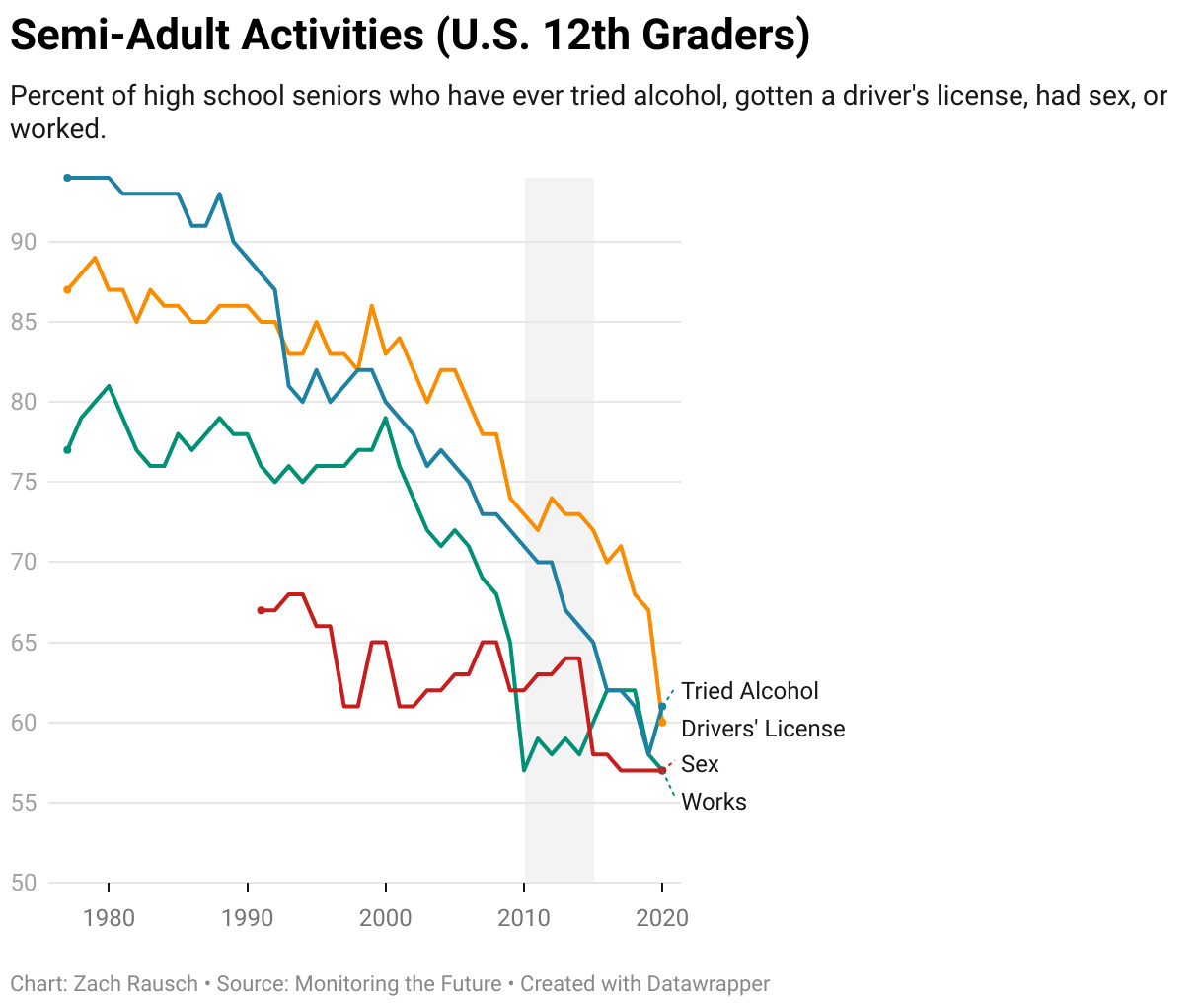
As Gen Z grows up, our adulthood shows signs of developmental delays. We go on fewer dates and have less sex. We are getting our driver’s licenses later or not at all; we are living with our parents longer. We drink less and go to fewer parties than past generations. Our abstinence from risk is not a reflection of strict moral influences or time redirected to other, “safer” ways of interacting with the three-dimensional world—far from it, we are less likely than past generations to engage in hobbies, play and watch sports, or work after-school jobs. We are, quite simply, doing less than any generation before us. 
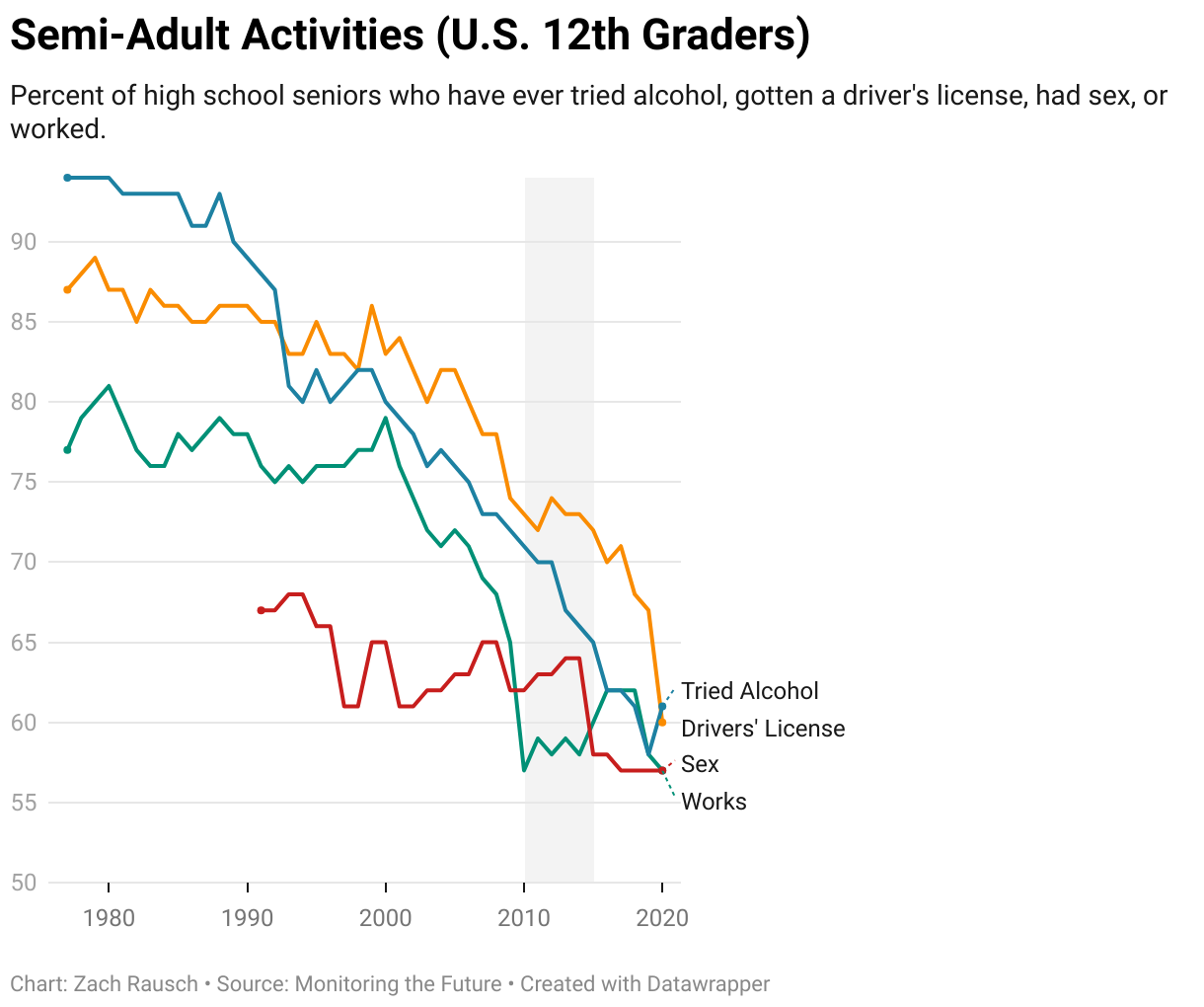
Chart: Zach RauschSource: Monitoring the Future Get the data Embed Download image

Social psychologist and author of The Anxious Generation Jonathan Haidt argues that our increasingly two-dimensional lives are the result of “the end of play-based childhood” and its replacement with “phone-based childhood.” During a recent talk in London, Haidt asked audience members of the Gen X and Baby Boomer generations to think back to their childhoods. He asked them to remember the things they did with friends, the adventures they had, and then imagine removing 70% of those encounters – remove hobbies, then risks, thrills, and adventures where you might have gotten hurt—imagine 80% of that gone, he said. Now imagine growing up with what’s left. That is the extent to which Haidt believes smartphones gutted Gen Z’s childhood and adolescence. Our lives are now smaller, hollowed out, contained within digital software. 

“The fact that risk-taking activities like drinking are going down is a broader sign that young adults and adolescents are engaging with the world far less,” says Dr. Jessie Borelli, a clinical psychologist and professor at the University of California, Irvine. “Becoming an adult involves risk. Making mistakes, including through risk-taking behaviors, is practicing being an adult.” 

Moreover, she says, “Getting together in person is effortful. You have to endure a certain amount of discomfort, whether it’s the cost of leaving the house, encountering traffic, or the time it takes to put on different clothes.” 

We are not safer; not with ourselves.

For a subset of the population who grew up on social media and spent some of their most formative developmental years taking classes and interacting with peers only online, any effort at real-life interpersonal connection carries inherent risk — embarrassment, rejection, heartbreak, abandonment. When we weigh the decision of whether to engage effortfully with the world or just stay home, it’s no wonder we gravitate toward the option that involves less risk.

What that cost-benefit analysis is missing, however, is the fact that loneliness and isolation have profound consequences for not just our emotional wellbeing, but our long-term physical and cognitive health. “Social isolation and loneliness increase a person’s risk of heart disease, obesity, diabetes, Alzheimer’s, dementia, depression, anxiety, suicidality, and premature death,” says Shannon Vyvijal, the Communications and Programming Coordinator for the Foundation for Social Connection. The upside, Vyvijal says, is that “social connection is really both a remedy and a preventative measure. In addition to making us healthier, it makes our communities safer. Socially connected communities have lower rates of gun violence and drug deaths. It makes communities more prosperous and helps local GDP. It leads more people to volunteer in their communities. It helps us become more civically engaged. We begin to trust institutions and one another again.”

Gen Z knows it’s lonely. “Loneliness is a discrepancy between how connected we are, and how connected we want to be,” Vyvijal says. “If, like many members of Gen Z report, you are someone who wants to date and hasn’t yet, or you are on dating apps and not satisfied with the level of connection they provide, that discrepancy is contributing to loneliness.” The disconnect between having and wanting connection often sets in motion a self-fulfilling prophecy, with the stigma of social undesirability increasing a person’s tendency to retreat from others. “The lonely brain continues to self-isolate,” she explains. 

They—we—are not content to live in a purgatory of risk-averse, adventureless post-post-adolescence.

Even as hyper-individualism in work and school swells and spills over into life after-hours, Gen Z is begging for community. We are begging for risk. Signs of our accelerating desperation occupy every corner of the Zoomer internet. In the r/GenZ subreddit, an 18-year old appeals to their peers for advice on how to make friends; a 21-year-old college student laments her campus’s lack of community; a 19-year-old worries she’s a “loser” for having never gotten drunk or gone to a party.  On Facebook, young adults post friendship applications. A Gen Z woman complains of the death of clubbing in a TikTok video that amassed over 3.5 million views. A viral dating deep-dive from The Cut shows young women crying on camera while describing their longing for partnership. 

Not far behind, tech companies roll out solutions for Gen Z to cure our loneliness without looking up from our phones. Tinder backs a new “dating app for friends.” On Bumble BFF, users swipe right on pictures of prospective friends. Still lonely? Try downloading Replika, “THE chatbot for anyone who wants a friend with no judgment, drama, or social anxiety involved.” No risk, all reward.

But Gen Z is getting older, in spite of its delayed adulthood, and making the move toward real-world community as a form of generational healing. The tide of self-isolation appears to be turning as loneliness and boredom reach a fever pitch, with a growing number of young adults taking the matter offline and into their own hands. Running clubs, singles parties, book clubs, wine nights, and self-made social events are on the rise. A new trend emphasizes the importance of third places—communal spaces like public parks, libraries, and coffee shops where people can come together and fill the time between work and home. They are taking their hobbies offline. They are volunteering more. They are urging moral awakening over self reinvention. They—we—are not content to live in a purgatory of risk-averse, adventureless post-post-adolescence.

I can’t say I wish playground injuries on kids or hangovers on college students. I do hope, however, that we will return to a margin of risk where it’s OK to fall off your bike, get your heart broken, dance badly at a party—because that’s part of the deal of living in the three-dimensional world. If we watch from a safe distance, that world will keep outgrowing us.
The Case for Transformational Education

Higher education is currently under enormous scrutiny. Part of this scrutiny results from the challenge of balancing the traditional roles of college in helping students “find a job” and “find themselves.” Eliminating the conflict between these goals, and indeed underscoring their interdependence, offers an excellent opportunity for higher education to take steps toward restoring public trust. To take full advantage of this opportunity, we must work harder to deliver the real value of a college education: a transformative learning experience.

For generations, traditional age students have enjoyed the benefits of college’s unprecedented ability to offer intellectual discovery at the inflection point of their personal development. This exceptional combination comes with a shift in learning that distinguishes college from primary and secondary school experiences dominated by extrinsic motivation like deadlines, teacher approval, and grades. Higher education, when done well, sets the stage for life-long learning by introducing intrinsic motivation that goes beyond knowledge and skill, shaping attitudes, behaviors, and beliefs — or “mindset.” Colleges and universities’ ability to teach students how to learn, not what to learn, is fundamental to the personal and professional success of graduates, often including, ironically, higher education’s harshest critics. 

Experiences in college can lead not only to professional success, but to a greater sense of wellbeing long after graduation. Current evidence based on measures of life-long wellbeing developed at Gallup indicates that having emotionally supportive mentors, particularly faculty, correlates strongly with life-long wellbeing. Gallup alumni surveys additionally show that initiatives that increase students’ sense of agency, through experiential learning opportunities such as projects or internships, also correlate with wellbeing long after the college years. One particular program, Purposeful Work at Bates College, produced profound evidence that a sense of wellbeing is substantially enhanced in students who find career opportunities closely related to areas of study that develop a sense of purpose and meaning.

Higher education, when done well, sets the stage for life-long learning by introducing intrinsic motivation that goes beyond knowledge and skill, shaping attitudes, behaviors, and beliefs.

The challenge facing higher education is how to achieve a broader recognition of the need to strengthen students’ transition from extrinsic to intrinsic learning and encourage experiences like hands-on learning and mentorships correlated with wellbeing at a time when vocationalism and return on investment dominate the public narrative.  Barriers such as check-box general education curricula and faculty reward systems that disincentivize truly student-centered, innovative teaching exacerbate the problem as does the underlying issue of the cost of a college degree.  

Restoring the public’s esteem for higher education by promoting lifelong wellbeing and refocusing the conversation on the student experience make up the central mission of The Coalition for Transformational Education. The Coalition is a learning community of almost 30 institutions across the country dedicated to changing the ways we teach and students learn, each pursuing distinct initiatives that offer best practices in engendering identity, belonging, agency and purpose in students based on experiences known to promote wellbeing.

The Coalition is focused on promoting this transformation across all of higher education by changing the narrative about what matters most in the student experience and encouraging faculty to experiment at the undergraduate level with evidence-based interventions to improve outcomes and wellbeing, and scaling these to all enrolled students. All of the institutions that are members of the Coalition are committed to assessing the interventions they introduce and refining them over time to continually improve their long-term impact. 

All members of the Coalition are committed to producing positive educational experiences that touch all enrolled students, not simply those that are focused only on specific populations such as the talented and gifted or the under-resourced or under-prepared. The Coalition is dedicated to making all of these interventions accessible to every enrolled student, regardless of their academic record or financial resources. The Coalition has the potential to transform higher education in ways that allow it to deliver on its full promise of career preparation and personal development, ensuring that students graduate not only with broader and deeper intellectual outcomes, but also with a greater sense of who they are and who they can become.

Our Students Have Something to Tell Us

As the academic year drew to a close in May, I waited for my fears to be actualized. After a spring of over 3000 arrests of college students—something unprecedented in my professional experience of nearly 30 years—I found myself questioning my confidence in the core commitment I made to my students. I have always expected students to change the world, to utilize the educational experience to be, what I call “comfortably uncomfortable.” Yet, I was getting increasingly uncomfortable as encampments, protests, and arrests proliferated around campuses in the United States. I worried, for the first time, that perhaps we were afraid of our students and their calls for intervention in a time of global crisis. I saw campuses closing their gates and worried we might temper our commitment to the rigorous exchange of ideas that so fundamentally defines higher education and the joys found in this setting. 

And then I listened. Over the course of a week, I attended nearly a dozen graduation ceremonies involving countless student voices. I have gone to senior balls and hugged tearful students who, only a few weeks earlier, presented me with lists of demands. Time and again, I am reminded that our adolescents are experts in their lived experience. We fail that expertise when we presume the wisdom we gained as adolescents decades ago somehow supplants the wisdom of today’s lived experience. We need to listen and then apply our wisdom as leaders and educators. As I reflect on that remarkable spring, I am reminded of a few key factors influencing our future work together: 

Teenagers don’t “get over” a pandemic. The impact of the isolation resulting from the pandemic interrupted an important stage of adolescent development among teenagers. It has left an undeniable impact upon today’s youth and it will influence our understanding of early, mid, and late adolescence for years to come. This should not be a surprise to educators. Assessments of adolescent health and well-being clearly established a prevalence of stress, anxiety and depression that preceded the pandemic. Isolation caused by the pandemic increased loneliness and adversely impacted interpersonal skill development. For a community whose high school and early college experience was defined as “Wake up, open Zoom, close Zoom, sleep. Repeat,” learning how to meaningfully connect with others is anything but inherent. The Healthy Minds report of 2022-23 noted 42% of respondents missed companionship and nearly 70% of respondents reported feeling isolated often or some of the time. It is now normative, not exceptional, for our emerging adults to be lonely, want true friendships (not the social media kind), and are urgently seeking a sense of community. The resilience I may have learned in my college experiences in the 80s, is not the same resilience our students learned during periods of mass shootings, isolation, and the desire to be compassionate actors in a complex world. Our students are trying very hard to change the world on a stopwatch, understandable given the disruption of time, space and developmental growth caused by the pandemic.

I have gone to senior balls and hugged tearful students who, only a few weeks earlier, presented me with lists of demands.

Listen to what our students are telling us. They care. And they are learning how to show it to an older (yes, that’s us) generation that doesn’t seem to be listening. Countless encampments, arrests, and fear of a global crisis enfolded this past academic year on the heels of years of mass shootings and uncertainty. There is no better time than now for higher education to invest in our youth and engage in developing skills associated with care for others, curiosity, and, yes, conflict. Let’s remember everything we learned in high school through interpersonal interactions. Our hearts were broken and restored, we had best friends and best best friends (they might have changed often based on how the day went), and there was a “cool kids” table in the cafeteria. We learned, through interpersonal engagement, empathy by being in the 3D presence of emotion expressed without a mask on. 

In their graduation remarks at my institution, students repeatedly appealed to each other for community, dialogue, and compassion; not revolution. One of my favorite graduation speakers remarked on this theme by sharing, “We are united by…this innate desire to be interconnected and care for one another everywhere we go.” They are just learning how to do that in a world where Chicken Little, to them, is starting to look like a soothsayer. These students share our compassion but they haven’t learned as well how to express and moderate that compassion and care for others. They may protest sometimes, they may express frustration when they see horror: they are retroactively learning how to express those feelings in real time, in 3D. Our colleges and universities are well prepared to provide some calm and purpose. 

There is no better time than now for higher education to invest in our youth and engage in developing skills associated with care for others, curiosity, and, yes, conflict.

I am confident our institutions can continue to do what they know is best: educate and inspire global scholars who will transform our world. The expression and curiosity of those scholars serve as a litmus test for the success of today’s adolescence following the interruption of the pandemic. Higher education must pursue our mission in a manner that is responsive to the curiosity, compassion and isolation our students carry within them. The actions of our younger scholars are impacted by these realities and require responsive and continued commitment to their post-graduate success in a world that is complex—and eager—for their impact. Let’s listen, please, and then do what we do best.


Eleanor J.B. Daugherty, PhD, MEd, is the Vice President of Student Affairs at Georgetown University. Daugherty previously served as Associate Vice President for Student Affairs and Dean of Students at the University of Connecticut (UConn). 

Seeing the Unseen

In the landscape of higher education, student fathers face a particularly stark lack of recognition and support. A new report by Generation Hope,”EmpowerED Dads: Amplifying Voices, Advancing Higher Education for Student Fathers,” sheds crucial light on the unique challenges and needs of these individuals. As we strive for a more inclusive and equitable educational environment, it is imperative that we amplify the voices of student fathers and advocate for policies that support their success.

Student fathers often juggle multiple roles, balancing their studies with the demands of caregiving and employment. This multifaceted responsibility is compounded by societal stereotypes that frequently cast fathers, particularly fathers of color, as absent or uninvolved in their children’s lives. The report highlights that Black and Latino student fathers, in particular, face significant obstacles, including higher rates of basic needs insecurity and lower utilization of support services​.

Despite these challenges, student fathers demonstrate remarkable resilience and dedication. They are not merely pursuing degrees but striving to provide better futures for their families. However, their efforts are often overshadowed by a lack of visibility and recognition within the academic sphere. This invisibility can profoundly impact their self-esteem and academic performance, perpetuating a cycle of underachievement and disengagement.

The Need for Tailored Support

To address these issues, tailored support systems that acknowledge and address the specific needs of student fathers must be developed and implemented. Policies and institutional practices must evolve to provide flexible scheduling, accessible childcare, and financial assistance for this demographic. Additionally, mental health services should be made readily available to help student fathers manage the stress and anxiety that come with balancing their multiple roles.

As we strive for a more inclusive and equitable educational environment, it is imperative that we amplify the voices of student fathers and advocate for policies that support their success.

Furthermore, creating a campus culture that celebrates the contributions of student fathers can go a long way in fostering their sense of belonging and purpose. Universities should promote awareness campaigns and support groups that provide a platform for student fathers to share their experiences and build a supportive community.

Policy Reforms and Institutional Changes

Policy reforms are crucial in driving systemic change. Legislators and educational institutions must work together to ensure that student fathers are included in discussions about higher education support strategies. Financial aid policies should consider the unique financial pressures faced by student parents, and academic policies should offer greater flexibility to accommodate their schedules.

Generation Hope’s report underscores the importance of including student fathers in the broader conversation about diversity, equity, and inclusion in higher education. By advocating for policies that recognize and value the experiences of student fathers, we can create a more equitable and supportive educational environment for all students.

A Call to Action

The journey of a student father is marked by resilience and a deep commitment to their families and education. It is time for us to recognize and support their efforts. By amplifying their voices and addressing their unique needs, we can help student fathers achieve their academic goals and secure better futures for themselves and their children.


Brittani Williams is the Director of Policy, Advocacy and Research at Generation Hope.

Generation Hope engages education and policy partners to drive systemic change and provides direct support to teen parents in college as well as their children through holistic, two-generation programming.

Building Support for Student Parents

One out of every five college students is a parent. As with most students, student parents are balancing many and often competing demands on their time, including classes, studying, and work. Unlike their peers without kids, student parents also have to manage the complex scheduling puzzle of childcare responsibilities on top of everything else they handle each day.   

Parenting students are trying to succeed, while receiving limited support from higher education and financial aid systems that were not designed with them in mind. It is long past time for policymakers to recognize the need for targeted support to help this group flourish. Decision makers must pay more attention to parenting students with inclusive and specialized efforts. It will take better data collection, holistic wraparound services, and building trust through consistent action over time. 

This is especially important as colleges face enrollment challenges created by changing demographics. By supporting parenting students, and adopting student-centered policies, colleges and universities can become environments where student parents feel welcomed and supported to succeed—a win for student parents and for colleges trying to alleviate the enrollment crunch. 

Supporting parenting students is more than just a matter of fairness. It is also an issue of economic development and mobility. After all, when we ensure student parents succeed, we ensure their families succeed. As policy leaders are considering supports to retain historically undersupported students, student parents should be at the top of the list. Juggling the responsibilities of parenthood and being a college student is hard enough, the way in which our systems and policies are structured shouldn’t make it even harder.

Several states, including Texas, California, Illinois, and Oregon, recognized the need and enacted legislation to support parenting students in higher education. These state-level policies aim to dismantle barriers by mandating data collection, support services and accommodations on college campuses. And, while progress has been made, more needs to be done in acknowledging and addressing the unique challenges faced by parenting students.

Why support parenting students?

The landscape of higher education is rapidly evolving, and institutions must adapt to the needs of the increasingly diverse student body encapsulated by the incredibly diverse student parent population. Student parents are more likely than non-parent students to be people of color, women, and veterans, all groups that are entering higher education at increasing rates but often face barriers to success.

Research from the Institute for Women’s Policy Research and Ascend at the Aspen Institute shows that parenting students face significant challenges in completing college compared to their peers without children. Only 37 percent of parenting students graduate with a certificate or degree within six years of enrollment, in contrast to nearly 60 percent of students without children. 

Parenting students encounter obstacles related to childcare, basic needs insecurity, time constraints, financial insecurity, and mental health, which can disrupt their path from enrollment to graduation day. We know that one of the fastest paths to economic security for a family is for a parent to gain a degree or other credential. Given these statistics, supporting student parents is not just the right thing to do—it also makes economic sense by creating opportunities to increase household incomes, reducing reliance on public benefit programs and ensuring a well-educated workforce to help drive economic growth and development. 

Supporting parenting students is good for colleges and states

Targeted support for parenting students can also help states meet their postsecondary  attainment goals. States need to increase the proportion of individuals with postsecondary credentials, such as degrees or certificates to help provide the skilled workforce that drives economic growth. State and federal governments should invest in students because that investment confers important community and societal benefits as well as individual benefits.

Without addressing the barriers faced by parenting students, states risk leaving behind a substantial portion of their population and falling short of their attainment targets. By creating a more inclusive and supportive environment, colleges and universities can attract and retain a diverse pool of students, thereby mitigating persistence barriers.

Mitigating persistence barriers for parenting students starts with better data collection at the state and federal levels. Evidence suggests that targeted support can enhance the success rates of parenting students. However, the lack of comprehensive data on this group creates a significant gap in colleges’ ability to address their needs effectively. The absence of data is a missed opportunity for the federal government, states, and institutions to improve student outcomes and underscores the need for greater attention to the unique challenges faced by students with children.

Parenting students encounter obstacles related to childcare, basic needs insecurity, time constraints, financial insecurity, and mental health, which can disrupt their path from enrollment to graduation day.

Targeted support needs for parenting students are equally important for mitigating persistence barriers. In our work at Generation Hope, we have seen targeted and direct services and supports make a massive difference in the success of students. This is why federal policymakers should integrate wraparound support services, such as counseling, mentoring, and access to resources like housing assistance and healthcare, to address the holistic needs of parenting students to help them increase degree attainment. 

Moreover, recognizing parenting students’ diverse backgrounds and experiences is crucial in designing effective support programs. Federal and state policy leaders should employ culturally responsive and trauma-informed approaches that consider the unique needs and challenges faced by parenting students, creating inclusive and supportive learning environments where all individuals feel valued and empowered to succeed.

If policy leaders and influencers do more to provide support for groups with the most complex needs, they can also make life easier for all students who face similar challenges like managing conflicting work and school schedules and struggling to provide for their basic needs. When we smooth the path to college completion for student parents, we make it just a little bit easier for other historically under-supported populations to get from enrollment to graduation day.

Brittani Williams, Director of Policy, Advocacy and Research at Generation Hope.

Generation Hope engages education and policy partners to drive systemic change and provides direct support to teen parents in college as well as their children through holistic, two-generation programming.

Edward Conroy, Senior Policy Advisor, New America Higher Education Policy Program. 

New America’s Higher Education team focuses on creating a higher education system that is accessible, affordable, equitable, and accountable for helping students lead fulfilling and economically secure lives. New America’s Student Parent Initiative conducts research, policy analysis, and advocacy work in the student parent space.

Adopting Education For Life as a Guiding Principle for Health Professional Education

The COVID-19 pandemic catalyzed seismic transformation in education, particularly for Health Professional Education (HPE). Following a decade of imaginative innovations, the pandemic disrupted education systems everywhere, accelerated adoption of online technologies, forced major institutional rearrangements to accommodate hybrid instructional models, and laid bare pre-existing inequalities in access to educational resources within and among countries.

In the report “Challenges and Opportunities for Health Professional Education in the Post-Pandemic Era”, recently published by The Lancet, my co-authors and I evaluated how transformative developments have emerged, including in competency-based education, interprofessional education, and especially the large-scale application of information technology to education.

By tracking institutional and instructional reforms, we pose two crucial questions: What has happened to Health Professional Education over the past decade, and how has the Covid-19 pandemic altered the education process?

While the pandemic did not initiate such transformations, it greatly accelerated them, and they are likely to have a long-term impact on HPE. These educational developments converge with broader societal shifts exposed and fostered by the pandemic. 

The challenge is not merely to adapt to a new normal, but to proactively build a better normal. The first step in this endeavor is to develop novel ways of conceptualizing the models that could shape Health Professionals Education in the post-pandemic era.

Two main forces are driving this transformation. First, advances in educational technologies rooted in cognitive sciences are revolutionizing how we teach and learn. Second, the rapid evolution of health systems, marked by technological and organizational complexities, demands a more dynamic approach to education. The traditional notion of completing education before entering the workforce is no longer viable, as new jobs emerge and existing ones evolve faster than educational programs can keep pace.

This means that initial instruction is not sufficient to assure successful performance, either in terms of professional proficiency or of personal well-being. At the same time, new educational technologies make it possible to extend competency development beyond the traditional confines of formal full-time instruction, thus blurring the borders between the previously separate life stages of learning and work. 

Taken together, the two drivers of change demand a strategic shift in higher education towards a model that could be called Education for Life, with profound implications for both instructional and institutional design.

Based on our assessment, we offer three core recommendations, the first of which highlights the importance of adopting Education for Life as a guiding principle for health professional education. The concept of Education for Life encompasses three dimensions—learning throughout life, learning to promote and restore healthy lives, and learning to live one’s own life.

The challenge is not merely to adapt to a new normal, but to proactively build a better normal.

Learning throughout life refers to education that lasts a person’s entire lifetime, rather than merely during a defined period. Traditional educational models divide the life course into separate stages for learning, work, and retirement. Closed educational systems that front-load the content and cost of education before learners enter the labor market should be complemented and eventually superseded by open systems designed to meet the evolving needs for new competencies along the entire career trajectories of health professionals.

Learning to promote and restore healthy lives is at the heart of the substantive content of HPE, which centers on developing the competencies to preserve and improve the lives and well-being of individuals, families, and communities. In other words, this is education to help the lives of others through the technical expertise and service ethic of health professionals.

The final dimension, learning to live one’s own life, highlights that part of the educational experience should enable learners to preserve their sense of purpose and mental well-being. This involves learning to balance work life and family life. It also means learning to cope with stress and adversity. Preventing burnout, however, is not only a matter of developing these individual capabilities but also of learning how to transform the organization of work in ways that promote the well-being of all team members, while promoting equity among the different categories of the health workforce.  In the face of increasing workloads, adequate staffing is essential for freeing up time to manage the stress and pressures that compromise wellbeing. 

If institutions providing HPE are to effectively implement the three dimensions of Education for Life, they must face the challenges and leverage the opportunities presented by technological innovations and health system disruptions, which were already present before the pandemic but have since become even more crucial drivers of change.

Health Professional Education will continue to be challenged to respond to societal concerns over health equity and to strengthen a new professionalism that incorporates concern for the individual and the community. Meeting these challenges while nurturing the core values of the healing professions should remain a vital goal for health educators.

Julio Frenk is a global public health expert and president of the University of Miami.

Reading Between the Lines

The average age of a college president today is sixty. That makes them too young to have participated in the major social movements of the 1960s and not too old to be keenly aware of the emotional and mental health problems reported by young people today. These leaders are now navigating the minefield of issues laid bare by student protests over the war in Gaza, including the internal and external political pressures that have pushed them into defensive positions. As they contend with conflict in the most public of ways, they should make a connection amid the chaos to something most have long advocated for: the wellbeing and personal development of their students as they stand in solidarity around an issue for which they care deeply.  

Every protest movement has a wide range of viewpoints, and this does not excuse any of the bad actors or extreme views on any side of this issue. But for someone who has reported on college student mental health and wellbeing throughout the “college mental health crisis,” I cannot help but link the most active campus protests we’ve seen in years with some of the elements of emotional wellbeing we hope our young people will experience – agency, empathy, belonging and sense of purpose. The absence of these elements has created the loneliness and isolation that Surgeon General Vivek Murthy included in his young adult mental health advisory of 2021 and his book Together, wherein he discusses America’s loneliness epidemic and the healing power of human connection. 

For over a decade, college students have reported a significant increase in anxiety and depression, along with high rates of loneliness, plateauing during the pandemic and remaining prevalent today. Gen Z students, who have been dubbed “The Anxious Generation,” are also feared to lack independence, to be overly tethered to their parents, and to be unable to advocate for themselves. College administrators have addressed this problem in myriad ways, from increasing mental health support resources to experimenting with co-curricular programs designed to help students build resilience and a sense of belonging. First-year programs now frequently include reflection about purpose and meaning as a way to center anxious students and give them the grace of seeing themselves in the bigger picture. Affinity groups, often organized by the school, help socially wary young adults find their people. 

The students united in protest, some in traditionally opposing camps, are their own curated affinity group.

There is a connection here between students’ fervent reaction to the war in Gaza and their social and emotional health that is understandably buried in the severity of the issue and the thorny consequences of the protests. Participation in protests can improve students’ sense of belonging and identity, leading to positive mental health outcomes. “In higher education, we want students to feel like they belong to a community. Participating in activism, such as protests, allows students to be in a community with other people who share their same values and can provide them with meaningful connections to others,” wrote Dr. Samantha Smith in an op-ed for LearningWell.  

The literature is particularly robust on the connection between purpose and wellbeing. Research indicates that having a purpose in life is significantly associated with lower levels of depression and anxiety and may increase resilience after exposure to negative events. To the extent that their method of protest aligns with their good intent, we should recognize that the majority of these students are standing up for the humanity of others — and that is a good thing for a generation accused of obsessing about their images on social media. 

The more the movement grows, the more valid these arguments become. Given the momentum, administrators can no longer view this as the predictable behavior of certain student groups. There is something bigger going on. Perhaps most promising is that the movement is entirely student-driven. The students united in protest, some in traditionally opposing camps, are their own curated affinity group. Their passion is evidence that the teenagers who finished high school in their bedrooms and on their screens have learned to find their outside voices. Let this be a positive element in an otherwise complex and difficult leadership challenge.

Wellbeing Curriculum: A Student’s Perspective

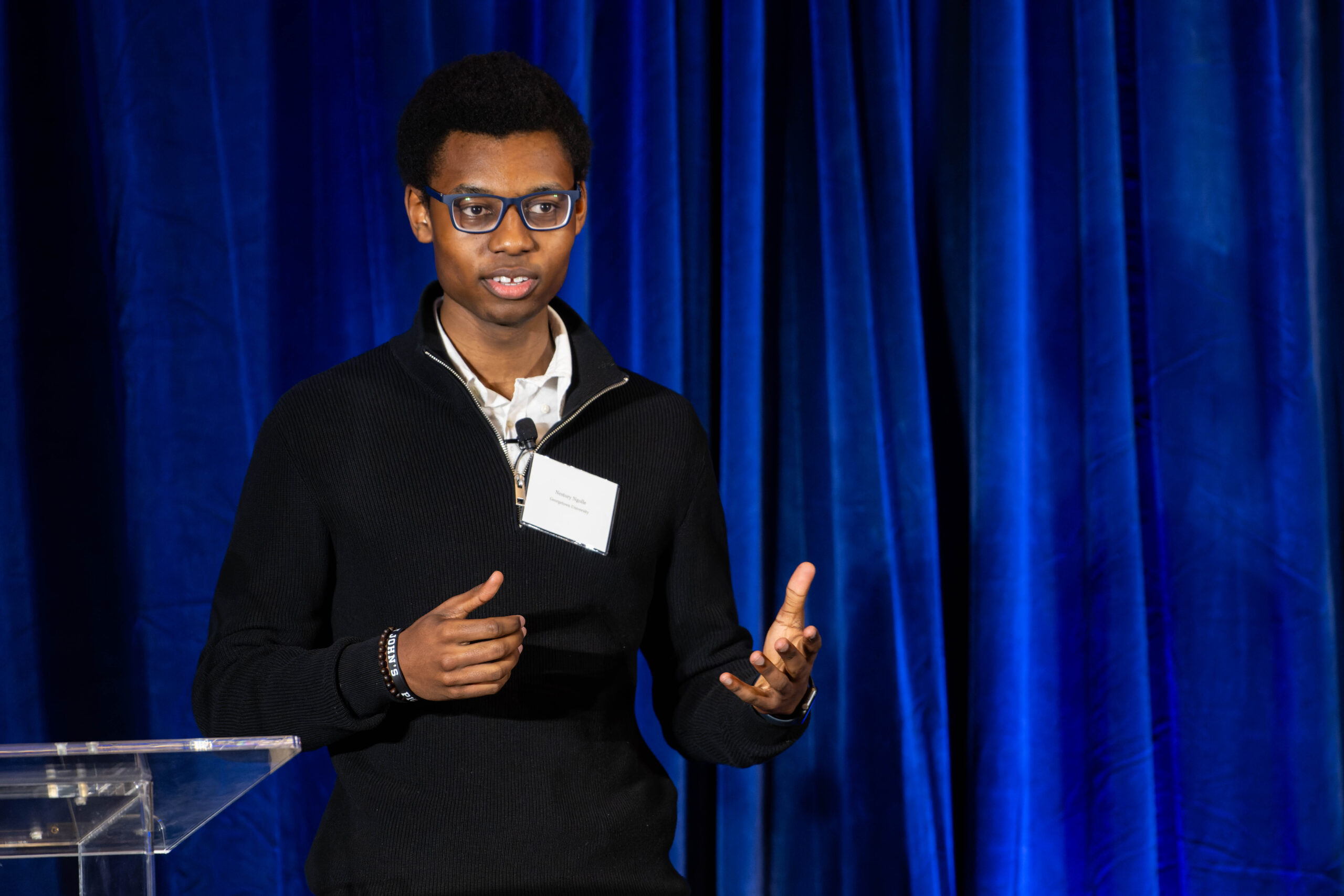
Nestory Ngolle is a sophomore at Georgetown University, a biology and global health major, an EMT, and a member of the Engelhard Project Student Advisory Council. The Engelhard Project for Connecting Life and Learning is Georgetown’s curricular approach to integrating whole-student learning and wellbeing into academic contexts — and, as Ngolle sees it, creating an environment where students can connect what they learn about the world to what they learn about themselves. 

Bringing health and wellbeing into the classroom increases engagement, encourages collaboration and self-reflection, and cultivates a sense of purpose that helps students flourish across all facets of college life, he says. In late March, Ngolle joined Joselyn Schultz Lewis, Director of Inclusive Pedagogy at Georgetown’s Center for New Designs in Learning and Scholarship, for a presentation on Engelhard’s innovative, student-informed pedagogy at the Coalition for Transformational Education’s national conference in Washington, D.C. LearningWell caught up with Ngolle to see what his experience can teach leaders and learners in higher education.

In his first semester at Georgetown, Ngolle took a foundational biology class that happened to be an Engelhard course. “Rather than memorizing information and applying it to problems, we were applying what we learned to ourselves and our experiences. It helped students feel connected to what they learned and reflect on their own lives in relation to the academic material.” The following semester, Ngolle enrolled in a medical anthropology class, another Engelhard course. “From there, I think I sort of fell in love with the Engelhard mission,” he said. “You can see the positive impact in the classroom, in student participation, and in how students approach the work.” 

Bringing health and wellbeing into the classroom increases engagement, encourages collaboration and self-reflection, and cultivates a sense of purpose.

While we tend to look to college counseling centers, peer advising, or support groups as the first frontiers of student mental health, Ngolle emphasizes the transformative potential of acknowledging and promoting wellbeing within the content and culture of academic life. In the classroom, that means inclusive pedagogy and exploring the relationship between student wellbeing and engaged learning. Engelhard’s course model invites faculty to redesign existing courses by identifying an area of wellbeing that is relevant to the curriculum. Engelhard courses exist across academic disciplines, so students of philosophy, mathematics, business, or medicine have opportunities to enroll in courses that incorporate topics such as substance use, depression and anxiety, sleep, social media use, or sexual assault into their curricula. 

Crucial to this integration is getting students to understand that good grades, even superlative grades, are not at odds with wellness. Rather, Ngolle says, academic success and wellbeing can coexist and complement one another. For students like Ngolle on the pre-medical track, academic rigor and ambition have a reputation of souring into severe stress or competitive, unsupportive peer relationships. Professors can be active in dismantling this process before it begins, Ngolle says, by creating a sense of community and belonging among classmates. “Those are the people we are going to walk across the stage with in four years,” Ngolle said of classmates, who often see each other as opponents rather than as peers. A spirit of unconditional individualism, he argues, can get in the way of finding community and belonging, an essential ingredient for good mental health in college. 

The end goal, as Ngolle sees it, is to arrive at a point where “all classes are centered around students and strive to cultivate a sense of health and wellness in the classroom.”

Ngolle believes that healthy behaviors, improved memory and information retention, positive peer networks, and the confidence to talk to professors or speak up in class all reinforce one another. He hopes to dismantle the narrative that students, in order to achieve a good GPA or ace their exams, must compromise their sleep, suffer under stressful conditions, and work themselves to the point of burnout. The Engelhard Project has taught Ngolle that wellbeing and care can extend into every aspect of a person’s college existence, including academic life. He now amplifies his peers’ voices as a Student Advisory Council member for the Engelhard Project, and he hopes to see the program’s reach grow. The end goal, as he sees it, is to make every course an Engelhard course, eliminating the need by arriving at a point where “all classes are centered around students and strive to cultivate a sense of health and wellness in the classroom.”

Ngolle’s experience as a student in classes that prioritize wellbeing has affirmed and shaped his ambition to pursue medicine. “Healthcare is more than just prescribing medication to a patient. It can mean connecting with patients on an individual level, being there to just sit and talk with them. These courses have led me to see patients as people: the goal is not to treat a disease; the goal is to treat a patient.” 

For Ngolle, the pre-med student experience has expanded his definition of what it means to be well, both for himself and for all medical patients receiving care. His professors have “challenged student perspectives of what it means to be healthy and well. That means that going to the doctor or talking to a psychiatrist are not the only settings where we can talk about our health and wellbeing. In the classroom, we can achieve wellness — not just through grades, but through the knowledge we acquire.” Students connect more meaningfully to course material when they are able to see its relevance to daily college life, Ngolle says. That connection not only leads to better academic outcomes, but to better lives.

Identity, Work, and Purpose

Clayton Spencer served as the President of Bates College from 2012 to 2023. A lawyer by training, Clayton was the vice president for policy at Harvard for seven years, and she has also served as chief education counsel to the U.S. Senate Committee on Labor and Human Resources.

“Purpose in Work and Life” by Clayton Spencer first appeared in Virtues and Vocations: Spring 2024.

Thinking About Work

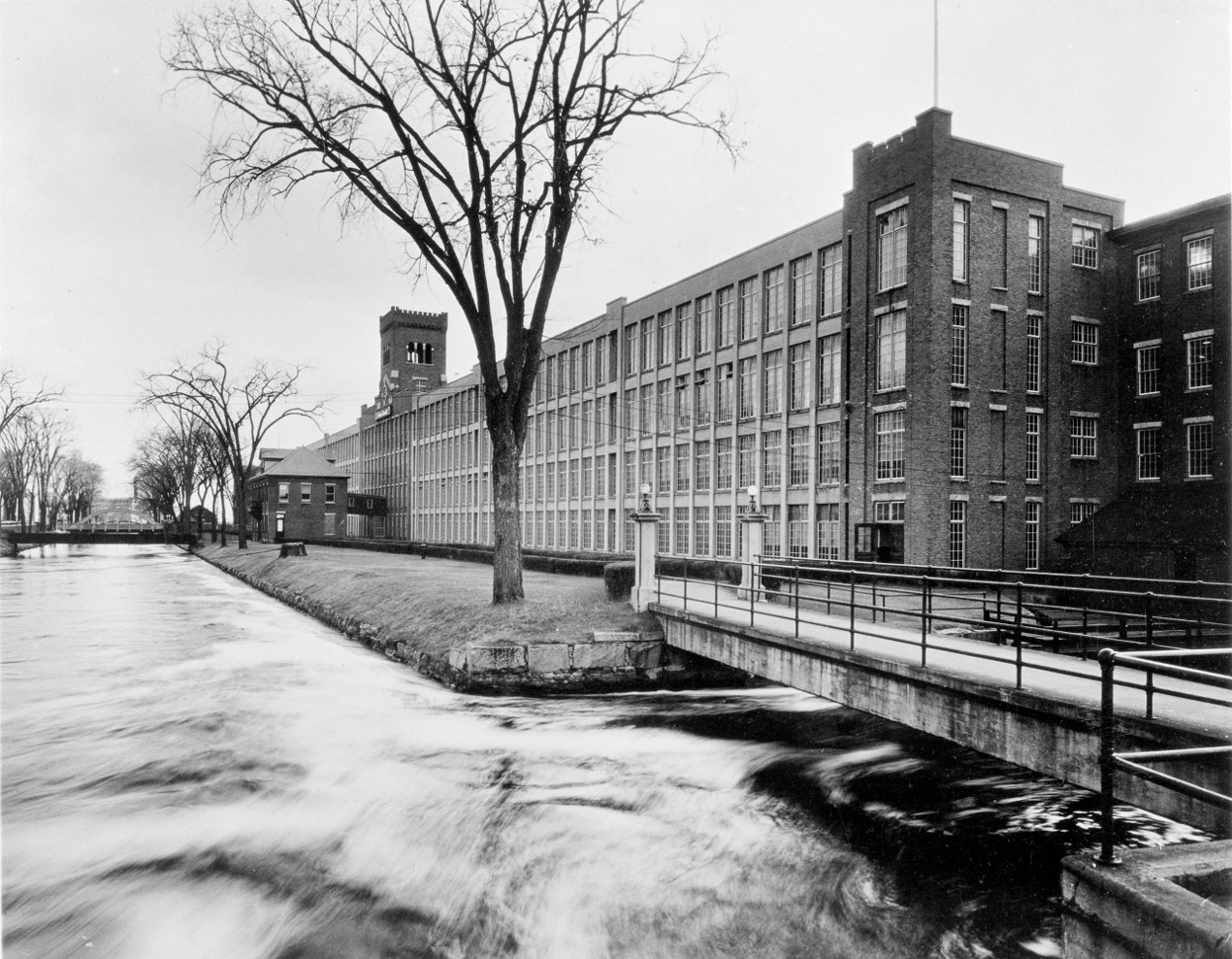
When I arrived in Lewiston, Maine in the summer of 2012 to become the eighth president of Bates College, I was captivated by its grand landscape of manufacturing. Enormous mill buildings, most now quiet, line the city’s river and canals, their perfect rectangular forms, huge courses of impeccable brickwork, and row upon row of tall, symmetrical windows embodying the very essence of the industry they made possible. The number and sheer scale of these buildings speak to the might of Lewiston and its sister city Auburn as a textile and shoe manufacturing hub well into the twentieth century. The beauty and precision with which these structures were crafted reflect “industry” in a different sense—namely, the diligence and skill of the human beings who built the mills and ultimately worked within their walls.

It didn’t take long for me to realize that I had landed myself in a world whose deep logic involved “work.” Work as a beacon of hope for generations of French-speaking Canadians who saw in the mills of Maine the promise of a paycheck and a means to build new lives. Work as a source of vibrancy and community in a new country. Work in its most concrete form—making things.

Yet, I was charged with the seemingly cerebral task of leading an excellent undergraduate college devoted to the liberal arts and justly proud of its strong academic culture. How, then, was I to think about the work of the liberal arts in this particular setting? To be sure, a liberal arts education is not primarily about making things, but might it, in fact, involve making?

I found a compelling starting point in the words of Peter Gomes—Harvard professor, theologian, long-time minister of the university’s Memorial Church, and, as it happens, a Bates graduate. He died in 2011, after forty years spent sharing his wisdom with successive generations of Harvard undergraduates. About the aims of a Harvard education, he famously said: “We put the making of a better person ahead of the making of a brighter person, or a better mousetrap.”1 According to Gomes, we do this by helping students figure out what kind of life they wish to lead: “What is my purpose? How can my life be better? How can I help to make a better world? These are the questions worth asking, and college is one of the few places that allows you, even requires you, to do so.”2

The Logic of Purposeful Work

If motivating and equipping our students to live lives of meaning and contribution is a core purpose of the liberal arts, then work is central to the project. Whatever a person’s particular interests, choices, or constraints, most people wish to figure out a way to stay healthy and happy, to nourish human connection, and to leave the world—or at least their corner of it—better than they found it. For many people, this means, among other things, finding work that contributes to an overall sense of fulfillment, while also furnishing the practical and financial means to sustain a life.

The most important dimension of the Purposeful Work approach is the sense of agency and confidence it fosters in students.

Which is why preparing students for work and career should not be—as it has been for far too long at many excellent colleges and universities—an afterthought relegated to the waning months of senior year. (Remember the binders of banking jobs?) Nor can it be addressed by tactics alone—online hiring platforms, access to alumni networks, job shadows, internships, or industry info sessions. These practical tools are important, but only as part of a framework that locates questions about work where they belong—at the center, not on the outskirts, of the project of the liberal arts.

Purposeful work, as we came to think about it at Bates, is not a kind of work. It is not found “out there” inherent in a particular type of job or career. It can be paid or unpaid, within a family or for an outside organization, part-time or full-time, manual or intellectual, artistic or managerial. It is not “do-gooder” work, though for some individuals it might be. Rather, purposeful work is about aligning who you are with what you do and how you choose to move through the world.

Because life is a journey and we evolve over time, even as the world and ourworlds also evolve, the answers to the question of how we wish to live our lives change over the lifespan. But the essence of the exercise—learning to navigate the dynamic relationship between “self” and “world”—remains the core pursuit.

In a liberal arts setting, we give our students a great deal of choice about which courses they will take, what they will major in, and how they will populate their college experience outside the classroom. We also do our best to give them the tools to approach their choices with self-awareness, diligence, and discernment so that they can carve out a path, in college, first, and ultimately in life, that will be authentically their own.

The concept and methodology of the Purposeful Work program are built on these core principles. It is not, for instance, about exhorting students to “find their passion.” Just as purpose is not found “out there” inherent in certain types of work and not in others, it also does not typically reside within a person as a pre-existing passion waiting to be liberated. Unless, perhaps, you are Albert Einstein, or Toni Morrison, or Yo-Yo Ma.

For most ordinary mortals, purpose tends to emerge in the “doing.” This is how Richard Courtemanche, a handsewer in one of the shoe factories of Lewiston, described his purposeful work.

An average handsew[er], back in those days, in the ’60s, would probably do about twenty pairs a day. A good handsewer would do around thirty pairs a day, as he was considered to be fast.

A real fast guy, we’re talking, you know . . . thirty-five to forty pairs. I would do around sixty pairs a day, for many years. Myself and Vern, Vernon Daigle, locally, were probably the fastest handsewers. That was unheard of, what we could do. We did it because it was, it came natural, what other people would do, unnatural. So he was a good man. I learned from him, because he used to handsew quite a few years before me. I used to watch, and I’d say, I can do the same thing. And then from there I picked up the tricks that my dad used to show me, then I picked up some others, then after that, I loved it.3

Richard Courtemanche did not start with a passion for shoemaking that he unleashed on the world. Rather he waded in, he paid attention, he learned the skills, and then along the way he discovered that he was really good at stitching shoes. Only “after that,” did he come to love his work. In other words, the passion did not precede the engagement with work, it was the other way around.

Learning a set of skills or a base of knowledge is a fundamental aspect of identity formation, of becoming fully human. I can sew shoes. This is what I do. This is who I am. I am proud of it. “Myself and Vern . . . . That was unheard of, what we could do.”

For our students, most of whom have a luxury of choice that Richard Courtemanche could only dream of, purpose emerges (or not) as you try different things and get your hands dirty. But this only happens if exploration is paired with reflection. The Purposeful Work team at Bates works with students beginning in first-year orientation to ease them into the notion that the starting point for making life choices is understanding who you are and what matters to you. The staff use various tools and strategies to help students gain an awareness of their interests, strengths, and values—what brings them joy, what kind of things they know they are good at, where they are, or are not, confident in their abilities, what sorts of things they might like to try, and how much risk are they willing to take, to name a few examples.

Unquestionably, the most important dimension of the Purposeful Work approach is the sense of agency and confidence it fosters in students as they make their way through various cycles of exploration, reflection, and adaptation. These elements are specific and concrete, and students internalize the process. Based on what you’ve figured out about yourself, what kinds of work would you like to explore? Once in an internship or a job shadow, how was the experience for you, and do you wish to pursue it further? If it feels like the right field, but the wrong role, you refine your choice for your next opportunity. If the experience does not feel right at all, you move on, consciously rejecting pathways that do not align.

Learning a set of skills or a base of knowledge is a fundamental aspect of identity formation, of becoming fully human.

Not only is the Purposeful Work program built on the core values of the liberal arts, it also reinforces them. The emphasis on self-knowledge as the starting point, and the structured approaches used to develop it, puts students in the habit of making conscious choices about many aspects of their college experience—whether in the classes they choose, the activities they jump into, or the leadership responsibilities they take on. Students begin to think of their college experience itself as their “purposeful work” during the undergraduate years, even as they look toward how they will find it after graduation.4

This well-scaffolded approach is proving to be powerful for all students. It is particularly important, however, for students who may be the first in their families to go to college or have not had much exposure to a broad range of careers. From the beginning, Bates conceived of the Purposeful Work program as an important piece of its equity promise to all students. Bates is committed to providing broad access to the education it offers, and it has become much more intentional about supporting all students for academic success and full participation in the college experience. Purposeful Work adds another piece of the puzzle. A well-thought-out and well-executed approach to helping students bridge from college to work and career ensures that all students—not only those whose parents are able to connect them to networks of opportunity—have the skills and confidence to seek out career opportunities commensurate in scope and ambition with the education they have received.

Testing Our Assumptions

Bates developed its Purposeful Work program based on the intrinsic logic of a liberal arts education. Yet, the link between finding purpose in work and overall fulfillment resonates far beyond a particular set of colleges and universities and the students who attend them.

In the fall of 2018, Bates partnered with the Gallup organization to conduct a survey of nationally representative college graduates, of varying ages, career stages, and types of higher education experience, to examine how they think about purpose and work.5 Since the mid 20th-century, Gallup has explored global measures of well-being in terms of five interrelated elements: purpose well-being, social well-being, financial well-being, community well-being, and physical well-being. In examining the relationships among these, Gallup identified purpose (defined as liking what you do every day and learning or doing something interesting each day) as the most important element given its disproportionate impact on one’s overall well-being.

The Bates/Gallup study was designed to build on the existing research related to purpose well-being by specifically examining the extent to which college graduates seek purpose in their work. The findings were striking. Eighty percent of college graduates say that it is very important (37%) or extremely important (43%) to derive a sense of purpose from their work. Yet less than half succeed in finding purposeful work, and purposeful work was found to be particularly important to the younger workforce. Reflection and self-understanding are central to finding purpose—graduates who align their work with their interests, values, and strengths are three times more likely to experience high purpose than those with low levels of reflection. Finally, graduates with high purpose in work are almost ten times more likely to have high overall well-being. Only 6% of those who have low levels of purpose in their work have high levels of well-being, whereas fully 59% of those with high purpose in work have high well-being.

I offer this study not as the definitive word on a topic as deep and rich as “purpose.” Rather, I mean to describe the impulse we had at Bates, as we moved forward in developing the Purposeful Work program, to pressure-test our assumptions with a broader audience not necessarily steeped in the goals and methods of a liberal arts education.

Concluding Thoughts

We live in a world defined increasingly by complexity, uncertainty, and rapid change, where a college graduate can expect to have multiple distinct jobs before the age of 50. It is no longer sufficient or even plausible, therefore, to prepare our students for work or career based on the availability of a particular kind of first job, or on the notion of “career” as a stable and well-defined pathway through life. Instead, the ability to sustain work over a lifetime will increasingly depend on individual agency that combines the content knowledge, cognitive skills, and interpersonal abilities required for employment with a mindset of informed self-determination and adaptability.

Far from being irrelevant to preparing students for work and career, these are precisely the strengths that a liberal arts education brings to the table.

The Purposeful Work program at Bates reflects the efforts and contributions of many, including faculty, staff, students, parents, alumni, and outside experts. It began with an idea and generative discussions on campus, followed by the appointment of the “Purposeful Work Working Group” that crafted its report and recommendations in 2013-14, further program development led by a small design team reporting to the President, and the creation of the Center for Purposeful Work in the fall of 2018.

To find out more about the Bates Center for Purposeful Work, visit https://www.bates.edu/purposeful-work.

To learn about other efforts across higher education focused on the education of the whole person for growth and transformation, visit https://thecte.org.

Notes

  1. Gomes, Peter, Never Give Up! And Other Sermons Preached at Harvard, 2008–2010, ed. Cynthia Wight Rossano, Cambridge Memorial Church, Harvard University, 2011, p. 21.
  2. Ibid., p. 41.
  3. Richard Courtemanche, “Portraits and Voices: Shoemaking Skills of Generations,” Exhibition, Museum L-A, Lewiston, Maine (2012).
  4. Almost half of Bates faculty have formally integrated aspects of Purposeful Work into their classes, and all Bates students at this point engage with the program over the course of their college, many in multiple ways.
  5. The final report of the Bates/Gallup survey may be found in full here: bates.edu/purposeful-work.

Looking for meaning in college? Try discussing a great book.

Andrew Delbanco has argued that, as innovations go, the American university is a pretty distinctive one. Right up there with abstract impressionism and fast food.

But Delbanco, a professor of American Studies at Columbia University, worries that higher education has increasingly moved away from one of its core obligations: to help students think deeply and collectively about life’s most profound questions. 

Instead, he says, “colleges and universities — without quite saying so — have begun to think of themselves more and more as vocational training institutions.”

The fate of higher education has long captivated Delbanco, author of the 2012 book College: What It Was, Is, and Should Be. And to be fair, as he notes in College, folks have been complaining about American higher education pretty much as long as it’s been around. 

In 1776, Abigail Adams wrote to her husband that professors too often shirked their teaching duties; the state of education, she said, had never been more dire.

Still, for all the hand-wringing, colleges and universities in the US have been distinguished by their willingness to allow students to explore various interests, rather than — as in many other countries — immediately hone in on a very specific course of study. It’s an environment where folks from Condoleezza Rice to Bill Bradley have encountered people and ideas that changed their lives.

“Young people want an experience of self-discovery,” says Delbanco. “They want to figure out what they’re going to do with their lives. And it’s a betrayal of the American promise to expect young people to know exactly what they want to do, what they’re fit for, and what their life is going to look like at the age of 17 or 18.”

Delbanco has spent more than 40 years as a professor, penned books on everything from Herman Melville to the Puritans, and received the National Humanities Medal from President Obama. But he says he’s not concerned that fewer students now major in the humanities. Nor is he surprised that young people are drawn to science and technology.

What does worry him is that while a student is pursuing a degree, they “should be having an experience in college that allows for some kind of reflection, that allows for learning… Learning how to listen to other people with different points of view. Learning the difference between an argument and an opinion. Learning that debating with somebody is not the same thing as fighting with that person. And the classroom where those lessons are most likely to be learned is the humanities classroom.”

But as college sticker prices have skyrocketed, haven’t the humanities become an increasingly unaffordable luxury? No, Delbanco argues. “One of the things that employers are telling [colleges and universities] is: We want people who can actually work together with people with whom they disagree. We want people who understand that there are multiple perspectives on the world.” 

“It’s a betrayal of the American promise to expect young people to know exactly what they want to do, what they’re fit for, and what their life is going to look like at the age of 17 or 18.”

“In an increasingly diverse society, in an increasingly global economy, we don’t only want people who can code or do actuary tables. We want people who can work productively with other human beings, and who can think creatively.” 

“And as the humanities majors have been emptying out, general education becomes all the more important. Because it’s going to be the only place where students will have an experience of reading a great novel or seeing a Shakespeare play or grappling with a philosophical concept.”

Beyond that, as institutions diversify, there are more opportunities for students to splinter into identity-based groups and organizations. Foundational humanities classes provide a place to transcend those differences, a place where everyone comes together around a common text.

Over the last few years, a wave of schools have brought back core courses designed to engage with questions around meaning and purpose. In 2020, for example, Stanford instituted a requirement for first-year students: Civic, Liberal, and Global Education (COLLEGE). The program echoed a century-old compulsory course introduced at Stanford in the 1920s, amidst the backdrop of global and national upheaval (post-WWI realignments, women’s newfound right to vote, and an enormous surge in foreign-born Americans).

“An educational model that leaves no room for a core curriculum shaped by the demands of 21st-century democracies leaves students woefully ill equipped for dealing with disagreements,” Stanford’s Debra Satz and Dan Edelstein recently noted in The New York Times.

In his role as president of The Teagle Foundation, Delbanco has sought to support these sorts of efforts around the country — at Stanford, Vanderbilt, Purdue, and nearly sixty other schools. It’s worth keeping an eye on, he says, “because I think this could be the beginning of a real change.”

Melinda Zook, a history professor who leads the Cornerstone Integrated Liberal Arts program at Purdue, agrees. “This should have always been the job of the liberal arts… To me, the point of college is to challenge you.”

The Cornerstone Program requires that first-year students — who, at Purdue, often plan to major in engineering, computer science, or business — take a sequence of two courses on transformative texts. There are usually about 30 students in each class, and texts can range across time and place, from Plato to Frederick Douglass to Virginia Woolf. 

But Zook emphasizes that great texts only come alive in the hands of great teachers. So when she preps professors — who are drawn from the ranks of liberal arts faculty — she tells them to “create the class you always wanted to teach. So it gives them a lot of flexibility, and you know it’s going to fill up. It fills every time.” 

Zook notes that while technical knowledge can become outdated, certain skills never will, like learning how to think, communicate, and interact with a wide range of people. One day, she recalls, “I’m walking back to the parking garage, and I bump into one of our basketball players, who you cannot miss because he’s so tall. And he’s in transformative texts. And he says to me: ‘who would have thought Plato would have been so relevant?’”

“We in the liberal arts! We thought of that,” she tells me, laughing.

But Purdue’s program has a significant, additional upside, says Zook. It creates a space in which a faculty member gets to know a small group of students. “One of the things that we do at Cornerstone is we use it as sort of a hub, where we have eyes on the students. We know their names. We know how they’re doing. And none of their other classes do, because they’re huge.”

Zook notes that, while there was a mental health crisis among students prior to the pandemic, it has gotten much worse. And building strong relationships with faculty early on can be crucial to getting students the support they need.

In Delbanco’s view, a small class that tackles big questions around a text or piece of art “can become a safe space where you can trust the teacher to teach you like a person… The teacher is not in the room fundamentally because he or she wants to show off how much they know about a given subject. They’re not in the room on behalf of the discipline. They’re in the room on behalf of the students.”

The Teagle Foundation now seeks to envelop even younger people in this effort to read great authors and ask big questions. Their “Knowledge for Freedom” program offers grants to colleges to create on-campus, humanities-focused programs for local, low-income high school students. And there are now more than 30 such programs around the country.

Delbanco sees the program changing kids’ lives. And, he says, it’s a way of “reminding them that when you go to college, you should expect this kind of experience. You should be able to ask yourself questions about justice, about how society should be organized, about what kind of life I want to lead.”