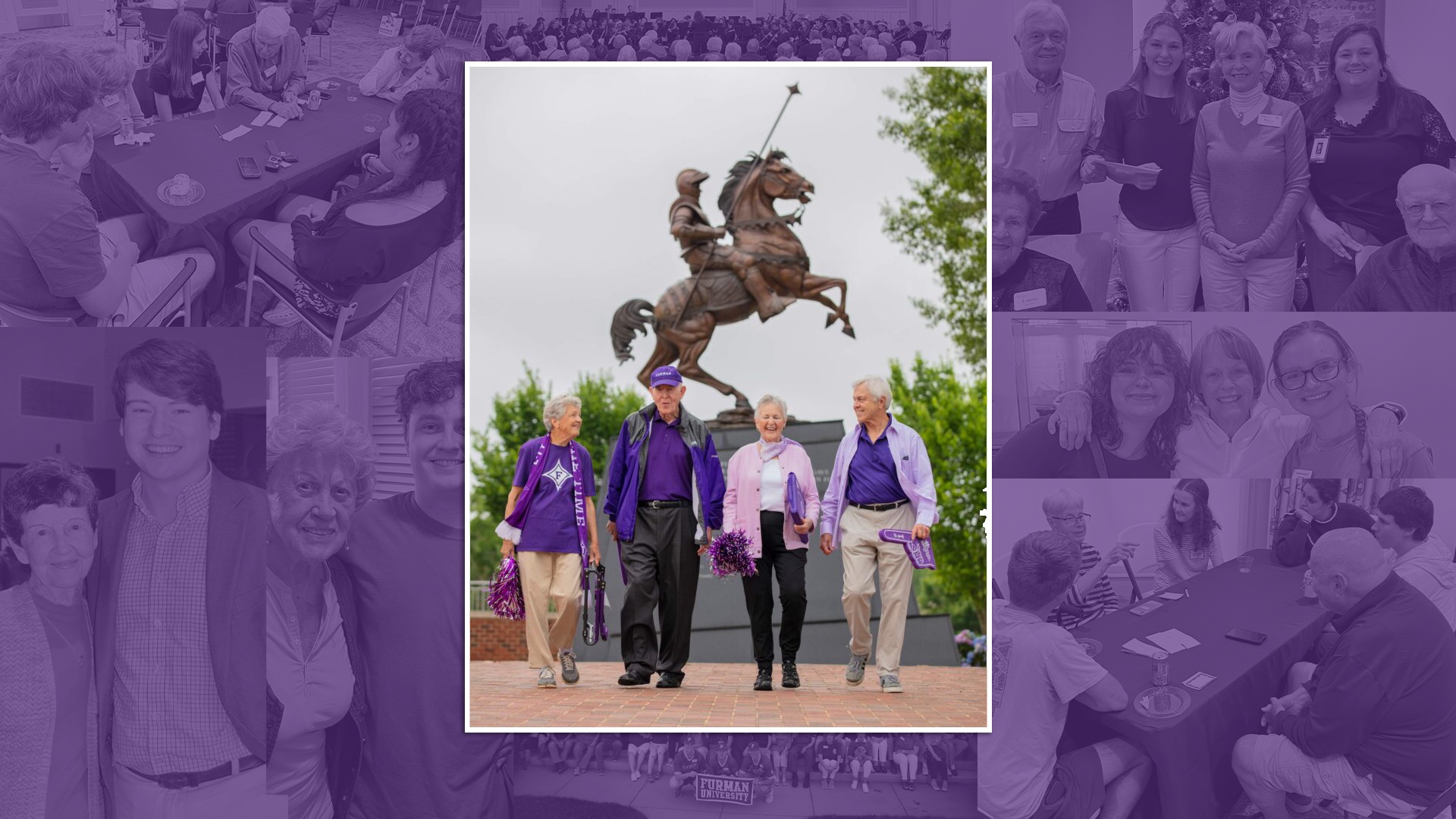
When Ezra Hall arrived at Furman University as a freshman, he signed up for the school’s Adopt a Grandparent program expecting a light volunteer activity. In the introductory session, students met residents of The Woodlands at Furman, a retirement community bordering campus, in a kind of speed-dating event. There, they chose whom they wanted to spend time with over the coming year.
Hall connected with retiree Jeanne Christie. At first, they met for meals or campus events. Before long they were attending church together, celebrating birthdays and graduations, and talking about everything from family to books and career plans. Christie eventually encouraged Hall to call her Mimi, the name her own grandchildren use. It stuck, and so did the relationship, which influenced more than his college experience. After interning at The Woodlands while he was a student, Hall decided to work at the retirement community full time after graduation. Now, as the director of philanthropy and engagement, he helps create opportunities for others to have similar intergenerational relationships.
Hall’s was a fortuitous match. But the circumstances that brought him and Christie together are becoming increasingly intentional. Across the country, a growing number of colleges and universities are partnering with retirement communities — or building their own — as an extension of their educational mission. Since the mid-1980s, more than 80 of these types of residences have opened across the U.S., including The Woodlands at Furman University, Mirabella at Arizona State University, University Commons at the University of Michigan in Ann Arbor, and Oak Hammock at the University of Florida. Demand has increased along with the aging of boomers, and waiting lists for openings is common. The Woodlands, for example, has a wait list of 500 people for its 280 residences.
The opportunity starts with the chance to continue learning. Residents can audit university courses, attend lectures and performances, use campus libraries and athletic facilities, and remain connected to an intellectually vibrant community. Some are retired faculty members or administrators, and others are alumni or even relatives of matriculated students. But most are people with no previous affiliation to the institution but want to live in an environment where ideas continue to enliven their world.
And while the intellectual stimulation is a draw, these communities are increasingly discovering that some of the richest forms of lifelong learning happen outside the classroom — and that it goes in both generational directions. Students and residents mentor and tutor one another and form friendships that span generations. In the process, lifelong learning comes to mean something broader than continuing education. It becomes an ongoing exchange of experience, curiosity, and perspective that continues long after formal schooling ends and underscores the value of age-accumulated experience.
And while the intellectual stimulation is a draw, these communities are increasingly discovering that some of the richest forms of lifelong learning happen outside the classroom — and that it goes in both generational directions.
The experience within these communities also reflects wider evidence on the benefits of intergenerational connections. For older people, being in relationship with a younger person leads to greater wellbeing and quality of life. Likewise, a review of intergenerational programs found that younger participants experience greater empathy, self-esteem, and social and communication skills through their relationships with older adults. Given these benefits increase with stronger connections, the longer-term living/learning arrangements of campus-based retirement living pose to be particularly effective.
There are a number of compelling practical advantages to these programs as well. A.S.U. graduate student and musician Caleb Bailey is one of a handful of young people living at Mirabella. Initially, the arrangement was actually motivated by a financial issue. Growing up in rural Maryland, Bailey never imagined graduate study in classical guitar was within his financial reach. His mother managed a Lady Foot Locker store; his father’s income came from buying and reselling items on eBay. As a first-generation Hispanic college student with A.D.H.D., Bailey felt talent alone wouldn’t cut it to cover tuition or rent.
“I was trying to figure out how graduate school was even going to be financially possible,” Bailey recalled. At A.S.U., Mirabella houses a few graduate students in the arts free of charge each year in exchange for performances and engagement with residents. Bailey had participated in a similar artist-in-residence program while earning his undergraduate degree at Johns Hopkins University, and the arrangement made graduate school financially feasible.
There, and at A.S.U., he has found much more than affordable housing. Residents attend his recitals and ask about his research. They remember upcoming performances and stop him in the hall to ask how auditions went. Others simply became enthusiastic supporters of a young artist trying to build a career. Casual conversations after concerts often stretched longer than the performances themselves. “It’s like having 300-plus grandparents,” Bailey laughed.
The relationships changed his musicianship as well. Residents weren’t interested only in technical perfection. They wanted music that moved them, comforted them, surprised them, or reminded them of someone they loved. Bailey began thinking less about performing for judges and professors and more about performing for people. Some residents decided to rediscover instruments they had abandoned decades earlier. One resident, a retired engineer, had spent years quietly writing songs for his wife. Bailey worked with him to arrange and perform them.
“I realized music is about serving the listener. That shifted my whole perspective,” said Bailey, who is attuned to giving residents a choice in what they’d like to hear. This is especially true of those in a higher level of care. People with limited mobility or serious health issues may have less agency in their daily routines. “It’s always nice to be asked what you’d like to hear.”
The experience also reshaped his professional ambitions. Today, Bailey is developing a nonprofit organization designed to expand artist-in-residence programs like Mirabella’s to retirement communities around the country, making graduate education more financially accessible while enriching the lives of older adults through sustained artistic engagement. His story illustrates something advocates of university retirement communities have been observing for decades: Meaningful intergenerational learning rarely emerges from occasional programming alone.
“It doesn’t happen by accident,” said Andrew Carle, a nationally recognized expert on university retirement communities who has spent more than 20 years studying their development. Simply building senior housing next to a campus isn’t enough. The strongest communities create intentional opportunities for residents and students to cross paths through academics, the arts, athletics, volunteerism, and everyday campus life. Over time, those encounters accumulate into relationships that no one could have predicted.
Carle describes the model as having five essential pillars, including formal lifelong-learning opportunities, access to campus life, intergenerational engagement, wellness, and a close institutional partnership with the university. Remove any one of those elements, he said, and the experience begins to look less like an extension of the university’s educational mission and more like housing with a convenient address.
That philosophy has become central to how Mirabella approaches lifelong learning. When the community opened in 2020, administrators expected residents would primarily attend lectures and audit classes. But over time, something more dynamic emerged.
“I would say the vast majority came in saying, ‘I want to take A.S.U. classes.’ And as they’ve lived here for some years, just about 40 to 50 percent of the residents actually audit classes,” said Lindsey Beagley, Mirabella’s senior director of lifelong university engagement. That’s because there are so many different avenues to intellectual and psychological enrichment. International students are invited to Mirabella to interact with others interested in speaking their language or to find companionship for a Thanksgiving meal when much of the campus empties out. Retired entrepreneurs step in as judges in departmental competitions; mentors in clubs give students a better sense of their profession.
“There’s 400 residents who have full access to campus, so there’s 400 completely different experiences, and that’s what’s exciting about this model,” Beagley said. “It’s really their own question to answer: How do you want to spend your time? What’s important to you? What do you want to learn?”
For Kathie Zurfluh, a 74-year-old former elementary school teacher, the classroom was what first attracted her to university retirement living. She and her husband had already built what they assumed would be their forever home further away in Arizona. But as they began thinking about the next stage of life, they were drawn to the idea of remaining intellectually engaged.
“The opportunity to take classes was just right up our alley,” she recalled. They put their name on the list at Mirabella and sold their forever home. Today, she continues to audit university courses. But some of her most meaningful learning happens outdoors, in regular conversations with students that offer insight into the lives of young people today. Two mornings each week, Zurfluh has a volunteer shift on a Friendship Bench beneath the shade of a tree with her certified therapy dog beside her. Students know that anyone sitting on the bench is open to conversation (the banner says, “I’m all ears”). Sometimes they stop because they’re homesick. Sometimes they’re overwhelmed by exams or relationships. Sometimes they simply miss having an older adult to talk with. Some conversations last just a moment while students pet Griffy, her Golden Retriever, while others continue for months, with students seeking her out regularly in her expected Tuesday-Thursday place.
“If they call Griffy’s name when they’re coming out of class, he gets so excited I have to hold onto him,” Zurfluh said. She and Griffy have celebrated acceptances for internships and graduate school and watched nervous freshmen struggling with loneliness grow into confident seniors. In return, the students have introduced her to new music, new ways of thinking, and shared their feelings about school shootings and other realities of growing up in a very different generation.
The exchange is precisely what Carle believes distinguishes successful university retirement communities from traditional senior housing that just happens to be located near a campus. The goal isn’t simply to give older adults access to university resources or proximity to students. It’s to create enough regular opportunities for authentic encounters that relationships can develop organically.
Rick Brackett, the president and C.E.O. of The Woodlands at Furman, has watched those relationships ripple outward in unexpected ways. International students who may be thousands of miles from their own families often find surrogate grandparents in the community. One Japanese student would come share meals at The Woodlands with a former director of Asian Studies. After the student graduated, the former director and his wife traveled to Japan to visit and meet her family.
There are paid conduits to relationships, too, with student interns receiving a stipend to work in the dining hall or teach classes at The Woodlands. “Some of the most successful are the athletes that intern in our wellness facility and teach exercise classes,” Brackett said. “The residents love the football players and soccer players that come over — they’re just superstars.” At games, the prime tailgating spots going into the stadium are lined with residents cheering for the players they know who march by.
The residents can be superstars in their own way, too, with decades of professional experience and connections. Students preparing for careers in medicine, business, education or public service benefit from regular access to people whose professional lives span decades. Residents contribute institutional memory, hard-earned perspective, and even networking opportunities. One retired physician recognized that pre-med students needed a place to talk candidly about burnout, uncertainty and the emotional realities of medicine. He helped launch the Future Physicians Forum, creating conversations that complement what students learn in the classroom.
At the same time, residents remain connected to emerging ideas, technologies, and cultural shifts through daily interactions with younger people studying their field. That reciprocity represents some of the quiet innovation at the heart of university retirement communities.
For decades, lifelong learning has often been understood as continuing to accumulate knowledge through classes, lectures, and books, and through campus-based programs like the Osher Lifelong Learning Institute, with 125 chapters on campuses across the United States. But the stories emerging from communities like Mirabella and The Woodlands suggest a broader definition. Perhaps the most enduring lesson these communities offer is that lifelong learning isn’t just the pursuit of new knowledge. It is remaining part of a community where curiosity, generosity, and perspective continue to shape us, regardless of age.
Ten years after meeting Jeanne Christie, Ezra Hall still meets her for lunch almost every week. He continues to be influenced by the vitality of her mind, and through his career path at The Woodlands, he plays a role in future students having personal relationships of their own with future seniors.
“Retirees still have a lot to offer. Retirement has changed in recent years. No one wants a rocking chair on the porch anymore,” Brackett said. “Students get to see how active and engaged you can be into your 80s and 90s, if you stay healthy and still contributing to a community. It’s inspiring, and it’s a new roadmap for the students going forward.”