Sometimes There’s a Wolf

In his 2023 book, “Whatever it is, I’m against it,” Brian Rosenberg sums up higher education’s aversion to change. In making his case, the Macalester College president emeritus identifies institutional barriers, such as shared governance and insular cultures, that keep higher education from addressing uncomfortable truths, like a flawed economic model and plummeting public support. He warns that this head-in-the-sand strategy will leave higher education vulnerable to a political take-down, like the one it is currently experiencing. 

Now that external forces of change, led by the Trump administration, are threatening to upend higher education as we know it, Rosenberg is far from gloating. A visiting professor at the Harvard Graduate School of Education, Rosenberg continues to advocate for strategies that will strengthen higher ed—those that will bend the cost curve, improve the student experience, and open up access for people who want to go to college but can’t afford it. He distinguishes this type of change from the unhelpful assaults on higher education he believes will have disastrous effects on the sector he both admires and admonishes. 

In this candid interview, Rosenberg explains how higher education got to where it is now and why this is not the time to stay neutral.  

LW: You have long advocated for change in higher education which, as you say, is very difficult to achieve. Do you think this point in time feels different?

Rosenberg: Higher education has been the most stable industry in the world for centuries. It hasn’t really needed to change in more than incremental ways, and there have been some good things about that. But when you go years and years without change because you don’t have to, you also fall into some really suboptimal practices, and sooner or later those are going to catch up with you. I think right now the pressures on higher education are so strong that incremental change just won’t do it anymore. People have been saying this for a long time, and it’s easy to think of someone like me as a boy crying wolf. But what I say to people all the time is, every once in a while, there’s a wolf. And I think we’re at that moment. 

LW: What would you say is driving the necessity for change?

Rosenberg: First, the economic model is unsustainable. The demographic trends are not on our side. And if it wasn’t clear to people a year ago, it certainly should be clear right now: people don’t like us. If there’s anything that the far left and the far right agree upon right now, it’s that they’re not particularly fans of higher education. They have different reasons, but what we’re seeing is that public discontent translates into public policy and that public policy has the potential to be extremely damaging to higher education, whether it’s an endowment tax or cuts to funding from the N.I.H. (National Institutes of Health) or limitations on what people can teach or services they can provide. 

If people liked us, it would be harder to implement those changes. But because the public regard for higher education has declined so much, we become a politically convenient punching bag, and that’s going to have real impact. If you combine economics, demographics, and public sentiment—you can throw in technology and artificial intelligence—I really do think we are at an inflection point now where same old, same old is just not going to cut it for the next five, 10, 20, 25 years.

LW: Let’s start with the economics of higher education. What needs to change there?

Rosenberg: When people say, change isn’t really necessary, the number that comes to mind for me is 56%—that is the average discount rate now at private colleges across the United States. Higher education in these places is  on sale for more than half off. If you walked into a store and you saw a sign that said everything is 60% off, you would assume it was a closeout sale.

That is the definition of an unsustainable model—when that discount is going up every year and every year you are marking down your product more and more. And sooner or later you’re going to get to 100% and be giving it away for free. So the need to bend the cost curve seems to me inarguable. We cannot continue on this economic trajectory. More people are deciding not to go to college because it’s too expensive, and more people who can afford it are still deciding not to pay it because it’s too expensive. In Boston for instance, the percentage of students in public schools who choose to go directly to college has dropped over the last decade from almost 70% to a little over 50%. In a high education state like Massachusetts, that’s staggering. 

LW: People tend to think of high tuition as the result of overspending or inefficiency. Is there truth to that? 

Rosenberg: The economic problem in higher education is not caused by climbing walls and lazy rivers, and it’s not caused by extravagant residence halls. Sure, at some institutions those are wasteful expenditures, but that’s not what is driving the increase in cost. What is driving the increase in cost overwhelmingly is personnel, which is about two-thirds of the budget. The majority of every college and university budget in the country goes toward paying people’s salaries and benefits because it has always been a very people-intensive industry. And the problem that higher education has faced is that the cost of hiring those people has gone up, but productivity hasn’t changed. It’s a fundamental economic problem called “cost disease,” where your costs of hiring people go up but you see no increased productivity.  Industries that have bent their cost curves have generally done it by increasing productivity. It’s easier to do in manufacturing than in service. If you look at things like the cost of producing an automobile adjusted for inflation, that’s actually gone down because you have so many fewer people. It’s so automated. But in higher ed, that’s not the case. 

The second largest cost driver is the physical plant. Institutions tend to have big, old physical plants that cost a fortune to maintain. They almost all have gigantic deferred maintenance budgets that they’re not really addressing. The only way to make it cheaper—and people don’t like to hear this, but it’s true—the only way to make it cheaper is to do it with fewer people and fewer buildings. And that’s very, very hard to accomplish in higher education because it’s not wastefulness as much as it is things that we prize. Things like student faculty contact are exactly the things that drive our costs. We haven’t found the right balance between doing things that we think are effective and doing things that we think are economically affordable. And so that’s the situation that the vast majority of colleges that are not places like Harvard find themselves in right now.

LW: What is at stake here if higher education does not change?

Rosenberg: I think what’s at stake is that you’re likely to see high quality higher education become a luxury good reserved for the few and much lower quality, less expensive higher education become something that most people experience. At one extreme, you have places like Harvard and Williams and they’re not going to go anywhere, but I think we run the risk of seeing a lot of very good, much less wealthy institutions go away and be replaced by institutions that are far less effective and consumer-focused. 

I’m someone who believes that essential public services are not best served when they are provided by for-profit entities because the profit motive and the motive of social good can come into conflict.  Worst case scenario is that higher education becomes taken over by for-profits and it stops being a public good and starts being a revenue source and a way to return money to shareholders. And I think that would be a disaster.

LW: The title of your book suggests you know something about resistance to change in higher education. You’ve lived it and studied it. What is your theory?

Rosenberg: If I had to boil it down to the simplest formulation, I’dborrow a phrase from Larry Bacow, who was the president at Tufts and then the president at Harvard for five years. He has said, “Virtually none of the internal actors within higher education have incentive to change it.” There’s certainly a lot of incentive for people outside of higher education—families who want to pay for college, students who want to attend college, states that want to educate more people. But inside higher education, if you think about the key actors, you have college presidents, and any college president who wants to keep their job knows that if you push for dramatic change, you’re likely looking at no-confidence votes and a short presidency.  If you want to keep your job as a college president, the easiest thing to do is not rock too many boats. Steer the boat, but don’t sharply change direction because you’re probably not going to survive. 

Boards of trustees certainly at private colleges are made up of alumni whose vision of the college is from the past more than it is the future. And so they hold on very tightly. And this is true of alumni in general. They hold on to the past version of the college that they experienced. Any college president you ask will tell you that any kind of change beyond what is very small is going to get pushback from alumni. If you’re a tenured faculty member and you have a job for life and your institution isn’t about to go under, why in the world would you change anything? You have a privilege that no other worker in the American workforce has, with the exception of federal judges. 

People often point to students, but when students push for change, it tends to be around things like political issues or better food in the dining hall. Most students don’t want the college that they enrolled in to go through disruptive change while they’re there. That’s not comfortable. The only people within the system who I think are incentivized to change it are the people who have no power to change it. I would say that’s staff, non-tenure track faculty and graduate students. They all know the system’s broken, but they have no power in the governance instruction. And so you have power located with people with no incentive to change, and you have incentive to change located with people who have no power. And that is a recipe for stasis. And of course then there are all these structural impediments like shared governance.

Anyone who studies change will tell you that two of the conditions that are necessary to change an organization are the right incentives and alignment, and you don’t have either in higher education. The desires and the priorities of a history department and the priorities of a college president are not necessarily going to be in any way aligned. And colleges, if you think of a metaphor, aren’t like highways. They’re like those bumper car rides that you used to go to at amusement parks, where everybody’s driving into each other and nobody goes anywhere because everybody’s driving in their own direction. That’s kind of the way decision-making at a college happens. We prioritize participation over outcomes. And that has a history that goes back more than half a century now, and it’s very hard to change when consensus and innovation don’t sit easily together because innovation by its very nature is disruptive and consensus by its very nature is not.

LW: What other things about higher ed do you think need to change that may or may not be related to the economic model but may be contributing to the decline in public sentiment or the questioning of its value?

Rosenberg: Higher education has tended to be extraordinarily insular. Just think about the typical college campus: it has sometimes literal walls between itself and the rest of the community, and it certainly has figurative walls. One of the things that needs to change is that higher education needs to start looking outward more and stop looking inward, asking itself, “What does society need?” People who teach at liberal arts colleges or research universities don’t like to hear this, but we need to be asking, “How can students get jobs?” This is for most people the largest investment they’re going to make other than maybe buying their house. Especially for first generation students, getting a job is not a luxury. It’s kind of a requirement.

I’m not saying that it all needs to be vocational, but are we teaching the right skills? Are we teaching the right competencies so that the people we are sending into the workforce are the people that employers want? Right now, the message back from employers is you’re not doing a very good job, that there’s not a great alignment between what we’re seeing in your graduates and what we want in our employees—things like creativity, being able to work in teams, resilience, adaptability. There are certain hard skills like being able to communicate well, work with numbers, work with data sets. I would describe it as a set of hard and soft skills that higher education has neglected in its focus on disciplinary expertise and on research. I mean, most college and university majors are still designed as if their graduates are going to become college professors, and that’s not what they’re doing. 

I also think about the method of instruction. There have been, at this point, countless studies that have shown that passive learning is not very effective. And yet higher education still relies very heavily on things like large lectures, when we know that students learn very little in that setting. You get a grade, you move out of the class, and then within a year, you don’t remember anything that you learned, whereas learning through doing—experiential learning—teaches you a lot more. And higher education has been incredibly slow to embrace the importance of learning-through-doing rather than learning-through-listening ,so I think the pedagogy could be improved as well. And that means that faculty members like me who were trained in a certain way have to rethink how they teach. And it’s hard to get people to do that. 

LW: Without those incentives, other than being a good person who cares about the post-graduate lives of your students, what is the motivation for professors to change their teaching? 

Rosenberg: I think the incentive is going to come from the bottom-up and not from the top-down. All of these schools now are facing incredible constraints and challenges, and you have a choice when you’re in that situation. For most schools, the incentive is survival. If you’re going to survive, then you’re going to have to offer something different than what you’re offering now. I have to believe that there are going to be some schools that take a look at a failing model and say, “All right, we have nothing to lose. We’re going to try something different.” My old AP biology teacher used to say that the nature of change is adapt, migrate or die, and migration is not a real option for colleges. But adapt or die is going to be, I think, the thing that sparks change In higher education. 

LW: You mentioned experiential learning, working in teams, some of the other high-impact practices that have proven to lead to things like wellbeing, fulfillment, and flourishing. These outcomes are also important to employers. Do you think embracing these kinds of experiences would help improve how people view higher ed?

Rosenberg: I think they would. And again, even if you look within very well-resourced institutions, there are departments that are struggling. Everybody points to the humanities. And so if you’re in a department where you’re just bleeding students, it seems to me you should be incentivized to look at what you’re doing and say, “All right, what can we do to make what we’re doing, what we’re teaching, more attractive to students?” And that would mean adopting some of those high-impact practices that we know work very well. 

We’re not talking about the French Revolution here. I think that there are things that could be done without completely blowing up the system that would begin to incorporate some of these high impact practices and conceivably could help bend the cost curve a little bit. For example, if you have more students doing group work, then maybe you don’t need quite as many TAs, or maybe you don’t need quite as many instructors because students are working in groups. So certainly, it could improve the quality, and it might actually even help with the cost.

LW: As you say, the wolf is at the door. Is there anything positive about what we are witnessing from the Trump administration in regards to changes in higher ed?  

Rosenberg: Is there anything positive here?  Sometimes it takes a major jolt to the system to change something for the better. If you’re in the habit of driving while intoxicated, and you get into an accident, and you narrowly escape with your life, maybe you say, “I’m not going to do that anymore.” And I would say higher education needs to start looking outward more and stop looking inward, asking itself, “What does society need?”

I don’t know what’s going to happen with this cut in indirect cost from the NIH, but if it stands, no university, even places like Harvard and MIT, is going to be immune. It’s certainly a message that if you don’t pay attention to the world outside the campus, sooner or later, that’s going to come back and bite you. And so if we get through this without complete disaster, maybe colleges and universities will rethink how they engage with the world beyond their campuses, do a better job of making the case for their value, and actually provide more value.  I think it’s waking people up to the fact that whether we like it or not, it’s not going to look the same in 10 years as it looks now. The question is: to what extent do we want that forced upon us? And to what extent do we want to try to have some control over that?

“The question is: to what extent do we want [change] forced upon us? And to what extent do we want to try to have some control over that?”

LW: What would you offer as suggestions to people like Vice President JD Vance who have called higher education the enemy?

Rosenberg: If in some alternative universe, someone like JD Vance were reasonable enough to actually listen to how to improve higher education, my response would be pretty simple and that is to double the Pell Grant—double the size. That is one tool that could make a major difference tomorrow. The Pell Grant has been stuck in the $6,000 to $7,000 range for decades. When it was first designed, it mostly covered the cost of college. Now, it doesn’t even come close, unless you’re talking about a community college. If you dramatically increased the Pell Grant, a) the money would be going to people who need it—lower income students and families—and b) it would make college much more accessible. I don’t believe everybody should go to college. What I believe is anyone who wants to go to college should be able to, shouldn’t be prevented by economics from not being able to. As with our infrastructure, we’ve neglected these kinds of investments because we’re so fixated in this country on low taxes.

I would also acknowledge that one major weakness is that higher education has become too ideologically uniform and that that’s not helping students. We need to figure out a way to make sure that people with all reasonable views can express them on college campuses without fear of reprisal or being shouted down. And that’s on colleges and universities. We haven’t done as good a job as we might have. That said, the answer to one form of censorship is not another form of censorship. And what we’re seeing now, in response to the soft power of students shouting down a speaker, is the hard power of the government telling you what you can and cannot teach and what you can and cannot do. That’s exactly the wrong thing. People like JD Vance and Musk talk about all the woke things that they’re rooting out. What we’re seeing now is that if you’re not on board with that particular ideology, then the law’s going to come after you. And that’s a lot scarier. 

You can say all you want about student protestors or about student demonstrators, but their power compared to the power of the state is minuscule. And right now, we’re seeing the enormous power of the state being brought to bear to shut down the open exchange of ideas on college campuses. And that is infinitely more dangerous than anything that’s come from within colleges. So I would acknowledge the failures, but I would also say that this prescription for correcting it is worse than the disease.

LW: I am guessing this is not the kind of change you talked about in your book.

Rosenberg: That Dear Colleague letter from the DOE, I’ve never seen anything like that come from any agency of any government in my entire life — state, local, federal. It read like an editorial in the New York Post. I mean, it was crazy—not just in terms of  its language, but its interpretation of the law was also just completely wacky. In some ways, it was directly inconsistent with the Supreme Court ruling on affirmative action, where Justice Roberts said, for example, that schools could use the students’ essays to make judgments about their life experiences. It went way beyond what was a fairly narrow ruling about affirmative action and admissions. I have yet to see a legal expert, right or left wing, that says this is actually supported by the law. There’s nothing about it that’s helpful. It’s just a standard playbook: overreach and scare people. And it’s a standard authoritarian playbook. What you get is a lot of what historians have called anticipatory obedience. People obey without you having to force them to do it because they’re scared. We’re seeing a lot of that right now. It’s a very effective way of exerting control when you can’t actually do what you’re threatening to do, but just the threat causes people to cower and to change what they’re doing. 

LW: Are you disappointed in the way that higher ed leadership has responded?

Rosenberg: The short answer is yes, I’m disappointed. But I do understand. I’m sympathetic to the notion that we should become more neutral. It’s probably true that higher education over the last decade has gotten too embroiled in political issues. I don’t think that’s entirely unreasonable because I think it coincided with the rise of Trump and so many actual or proposed policies that go against everything that higher education is supposed to stand for. That led higher education to get much more politically active and opened it up to a lot of these attacks.

“I believe that more leaders have an obligation to speak about what parts of the university we will not compromise on.”

I’m also sympathetic to the fear of reprisal. If you’re a college president and you’re dependent upon the legislature for funding, you don’t want to do harm to your institution. But having said all that, we need to have a different response. This goes back to something called the Kalven Report from the University of Chicago in 1967, which talks about institutional neutrality. It says the exception to that is when society or some segments of society propose or do things that threaten the mission of the university. In these instances, you have an obligation to speak—not an option, an obligation. And I really believe that we’re at that point now. I believe that more leaders have an obligation to speak about what parts of the university we will not compromise on and we will fight for and what things being done to our students in particular are unjust.  

I am sympathetic to the caution, but I’m also somewhat disappointed in it. I think that one of the things you learn when you’re in a schoolyard is if you keep getting punched in the nose by a bully, they’re going to keep punching you until you punch back. If you think that someone like Donald Trump or Elon Musk is going to stop punching you because you hide behind neutrality, you haven’t been paying attention. 
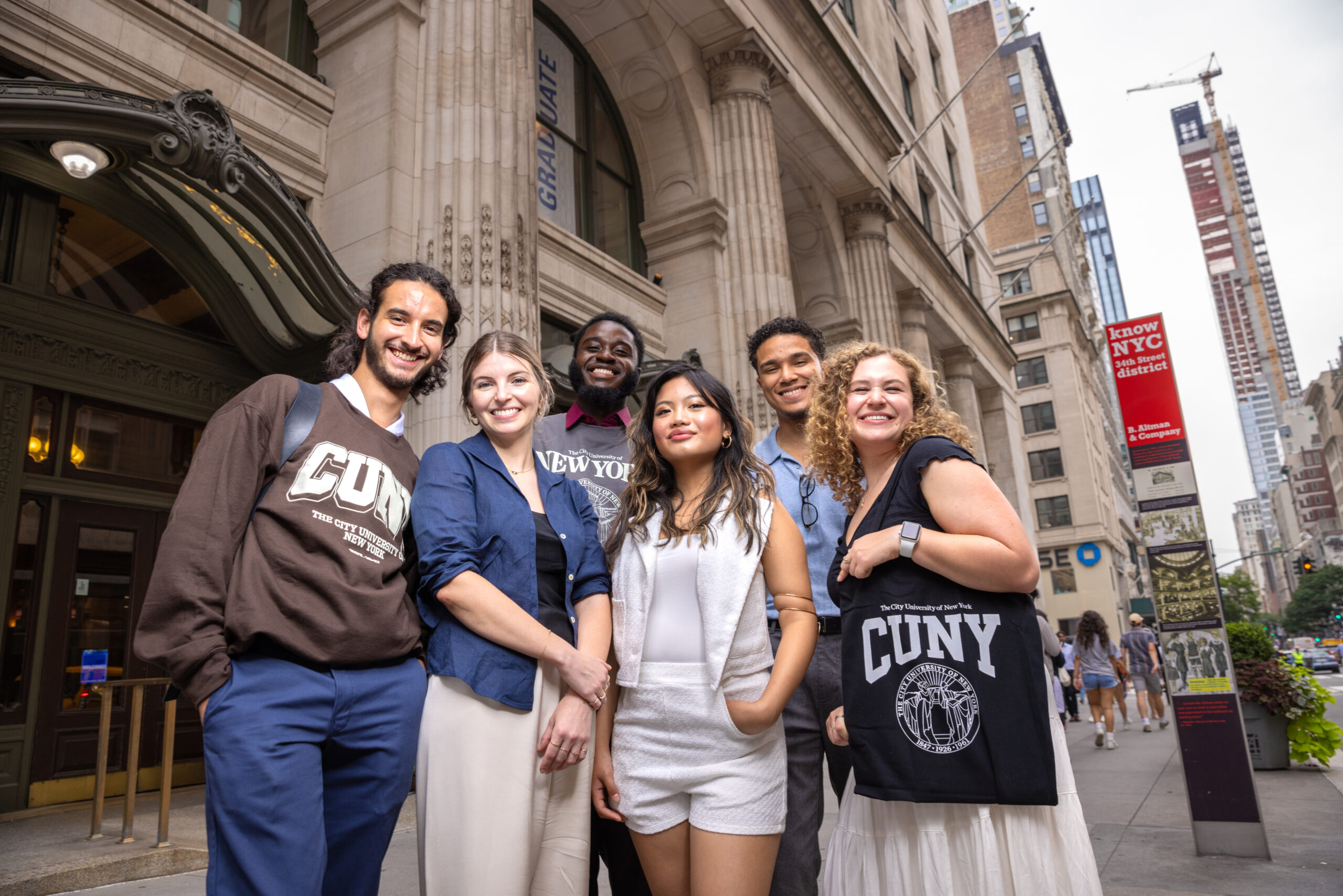
Posted in Q&A

Innovation and Financial Well-Being at CUNY

The spring semester at the City University of New York (CUNY) brings a fresh approach to a perennial problem. CUNY’s new Transfer Initiative enables students currently transferring for Fall 2025 to move anywhere within the system without sacrificing credits towards their major. The key is an automated process that shows them how their existing credits transfer immediately upon acceptance. 

The new initiative helps students avoid losing credit, time, and money when moving from associate’s to bachelor’s degree programs within the 25-college system. It is a culmination of a number of strategies at CUNY aimed directly at benefiting students, the majority of whom are low-income and/or first-generation. The person driving much of this innovation is Alicia M. Alvero, CUNY’s Interim Executive Vice Chancellor and University Provost. A first-generation American trained in Organizational Behavior Management, Alvero has the heart and the head to make systemic change at the country’s largest urban university. 

From streamlining advising to harnessing generative AI, Alvero is helping the colleges strengthen how they support students, particularly with factors such as time-to-degree and career alignment, which affect their financial well-being. In this interview with LearningWell, she discusses her own trajectory in higher ed, how those experiences helped guide her work in CUNY’s central office, and how organizational change can benefit the people who need it the most.  

LW: You wear a number of hats at CUNY. Tell me a little bit about your trajectory there and, in your own words, what the job entails.

Alvero: So I started in CUNY at Queens College as a faculty member of Organizational Behavior Management in 2003. And during that time, I was doing a lot of consulting work for organizations on both leadership training and improving workflow and efficiencies within businesses. And as with all faculty, once you get tenured, you get administrative responsibilities. And so sure enough, I ended up with administrative responsibilities and started to realize that all of these skills I was teaching to outside organizations, I could apply in-house to the psychology department, which at the time was the largest department. 

We would have a lot of students who would get denied graduation because they took a wrong course. And I thought, that’s a crazy time to find that out, when you’re applying for graduation. And so I started to think, how do we improve our advisement system within the department to eliminate that? That is, how do we get that information to students right away? How do we create work or course schedules that really meet the needs of our students? 

We’d get complaints from students saying, “I took this course, but it’s only offered Tuesday/Thursday, and it conflicts with another course that I need to graduate.” So I started really looking at how we were doing the work and then meeting the needs of the students. How do I ensure the right faculty, especially the part-time faculty, get assigned to courses for which they’re experts? We’d create a schedule and then try to fill all the adjuncts, but sometimes at the day and time of the course that aligned with their expertise, they were unavailable. And I thought that was a silly reason to lose this wonderful person.

And so I started making some changes in the department. I guess it started getting recognized by the college and the president and the provost. And they started saying, “Can you do this for the entire college?” And that was really my introduction to what it could be like to be an administrator for college. Then I became the Associate Provost for Academic and Faculty Affairs. Then our provost was retiring, and so it was announced that I’d be the interim. But before stepping into the role, our now former Executive Vice Chancellor University Provost, Wendy Hensel, was coming from Georgia State, and she reached out to me and said, “I really need somebody on my team who understands CUNY faculty, understands the system, because I’m an outsider.” And that’s how I came to the central office. I said I couldn’t pass up an opportunity to do what I love at a much larger scale. So I became a Vice Chancellor of Academic and Faculty Affairs for two-and-a-half years, and now I’m the Interim University Provost and Executive Vice Chancellor. 

LW: If you could identify one main priority of your work, is that to better facilitate a supportive, or student-friendly, way for students to get from entrance to success throughout their degrees?

Alvero: Yes, but it’s also about taking a holistic approach. It’s not just about making the process student-friendly. It’s about ensuring that our technologies, platforms, and policies are truly designed to support student success. Are our systems integrated in a way that makes life easier for students? For example, when a student transfers, does their information seamlessly transfer with them, or are they required to fill out unnecessary paperwork, even within CUNY?

We examine every step of the student experience—from entry to graduation—including the technologies we use, the policies in place, and the human factors like academic advisement. Gaps in policy can hinder student success, and some existing policies may not be functioning as intended. Additionally, students often receive contradictory information when moving between institutions, and we need to eliminate that confusion.

Our goal is to streamline information—through technology, well-designed policies, and well-trained advisors—so that students can make informed academic decisions and receive the right support at the right time. We shouldn’t wait until a student drops out to intervene. Instead, we should leverage predictive analytics and artificial intelligence to identify and support struggling students early on. It’s about a comprehensive, proactive approach, rather than a single initiative.

LW: And why would you say this support is particularly important at CUNY, which primarily serves first-gen and low-income students?

Alvero: The majority of our students don’t have the benefit of an expert in their home to guide them through the college process. When someone in a family has gone to college, they often understand—at least to some degree—what it takes to be successful. Most of our students don’t have that resource. And while attending college doesn’t automatically make someone an expert, any level of insight or support from someone who has navigated the system can make a significant difference.

Without that guidance, many of our students are left to advocate for themselves. But how can they effectively do that if they don’t even know the steps? That’s why it’s so critical for us, as a system, to proactively remove obstacles and provide the support they need, rather than expecting them to figure it out on their own.

LW: Could you give me an example of what some of those specific measures or supports look like? 

Alvero: For example, when a student transfers from one school to another, they often have to make a decision about which school they should go to. And there’s this misconception that, “Well, all 60 credits from my associate’s degree will transfer.” That is true. All 60 credits will transfer, but it’s how they transfer that makes the difference. Even if you’re transferring from accounting to accounting, credits that you thought would count towards the accounting degree could end up transferring as electives. That’s not useful. And so I bring this up because as a student, if I apply and get accepted to two schools, I should be going where the majority of my major credits are going to apply towards that major. But students often have to make this decision completely in the dark. 

We just automated that entire process. So now, say a student applies to three schools and gets accepted to two of them. They log into their account and see how each school will accept every one of their credits. That’s very powerful information. And the moment they’re admitted, it’s triggered, before they even commit to a school. Oftentimes, students used to accept admission and still not know this information because there was a delay in somebody getting it to them. So this is one example of support through information that helps make a well-informed decision.

LW: I imagine many students, from a financial perspective, may not have the luxury of saying, “Oh, well that course won’t add to my degree from a credential perspective, but it was fun.” They have to be really focused, right?

Alvero: Absolutely. And for students on financial aid, they lose their aid because aid is based off of a certain number of credits. So if you’re spending time taking credits that aren’t going to count, you already used the aid for those courses. And so whether it’s wasted dollars out of pocket or wasted financial aid dollars, what happens when you run out of aid and you can’t afford to pay out-of-pocket and now you can’t complete your degree because you took too many courses that wouldn’t apply?

We estimated that we’ll be saving students $1,220 with the new transfer initiative because of the average number of wasted credits for our students, which is in line with the national average.

“What happens when you run out of aid and you can’t afford to pay out-of-pocket and now you can’t complete your degree because you took too many courses that wouldn’t apply?”

LW: How about teaching and learning innovations? What are you working on inside the classroom?

Alvero: I’ll give a very obvious answer, but it is a priority, and it’s artificial intelligence. There’s just so much potential and so much that we’re exploring, and faculty are really very excited about ways in which they can use artificial intelligence to help their teaching, help students learn, but also teach students how to use AI, a skillset they’re going to need in the workforce. 

We recently asked faculty to submit proposals for creative ways of embedding artificial intelligence within their general education courses. And we received well over, I think, 40 applicant requests. We received more requests than we could grant because we provide faculty with a stipend. We want them to report back after the semester about how it went. Did they see a change in student learning outcomes? We want to know if we should be working with faculty to embed these strategies throughout, whether it’s within our math courses or English courses, where we see students struggle. We’ve not recovered since the pandemic with the learning loss, and students are really struggling in those gateway courses. And so not surprisingly, a lot of faculty are trying creative solutions in the classroom to try to improve student learning outcomes.

LW: There is evidence that avoiding remedial classes and going straight into regular classwork tends to have better outcomes for students. Do you think AI could be a tool to help students get up to speed? 

Alvero: CUNY actually moved away from traditional remedial classes for the very reason you mentioned. Instead, we now use a co-requisite model, where students who need extra support are placed in regular classes but with additional hours of support built in. So for example, if a course is usually three hours a week, this one might be five or six hours. In those extra hours, there are opportunities to use generative AI. Let me give you an example: A professor might provide slides to the students, and since CUNY has a license with Microsoft, students can access a tool called Microsoft Co-Pilot, which is a secure AI chatbot that requires a CUNY login. A student could use the tool to say, “Take these slides and create a 10-question multiple-choice quiz for me.” The goal is to help students use these tools to master the material. Of course, we also need to teach students critical thinking skills so they can spot errors, including those that might come from AI. But by using Co-Pilot and other tools we have secure university licenses, we minimize issues like AI hallucinations because the information is based on the class slides, not something random from a public AI platform. That’s just one example of how AI can be used in the co-requisite model to help students learn.

LW:. How are you guys thinking about student well-being? Do you see people, particularly from your seat in the central office, focusing on or investing in these issues?

Alvero: Absolutely, it is definitely at the forefront of most all of our conversations. We work closely with the university student senate so that we have a direct line of communication and they can express student concerns, but it’s about creating a really supportive and safe environment for our students. And how that’s defined—what those needs are—will vary from student to student. For financial well-being, it’s not just about ensuring that they have their basic needs met. It’s also, how do we provide them with financial literacy? Because getting a degree is great, but if they don’t come out with that degree understanding finances and how to manage them to help break that cycle, that’s on us, in my opinion. So we think about it in every single aspect—ensuring basic needs are met, ensuring if anything should happen to a student where they don’t feel safe that they have resources when they need them.

Of course, mental health is really important, but so is academic support, financial assistance, and access to basic needs. We have a program called CUNY Cares, which is based in the Bronx. It’s a one-stop shop where students can go to see all the benefits they qualify for in New York City, instead of having to go from agency to agency. It’s been incredibly impactful for our students because they have someone there to help them navigate this complicated process. They get guidance on things like, “Do I qualify? How do I get all of these services I might be eligible for?” The truth is, many of our students are eligible for far more services than they actually receive.

LW: CUNY is a very pluralistic environment. How do you make people feel welcome wherever they come from, particularly in today’s political climate? 

Alvero: CUNY offers a number of resources to support students from all backgrounds. For example, we have an office specifically for undocumented immigrant students, where they can get help with finding relevant support, both within CUNY and externally. Every campus has a dedicated contact to guide them through the process.

We also have a college language immersion program that’s open to anyone in the community interested in learning English. It not only helps with language skills but also provides college readiness, acting as a pipeline for students to move forward. This approach is really woven into the fabric of who we are as an institution.

LW: How about your focus on helping students connect with careers? Are you thinking, in addition to salary and similar benefits, about the importance of students finding purpose and meaning in their profession?

Alvero: Oh, absolutely. And this is another example of the holistic view. The way I see this, it’s not just about connecting them to the right career. It’s helping them from the beginning figure out the right career choice for them. And so in my dream, which is something I am planning to bring to fruition, students could have one place to really explore CUNY from A to Z. For career exploration, they could figure out what appeals to them, what might they do, and then be connected to what programs exist within CUNY. Because if I enroll at one CUNY school, they’re not going to have every single major. Maybe I realize that for what I’m aspiring to, I’m in the wrong CUNY school. Maybe I should have started somewhere else. How can we help students navigate that? 

And as I’m navigating what programs exist within CUNY academically, what internships opportunities are there? How can we connect students directly to our career partner industries? We’re doing a lot of work with that and integrating career milestones into academic degree maps. Currently, most degree maps are just, “Take these courses in this order if you want to graduate in X amount of time.” But what are the career milestones at different points in time? So it’s this holistic view of exploring careers, academic programs, and career milestones all within one place.

LW: Clearly advising takes a number of different forms at CUNY. How important is that? 

Alvero: CUNY now officially has a Senior University Director of Academic Advisement Initiatives that can help. The colleges are craving this. They’re all trying to do their very best, but until now, we haven’t shared best practices. How can we connect all of the advisors? We have an Academic Advisement Council. Every college has their Director of Academic Advisement, so they are at the forefront of these discussions.

The schools all have their own culture, their own things that their academic advisors must learn and navigate, but there’s also a level of consistency, especially with really critical information: the general education curriculum, appeals processes, how transfer works. These are things that are universal to all the colleges. So rather than having them spend time designing training, how can we serve in that capacity to provide really robust training and provide resources that are universal to all of them, so everybody’s on the same page with some of the foundational, critical information? 

LW: You seem to me like a very humble person, but that sounds like something you made happen?

Alvero: I don’t want credit. It’s a team effort. 

Posted in Q&A

Walter Mondale and Me

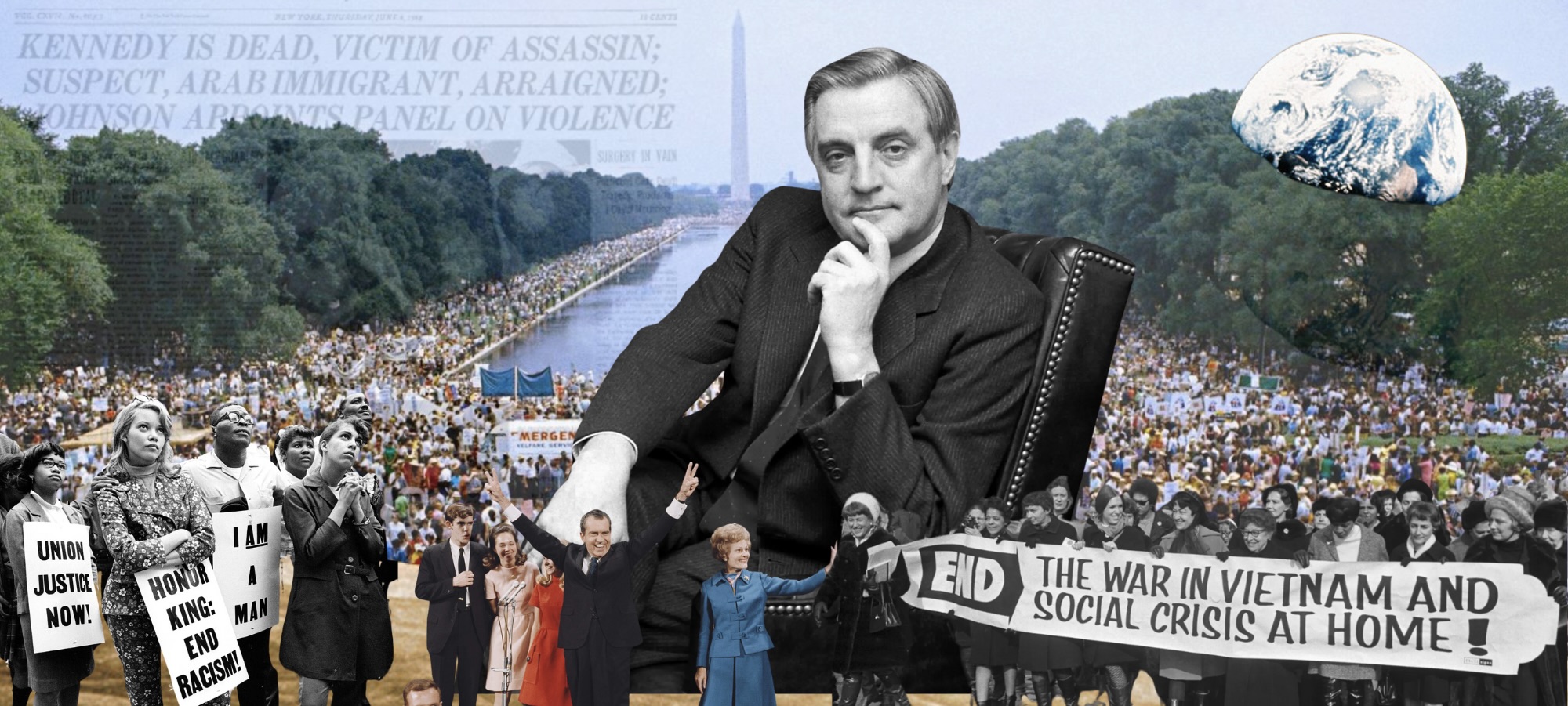
I started at the University of Wisconsin in the fall of 2001, just a week before 9/11. For me, and so many other first-year college students, this was a defining feature of the next four years. I was busy with work, internships, and other activities at a large public university and found that while I had many great professors, I don’t recall developing significant relationships with any of them, nor did I in graduate school, with the exception of one class. 

While attending the University of Minnesota’s Humphrey Institute of Public Affairs in 2006, I was selected for a seminar course led by former Vice President Walter Mondale and supervised by Professor Larry Jacobs. The class was featured in the documentary Fritz: The Walter Mondale Story. As part of the class, students identified different sections of Mondale’s biography and did original research based on his newly released papers at the Minnesota Historical Society. I chose to research his role as campaign manager for his friend and mentor Hubert Humphrey, who had waged an unsuccessful presidential bid in the tumultuous year of 1968. It was a fascinating experience to learn about such an important period in American history with so many epic characters like Bobby Kennedy, Lyndon Johnson, Richard Nixon, and Eugene McCarthy; and to get a sense of what life was like in a year of protests, assassinations, and war. I’ve always wanted to turn my paper into a book (someday).

Mr. Mondale was an engaging professor, generous with his time and willingness to share his personal experiences. In one of my memorable email exchanges with him, I asked him what lessons he took with him from 1968 that he used in his own campaigns. Besides the need to run a disciplined campaign (Humphrey’s campaigns were an apparent study in disarray), Mr. Mondale stressed the need to be yourself, work hard, and be kind. He remembered Hubert Humphrey as one of the most gifted orators of the 20th century, a superlative he said he would emulate but never achieve. In his email, he wrote:

“Humphrey was a magnificent speaker and performer. I couldn’t match that so I tried to compensate by working carefully on my speeches, doing some of my own research and reading, and connecting with people through friendship and kindness. We were very close friends but very different personalities. I did not try to be a Humphrey clone; I tried to be myself as unimpressive as that was and is.” 

“From him, I learned that you don’t need to be gifted to do great things.”

Besides his obvious humility, I was struck by his comment about “connecting with people through friendship and kindness” and the need to be diligent and work hard. From him, I learned that you don’t need to be gifted to do great things. As a fellow small-town Midwesterner interested in a career in public service, I was really inspired by him and could relate to his approach. I found him to be the ideal of what I thought of a public servant to be—honest, grounded, generous, smart, and always focused on improving people’s lives. He also had a great sense of humor that most people didn’t know. The class was a defining experience of my time in higher education. 

“Higher Education Builds America” 

On the first two Sundays in October, the American Council on Education ran a full-page ad in the New York Times targeting both presidential candidates with the tagline “Higher Education Builds America.”  In what was both a PR campaign and a policy brief, the ACE ad was part of a larger effort to promote higher education’s economic value within a bipartisan message meant to withstand either election outcome.  Now that the candidate less likely to embrace their agenda heads to the White House, ACE continues the fight with renewed vigor. 

The face of the campaign is ACE president Ted Mitchell, but the person in charge of it is  Nick Anderson, former long-time higher education reporter for the Washington Post, now ACE’s vice president for higher education partnerships and improvement.  As a former journalist who has observed the highs and lows of a sector considered the bedrock of the American dream, Anderson does not seem defeated or discouraged by the political situation. More than most, he knows that higher education isn’t going anywhere. 

While this may be true, innovation in higher education is something Anderson says is part of the campaign’s message. But messaging is different than policymaking, and it remains to be seen how ACE’s left-of-center advocacy agenda performs in the Republican legislative lock-down. In its open letter to candidates, ACE laid out  a set of priorities that include increasing federal aid for students and research, repealing the taxability of scholarships, reforming the endowment excise tax, and improving the visa process to better support international students. 

As the non-profit’s government affairs professionals work the agenda on Capitol Hill, Anderson and his colleagues will be in forums, and on social and traditional media, getting policymakers and thought leaders to look at the bigger picture.  

Here is an excerpt of our interview for LearningWell.

LW:  Let’s start at the beginning.  What motivated ACE’s new campaign? 

We started the campaign a little before September when we were thinking about what to say to the presidential candidates.  We wanted to articulate some core principles.  We wanted to say to the campaigns: “This is who we are, this is what we do, and here’s what we’d like you to look at when you take office.” 

It’s been a rough year for higher education.  Arguably, it’s been a rough few years for higher education and yet, here we are, definitely wanting to be part of the conversation – the policy conversation and the political conversation and we’re not going away.  Higher education has been part of the country since the beginning, for all of our flaws.  We have grown with the country and helped the country grow.  And now in the 21st century, we’re here to help it grow some more. In September, we wrote an open letter to the candidates – which was the basis for the New York Times ad – that articulated this vision of our history and our connection to America with a strong message that whoever wins the election we are ready to work with you. 

LW: What is it you hope to communicate through the campaign? 

From a message perspective, we wanted to draw the big picture for folks. We wanted to step away from the controversies of the moment – and there will always be controversies – and remind people that higher education is simply part of the American story. It has been here from the beginning. Thomas Jefferson went to William and Mary and founded the University of Virginia. Abraham Lincoln signed the Land Grant Act that created land grant institutions throughout the country.  There’s the establishment of the HBCU’s, the national enterprise of the community college movement, the GI Bill, the Higher Education Act of 1965, the Pell Grant and on and on. This historical through line of higher education is something we need to really emphasize to President Trump now and to Congress.  

We are not a sector that sprang up yesterday. We are here and we have always been here. When you talk about national security, when you talk about public health and medicine and lifesaving medical breakthroughs, when you talk about the regional economies of this country and the national economy, we have always built America and we will keep on building.  These are the kind of big picture messages we want to advance because, frankly, that often gets lost in the public narrative.

“We have always been part of the American story”

LW: Is ACE concerned about the election of Trump and the anti-higher education rhetoric his campaign employed? 

The rhetoric around the campaign season can get pretty heated, but there are campaigns and then there is governing.  We’ll see what all this means.  Trump hasn’t taken office yet. The new Congress hasn’t been sworn in. We are extending our hand to every national leader from the president to the Senate majority leader, the Senate minority leader, the House speaker, the House minority leader. We obviously will stand up for ourselves but wherever there is opportunity for advancing, we will advance. 

Regarding the attack on higher ed, I would say we are big enough to weather critiques. If there are people outside or inside of higher ed who are labeling us as “woke” or “elitist” or any particular adjective, we have to reckon with that. What does that mean? I would argue that we can absorb those critiques and evolve and take necessary steps if need be, but, more importantly, we need to simply be there and listen so that people understand that higher ed is hearing them. We have to avoid being defensive. We are institutions that promote, elevate and value the marketplace of ideas and political debate. As such, we have to be big enough to absorb any criticism and listen to it.  At the same time, we have to continue to promote our values.  We value academic freedom.  We value free speech. And we value institutional autonomy. 

LW: As part of the campaign, you acknowledge the need for change along with the value that higher ed brings.  What are some examples of that?

We have real work to do on the affordability front. I think it’s two things at the same time. There’s plenty of data that shows that college opportunities are affordable and available in many ways and we need to do a better job at communicating that. We are champions of access and champions of policies that promote affordability. We are champions of the Pell Grant. We are champions of the Free Application for Federal Student Aid, which had a disastrous year, but it’s now on the road to getting better. 

We want very much to promote the message that college is affordable, and yet we know that there are things that must be done to make it more affordable to more people and to have the value of college be elevated so that families, when they’re thinking about making a significant investment of money, and time, that they think it’s worth it. 

I also want to be crystal clear that what we’re saying here is meant to be maximally inclusive and has relevance for those who choose not to go to college.  Your life could have many paths that intersect with college at different points.  Our fixation with the education of 18 to 22 year olds is well grounded because we all care about our children and their emergence as adults in the economy and in their communities. But that traditional pathway has been shown many times to be too narrow to define what higher education is. There are a lot of people who intersect with higher education after age 25, and we need to capture that in our conception of who we are.

LW: What changes to do you see coming?

The sector is really a vast field of institutions and I think there’s a real value in partnerships between different types of institutions – community colleges and research universities, for example. Universities are an obvious example of fertile ground for partnerships and coalitions that would bring home to average folks that, “Hey, I’ve got college everywhere available to me. It’s not just that distant state flagship or those private universities off on the coast somewhere.”  Promoting community colleges and the wonderful work that they do and their accessibility is critical to that. But promoting the linkages between colleges that can be very different is really essential as well. 

We also have to promote different modalities.  Online education is here to stay. It’s not the enemy, it’s part of our fabric right now. I think the pandemic accelerated that and raised some questions about how it fits with residential higher education, but there’s no question that online higher education is real and important and potentially a crucial area for higher education to expand access to more Americans. There’s also a really important movement of credit for prior learning that we are very interested in helping to integrate into our thinking about higher education.  Innovation is part of higher education. To go back to my theme, I want to emphasize to the thought leaders and policymakers the vastness of who higher education is, what higher education is. 

LW: You have covered higher education for many years.  What is your observation about the state of higher education today? 

I literally covered higher ed directly for the Washington Post for 12 years. And every one of those years there were burning issues that were perceived in some way as an existential crisis for higher ed.  And in the last decade there have been plenty of crises of the moment. Certainly Covid was an existential crisis. There were crises related to “Me too” scandals and questions about sexual misconduct and sexual assault on college campuses that were really crucial to acknowledging the age-old problems of securing safety for students and creating an environment free of harassment and free of intimidation. The last year seemed to have very acute challenges, with the protests (over the war in Gaza) and the congressional hearings, but it’s not the first time that colleges have been rocked by challenges.

LW: What excites you about this new role?

I spent a couple of decades covering education and now I’m fighting for it. That, for me, is a wonderful pivot. There’s a lot of work to do. People in this country care about the American dream and getting ahead. And I think they also care about the free exchange of ideas and all those good things that higher education provides for us.  

Posted in Q&A

A Way Forward

There is finally some better news about student mental health: this year’s Healthy Minds Study shows for the second year in a row a drop in depression, anxiety, and suicidal ideation among college students. While the overall rates remain alarmingly high–more than a third of students say they struggle with mental health issues–this two-year decline suggests that increased pre- and post-Pandemic attention and support may be making a difference.

More robust services alone, however, will not solve the student mental health crisis. I’ve witnessed it up close, as a faculty member and administrator at Bennington College, and at a remove, as a higher education program officer at Endeavor Foundation. It is very real. A college is not a treatment center, nor can it reasonably provide everything that students and their families require as they grapple with a tangle of issues.

Colleges and universities must simultaneously reinvest in the most powerful educational contributions that college can make to fortify student mental health: helping students discover their purpose and see beyond themselves.

Finding purpose–once understood as a primary aim of college–has been steadily squeezed out by the gradual and insistent equating of education and career preparation. Intense pressure for return on an ever more costly investment has changed the face of U.S. higher education. The liberal arts, in particular, which emphasize discovery of self and the world, continue to strain under perceived lack of relevance to careers, despite plentiful evidence to the contrary. Unsurprisingly, the study of the humanities, the lifeblood of the liberal arts, is in precipitous decline.

Further, we are compelling youth to determine ever earlier what they will study. Uncertainty has become a proxy for the waste of time and money. But many teenagers do not know what they want to do and–crucially–have not had enough exposure to the possibilities to make such determinations. College is meant to foster this developmental process through exploration and the ignition of interests and passions. This discovery has long been advanced by the liberal arts as essential to well-being, in service of both the student and civic and social good.

A recent Gallup survey found that the happiness and satisfaction of Generation Z is directly linked to the belief that their life has significance. Yet, today, more and more students are making the choice of a major based on the salary that related jobs command, rather than freely choosing the fields they are most drawn to making their own. Across higher education, the number of bachelor’s degrees in computer and information sciences, engineering, health, and business has more than doubled over the past ten years.

the content of higher education is shrinking, and with it a primary pathway to finding well-being through fulfillment.

Declines in arts and humanities majors are leading, on a macro level, to consolidations and cuts of disciplines at all but the best resourced institutions. Concurrently, liberal arts-focused colleges are disappearing at a steady clip. Both dramatically and quietly, the content of higher education is shrinking, and with it a primary pathway to finding well-being through fulfillment.

The contraction of the liberal arts and humanities is also robbing students of opportunities to understand what it means to be human. While there is debate as to whether the youth mental health crisis can be directly attributed to social media addiction and technology use, there is also widespread acceptance that both have radically changed how young people know, experience, and respond to the world. A stunning portion of teen’s social interactions are mediated by tech companies, their time displaced in the repeating reels of Tiktok and Instagram. The development of broad perspective, something at the heart of the liberal arts and humanities, is critical to releasing them from this algorithm.

Students need the span of knowledge, breadth of understanding, and portals to past human experience that a liberal arts orientation offers, whether at a small college or a large university, both for themselves and for society. Such far-reaching intellectual anchoring nurtures the ability to wrestle with the large, open questions that frame our existence and situate ourselves within them, individually and collectively.

Disciplines such as literature, history, and the arts are sourced from the human condition itself and particularly suited to opening the mind to new ways of understanding it. At the same time, to combat social isolation, students need common curricular experiences and co-curricular opportunities for engagement, debate, and dialogue. They need to be able to locate their very different individual selves as part of something larger, together.

But general education, the vehicle for delivering common content, has lost its vitality over time, weakened, in part, by demands for greater career preparation. Even at liberal arts institutions, core curricula—rendered fraught by decades-long political and ideological debates about their makeup—now largely privilege individual choice over shared, common experiences. As a result, students have fewer bridges to each other through common historical and societal knowledge, when what they need are more and stronger ones. Recognizing the opportunity to rebuild their educational frameworks around understanding of our shared humanity is one of the most significant steps that colleges and universities can take to strengthen student mental health.

At Endeavor Foundation, we are supporting a project at eleven small liberal arts colleges to do exactly that through collaborative efforts. Together, these colleges are infusing the personal and intellectual discovery they catalyze with new forms of support and inquiry. They are introducing initiatives to help students metabolize stress and build resilience, as well as bolster their real-time connection to others and draw out purpose through their studies. And they are helping students identify, prepare for, and secure future work born of what matters to them.

There is no doubt that policy makers and educational leaders must address the skyrocketing cost of higher education. Students, most especially those from underrepresented backgrounds, can no longer be left with crippling debt or, worse, excluded from the very social mobility that college promises and–ultimately–delivers. At the same time, we must reset the narrative that career preparation is college’s main function and re-value students’ future mental health as an equally vital outcome.

Isabel Roche is the Executive Director for Special Programs in Higher Education for the Endeavor Foundation.

The “weird” attack on higher education

Listen Here:

In a season filled with political one-uppmanship, the word “weird” has become a catch phrase for all things suspicious or “dodgie,” effectively putting a spotlight on views outside the mainstream. The highly politicized attacks on higher education might well fit into this same category, considering the fact that the many criticisms against colleges and universities are, indeed, bizarre and unsupported by the majority.

While the most aggressive denunciations of higher ed are catnip for the media and burrow into the public consciousness, many of these criticisms come from a vocal minority. Even some of the most politically charged topics, where one might suspect the arguments to have persuaded a larger share of the public, aren’t producing these outcomes. Consider the aggressive anti-DEI (Diversity, Equity, and Inclusion) stance that has gripped the attention of the media and the public: despite the buzz, banning programs that help students feel they belong on campus is incredibly unpopular. Only 27% of Americans, and less than half of Republicans, oppose DEI initiatives in colleges, according to a 2023 YouGov poll. The same goes for controlling what subjects students can learn in college, another pervasive yet unpopular battle cry. Only 33% support government regulation of public college professors’ classroom speech, according to a separate YouGov poll.

The reality is that most of our friends and neighbors still want their kids to go to college, where they hope they’ll grow personally and intellectually, finding a sense of identity, agency and purpose that sets them up to flourish throughout their lives. It’s time to embrace the fact that, despite its flaws and the genuine need for improvement (particularly in affordability), college remains a positive force for young people and society at large.

Also, in the realm of the “weird” is the notion that college exists solely for skills training and job placement, an idea that doesn’t align with the wants of students, their families, or employers. According to Pew Research Center, 73% of college graduates with two- or four-year degrees found their degree very or somewhat useful for both personal and intellectual growth. Additionally, 90% of employed adults emphasized the importance of interpersonal skills such as patience, compassion and getting along with people to their work – attributes cultivated by a well-rounded college experience that includes mentorships, teamwork, and applying what is learned in the classroom to real world problems. Monster’s Future of Work report highlights that employers value dependability, teamwork, flexibility, and problem-solving – skills often honed through a well-rounded education.

To reassert the value of the college experience and restore public trust, we must provide the type of higher education experience that people want.

Just as the idea that higher education should simply deliver skills is out of step with the American public, so too is the belief that college is no longer worth it. Polling shows that 75% of people believe there is a good return on investment in a college degree, and nearly 70% say a close family member needs at least an associate’s degree for financial security. In a 2024 Gallup-Lumina poll, 94% of adults said at least one type of postsecondary credential is “extremely valuable ” or “very valuable.” Moreover, research shows that higher education is linked to improved health and wellbeing, including reduced risk of heart disease, high blood pressure, diabetes, anxiety, and depression. College graduates exercise more, drink less, and are more likely to seek preventive healthcare. They report higher levels of self-esteem and job satisfaction than high school graduates who do not go on to earn higher education degrees.

But just as the data show we cannot believe all of the anti-higher education rhetoric, we must not ignore that people are upset with the sector, and for valid reasons. We must address the affordability issue, a major driver of the anger and frustration directed at colleges and universities. And we must work harder to make a stronger case for the value of higher education on human development, workforce development, and society overall that can be embraced by Americans of all viewpoints. Forty-five percent of Americans believe colleges and universities have an overall negative impact on the country – this in spite of the data showing that college graduates are more likely to vote, volunteer, donate to charities, join community organizations, and participate in educational activities with their children than non-degree holders.

Rather, to reassert the value of the college experience and restore public trust, we must provide the type of higher education experience that people want: one that fosters personal and intellectual growth, offers a transformational experience, and lays the foundation for a lifetime of flourishing.

Dana Humphrey is the Associate Director of the Coalition for Transformational Education. The Coalition for Transformational Education is a group of leaders in higher education dedicated to evidence-based, learner-centered education that lays the foundation for wellbeing and work engagement throughout life. Through assessment, collaboration, and best practice-sharing with our member institutions, we strive to inspire the academy to prioritize lifelong wellbeing.

Dr. Estevan Garcia is at the Table

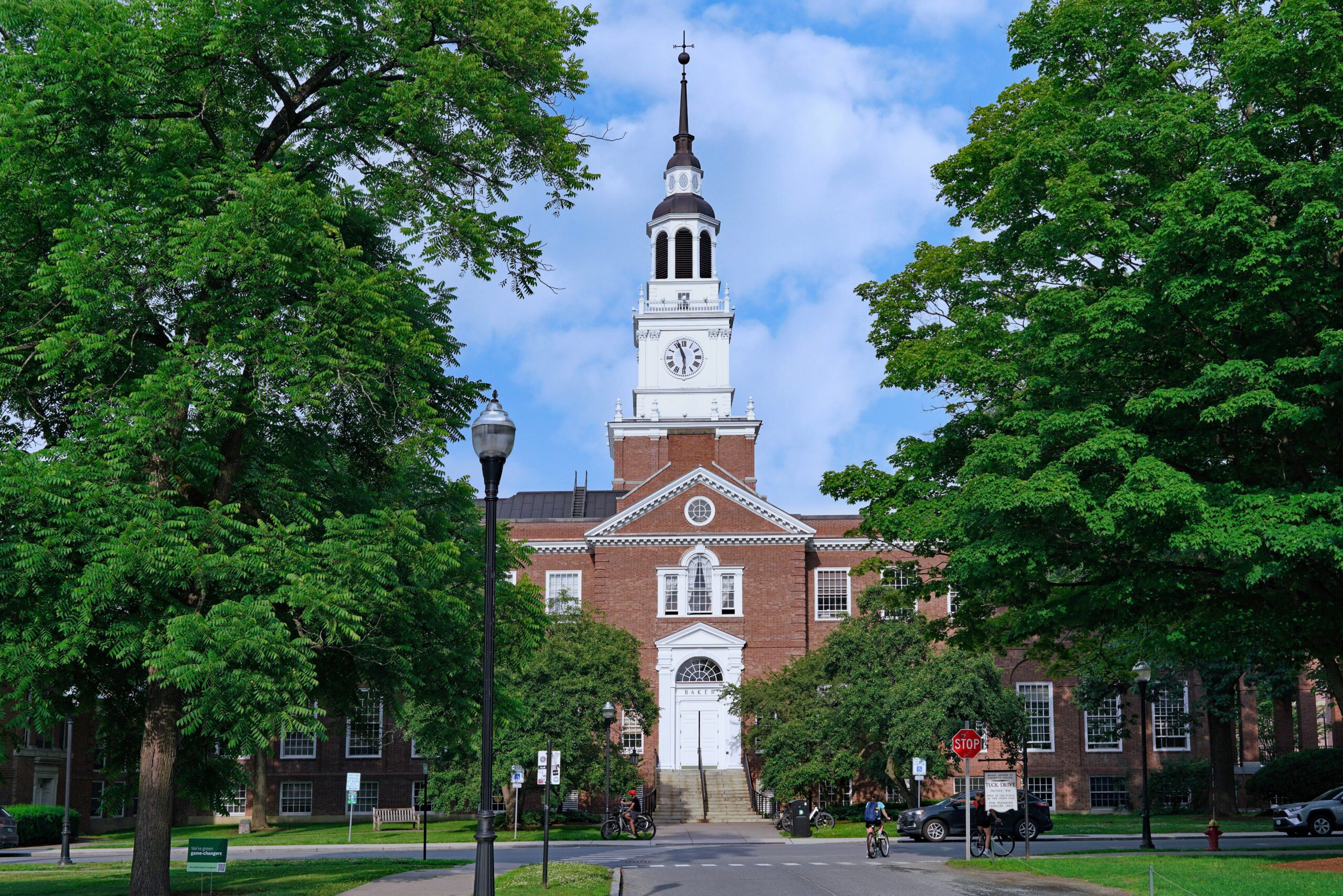
Given his background, Dr. Estevan Garcia might be considered an unusual member of a college president’s cabinet. But as Dartmouth’s new Chief Health and Wellness Officer, the physician and public health expert works directly with President Sian Beilock on an issue she has made a well-publicized priority in her first year in office – protecting the mental health of students, faculty and staff. Garcia, who is a pediatrician specializing in emergency medicine, came to Dartmouth from the Massachusetts Department of Public Health where he helped led the effort to address the behavioral health crisis in emergency departments during the pandemic.

It is now Garcia’s job to lead Beilock’s health and wellbeing agenda, most specifically through the implementation of the school’s comprehensive strategic mental health plan called the “Commitment to Care.”  The origins of the plan predate Garcia’s arrival and was informed by a collaboration with the Jed Foundation, a non-profit organization dedicated to protecting emotional health and preventing suicide in young people. Beginning in 2020, the Dartmouth community lost several students, including by suicide, as the pandemic eclipsed college life.

Dr. Estevan Garcia

Four years later, the Jed Foundation featured Dartmouth as a success story in its impact report and Garcia is now focused on the longer term outcome data that will provide a more precise evaluation of their recent work.  He views the plan as a pathway to a wellness culture at Dartmouth that prioritizes self-care, community care and mental health innovation. With an increased staff and budget behind him, Garcia is addressing a number of wellbeing issues often associated with elite institutions, particularly ones like Dartmouth, located in remote areas with less community resources.  These include the stress of perfectionism among high-performing students and the lingering lack of belonging many students feel, particularly those with mental health issues and/or those with diverse identities. As the fall semester brings new and familiar challenges to students’ wellbeing, Dr. Garcia is ready and at the table.

LW: What was the thinking behind having a new position in this area reporting directly to President Beilock?

EG: I think her vision for the role was to elevate student mental health and wellness as a high priority but also to bring under one umbrella campus-wide health and wellbeing. Part of my portfolio is faculty and staff health and wellness so it was important to President Beilock to have that direct communication on all of the activities in this area across campus.

LW: How has your background in public health prepared you and/or motivated you to take on the position of Chief Health and Wellness officer at a college? 

EG: What brought me to this work came from what I saw in emergency departments during, and predating COVID, with adolescents and young adults in crisis. To me, that was really shocking.  When I started in the Department of Public Health {in Massachusetts} I partnered with the Mass Department of Mental Health through the community behavioral health programs, providing options that would divert the mental health crisis from emergency departments when appropriate.  I spent those two years heavily involved in the work we were doing to create an actual road map for behavioral health in Massachusetts. 

My background is in emergency medicine.  I useasthma as an example of the way we look at illness in the emergency department.  You would come to the emergency department after you had gone through your asthma action plan – “I’m a green, I’m a yellow, I’m a red,” — here’s how I step up my care so by the time you came to us, you had exhausted your plan.  Westarted to view behavioral health in the same way.  “I’m at home fighting with my parents, or “I’m depressed, I can’t leave my room” or “I’m in crisis, potentially I’m suicidal” – all of those scenarios have varying degrees of illness and severity.  Ifwe treated them all as emergencies, we would be failing our patientsand our ability to manage true crisis and emergencies.

LW: Do you have a similar strategy around health and wellbeing that you are utilizing at Dartmouth?

EG: When I first came here, it was important to explain to my colleagues what we mean by health and wellness because not everyone understands this. One of the things I did was develop a pyramid that shows the different degrees of mental health needs. The base of the pyramid is the 70% of the students we have here – very successful, high achieving – experiencing the stress that comes with that.  There’s another 20 to 25% who could use some clinical support.  The final piece at the top of the pyramid is the group of students who were most clinically concerning, potentially suicidal, and these are the student we need to act quickly to support and get into the appropriatesetting. 

The goal of this kind of structure is to understand that much of what we do is at the base – that 70% of our students need easy access to services and almost no barriers to the many wellness activities we should be providing across campus. The idea is that college is the right timeto experiment with wellness and to build your portfolio of activities and support strategieswhen you are successful – when you are at the base – so you can manage the challenges that will come your way.  You will be more prepared when you fail a test, or break up with your girlfriend, or have other challenges– all the things that challenge yourequilibrium andcould push you into crisis.

“College is the right timeto experiment with wellness and to build your portfolio of activities and support strategies when you are successful –- so you can manage the challenges that will come your way.”  

For the 20 to 25% in the middle, we have clinical  supports that help themmanage their illness, while also providing access to wellness activities.  With the smaller group, my job is to really help identify them as their situation evolves and get them the support that they need, and this can be a protective setting in a hospital if that’s necessary.  And it is really important that we don’t make them feel that they are alone.  You have to care enough about the students that require services outside of the college to partner with them – to give them time away, with support, and then bring them back with the appropriate accommodations. This is how I see my job.

LW: What have been some of your early priorities?

EG: President Beilock has recently completedher first year as presidentbut was very involved in the creation of the strategic plan for mental health and wellness before that. I would say the majority ofmy work since I came to Dartmouthhas been to implement that plan.  It has multipledeliverables and my job was to take that on and run with it, delivering on health and wellness as a priority for the president and for the campus.

Part of those deliverables involved new permanent staffpositions – across ourstudent health and wellness divisions.  It was really a huge investment by the college and we had to make sure those were the right positions and we were utilizing them in the right way.  

The Dartmouth community has faced several challenges since I arrived.  I think it is helpful to have a clinician at the table.  Health and wellness staff arenot enforcers, but supporters.  We arevery much there to support students, and help them engage in tough conversations. I think partnering with students has been one of the strongest game changers for me personally. I worked with them before as patients but now they are really partners to me in the work we are doing around health and wellness.

LW: What was the history behind the Commitment to Care plan?

EG: When Covid started, we (in reference to Dartmouth) were doing the best we could, but clearly it was very isolating on this campus and colleges across the country. It was not your normal college experience by far here and of course everywhere.  Beginningin 2020, we had several student deaths including bysuicide, and it was clear they needed to address what was happening.  In the summer of 2021, they brought the Jed Foundation in and that led to a major mental health review –  campus visits, survey data, all of that.  Additionally, the provost at the time set up a steering committee to work on an all-Dartmouth strategic plan on health and wellbeing from May 2023 to September 2023, that was the foundation of the Commitment to Care. It was across all campuses – undergrad, grad schools, professional schools. 

What makes it unique is that it is very stakeholder-driven, very student-driven and the result is this multi-year, campus-wide engagement with actual deliverables. What I found interesting when I first came to campus, folks would introduce themselves – students, staff, faculty – and they would say “I was on the committee for mental health” or “I was on the committee for health promotion.”

LW: What are the elements of the plan?  

There are five pillars to the plan which drive the many activities and initiatives that we are working on.  (From materials): Center wellbeing in all we do both inside and outside of academics; Create an inclusive community to foster mental health and well-being for students with diverse lived experiences; Equip students with the resources and skills to navigate both success and failure with strength and confidence; Proactively address mental illness to aid students in reaching their goals; Invest in innovative applications of evidence-based approaches to respond to changing environments and needs.

It is a very broad approach involving all aspects of the college.  Regarding the second pillar, we pride ourselves on attracting first generation students and students with diverse lived experiences, and it is important for us to center those lived experiences in what happens on campus, particularly here in rural New Hampshire. This includes how we address mental health and wellness and creating a sense of belonging.

President Beilock was clear that focusing on wellbeing is critical to a successfulacademic career. One of the key pillars for us is helping students navigate success and failure, this is number three.  There is an understanding that our students are incredibly driven. They are gifted and they are used to being at the top. They are not used to failure. But failure is part of succeeding and it is how you pick yourself up and move forward that is important.  We call it normalizing life.

Regarding wellness services, we have made significant gains here.  One of the first things I did was to move wellness to be a separate divisionwith a director reporting to me.  Our health services are really top notch and I wanted wellness to be on equal footing.  Additionally, we are arural community sometimes makingrecruitment difficult.  To better meet the needs of our students, we needed to find ways of extending and diversifying our services.  We partnered with a tele therapycompany, that gives us 24/7 behavioral health support for students and that made a big difference in accessibility when our team was not in the office.  We have several hundred students who have engaged with the service.  We have unlimited access to 30 minutes therapy slots any time of day or night and will beexpanding that to 50 minutes for those who need it.

The addition of the tele service didn’t lower our need for in-person services but it enabled other students to access therapy who might have been uncomfortable doing so before.  We know that a quarter of our students utilize our mental health services and that is similar across our student groups.  That is a significant point since historically, underrepresented students seek help less frequently. 

And the other piece – which I think is one of the harder ones – is thinking about data analysis and evidence-based approaches to make sure that what we are doing is impactful. This is really important because as we are delivering on a lot of these initiatives, we need to know what is helpful and not helpful and then redirect our time, energy and resources accordingly.

LW: You have said that some of your work is inside as well as outside the classroom.  What has been your experience there?

EG: There are a few tracks to this work, one involving academic policies and calendars that students have said would be meaningful to them in terms of reducing their stress levels over academics.  There’s also some interesting things faculty are doing in their classrooms by integrating mindfulness techniques in their academic disciplines including physiology and languages.   These are just some of the ways we are partnering with academic leadership, and I will say it does make a difference now that we are at the table.

Posted in Q&A

Where Did All the Good Times Go?

Listen Here:

They are familiar culprits: smartphones, social media, the decline of in-person social connection that began before, bloomed during, and held firm after the COVID-19 pandemic. A growing reserve of data and reporting raises the alarm about Gen Z’s age of discontent, always coming to the same conclusion: it doesn’t look good for the digital generation. As panic descends over what the Surgeon General has labeled a mental health emergency and, more recently, a loneliness epidemic, few accounts of Gen Z’s state of mind manage to foreground what I suspect is at the root of my generation’s distress: the shrinking of three-dimensional life, and with it, the loss of risk, adventure, and thrill.

Forty-two percent of Gen Z suffers from depression and feelings of hopelessness, a rate almost twice as high as that of American adults over 25 (23%). On the climate crisis, 56% believe humanity is doomed. Since 2010, anxiety among American college students has increased by 134%, depression by 106%, bipolar disorder by 57%, and anorexia by 100%. In a 2023 poll of college students, 39% said they had experienced loneliness the previous day, ranking it above sadness (36%). 

As our parents’ generations had fewer children and nurtured them longer, we were raised to be risk-averse. Emergency room visits for accidental injuries—falling off a bike, breaking an arm, spraining an ankle on the soccer field—have declined significantly among children and teenagers born in the early aughts. That sounds like a good thing—fewer broken arms means kids are safer, right? But while accidental, play-related injuries have gone down, emergency room visits for self-harm have increased 188% for adolescent girls and 48% for boys since 2010. We are not safer; not with ourselves.

As Gen Z grows up, our adulthood shows signs of developmental delays. We go on fewer dates and have less sex. We are getting our driver’s licenses later or not at all; we are living with our parents longer. We drink less and go to fewer parties than past generations. Our abstinence from risk is not a reflection of strict moral influences or time redirected to other, “safer” ways of interacting with the three-dimensional world—far from it, we are less likely than past generations to engage in hobbies, play and watch sports, or work after-school jobs. We are, quite simply, doing less than any generation before us. 

Chart: Zach RauschSource: Monitoring the Future Get the data Embed Download image

Social psychologist and author of The Anxious Generation Jonathan Haidt argues that our increasingly two-dimensional lives are the result of “the end of play-based childhood” and its replacement with “phone-based childhood.” During a recent talk in London, Haidt asked audience members of the Gen X and Baby Boomer generations to think back to their childhoods. He asked them to remember the things they did with friends, the adventures they had, and then imagine removing 70% of those encounters – remove hobbies, then risks, thrills, and adventures where you might have gotten hurt—imagine 80% of that gone, he said. Now imagine growing up with what’s left. That is the extent to which Haidt believes smartphones gutted Gen Z’s childhood and adolescence. Our lives are now smaller, hollowed out, contained within digital software. 

“The fact that risk-taking activities like drinking are going down is a broader sign that young adults and adolescents are engaging with the world far less,” says Dr. Jessie Borelli, a clinical psychologist and professor at the University of California, Irvine. “Becoming an adult involves risk. Making mistakes, including through risk-taking behaviors, is practicing being an adult.” 

Moreover, she says, “Getting together in person is effortful. You have to endure a certain amount of discomfort, whether it’s the cost of leaving the house, encountering traffic, or the time it takes to put on different clothes.” 

We are not safer; not with ourselves.

For a subset of the population who grew up on social media and spent some of their most formative developmental years taking classes and interacting with peers only online, any effort at real-life interpersonal connection carries inherent risk — embarrassment, rejection, heartbreak, abandonment. When we weigh the decision of whether to engage effortfully with the world or just stay home, it’s no wonder we gravitate toward the option that involves less risk.

What that cost-benefit analysis is missing, however, is the fact that loneliness and isolation have profound consequences for not just our emotional wellbeing, but our long-term physical and cognitive health. “Social isolation and loneliness increase a person’s risk of heart disease, obesity, diabetes, Alzheimer’s, dementia, depression, anxiety, suicidality, and premature death,” says Shannon Vyvijal, the Communications and Programming Coordinator for the Foundation for Social Connection. The upside, Vyvijal says, is that “social connection is really both a remedy and a preventative measure. In addition to making us healthier, it makes our communities safer. Socially connected communities have lower rates of gun violence and drug deaths. It makes communities more prosperous and helps local GDP. It leads more people to volunteer in their communities. It helps us become more civically engaged. We begin to trust institutions and one another again.”

Gen Z knows it’s lonely. “Loneliness is a discrepancy between how connected we are, and how connected we want to be,” Vyvijal says. “If, like many members of Gen Z report, you are someone who wants to date and hasn’t yet, or you are on dating apps and not satisfied with the level of connection they provide, that discrepancy is contributing to loneliness.” The disconnect between having and wanting connection often sets in motion a self-fulfilling prophecy, with the stigma of social undesirability increasing a person’s tendency to retreat from others. “The lonely brain continues to self-isolate,” she explains. 

They—we—are not content to live in a purgatory of risk-averse, adventureless post-post-adolescence.

Even as hyper-individualism in work and school swells and spills over into life after-hours, Gen Z is begging for community. We are begging for risk. Signs of our accelerating desperation occupy every corner of the Zoomer internet. In the r/GenZ subreddit, an 18-year old appeals to their peers for advice on how to make friends; a 21-year-old college student laments her campus’s lack of community; a 19-year-old worries she’s a “loser” for having never gotten drunk or gone to a party.  On Facebook, young adults post friendship applications. A Gen Z woman complains of the death of clubbing in a TikTok video that amassed over 3.5 million views. A viral dating deep-dive from The Cut shows young women crying on camera while describing their longing for partnership. 

Not far behind, tech companies roll out solutions for Gen Z to cure our loneliness without looking up from our phones. Tinder backs a new “dating app for friends.” On Bumble BFF, users swipe right on pictures of prospective friends. Still lonely? Try downloading Replika, “THE chatbot for anyone who wants a friend with no judgment, drama, or social anxiety involved.” No risk, all reward.

But Gen Z is getting older, in spite of its delayed adulthood, and making the move toward real-world community as a form of generational healing. The tide of self-isolation appears to be turning as loneliness and boredom reach a fever pitch, with a growing number of young adults taking the matter offline and into their own hands. Running clubs, singles parties, book clubs, wine nights, and self-made social events are on the rise. A new trend emphasizes the importance of third places—communal spaces like public parks, libraries, and coffee shops where people can come together and fill the time between work and home. They are taking their hobbies offline. They are volunteering more. They are urging moral awakening over self reinvention. They—we—are not content to live in a purgatory of risk-averse, adventureless post-post-adolescence.

I can’t say I wish playground injuries on kids or hangovers on college students. I do hope, however, that we will return to a margin of risk where it’s OK to fall off your bike, get your heart broken, dance badly at a party—because that’s part of the deal of living in the three-dimensional world. If we watch from a safe distance, that world will keep outgrowing us.

The Case for Transformational Education

Higher education is currently under enormous scrutiny. Part of this scrutiny results from the challenge of balancing the traditional roles of college in helping students “find a job” and “find themselves.” Eliminating the conflict between these goals, and indeed underscoring their interdependence, offers an excellent opportunity for higher education to take steps toward restoring public trust. To take full advantage of this opportunity, we must work harder to deliver the real value of a college education: a transformative learning experience.

For generations, traditional age students have enjoyed the benefits of college’s unprecedented ability to offer intellectual discovery at the inflection point of their personal development. This exceptional combination comes with a shift in learning that distinguishes college from primary and secondary school experiences dominated by extrinsic motivation like deadlines, teacher approval, and grades. Higher education, when done well, sets the stage for life-long learning by introducing intrinsic motivation that goes beyond knowledge and skill, shaping attitudes, behaviors, and beliefs — or “mindset.” Colleges and universities’ ability to teach students how to learn, not what to learn, is fundamental to the personal and professional success of graduates, often including, ironically, higher education’s harshest critics. 

Experiences in college can lead not only to professional success, but to a greater sense of wellbeing long after graduation. Current evidence based on measures of life-long wellbeing developed at Gallup indicates that having emotionally supportive mentors, particularly faculty, correlates strongly with life-long wellbeing. Gallup alumni surveys additionally show that initiatives that increase students’ sense of agency, through experiential learning opportunities such as projects or internships, also correlate with wellbeing long after the college years. One particular program, Purposeful Work at Bates College, produced profound evidence that a sense of wellbeing is substantially enhanced in students who find career opportunities closely related to areas of study that develop a sense of purpose and meaning.

Higher education, when done well, sets the stage for life-long learning by introducing intrinsic motivation that goes beyond knowledge and skill, shaping attitudes, behaviors, and beliefs.

The challenge facing higher education is how to achieve a broader recognition of the need to strengthen students’ transition from extrinsic to intrinsic learning and encourage experiences like hands-on learning and mentorships correlated with wellbeing at a time when vocationalism and return on investment dominate the public narrative.  Barriers such as check-box general education curricula and faculty reward systems that disincentivize truly student-centered, innovative teaching exacerbate the problem as does the underlying issue of the cost of a college degree.  

Restoring the public’s esteem for higher education by promoting lifelong wellbeing and refocusing the conversation on the student experience make up the central mission of The Coalition for Transformational Education. The Coalition is a learning community of almost 30 institutions across the country dedicated to changing the ways we teach and students learn, each pursuing distinct initiatives that offer best practices in engendering identity, belonging, agency and purpose in students based on experiences known to promote wellbeing.

The Coalition is focused on promoting this transformation across all of higher education by changing the narrative about what matters most in the student experience and encouraging faculty to experiment at the undergraduate level with evidence-based interventions to improve outcomes and wellbeing, and scaling these to all enrolled students. All of the institutions that are members of the Coalition are committed to assessing the interventions they introduce and refining them over time to continually improve their long-term impact. 

All members of the Coalition are committed to producing positive educational experiences that touch all enrolled students, not simply those that are focused only on specific populations such as the talented and gifted or the under-resourced or under-prepared. The Coalition is dedicated to making all of these interventions accessible to every enrolled student, regardless of their academic record or financial resources. The Coalition has the potential to transform higher education in ways that allow it to deliver on its full promise of career preparation and personal development, ensuring that students graduate not only with broader and deeper intellectual outcomes, but also with a greater sense of who they are and who they can become.

Our Students Have Something to Tell Us

As the academic year drew to a close in May, I waited for my fears to be actualized. After a spring of over 3000 arrests of college students—something unprecedented in my professional experience of nearly 30 years—I found myself questioning my confidence in the core commitment I made to my students. I have always expected students to change the world, to utilize the educational experience to be, what I call “comfortably uncomfortable.” Yet, I was getting increasingly uncomfortable as encampments, protests, and arrests proliferated around campuses in the United States. I worried, for the first time, that perhaps we were afraid of our students and their calls for intervention in a time of global crisis. I saw campuses closing their gates and worried we might temper our commitment to the rigorous exchange of ideas that so fundamentally defines higher education and the joys found in this setting. 

And then I listened. Over the course of a week, I attended nearly a dozen graduation ceremonies involving countless student voices. I have gone to senior balls and hugged tearful students who, only a few weeks earlier, presented me with lists of demands. Time and again, I am reminded that our adolescents are experts in their lived experience. We fail that expertise when we presume the wisdom we gained as adolescents decades ago somehow supplants the wisdom of today’s lived experience. We need to listen and then apply our wisdom as leaders and educators. As I reflect on that remarkable spring, I am reminded of a few key factors influencing our future work together: 

Teenagers don’t “get over” a pandemic. The impact of the isolation resulting from the pandemic interrupted an important stage of adolescent development among teenagers. It has left an undeniable impact upon today’s youth and it will influence our understanding of early, mid, and late adolescence for years to come. This should not be a surprise to educators. Assessments of adolescent health and well-being clearly established a prevalence of stress, anxiety and depression that preceded the pandemic. Isolation caused by the pandemic increased loneliness and adversely impacted interpersonal skill development. For a community whose high school and early college experience was defined as “Wake up, open Zoom, close Zoom, sleep. Repeat,” learning how to meaningfully connect with others is anything but inherent. The Healthy Minds report of 2022-23 noted 42% of respondents missed companionship and nearly 70% of respondents reported feeling isolated often or some of the time. It is now normative, not exceptional, for our emerging adults to be lonely, want true friendships (not the social media kind), and are urgently seeking a sense of community. The resilience I may have learned in my college experiences in the 80s, is not the same resilience our students learned during periods of mass shootings, isolation, and the desire to be compassionate actors in a complex world. Our students are trying very hard to change the world on a stopwatch, understandable given the disruption of time, space and developmental growth caused by the pandemic.

I have gone to senior balls and hugged tearful students who, only a few weeks earlier, presented me with lists of demands.

Listen to what our students are telling us. They care. And they are learning how to show it to an older (yes, that’s us) generation that doesn’t seem to be listening. Countless encampments, arrests, and fear of a global crisis enfolded this past academic year on the heels of years of mass shootings and uncertainty. There is no better time than now for higher education to invest in our youth and engage in developing skills associated with care for others, curiosity, and, yes, conflict. Let’s remember everything we learned in high school through interpersonal interactions. Our hearts were broken and restored, we had best friends and best best friends (they might have changed often based on how the day went), and there was a “cool kids” table in the cafeteria. We learned, through interpersonal engagement, empathy by being in the 3D presence of emotion expressed without a mask on. 

In their graduation remarks at my institution, students repeatedly appealed to each other for community, dialogue, and compassion; not revolution. One of my favorite graduation speakers remarked on this theme by sharing, “We are united by…this innate desire to be interconnected and care for one another everywhere we go.” They are just learning how to do that in a world where Chicken Little, to them, is starting to look like a soothsayer. These students share our compassion but they haven’t learned as well how to express and moderate that compassion and care for others. They may protest sometimes, they may express frustration when they see horror: they are retroactively learning how to express those feelings in real time, in 3D. Our colleges and universities are well prepared to provide some calm and purpose. 

There is no better time than now for higher education to invest in our youth and engage in developing skills associated with care for others, curiosity, and, yes, conflict.

I am confident our institutions can continue to do what they know is best: educate and inspire global scholars who will transform our world. The expression and curiosity of those scholars serve as a litmus test for the success of today’s adolescence following the interruption of the pandemic. Higher education must pursue our mission in a manner that is responsive to the curiosity, compassion and isolation our students carry within them. The actions of our younger scholars are impacted by these realities and require responsive and continued commitment to their post-graduate success in a world that is complex—and eager—for their impact. Let’s listen, please, and then do what we do best.


Eleanor J.B. Daugherty, PhD, MEd, is the Vice President of Student Affairs at Georgetown University. Daugherty previously served as Associate Vice President for Student Affairs and Dean of Students at the University of Connecticut (UConn).