A Recipe for Growth and Love

If you asked people to describe the Healing Meals Community Project, you might get different answers. For families experiencing a health crisis, it is a lifeline of nutritious, medically tailored meals delivered with a personal note of support. For the high school students who prepare the food, and write the notes, it is a unique opportunity to serve others, while discovering the good in themselves. Perhaps the best way to describe Healing Meals is as an organization that leverages the powerful relationship between food, health, and community. 

“We want everyone who comes through our doors to feel better when they leave and bring that energy to the next person they come in contact with,” Sarah Leathers, the C.E.O. of Healing Meals, said at its annual fundraiser in June.  

According to the Healing Meals team, that positivity is baked into every meal they make; and, they say, their clients can taste it. As a healing protocol for patients dealing with a serious illness, the organization prepares and delivers meals to families in Connecticut’s Hartford, Middlesex, and Litchfield Counties. Eighty percent of those who receive the food are eligible to do so for free. All of it is organic, locally sourced, and nutritious, aimed at nourishing patients with medical conditions and/or limited diets.

Healing Meals is among a growing national community dedicated to “food as medicine,” meaning they advocate for food-based interventions in health care. Research shows that tailoring meals to meet a client’s specific medical diagnosis leads to positive outcomes in health and satisfaction for people with severe, complex, and/or chronic illnesses. But anyone who has been in the Healing Meals kitchen, or worked in the gardens, or delivered meals to families, knows that this work is not just about food. 

As part of its model, Healing Meals enlists teenage volunteers who show up daily, put their phones aside, and help grow, cook and prepare the food under the supervision of a chef and other adult mentors. Part experiential learning, part youth empowerment, the program lets students learn about the relationship between food and health, become an integral part of a kitchen crew, and, often, gain meaning, agency and belonging.  

“From the moment I walked in, I felt instantly welcomed,” said Ben, a rising high school senior who is interning at Healing Meals this summer. “All of the other volunteers were just incredibly helpful to me. It was nothing I had really felt before.”

Since its founding in 2016, Healing Meals has engaged 700 youth volunteers, the majority of whom stay beyond their first experience. Leathers said while the organization’s dual mission – supporting clients and students alike — can be challenging for donors to categorize, the success of the youth development program has taught her that one purpose often serves another. At a time when 40 percent of high schoolers report persistent feelings of sadness or hopelessness, Healing Meals is becoming a model for a different kind of youth volunteerism, where the kids that are helping others may be getting far more in return.  

Organic Roots

The Healing Meals story began in California, where Leathers’ sister, Cathryn Couch, was running a similar organization called Ceres Community Project. Now serving more than 2,500 clients throughout Northern California, Ceres also has a youth development component, though Couch said its inclusion was somewhat serendipitous.  

As a well-known caterer in the Bay Area, Couch was asked by a friend to give her daughter a volunteer job for the summer. At the time, she was helping a woman undergoing cancer treatment with medically tailored meals for herself and her family. Realizing the growing need for this kind of support within her community — and witnessing the empathy and confidence her young intern was gaining — Couch put it all together, gave up her successful catering business, and launched Ceres. 

“It addressed so many needs in the community and so many things I care deeply about,” she wrote in her origin story on the organization’s web site. “Young people would learn to cook. People who needed healing food would have it. We would help teach people about the link between what we eat and our health. And we’d help restore the idea of caring for our neighbors, something that has been lost between my parent’s generation and my own.”

Leathers had long hoped to launch something similar in Connecticut, where the sisters were raised. Having experienced a personal health crisis in 2011, she began studying the link between nutrition and health and the relationship between the mind, body and spirit. But she had also been a tutor to students with disabilities and a job coach to young people, including boys who hadn’t finished high school and were preparing to enter the construction field. Leathers, who is an engineer by training, built the Healing Meals model with these experiences as scaffolding.

“No matter where you come from or what your story is, every young person deserves to feel seen, valued, and supported,” she said. “We all need someone who genuinely cares and who helps us grow with accountability and love.”

The opportunity to mentor youth volunteers as part of the food-as-medicine model was particularly appealing to Leathers’ co-founder, Ellen Palmer. A certified holistic health and life coach, Palmer had worked with teenagers and young adults with stress and anxiety. Yes, the students would provide a valuable service, but they would also have an opportunity to contribute to something meaningful, away from the pressure of college prep and social media.

“Young people need a place to go where they can feel worthy and learn about themselves,” said Palmer, who was with the organization until 2023.

In November 2015, Leathers and Palmer went to California with their other two co-founders Ellen Deutsch and Emily Safino to complete the Ceres affiliate training course. They launched the Healing Meals Community Project from a dining room table and used a borrowed kitchen for the first year. From an event posted on Facebook, they got a handful of adult volunteers, their first four clients and $50,000 in initial funding. That funding has grown to over $1.4 million per year from people and organizations who have touched, or are touched by, the Healing Meals mission.

“The objective at Healing Meals is to have youth lean into the positive belief that we have about them: ‘You are amazing. You are capable. You can’t mess this up. We love you.'”

Cook. Breathe. Grow.

Nine years and more than 218,000 meals later, Healing Meals now has an industrial kitchen inside what was a former golf club, sitting at the bottom of a low mountain range in Simsbury, Conn. There are organic gardens and free-range chickens out on the grounds. The students come in just after school and grab their aprons. But before they get to work preparing whatever meal the chef has planned for the day, they enter a circle, hear from a recent client, and giggle through the icebreaker.

Questions in circle range from “What animal would you want to be?” to “What does Healing Meals mean to you?” Most of the kids start out as strangers, some frightened to socialize beyond screens and across differences. But Palmer said the immediacy of the task before them accelerates a special connection.

“There’s a level setting that goes on in the Healing Meals kitchen,” she said.  “We’re all in it together. Someone is chopping vegetables. Someone is mopping the floor. Someone is working on a recipe. Somebody else is taking out the garbage.” 

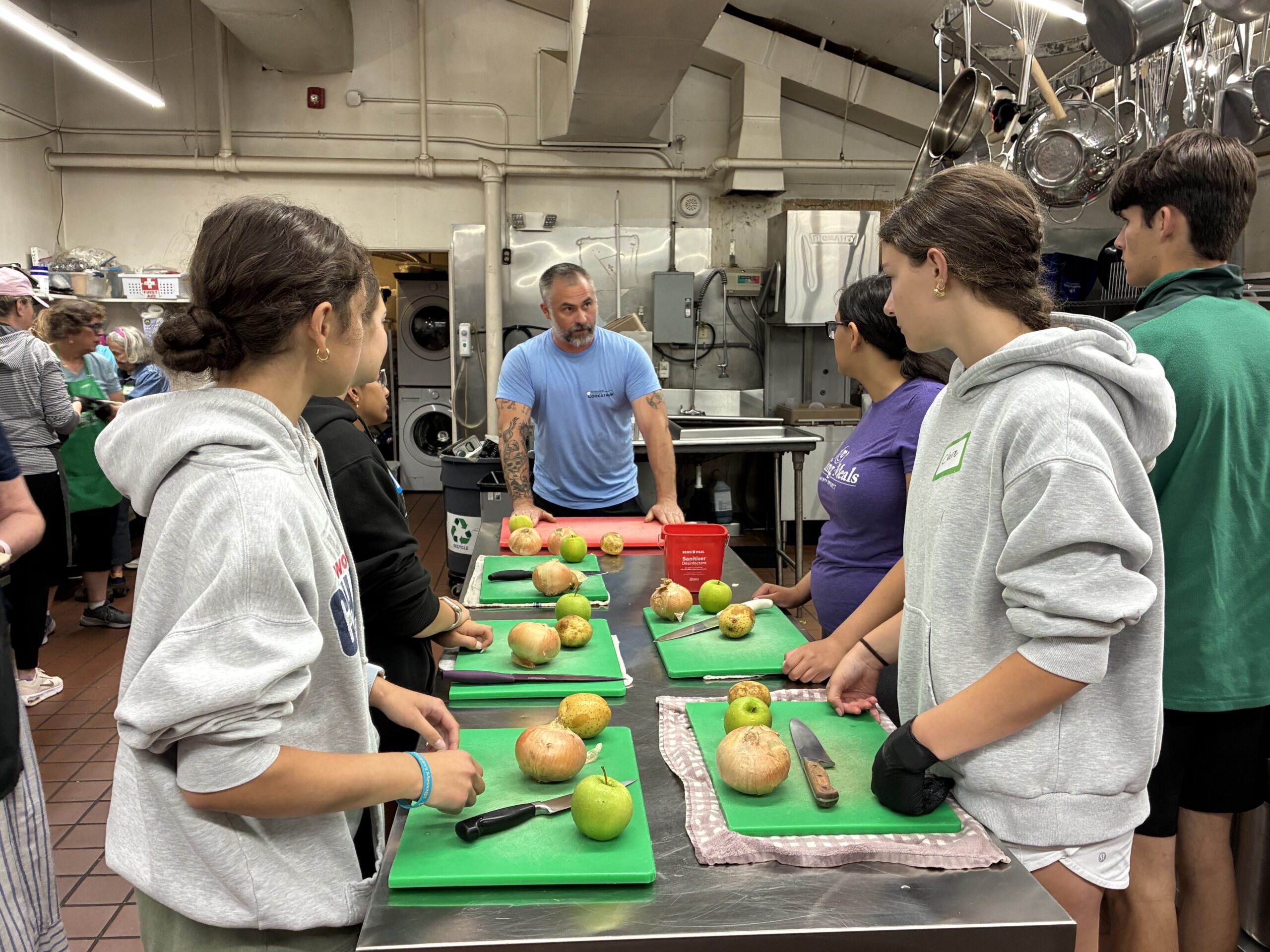
Executive Chef Joe Bucholz with student volunteers. Via Healing Meals.

Joe Bucholz is Healing Meals’ executive chef.  He said there are major differences between his current workplace and the upscale restaurant kitchen he used to run, particularly around command and control. “I do a lot of supervising, a lot of coaching, a lot of connecting,” he said. “But I’m not actually cooking the food.”  He said he is always surprised when he hears parents say, “In our house, you are famous.”

At Healing Meals, the students are involved in food and nutrition in a number of ways. Their shifts often begin with a lesson about what they are preparing, where it is sourced, why it is being used. They are invited to eat what they cook and provide suggestions on how it can be improved or scaled. The adults in the room are there to coax the learning, whether by teaching the volunteers how to gather herbs or asking them to improvise when they’ve run out of cilantro. While there are many important protocols to follow, and safety guardrails strongly enforced, the message the youth receive is “We trust you.”

“The objective at Healing Meals is to have youth lean into the positive belief that we have about them,” said Palmer. “’You are amazing. You are capable. You can’t mess this up. We love you.’”

After preparing and packaging meals, students sit down and write individual notes to each person the organization serves. The kids are encouraged to share positive thoughts and whatever is on their minds. Instead of “Get well soon,” the notes might say “It was such a beautiful day in the garden” or “I really enjoyed making these enchiladas for you.”

“It’s great to see how much they love this part,” said Leathers. “A lot of times, the clients write back, and that makes them feel like, ‘Oh my gosh, they cared about my card.’” Just outside the Healing Meals kitchen is a wall with hundreds of notes the students have received. 

While much of the volunteer experience unfolds organically, leadership and confidence are intentionally nurtured at Healing Meals. Students earn a Blue Apron after 50 hours of service and a Chef’s Coat after 100 hours. This final designation comes with an invitation to join the youth development committee, for which students meet regularly and contribute ideas and feedback that have led to enhancements in the program.

Addie, who will be leaving for college in the fall, has been volunteering at Healing Meals for three years. She was recently invited to join the board as a junior member. She said that, since starting at Healing Meals, her perspective on the work has flipped from “something that would be good on my resume that I should probably do”  to “an unbelievable experience that would also be good on my resume.” 

“I feel like people are motivated by what looks good or what their parents tell them to do. But for me, getting my Chef’s Coat, joining the development committee and then the board, these were things I worked for, I wanted for myself, that I’m proud of.” 

Leathers said the difference between students like Addie and those who have been “voluntold,” as she calls it, can be seen in the number of them who stay on. Eighty-five to 90 percent of the students that volunteer at Healing Meals continue with the program, whether they complete 20 hours or achieve 300. Leathers believes that what keeps the students coming back is the direct impact they have on the lives of the people they serve. 

“There aren’t a lot of volunteer opportunities for kids that can provide that,” she said.

“I still remember my favorite story that was shared in circle,” Addie said. “It was about a client who had come to the Healing Meals facility to visit, and she had noticed our wall of hearts, titled ‘Client Wall.’ She had asked if her name would be up there, and she was told to go see for herself. When she had found her name written in a heart, she had broken down in tears. She had felt so loved. In that moment, I really felt my impact. I had played a part in making this woman feel loved, something I never want to stop doing.”

Healing Minds

In addition to regular check-ins, Healing Meals surveys its students about the impact of their experiences. Increasingly, they have reported improvements to their emotional and mental health. In an email to Leathers, one parent wrote of her son, “He has reduced anxiety, reduced stress, increased confidence, increased social interactions and increased trust in others. He has since joined a sport and a club at school with his new-found bravery.”

Leathers sees this qualitative data as too powerful to ignore at a time when the adolescent and young adult mental health crisis continues to confound parents and educators. Indeed, there is ample evidence in the literature as to the benefits of service work on the mental health of young people, particularly through programs like Healing Meals which involve reflection on purpose and meaning.

Additionally, Leathers believes the palpable feeling of inter-generational connection at Healing Meals can be an anecdote to the unprecedented rates of loneliness youth are reporting and Former Surgeon General Vivek Murthy deemed “an epidemic.” 

Leathers is confident that as the organization expands to meet the increasing demand for medically tailored meals, the youth development program will grow, too. She has plans to open a new youth program in Hartford, Conn. in 2026 and looks forward to expanding in other parts of the state.

This summer, Healing Meals has launched its first-ever paid internship program for youth leaders who have earned their Blue Aprons. It is informed by the developmental relationship framework of the Search Institute, a youth-serving organization that conducts and applies research to promote positive youth development. As part of the program, Palmer is leading a session on life design that asks students to consider what they value and to reflect on how they want to feel.  Leathers sees the internship program as a pilot where staff and youth leaders are co-creating what they hope will be a more formal version of the iterative model that has helped so many young people grow. 

You can reach LearningWell Editor Marjorie Malpiede at mmalpiede@learningwellmag.org with comments, ideas, or tips.

The Toughest Game of Their Lives

When Alyssa Acompora began her career as a nurse in the intensive care unit, she threw her whole self into the job. As a former Division I swimmer at Fairfield University, that’s what she knew how to do: go all in. But unlike athletics, nursing didn’t offer external validation for her efforts, and before long, Acompora was burned out and considering leaving.

Acompora’s experience as a former collegiate athlete struggling to adjust to life after athletics isn’t unique. Many young adults who wrapped their entire lives and identities around their sport suffer as they attempt to transition to the real world. For that reason, Acompora created “Beyond the Athlete,” a counseling service aimed at helping former athletes discover their new purpose. 

“I thought I could just copy and paste how I operated as an athlete,” Acompora said. “But I was burning out because they don’t give gold medals in life.”

Beyond the Athlete is one of a growing number of similar businesses, especially as athletes of all levels have started speaking up about mental health, helping move the needle in the right direction. With unique challenges, the transition period between end-of-college athletic career and real career warrants a unique solution.

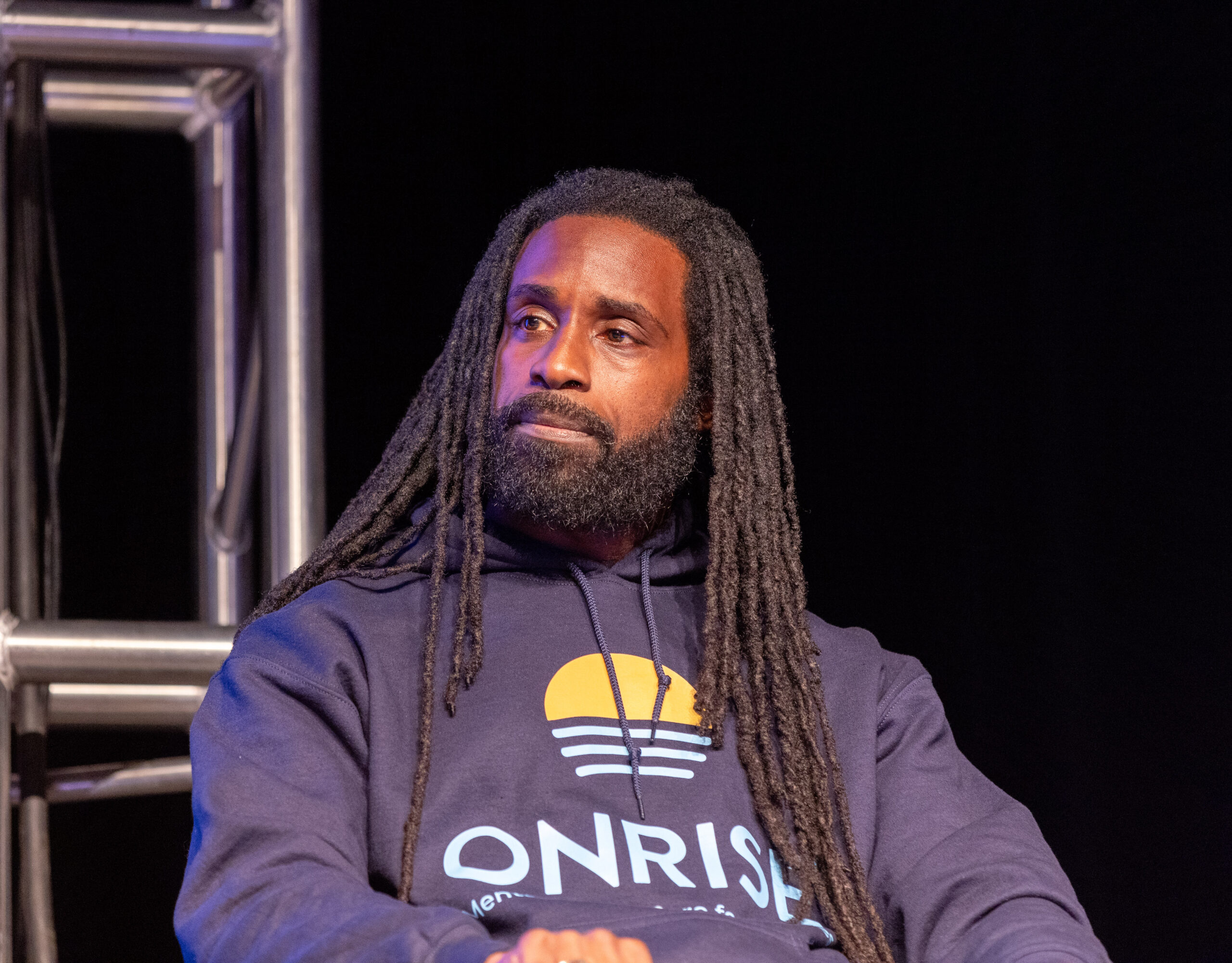
“These athletes face an identity crisis, especially if their careers come to an end by force, which they usually do,” said Derrick Furlow, Jr., chief athletic officer at Onrise Mental Health Care for Athletes. “They’ve been a part of their sport for so long and usually haven’t given thought to what’s next.”

In a world where only two percent of the 460,000 N.C.A.A. athletes move on to the professional level, a sobering number of young athletes are left struggling. 

“I thought I could just copy and paste how I operated as an athlete. But I was burning out because they don’t give gold medals in life.”

While some colleges are putting mental health support in place to help student-athletes adjust, many simply don’t have the resources, especially for those leaving the system. A 2022 survey from the National Association of Intercollegiate Athletics (NAIA) reveals that 90 percent of collegiate athletic directors do not feel their institutions provide adequate psychiatric support services for coaches and student-athletes.

Thankfully, former collegiate athletes are emerging to help those following in their footsteps. Their services take on different forms, but all have the same goal: to fill in the gaps that leave former student-athletes struggling as they adjust to a new world. 

Transition issues

When Acompora first began her nursing career, she did everything she could to be the best version out there. No matter how hard she worked, there were no gold medals to validate that effort. 

Like Acompora, understanding that life doesn’t offer external validation like athletics is something Tony Muskett has struggled with, as well. The 22-year-old recently graduated from the University of Virginia after finishing his football career there. “It used to be that when I had a big game, my social media would blow up all weekend,” he said. “Now, if I have a good day at the office, there’s no real acknowledgement. If you can’t find the internal motivation, you’ll struggle.” 

Acompora turned to therapy for help but found her therapists couldn’t relate. “They don’t think in an athlete mindset,” she explained. 

She kept trying, however, and eventually took some of the responsibility on herself, becoming a certified nurse coach, confidence coach, and athlete transformation coach. After eight years, Acompora began to pull out of her spin. “I began to identify patterns and habits of how I was trying to define myself,” she said. “I had to learn to internally validate myself.”

That meant identifying her core values, setting smaller goals and checkpoints, and celebrating herself along the way. This also carried over to her personal life, where Acompora learned to slow down, too. She took up yoga, surfing, and walking, defining consistency differently than she did as an athlete. “I realized I didn’t need to operate at full speed at 31 years old,” she said. “Many athletes feel like everything is a competition and that if they’re not going all out, they’re unproductive or lazy.” 

Muskett, who works in commercial real estate, admitted he was ill-prepared for the real world. He had his sights set on the N.F.L. draft, but injuries his senior year forced him to start thinking differently for the first time in his life. “For 20 years, I was programmed for football,” he said. “When you think about the possibility of life after football, it’s scary.” 

One reason for that, Muskett said, is that as a full-time athlete, you don’t have the time for internships and networking like other college students. Derrick Furlow said that’s a valid concern. “I was a football safety, so I was an anomaly who recognized I probably didn’t have a future at the pro-level,” he said. “I realized I needed to figure things out, so I started looking at the people around me to see who could expose me to other opportunities.” 

Not everyone thinks ahead like that, however, and many get stuck in the grieving process. “For most athletes, the game comes to an end, and its often not by choice,” Furlow said. “They will grieve the game, wish they had done more, and often experience anger about it.”

Jaimel Johnson, an all-American soccer player for the University of Tennessee who went onto a professional career, now works as an athlete mental health specialist at Onrise. “There are a lot of variables when you transition from school to after,” she said. “You’re trying to separate your identity from the field and figure out your value to the world.”

The helpers

In 1991, Brian Satola graduated from the University of Virginia, where he played football. He’s also the father to two student-athletes and has borne witness to how much things have changed. “There’s so much pressure on these student-athletes today,” he said. “Back when I was in school, the final whistle blew, we dropped off resumes, and found a job. Today, athletes are occupied with their sport full time and then must compete for jobs against kids who have done multiple internships and have stacked resumes.” 

During their time at school, these athletes have access to mental health resources. But when they graduate, they lose that structure. “A wall goes up and they’re left to dangle and figure it all out,” Satola said. “Colleges have limited resources to help and can’t provide the breadth of programming needed.”

For this reason, Satola recently helped found LAVA: Life After Virginia, a nonprofit dedicated to supporting U.Va. student-athletes as they navigate this transition. Working in partnership with the school and its athletic director, LAVA focuses on four key pillars: mentorship, mental wellness, alumni engagement, and career transition. “Many of these athletes don’t even know what they want to do after school, so we help pair them with alumni to get micro-internships,” he said. “We also let them hear alumni stories, so that they can understand how to launch a career.”

Satola started with a focus on the football players for now, with hopes that the model will expand to other sports at U.Va. He’s found an advocate in the coach and athletic director, who allow LAVA access to the student-athletes. “Without their support, the program doesn’t succeed,” he said. “The coach is a realist and understands the importance of mentorship and guidance for the players, and we begin offering that support from the start of the recruiting process.” 

Johnson would like to see these conversations begin even before high school. “I think we should get to a point where we start talking about the reality of what happens after sport at the youth level,” she said. 

The LAVA program models itself similarly to “4 For Forever” at the University of Notre Dame, whose intended goal is to support the student-athlete in a holistic manner, including preparing them for life after graduation. A former student-athlete created the Notre Dame program, and like U.Va., works with an external partner, called Life After Notre Dame. 

It was at a LAVA event that Muskett connected with Satola and to his first real job. “I’ve learned that I can apply some of the same principles I learned as an athlete to my career,” he said.

Identifying those assets, as well as what careers might be of interest, is key. “Athletes need to identify what transferable skills they have and what jobs might be good fits for that,” Furlow explained. “What are you good at? What do you do for free time that you enjoy?” 

Over their careers, these athletes have developed many transferrable skills, including time management, leadership, communication, and a hefty dose of confidence. But until someone points this out, they may not recognize how well they can apply those attributes in the real world. “We already possess the necessary skills,” said Alexis Hornbuckle, who played basketball at University of Tennessee and then won a W.N.B.A. championship with the Detroit Shock. “You’ve earned your athletic arrogance, and that comes across as confidence in a job interview. That can win in any space.” 

Conversely, that confidence can sometimes prove tricky. For athletes who are used to existing at the pinnacle of sport, understanding that they won’t be starting out as C.E.O. is a necessary reality check. Beyond the Athlete, Acompora’s organization, offers former athletes one-on-one mentorships to help them strategize a path forward and soon will add a community-focused membership, too. “Our goal is to help students keep the training wheels on for a while as they transition,” she said.  

Members of the Onrise team, including Kim Quigley, Derrick Furlow, and Alexis Hornbuckle, cheer on their shared alma mater, the University of Tennessee. Via Derrick Furlow.

Beyond the Athlete is relatively new, but in a nod to the fact that higher education is beginning to recognize the issues graduating athletes face, the organization is now an official partner of the NAIA. In this capacity, the organization provides mindset coaching, routine optimization, and identity creation. “There’s a growing recognition of the need for these services,” said Acompora. “Schools are learning that they need to care about athletes not just physically and mentally but to help them be well-rounded and prepared.”

Likewise, Onrise provides athletes with mental health specialists like Johnson, albeit in a business-to-business format. “We partner with organizations, and then the athletes can reach out to us without their coaches or anyone else knowing about it,” Furlow said. 

Onrise designed this format so that athletes have no hesitation asking for help. All its athlete mentors receive training in a “transition formula” that they can use with the student-athletes. Hornbuckle is one of those mentors. “In my era, we didn’t talk about mental health,” she said. “You didn’t want to be labeled as crazy. That’s changing, but we still want student-athletes to feel safe navigating this space.”

Hornbuckle added that, as a former athlete, she understands the issues students face, and how hard the end of a playing career can be. “It took me four years to truly retire,” she said. “When I quit, I felt like I was letting people down, and that sent me into a bad spiral.” 

The transition to the real world for student-athlete is highly individual, and all the newer organizations designed to help recognize that. The former student-athletes at the helm are uniquely equipped to understand the challenges the adjustment period presents.

Ultimately, no matter what supports are available to them, the student-athletes must seek out the help and put in the work for results, said Acompora. “They have to be the butterfly to my cocoon,” she said. “I can show them everything you need to transition, but they have to want it, too.” 

Without a Net

Seven years ago, Sam touched down in the United States, alone. Just 17, she had left her mother and siblings behind in West Africa to live with her father in New England, where he waited with her new green card.

But Sam’s arrival was one of the first and last parts of the move to go as planned. Her father became abusive, and after the pandemic descended, she moved in with a teacher who’d grown worried about her welfare. From then on, Sam’s education became both anchor and bridge to a better life.  

“I got that security from my teachers,” she said. 

College presented another respite from home, although it ended up coming with its own set of challenges, especially financial. From her first day on campus, Sam felt lost. She struggled to make friends in a dominant social culture that seemed to require an entrance fee she couldn’t pay. For her chronic health issues, she could barely afford transportation to appointments, let alone medical bills.  

Every year, Sam said, she wrote letters to the university administration explaining her financial shortcomings and appealing for leniency. The process started to feel dehumanizing, she said, as she found herself trying to prove “my story is sad enough to give me some aid.”

Yet she pushed on, often powered by a simple but effective refrain: “I don’t want to be poor.” Halfway through her first year, she caught a break when she was connected to the Wily Network, a non-profit based in the Boston area that provides holistic support to students navigating college without family assistance. The Wily Network helped Sam cover basic needs and went to bat for her before her last semester when it looked like she wouldn’t be able to make the final payment. 

Sam graduated this May, against all odds, and just in time to avoid some of the added fear students like her are experiencing, as the Trump Administration plans major changes to higher education and related social services. Months of speculation surrounding cuts to federal financial aid and public assistance, the elimination of diversity, equity, and inclusion (D.E.I.) resources, and the removal of immigrant and international students have left learners already at the greatest disadvantage haunted by the precarity of their situation. As the overwhelming uncertainty continues, it is these students who hang in the balance — those who rely on college for their safety and welfare and are one policy move away from losing it all. 

Keeping It Together

As the executive director of the Wily Network, Judi Alperin King, Ph.D., has had a front row seat to the host of new challenges her students have been managing in recent months.

The ground had always been shaky for those the Wily Network serves, Alperin King said, but at least they knew more or less what to expect. “Now that shaky ground is unpredictable.” 

“You cannot see the cracks in the foundation, and they just keep appearing,” Alperin King said. “Every day there’s a new crack, but it wasn’t in the place you thought it was going to be.”

Earlier this summer, one of Alperin King’s students flew across the country and drove deep into a rural territory, only to arrive and discover the internship that led him there had been cancelled. The work he’d been hired to assist was defunded amid the slew of cuts to federally funded programs, spanning climate and cancer research, foreign aid, and D.E.I. initiatives.

Other students had found out they lost their jobs before relocating for them, Alperin King said. This one hadn’t been so lucky.

With the student’s call alerting them to what happened, the Wily staff spurred to action, trying to figure out how exactly to get him to the airport from an area, apparently, without access to Ubers or even taxis. From there, he would need money for a ticket to Boston, a place to live when he got there, groceries to eat, and income to support himself until school started up in the fall. Without Wily on standby, he might have found himself stranded.

Some developments, like internship-ending cuts to programs and research, are affecting students in real time. Others simply loom, making everyone squirm. 

At any given time, top of mind for students assisted by the Wily Network is whether they’ll continue to be able to pay for college. Concerns have been churning around the fate of federal financial aid since Trump first began promoting the closure of the Department of Education and then signed an executive order to that effect in March 2025. 

Assurances from Education Secretary Linda McMahon that aid would continue didn’t assuage worries, especially as the initial version of Trump’s bill overhauling domestic policy included reductions to the maximum award for federal Pell Grants, which prop up more than six million students with the highest financial need.

This month, the bill that passed Congress and Trump signed into law didn’t include the Pell restrictions that had stoked the most fear, although there are other implications for financial aid. Among them are the elimination of Pell eligibility for students already receiving full scholarships from their institutions, as well as the expansion of Pell to cover shorter-term workforce training programs. In addition, the bill sets limits around the lifetime amount of federal aid students can receive for graduate school and winds down the number of loan repayment plans to two. 

Perhaps raising the most alarm are the law’s cuts to public assistance programs, namely Medicaid and the Supplemental Nutrition Assistance Program (SNAP), or food stamps. In 2020, an estimated 3.3 million students qualified for SNAP. But even if the changes don’t impact students directly, a trickle-down effect could. As states look to trim their budgets to fill the new gaps left in health care and food assistance, sector experts have warned higher education could take a hit that cuts back student support services or ramps up tuition costs.

The Trump bill’s changes to Medicaid and SNAP also involve denying eligibility to certain legal residents, including refugees and asylees. These restrictions come on the back of a larger crackdown on noncitizens in the United States.

From a higher education standpoint, these efforts have included the high-profile detention of international students, legally in the United States, targeted by Immigration and Customs Enforcement for their involvement in pro-Palestine advocacy on campus. The Trump Administration has also threatened to bar entry to international students who go to Harvard University as part of an ongoing power struggle with the Ivy League institution.

Any student originally from outside the United States or with family members from outside may be feeling vulnerable. Even Sam, armed with a green card upon arrival almost a decade ago, said she often can’t sleep at night from worrying about her status in the country. Learning about the recent detainment of an undocumented high school student by ICE in the town where she now lives didn’t make her feel better. 

“I think for me, I have always been scared,” she said. “I’m legal. I paid a lot of money to be here, but if you’ve never dealt with immigration before, it’s one hell of a beast.” 

“I think for me, I have always been scared.”

While policy confusion stirs up fear for high-needs students around their ability to stay on campus or in the country, the support services once designed to help them navigate this type of uncertainty are also taking a hit. 

Social worker Jamie Bennett, Ph.D., leads the Fostering Success Coaching Institute, which trains staff at groups like the Wily Network in best practices to assist high-needs students. Through her partnerships with these organizations, on and off college campuses, Bennett has gained first-hand insight into the kind of pressure they now find themselves under. At least two have undergone “mass layoffs,” Bennett said, due to funding cuts.

At a recent event Bennett hosted, free of charge and ironically focused on practitioner wellbeing, she guessed about 20 percent of those she had expected didn’t show. “Either they had lost their job or they were taking on responsibility from colleagues who were being laid off, so they couldn’t join,” she said.

For the most part, Bennett has been able to stave off any fallout for her work. But she imagines cutbacks for her partners could reduce her own services down the road. “That’s going to impact our ability to keep offering as many trainings as we do,” she said. “If they don’t have the funds to send their folks to professional development, they don’t come to us.” 

The Wily Network’s efforts have been affected, as well, as the flurry of cuts to university departments and resources leave even veteran advocates like Judi Alperin King unsure of how to help students. “In some ways, we’ve lost our power,” she said of her and her staff of “coaches.” With boundaries different from those of therapists and mentors, coaches take on wide-ranging tasks, from troubleshooting social problems and locating academic resources for students to acting as the emergency contact they wouldn’t otherwise have. 

“We knew what to do. Not every situation, but a lot of situations, they were predictable, and we could say, ‘Okay, here are the three steps you can take to support yourself through this,’” Alperin King said. Now those steps may no longer apply. 

Although neither Alperin King nor Bennett’s organizations receive federal funding, concerns have still emerged about whether they can completely evade government scrutiny. Both leaders have heard rumors that their group’s nonprofit status, which falls under the purview of the Internal Revenue Code, could be at risk should any of their activities draw higher concern, most likely in relation to the promotion of D.E.I.  

Those warnings haven’t stopped either from maintaining commitments to D.E.I., whether in spirit or explicitly on the company website and other materials. Bennett is firm on upholding her organization’s founding ideals. “We will say what we feel is just and what we feel is aligned with our values. Which are aligned on equity. They’re aligned on inclusion. They’re aligned on everybody’s voice matters.” 

While not overly concerned about her own job security, Bennett does worry about how that kind of stress, combined with increasing student needs, may affect the emotional wellbeing of other service providers. It’s critical, she said, for them to be “well and resourced and feel like they’re equipped to do their work, as they meet with students who have really complex situations and trauma.”

“If we start to see the support of them drop off, then it makes me nervous for what students will start to notice,” Bennett said.

At the Wily Network, one coach has begun to find her background in hospice care unsettlingly relevant to her current role supporting high-needs college students.

“You don’t really coach people at the end of life. You just sit with them, like, ‘Yep, death. Death is death,’” she said. Working with young people facing the unknown where their degree and future are concerned has started to feel like a similar experience.

“It’s more of an existential suffering,” she said.

The same coach has been struggling under the increasing weight of her students’ challenges. Guilt is a dominant emotion, stemming from the understanding she can distance herself from issues surfacing in higher education, from her job, in a way students can’t. 

“I feel like my empathic distress for students is harder to manage because, I mean, what’s going on is hard for me, but I feel like I have a home. I have a job. I have a lot of ‘knowns’ in my life that ballast against what’s going on,” she said. 

Student mental health has always been a prime concern for coaches, but now the uncertainty and fear fueled by real and perceived policy changes seem like the ultimate pile-on for young people already emotionally tested by years of striving and struggling. 

Alperin King knows her students are among the most resilient in higher education. She once used that fact to recruit new coaches, advertising the joys of championing talented students uniquely capable of battling through barriers — all the way to and through college.  

Students without family support who make it to college have a history of defying expectations. People like Alperin King and her colleagues are now asking, “Do we really need to raise the bar?” 

LearningWell used the pseudonym “Sam” and withheld other names in this article due to subjects’ privacy concerns.

You can reach LearningWell reporter Mollie Ames at mames@learningwellmag.org with comments, ideas, or tips.

Student-Centered Solutions   

Despite some signs of post-pandemic recovery, the college mental health crisis remains alive and not-so-well.

Young people passionate about their own and their peers’ mental health continue to sound the alarm on college campuses, while institutions across the country devote their own staff, resources, and time towards interventions to the same end. 

But are the two groups missing something or, more specifically, each other in the process? 

The Coalition for Student Wellbeing, a new student-led mental health advocacy group, is founded on the premise that the most authentic and effective solutions to student mental health issues will come from ensuring those making the decisions hear from those affected by them. 

Unlike other student groups that focus on issues within their institutions, the Coalition unites members across colleges nationwide to address a broad range of mental health concerns. The goal is to ensure that the student voice is part of the policymaking process, whether on campus or in Washington.

“The college student experience is so unique and dependent on the person,” said Carson Domey, the founder and executive director of the Coalition. “We need to tailor systems of care but also systems of education so that students are involved in these policymaking conversations at all levels.”

“We need to tailor systems of care but also systems of education so that students are involved in these policymaking conversations at all levels.”

Domey has never been one to sit on the sidelines. A rising senior at the University of Texas at Austin, he started the Coalition in August 2024, having been active in youth mental health advocacy for years.

He entered the world of policymaking and politics well before he could vote. By 11, he had been carted back and forth to hundreds of doctor’s appointments for a rare form of Crohn’s disease and began pushing for legislation in Massachusetts to expand access to telemedicine.

When a close friend died from suicide three years later, the scope of Domey’s advocacy grew. Since high school, he has pursued state-level mental health changes, like adding the 988 Suicide and Crisis Hotline to student IDs and expanding the definition of physical education to include mental health. 

At U.T. Austin, Domey makes time to be not only a full-time student and director of the Coalition but the chair of the Texas State Policy Council at the American Foundation for Suicide Prevention. His combined advocacy efforts regularly shift him between the Massachusetts and Texas legislatures.

Domey called the Coalition’s mission “purposefully ambiguous.” The broad purpose is “to bridge the gap between students and decision-makers,” though he didn’t set parameters around the type of “decision makers” members should target, nor the specific actions they should take to reach them. 

He likened the group to a sort-of universal puzzle piece, ready to fit in wherever needed.  

Raising awareness around student perspectives on mental health is one key focus. Members utilize a variety of platforms, like Substack, to publish their ideas on concerns, from suicide prevention and basic needs support to combatting loneliness.

A new webinar series the group launched similarly promotes young voices, and also puts them in conversation with experts. In June, the first webinar centered on the importance of K-12 mental health education to set up students for success in college and beyond. The second, airing in August, will be a “town hall” for students to share their thoughts on “the state of higher education going into the fall semester,” Domey said. 

But being a piece of a larger “puzzle” also means finding ways to compliment the efforts of other existing organizations and individuals, hungry for a student-informed edge. 

One example of this kind of collaborative advocacy is the group’s fall 2024 visit to the White House to contribute to a roundtable discussion on suicide prevention. 

Members of the Coalition for Student Wellbeing traveled to the White House in fall 2024 to participate in a roundtable discussion about suicide prevention.

Then, this spring, the Coalition teamed up with Active Minds to produce a toolkit of resources to help students advocate for printing the 988 Suicide and Crisis Hotline on student ID cards — an extension of Domey’s work in Massachusetts. 

The response from those the Coalition hopes to influence has been promising, as many leaders embrace the importance of including students in mental health policymaking on campus.  

The group’s advisory board comprising top administrators and advocates, including President Domenico Grasso of the University of Michigan and President Mark Gearan of Hobart and William Smith College, offers insights and expertise to help the students refine their advocacy efforts.

Gearan said he believes the student-inspired nature of the Coalition makes it both unique in the higher education space and valuable for administrators like himself. 

“It’s not that everyone can always agree with students, but the North Star is what is best for the student experience,” he said, adding that the diversity of the Coalition’s national membership is an added advantage.  

Domey has lost track, he said, of “the amount of times that I’ve just sat down with either a president, a provost, a dean of students, and really tried to get to know their role and their perspective more to make us a better organization.”

“We’re so much better for being able to have those resources,” he added. 

Domey expressed similar enthusiasm about the quality and connectedness of his student council. “There’s honestly a very small amount of students that I would say work on youth mental health nationally,” he said. “The pro is we’ve all gotten to really know each other, and it’s a really cool community of people spread throughout the country.”

While members may come from a range of backgrounds, they share a passion for mental health and, in many cases, impressive advocacy records.

Domey met Ela Gardiner, soon-to-be sophomore at Hobart, when they were both in high school in Massachusetts and already education advocates on the state stage. Gardiner had been elected one of her high school’s delegates to the Student Advisory Council of the Board of Education. 

She also struggled with anxiety and depression, an experience that spurred her mental health advocacy in the transition from high school.

When Gardiner discovered she could no longer see her Massachusetts-licensed therapist at college in New York, she dove into trying to adjust licensure policies and ensure students don’t lose crucial support at a vulnerable time. Along the way, she joined the Coalition. 

Shira Garg, a rising junior at the University of Georgia, connected with Domey and the Coalition through an internship involving research on college student mental health screening tools. Now, her pre-med focus not only grounds an interest in wellbeing but helps spearhead the Coalition’s assessment of gaps in the mental health space.

For the Coalition’s members, the collective dedication to mental health is a major motivator.

“All the students that are involved are so passionate about the topic, and I think that in itself kind of propels each one of us to want to do more and more and more,” Garg said. “When you surround yourself with peers that really want to make change, you also follow in their footsteps.”

The objective moving forwards is recruiting more members from new backgrounds and strengthening the foundation further, Domey said. 

“It all goes back to reflecting the stories of others and really trying to be that voice for as many people as you can.”

You can reach LearningWell reporter Mollie Ames at mames@learningwellmag.org with comments, ideas, or tips.
The Mindful Professor 

Lindsay Baker tended to be uncomfortable with conflict, a trait that extended to her professional life as an instructor at the University of Rochester. So when she heard about the new Mindful Professor Training Program available to the school’s faculty members, she saw an opportunity to address her aversion to engaging in difficult conversations.    

“After Covid, I wanted to stay involved with learning and professional development, and this program offered the chance to focus on things related to mindfulness that I haven’t looked at in awhile,” said Baker, an instructor of opera and arts leadership. “So I started asking myself, ‘How can I be more present in a conversation that might be challenging? What’s my own stuff I can take care of and shed before tense situations, so I can be open to better conversations with students and colleagues?’”

Launched in 2023, the Mindful Professor Training Program is a semester-long initiative that guides faculty through the principles of mindful leadership, helping them not only tend to their own wellbeing but also shape healthier, more supportive classroom environments. According to a 2021 study from the Healthy Minds Network (HMS), 21 percent of faculty surveyed said supporting students in mental distress had taken a toll on their own mental health — and 61 percent believed it should be mandatory for faculty to receive basic training in how to respond to students in distress. The Mindful Professor Training Program comes out of more than just post-pandemic urgency: a deeper recognition that the mental state of those who teach affects those who learn, and vice versa. 

“If we want to support students, we have to support the faculty and staff with these tools,” said Rebecca Block, director of the program and the university’s health promotion specialist. “We’ve known that students benefit from mindfulness. But what about the faculty? They’re the ones setting the tone.”

“We’ve known that students benefit from mindfulness. But what about the faculty? They’re the ones setting the tone.”

The inspiration for the Mindful Professor program took root in the years surrounding the COVID-19 pandemic. Faculty across higher education found themselves suddenly navigating Zoom classrooms and working with students in emotional crisis without training beyond empathy and instinct.

Research bore out what many were feeling intuitively. The 2021 HMS study showed that while 80 percent of faculty had spoken with students about mental health, only half felt equipped to identify emotional distress. “That was an eye-opener,” Block said. “We realized we needed a new kind of training as national data keeps on getting worse. We have to think differently because what we’re doing is not working.”

Block teamed up with consultant Lisa Critchley, whose background in mindful leadership in business settings brought a complementary expertise. Together, they created a curriculum that bridged personal mindfulness with leadership skills.

The result was a first-of-its-kind program in higher education: eight weekly workshops that combine meditation, discussion, applied classroom practices, and leadership skill-building. Critchley begins each session with a grounding meditation — breathwork, posture awareness, gratitude practices — before guiding faculty through exercises in mindful communication, self-regulation, and mentorly insight.

Lindsay Baker enrolled in the program in spring 2024 after spotting it in a faculty newsletter and joined a cohort of participants from a wide range of academic disciplines. 

“I used to have a really solid meditation practice, but it had fallen off,” she said. “I was curious whether this would help jumpstart it again and whether I could bring some of it into the classroom.”

She found that she could. From the earliest sessions, Baker was struck by the value of pausing — “arrival practices,” as she calls them. “I started incorporating little rituals into my acting classes: a breath before entering the studio, a moment of grounding before auditions. It’s simple, but it changes the space.”

Baker also found herself applying the lessons offstage. As she juggled multiple productions during a particularly intense semester, the program’s emphasis on resisting urgency helped her avoid spiraling into panic. Perhaps even more powerful was the community that the program fostered. Faculty came together across disciplines — from vocal coaches to mathematicians, from nursing faculty to researchers — that didn’t ordinarily have an opportunity to share substantive conversations.

“There was just this sense of acceptance that there is no one single way and we’re there to support each other,” Baker said. “Some people were hardcore meditators. Others said, ‘Hey, I remembered to breathe today — that’s a win.’”

Mindful Leadership, Not Just Mindfulness

What sets the Mindful Professor Training Program apart from traditional wellness offerings is its focus on leadership. While mindfulness courses for educators have existed for years, the University of Rochester’s program explicitly teaches participants how to show up for others — a skillset that can have tremendous impact on the tenor of a conversation and its outcome.

Mindful leadership equips faculty with emotional regulation skills that ripple outward. “How a teacher shows up in the classroom — whether calm or frazzled — actually influences students neurologically,” Block said, referencing the role of mirror neurons, which cause our brains to “match” the emotional state of those around us.

A teacher who brings a calm presence into a tense classroom doesn’t just feel better, Block said. They set a tone. They create an environment in which students feel more grounded, focused, and able to learn.

“Faculty who’ve gone through the program are better able to regulate their own emotions to be thoughtful when they speak, and they say it can impact the way the conversation goes,” Block said. “If you show up for a stressful conversation with a student in a calm way versus a stressful way, it’ll really affect the way the conversation goes and the way the student feels supported.”

Early results suggest the program is having an impact. Post-program surveys found 100 percent of participants incorporated mindfulness into their daily lives and teaching practices. The majority reported they’d experienced greater confidence in supporting student wellbeing and managing their own stress. And 85 percent said they were either “extremely” or “moderately” confident in their ability to use mindfulness strategies to support student wellbeing.

The program’s success has caught the attention of researchers and peers nationwide. Block and Critchley have presented their work at over a dozen national conferences and, last month, published a study in the peer-reviewed “Journal of American College Health” on the program’s measurable benefits.

To meet growing demand — and logistical challenges — the university is expanding its reach to make it easier for faculty to participate from different physical corners of the campus. This fall, a full cohort will be hosted at the University of Rochester Medical Center. Next spring, the team hopes to bring the program to the Eastman School of Music. A fully asynchronous version is also in development, aimed at increasing access for faculty with demanding schedules or at satellite campuses.

“Our goal is to meet people where they are. Sometimes the biggest barrier to participating in wellness work is just making it to the building,” Block said. “So we’re adapting.”

A Wider Movement Toward Educator Wellness

While the Mindful Professor Training Program is unique in its scope and integration of leadership training, it is part of a broader shift in higher education toward acknowledging the mental health needs of faculty.  

The University of Rochester’s broader “Well-being for Life and Learning” initiative offers an array of workshops focused on student wellness, and many faculty who complete the Mindful Professor program continue with follow-up coffee hours, self-care seminars, and classroom innovation labs.

With six cohorts completed and more than 60 graduates to date, the Mindful Professor program is gaining wider interest. Block receives regular inquiries from institutions looking to replicate the model, and when she speaks about it at conferences, she said she’s encouraged by the growing interest.

“We’re still growing,” she said. “But if our faculty feel more grounded, more connected, and more equipped to support students, that’s a win. They can really support not only student wellbeing, but their own teaching efficacy.” 

Inside the classroom, Baker is able to recognize that efficacy in the moment. “I’ve been able to identify and experience what we were talking about in the program in terms of that self-regulation and the ability to let some things go,” she said. “In those heightened moments of urgency or stress response, now I recognize what it feels like, and what I can do.”

You can reach LearningWell editor Marjorie Malpiede at mmalpiede@learningwellmag.org with comments, ideas, or tips.
Deconstructing ‘Climate Anxiety’

On April 8, 2025, the Trump Administration announced the end to $4 million in funding for research programs at Princeton University exploring risks associated with climate change. At the time, it was the latest instance in an ongoing wave of federal cuts to environmental initiatives. But this case sparked interest for another reason: According to the press release, at least one of the programs was eliminated because it was allegedly “contributing to a phenomenon known as ‘climate anxiety,’ which has increased significantly among America’s youth.” 

Environmental experts were quick to denounce the idea that the solution to anxiety about climate change would come from avoiding research on the topic. But it’s not the first time the phrase “climate anxiety” has been summoned for political gain, on either side of the aisle. The truth is the term gets used to describe all variations of distress over the state of the Earth. Parsing out the possible interpretations is an important exercise for educators, practitioners, and students themselves. 

2024 study of “climate emotions” in 16- to 25-year-olds found that up to 85 percent are “worried” about climate change and its potential impact; and for around 38 percent, these worries negatively affect daily life. Concern over climate change has become so widespread among young people that it’s affecting how they vote, whom they choose to work for, what products they buy, even their decision to have children. But are young people’s responses to climate change a clinical issue to be treated? Or do they fall in line with those to most social problems, just with a catchier, more damning name?

The framing of “climate anxiety” presents something disordered in need of a cure, but from a clinical perspective, there is a distinction between an anxiety disorder and experiencing some sense of anxiety. After all, the vast majority of young people may feel worried about climate change; the majority don’t have an anxiety disorder.

“Anxiety or worry on its own isn’t necessarily a problem or something to be treated,” said Kaitlin Gallo, a Boston-based psychologist whose practice focuses on young adults and college students. She said she’s encountered a spectrum of concerns when it comes to climate change. Even among her patients who tend to have clinical-grade issues, their climate concerns do not necessarily map onto an anxiety disorder. “Oftentimes, the worry is occurring outside of the context of an anxiety disorder, and it’s just what I might call sort of a normal or understandable worry given the state of the world,” she said. 

“Anxiety or worry on its own isn’t necessarily a problem or something to be treated.”

It’s when the worry becomes “hard to control or to move on from” that it could begin to signal a deeper anxiety disorder demanding a more clinical response, Gallo said. Even then, the end goal may not be to try to get rid of the concerns.

“I think sometimes when worries are realistic, then there’s just a different way to deal with them,” she said. “Sometimes it might not be reasonable or helpful to change the thought, but rather to think about how you want to live your life in the face of that concern.”

People who experience an anxiety disorder are certainly susceptible to dark fears about a fiery end. For others, particularly young people who have more time on the earth, climate distress, even fear, may be an unavoidable part of living. 

Olivia Ferraro, a 25-year-old living in New York, said dismissals of climate change are what really makes her crazy.  

“To watch business as usual go on around you with very little recognition of how distressing the state of the planet is can be really confusing. Because you’re like, ‘Am I insane?’” she said. “This feels like a problem that we should be moving to solve with World War II urgency. Everything needs to be mobilized to prevent catastrophe.”

When she first started experiencing more acute distress about the state of the climate and its future, Ferraro was surprised at the lack of sympathy she met from family and friends, especially those she expected to understand. If anyone had asked them, she knew they would say they cared about the environment.

Realizing her regular network might not be able to give her support she needed, she started exploring other options. She was especially interested in talking to people her age, given climate change, she said, “is a threat felt uniquely the younger that you are.”

“I wanted to be with people who could share that experience of, ‘I’m freaked out because I don’t know if I’m going to have a child anymore,’ or ‘I will be my parents’ age when a lot of these predicted catastrophic shocks happen. How can I think about my life when I’m 50 where I can’t get water from the tap?’” Ferraro said.

“I wanted to be with people who could share that experience of, ‘I will be my parents’ age when a lot of these predicted catastrophic shocks happen.'”

The support group she ended up finding was one she had to help create. Eager for an in-person space in New York, she started hosting “climate cafes,” or listening circles that bring together people with environmental concerns to share how they’re feeling. 

A grassroots initiative, climate cafes have popped up with chapters nation-wide. Ferraro said they can offer relief from advocacy-related burnout or help someone who doesn’t even identify as an “environmentalist” learn about new ways to contribute to the cause. On the website for Climate Cafe NYC, the branch refers to itself as “the social home of NYC climate action.”

“A lot of it is holding hands with people as they kind of walk into that unknown, knowing that you’re doing it together and that there are other people who are experiencing this,” Ferraro said. 

Part of the purpose is helping each other avoid hopelessness. “We can be sad, but to be despaired is a totally other feeling. That’s when you’ve given up,” Ferraro said. “We want to help people avoid despair and avoid nihilism and really, even though it’s very hard work, stay openhearted and willing to connect with people and understand how we can work together.” 

The need for these kinds of outlets is evident in the many students who are bringing their climate-related concerns to school with them. Professor Sarah Jaquette Ray said the emergence of this distress in her classes pushed her down a path towards a new expertise: emotions and the environment. Now she’s chair of the environmental studies department at Cal Poly Humboldt.

As recently as a decade ago, Ray said environmentalists were trying to ramp up concerns about climate change, with what she calls the “scare-to-care” approach. Opening young people’s eyes to the devastation that could come, the thinking went, would inspire them to act, before it was too late.

The strategy may have worked, but too well. Ray said she saw students becoming more enthusiastic about climate-related issues, but they also seemed more despairing. “I was noticing my students were not coping very well with the material,” she said. “I didn’t think my teaching was changing, but something was changing about the students.”

Up to that point, Ray had felt like her students were taking the issues in stride, embracing problem solving. With time, she said, “It felt more like an existential crisis for them.” She decided part of the problem was that students were learning a lot about what was going wrong and a lot less about how to manage their own response to the problems. “They weren’t learning all that stuff alongside coping skills or emotional intelligence or any kind of cultural frame as to why these things might be getting worse,” she said.

She set out to fill the gap. Research into the spiritual and therapeutic tools activists have used in other social movements became the basis of an understanding about how to deal with climate concerns. This mental health-forward approach to environmental issues also appears in her book “A Field Guide to Climate Anxiety: How to Keep Your Cool on a Warming Planet.”

Still, Ray continues to wait for the day when higher education institutions have integrated trauma-informed instruction and emotional intelligence into environmental education. That component “is just beginning to percolate on the edges of the tipping point,” she said. 

William Throop, professor emeritus and former provost at Green Mountain College, is also interested in activating a more personal dimension of environmental studies. For the philosopher-by-training, with a background teaching environmental ethics, it’s important to not only present possible climate change solutions to students but equip them with the life skills to enact them. This is an approach he views as part of “character education,” which he said prioritizes “the student as a person, not just as a collector of information.”

By learning what he calls “skillful habits,” Throop said, students stand to become “better critical thinkers, better ethical thinkers and actors.” In his book, “Flourishing in the Age of Climate Change,” he discusses a set of “hope skills” particularly helpful for confronting climate issues.

“Hope communication,” for example, is a skill Throop suggests could be particularly pertinent for tackling climate change. “How do you describe in a clear way the facts of a situation which are problematic and yet don’t turn people off?” he said. “How do you motivate people who address those facts in the way you communicate about them?”

Teaching hope, Throop said, might sound “like something a psychologist ought to do.” He thinks otherwise. “It’s something that should be embedded in curricula addressing these issues.”

As some faculty become more in tune with how students react to learning about climate change, students continue to turn towards each other to process the emotions they are experiencing. 

Eva Salmon, a rising junior at Barnard College, said she doesn’t usually struggle with anxiety in other facets of life; yet concerns about the climate are a constantly “simmering undertone” in the back of her mind. “In general, seeing everything happening in the world, it feels like my heart is constantly breaking, and I’m constantly experiencing a sense of betrayal.”

“Anytime it’s relevant, I can feel the grief. I can feel the anxiety. It really is there,” she said.

Compounding these emotions for students is the sense that their institutions are leaving them to lead the way alone. That’s the consensus among many members of Sunrise Columbia, the Columbia University branch of the Sunrise Movement, a national youth climate activism effort. 

Because it’s independent from the university, Sunrise Columbia can hold the administration’s feet to the fire in ways a club receiving school funding can’t. The student-run group conducts its own investigations into the university’s use of funds from fossil fuel companies to fund climate research. 

“Complicit Columbia” is the 53-page report the students published on their findings that the university accepted at least $43.7 million from fossil fuel companies between 2005 to 2024. More than a third of the funds benefitted the university’s research hub, the Center on Global Energy Policy.

Salmon, one of the student authors of the paper, said she takes issue with the fact that students, rather than university personnel, were the ones to take on this initiative. “The university needs to be more attuned and aware and doing its own research into these things. But for now, this is what we have,” she said.

The group of friends Salmon collaborates with has been key to keeping her motivated despite her frustrations. In general, she said she believes “a lot of the bad that’s happening in the world” is the result of “not prioritizing community” and disconnect among people. It’s a problem she feels grateful not to have. 

“To have found community and the space in the way that I have really has brought me a lot of peace and joy,” she said. The sense of support pushes her activism to the next level. “I think I would’ve done it regardless, but I don’t think I would’ve felt quite as empowered and impassioned.”

“At the end of the day, even if all this is happening around us, we have each other. And that feels like a very powerful, powerful thing,” she added.

Salmon’s overriding objective is to stay positive, to concentrate on the friends that are supporting her and the work they do together that bring her relief. “I really try and focus on recognizing the beauty in every step I take or recognizing things I like around me and just expressing gratitude for that,” she said. 

Olivia Ferraro, the climate cafe host, has adopted a similar outlook. While “climate anxiety” may be more apparent in her life than it was a few years ago, that discomfort has fed a deeper appreciation for the time she has left and a desire to make the most of it. It’s a guiding force that has changed her approach to relationships and decision-making.

“It’s been really freeing, honestly,” she said. “I like my life a lot more now than I ever did before.”

Personal Politics

The two most visible student political groups at the University of Texas at Austin are also the most opposed.

“There’s College Republicans, which is rah-rah Republicans, and there’s College Democrats, which is rah-rah Democrats,” soon-to-be senior Carson Domey said. He gravitated towards neither and wondered how an in-between space could be so hard to come by among more than 40,000 undergraduates.

The 21-year-old eventually arrived at a solution, the Annette Strauss Institute for Civic Life, a leadership development group that promotes “people instead of partisanship.” The “room for exchange of ideas” drew him in, Domey said, but the difficulty getting there explains his interest in a new insight from the Harvard Youth Poll, a semi-annual, national survey from the Institute of Politics (IOP) at the Harvard Kennedy School. This spring’s poll, released in April, offers a window into youth politics, including that only 34 percent of young people who identify as Independent or unaffiliated report a sense of belonging, compared to 51 percent of Democrats and 56 percent of Republicans. 

This latest iteration of the Harvard poll homes in on the impact of mental health in more ways than one. When it comes to today’s youngest — and most anxious and depressed — voters, the intersection of personal wellbeing and political formation is the object of growing concern. 

In 2000, the Harvard Youth Poll emerged after two undergraduates noticed a curious trend among their classmates: They seemed interested in public service but also appeared to prefer community service activities over more traditional political engagement. Was there something different, the students wondered, about their generation’s relationship with politics?  

Was there something different, the students wondered, about their generation’s relationship with politics?  

To find out, they approached John Della Volpe, then-president of an opinion research firm with ties to the IOP, to help design and conduct a survey of their peers’ political attitudes and activities.

Fifty polls later, the project has stayed true to its original mission, although the form changes every time. Della Volpe, now director of polling at the IOP, said the different questions season-to-season reflect “each cohort’s unique views” and how “they’re interested in understanding perspectives of their generation.”

While the poll’s founders delved into trends in political engagement, the students of 2025 probed more personal categories. In addition to views on federal leadership, DEI initiatives, and foreign policy, this spring’s survey inquires about social connections, financial stress, and life goals.

One of the resounding themes this time is, as Carson Domey pointed out, feelings of belonging. Among its major findings, the final report highlights that fewer than half of respondents say they feel a sense of community, and only 17 percent feel “deeply connected” to a community.

From there, the survey correlates sense of belonging and civic engagement. Forty percent of those who report feeling “deeply connected” to a community say they consider themselves politically engaged, compared to 14 percent of those without a strong sense of belonging.

To Domey, the struggle for belonging among young Independents seems to reflect the impact of polarization on Gen Z and the longing for community and the pressure to identify with a party as a result. Party affiliation, from his standpoint, may have as much to do with political theory as want of personal connection. 

Party affiliation may have as much to do with political theory as want of personal connection. 

The Covid-19 pandemic certainly didn’t help these feelings of disconnect. One in five respondents to the Harvard poll indicate they became more socially isolated during the 2020 lockdown, and these people are in turn more likely to be dealing with symptoms of depression now — five years later.

Those at major transition points, either starting high school or college, during the initial quarantine are most likely to report a lasting negative impact on their social lives. They are now 19 and 23 years old, respectively. 

John Della Volpe said he is wary of the over-attribution of certain political trends among Gen Z to their experience during the pandemic. Yet the way that the emergency disrupted their lives is important, and all the more for being just one of many crises they’ve encountered so far.

For Della Volpe, the real eye opening moment on the weight so many young people carry came before the term “Covid-19” existed. He was conducting a focus group, not long after the 2016 mass shooting at a gay nightclub in Orlando, Fla. that left 49 killed and 53 wounded. 

“The way you think about your taxes or your finances,” one student told him, “that’s the way we think about living and dying every time we walk into a classroom.” 

Within around two years, the same young people read about, or perhaps witnessed, the white nationalist rally in Charlottesville, Va. during which a car attack killed one and injured 35 others, including students from the University of Virginia; the mass shooting at a concert in Las Vegas, Nev. that killed 58; and the mass shooting at a high school in Parkland, Fla. that killed 17 staff and students.

“This generation’s not monolithic, and everyone’s experience is different,” said Rachel Janfaza, a youth politics expert. “But across the board, it would be hard to say that their politics is not at least somewhat interwoven with the fact that they have grown up amid crisis, and it is taking a toll on their mental health.”

Overfamiliarity with catastrophe does seem to dovetail with another major finding of the Harvard survey: widespread disapproval and distrust in the government. Only 15 percent say they think the country is “heading in the right direction,” and 19 percent say they trust the federal government to do the right thing most or all the time.

This discontent does not discriminate by party. While Donald Trump’s approval rating is about the same (31 percent) as in 2017, approval of Democrats in Congress dropped from 42 to 23 percent.

Janfaza imagines young people have become suspicious that “adults, elected officials pretend to know what they’re doing and have it all figured out.” Following the trials of the Covid-19 pandemic, she said, “the curtain has been peeled back.” 

“What I will definitely say is there is a mass feeling of uncertainty that’s on both sides of the aisle.” Domey said. 

Now that uncertainty seems to be affecting young people’s plans for the future. In what might be the most important finding for generations to come, less than half of the Harvard poll respondents rated having children as “important.”  

This trend may be the result of financial anxiety, with a quarter of respondents saying they are “barely getting by.” But Janfaza mentioned a conglomeration of factors: “Less stigmatization around not wanting to have kids, paired with rising cost of living, and fear about climate change, and just overall gloom and doom.”

Still, if frustrated, Gen Z-ers are not resigned. “They are showing up. They are saying they want to be involved,” Janfaza said. “Their lives are affected by these issues in their communities, and they are speaking up and out about it in a number of ways.”

To Domey, the Harvard poll feels like a call to help students cultivate new sources of much-needed certainty in their lives, whether through community or other senses of purpose.

“Like, how do we care for the whole person in college?” he said.

Taking It to the States

For 20 years, the Louisiana Center Addressing Substance Use (LaCASU) had been making strides in its work supporting state colleges and universities struggling with drug and alcohol prevention efforts. By all accounts, LaCASU’s research, training, and data collection made strong contributions to treatment and recovery at Louisiana State University and beyond. But gaining real traction, not to mention funding, required the power and gravitas of merging with an official state government body.

“My emails went over a little bit different coming from a board of regents email address,” Dr. Allison Smith, former associate director at LaCASU, half-joked to a crowd in Baltimore, Md. on April 23. She was participating in a panel discussion at the conference, “Building Resilience and Success: State and System-Level Mental Health Innovations,” hosted by SHEEO (State Higher Education Executive Officers Association) and The Jed Foundation.

In an age when federal funding is uncertain, campus leaders are looking for novel sources of state-based support for student mental health. The conference in Baltimore highlighted a number of ideas, options, and success stories. A new resource guide, “Engaging State Policymakers to Support College Student Mental Health,” presented by the American Council on Education (ACE), offers more to take home. 

“It was sort of like, well, in the current administration, where does it make sense to direct our energy?” said Hollie Chessman, director and principal program officer at ACE. “How do we continue to move the needle on mental health on our nation’s campuses?” The answer, she found, was rooted in pulling the right (state) policy levers.

“In the current administration, where does it make sense to direct our energy? How do we continue to move the needle on mental health on our nation’s campuses?”

While data suggests small improvements trending in some aspects of mental health in college students, anxiety and depression remain rampant. The 2024 Healthy Minds Study reported depression and anxiety symptoms had decreased three and two points, respectively, compared to the previous year. Yet 38 percent of students still reported struggling with depression, and 34 percent with anxiety.

The scale of the issue, which escalated year-over-year from 2007 to 2022, has drawn concern from both sides of the political aisle. Several bills promoting mental health interventions on college campuses, and at all education levels, have received bipartisan support in recent years. In 2022, the aptly titled Bipartisan Safer Communities Act, including initiatives targeting the reduction of gun violence, passed with $1 billion earmarked for school mental health services. In April, the Trump administration canceled this funding

Chessman and her colleagues at ACE had been worried about this kind of fallout for student mental health programs. In 2024, they were spearheading a $13.8 billion bill to back research, training, and other services at universities. This year, they refocused their attention on other projects, including a toolkit to illustrate a pragmatic route towards a solution. 

Coalescing with peers provided the path forward. Talks with a mental health coalition of leaders in the field, such as the American Psychological Association, Active Minds, and the Healthy Minds Network, revealed a gap ACE might fill: The experts were anticipating a pivot towards state-level advocacy, but needed direction on how to go about it. “From that conversation,” said Ngan Nguyen, ACE government relations associate, “we started to think about drafting a toolkit.” Nguyen and her co-associate Alexander Cassell became the lead authors.

The final guide features four main parts. First comes an emphasis on data collection to specify campus needs, with links to surveys for assessing mental health and a Return on Investment Calculator for College Mental Health Services and Programs. Then, the toolkit outlines a series of talking points. The first point covers the prevalence of mental health issues and their implications for college attrition and basic needs insecurity. Others home in on the interventions state funding in particular can promote, and the benefits of telehealth. The third and longest section delves into examples of work other institutions have done in partnership with states to advance mental health. The fourth lays out a final host of resources, including other organizations and assessment tools, to further university advocacy efforts. 

One of the main goals, and challenges, of designing the toolkit was ensuring relevance across states and for a range of professionals and institutions, Nguyen said. She thought about whether the strategies would be helpful for campuses in a variety of political climates; for those just launching advocacy efforts and others far along in the process; for university higher-ups, as well as general staff and students. The tools needed to be easy to customize.

 “The toolkit gives folks a really solid foundation, and then [they can do] whatever makes sense for them,” Chessman said. She added that not just the process but the end result might look different depending on the school or the state. “Maybe the climate in their state has the opportunity to ask for money. But it doesn’t have to be for money.”

Gathering data on return on investment for mental health initiatives struck Nguyen as one of the most crucial and broadly relevant recommendations. Tom Harnisch, vice president for government relations at SHEEO, agreed. (Harnisch also serves on the LearningWell editorial board.) “Investments in student mental health are important, but they’re going to be in a competitive environment, with a range of other items, vying for a limited pool of available state funding,” he said. “The focus on return on investment and student success is critical.”

Harnisch also highlighted the toolkit’s section listing examples of successful state mental health policymaking. “Policies to expand access to student mental health services. Growing the pipeline of mental health professionals. Boosting state funding. Addressing basic needs insecurity,” he recounted with enthusiasm. “There are so many ways that states can make a difference.”

Knitting in Class

Mary Beatty was stressed about the upcoming presidential election. It was fall 2024, and Beatty, then a senior at the University of Richmond, was spending her final year of college classes mindlessly doom scrolling on her laptop. 

Her mom suggested she try knitting. One day, Beatty, a leadership studies major, brought a beginner’s crochet kit to her classes, which ranged from five to 25 people. The repetitive, small movements required to crochet a blue narwhal—an item the kit provided instructions on how to create—forced her off her laptop and drew her into the class. 

 “I’m able to absorb the information better if my hands are doing something tactile,” she said. 

Beatty is among a new crop of students who are turning to an old craft to help them focus and relieve stress. Knitting has emerged in classrooms across the country, at liberal arts colleges and state universities alike. Student knitters and educators tout knitting’s unique ability, backed by research, to reduce stress and enhance focus.

Annabel Xu knits throughout all five of her first-year courses at Harvard Law School and has the wardrobe to show for it. This spring semester, she knit a blue sweater, a purple top, and a pink cardigan, which she made for her mom for her birthday.

During class, Xu will occasionally place her needles and yarn aside to jot down notes on paper or answer a cold call—a term for the fear-inducing Socratic method in which a professor peppers a student with probing questions.  

Xu said she received permission from her professors to knit in their classes after explaining that knitting helps her concentrate. “I’m not slacking off,” she assured them. 

Xu, who learned to knit on YouTube during the coronavirus pandemic, uses the continental stitch, a repetitive, rhythmic movement that she said keeps her hands occupied without requiring much brain power. 

There is a misperception, she said, that students who knit in class are not paying attention.

“People will say things to me like, ‘It’s funny that you were knitting, but then when you got called on, you knew the answer.’ And I’m like, ‘Yeah, because I was paying attention.’”

“People will say things to me like, ‘It’s funny that you were knitting, but then when you got called on, you knew the answer.’ And I’m like, ‘Yeah, because I was paying attention.’”

Research supports anecdotal evidence that knitting promotes mindfulness and focus, according to Teresa May-Benson, a life-long knitter and occupational therapist who practices outside of Philadelphia. 

“Sensory and motor activities help regulate the brain,” Benson said. “Doing things with your hands, especially if it is something productive, is very organizing. It is common that students, especially those with ADHD and other attention issues, find it helpful.” 

Not everyone in the classroom benefits from knitting. Harvard Law School student Nikhil Chaudhry said peers knitting in his classes has interfered with his ability to concentrate on the professor.

In one of Chaudhry’s classes, a student knits directly behind him, which he said sends the noise of metal needles clinking into his ears. In another class, a different student knits directly in his line of sight to the professor. 

“Knitting looks so different from everything else that it’s really a visual distraction,” said Chaudhry, who is surprised that professors tolerate students knitting in their classes. 

“It is disrespectful,” he said. “You have an eminent legal scholar, who you’ve paid $80,000 a year to learn from—and you’re knitting.”

A Harvard Law School spokesman did not respond to a request for comment on the school’s policy regarding classroom knitting. 

Harvard Law School Professor Rebecca Tushnet said that while she would allow students to knit in her classes, other professors may find it “off putting,” especially if they expect students to take notes. 

“Anecdotally, students have knitted in classes for a long time. I’ve spoken to a number of lawyers who either did it or remember a classmate who did it,” she wrote in an email. “I would allow a student to knit because I know from personal experience that it can aid focus on the class, as long as the knitting is simple enough.”

Students and teachers have not always supported students knitting in class or engaging in other sensory activities.

Beatty, the University of Richmond student, said her public high school in Connecticut banned all types of fidget instruments, such as friendship bracelets and fidget spinners. 

“There was a belief that you couldn’t get away with that in the real world,” she said. “The mentality was, ‘This would not fly in college.’” 

Samuel Abrams, a professor of politics at Sarah Lawrence College in New York, suggested knitting may be more prevalent at schools that promote a progressive approach to education, compared to schools that “may expect more traditional behavior.” 

“I believe in a progressive education and progressive teaching,” he said. “The result of which is I want to be as accommodating and open to whatever learning styles suit my students in the best possible way.”

Abrams said, in total, he has had more than a dozen students—of different genders—knit in his classes. 

He said he allows students to knit because it is an evidence-based intervention to promote focus that has few drawbacks relative to other accommodations he has granted. Abrams said a student once brought a support animal to class that went loose and caused students to scream. (He declined to name the kind of animal to protect the student’s anonymity.) 

“As with most things, it’s about having the right tone and recognizing that we want to try to maximize everyone’s needs and set the right conditions in our classrooms to make it work for people,” Abrams said.

Knitting may be out of the ordinary and visually conspicuous. But it is far from the only behavior taking place in the classroom that could be viewed as distracting.

Mary Esposito, a junior at the University of North Carolina at Chapel Hill, said she has seen students use their computers during class to play video games, shop for clothes, and even watch porn.

“Students are going to do what they’re going to do,” the business major said. 

Esposito went viral on Instagram for a video following the TikTok trend “there’s always that one kid in class” and depicting her crocheting a pink scarf toward the back of a lecture hall.

The video garnered roughly five million likes and 15,000 comments. Esposito, who said she is diagnosed with autism, uploaded a series of follow-up posts responding to the comments and dispelling beliefs that she knits in class to bring attention to herself or because she is not serious about academics.

“As someone who is on the spectrum, this is really helpful for me to do in class because my hands need to be doing something,” she said. “It’s more of a tool for engagement—not distraction. That was the bigger dialogue that this video started aside from being just a silly, funny trend.”

After posting the video, Esposito said, people came forward telling her they also knit during class. “All the sudden, going viral, it proved there were actually other people like me.” 

Esposito said her grade point average is a testament to knitting’s educational benefits (she has made the dean’s list the last two semesters). She recommended anyone struggling to focus in class travel to their nearest arts and crafts store to purchase needles and yarn.

A Framework for Flourishing 

If you studied or worked at a health-promoting university, would you know it? Would you recognize the institution’s commitment to wellbeing in your daily activities, your relationships, your environment? For the colleges and universities that are part of the U.S. Health Promoting Campuses Network (USHPCN), the answer to these questions is yes, or at least, that is the aspiration. 

The USHPCN is a coalition of colleges and universities dedicated to infusing health into their everyday operations, business practices, and academic mandates. It was launched in 2015 to promote the “Okanagan Charter: An International Charter for Health Promoting Universities and Colleges,” which offers a blueprint for making wellbeing an institution’s foundational principle.

As it celebrates its 10-year anniversary, the Okanagan Charter (OC) is now an institutional priority at 39 schools in the United States. Around 300 others are not official “adopters” of the charter but participate as “members” of its broader network. For these colleges and universities, the O.C. serves many purposes. It is a pledge, a road map, and in some cases, a license to experiment with new approaches outside the traditional lanes of higher education. More than anything perhaps, the Okanagan Charter is a major shift in thinking about what constitutes wellbeing on campus, as well as who is responsible.  

The Okanagan Charter is a major shift in thinking about what constitutes wellbeing on campus, as well as who is responsible.

“With the Okanagan Charter, institutions around the country are reimagining higher education as a catalyst for human and planetary flourishing on every campus, everywhere,” said Sislena Grocer Ledbetter, chair of USHPCN and associate vice president of counseling health and wellbeing at Western Washington University. 

International, Indigenous Origins 

The Okanagan Charter reflects an international recognition of the influence of higher education on “people, place, and planet”—the three domains frequently cited within the common language the OC provides. “Higher education,” the charter goes, “plays a central role in all aspects of the development of individuals, communities, societies and cultures—locally and globally.” Indeed, colleges and universities serve as not only large institutions but major employers, creative centers of learning and research, and educators of future generations. 

The OC grew out of the work of the World Health Organization’s Health Promoting Universities movement of the 1990s.  The document was formally launched at a 2015 International Conference on the University of British Columbia’s Okanagan campus in Kelowna, Canada. The first draft of the charter was based on input from 225 people with the support of a writing team and an additional 380 delegates who critiqued and refined the document. Its introduction includes an acknowledgement that the OC was developed on the territory of the Okanagan Nation.  

In addition to recognizing the influence of universities on people, place and planet, the charter’s creation and early appeal was in response to the growing international crisis in mental health. According to the Healthy Minds Study, the rate of (mental health) treatment (for college students) increased from 19% in 2007 to 34% by 2017, while the percentage of students with lifetime diagnoses increased from 22% to 36%. By 2015, it was becoming apparent that campuses in the United States were indeed not well. 

One recent paper, “The Okanagan Charter to improve wellbeing in higher education: shifting the paradigm,” suggests a public health approach is the way to solve this problem which led to overwhelmed counseling resources and concerns over inconsistent help-seeking. One of the authors is Rebecca Kennedy, assistant vice president for student health and wellbeing at the University of Alabama at Birmingham, the first school in the United States to sign the Charter. 

“For many years now, universities have been trying to help students on their campuses thrive and flourish, increasing the availability of services on campus,” Kennedy and her co-authors explain. “Many of these services, including mental health treatment, are directed towards individuals, which is important for that individual, but does nothing to create conditions that prevent the need for these services at the population level.” 

In their research, the authors found a paucity of population-based strategies and little examination on system-wide approaches. “There was little evidence of policy, systems, or settings wellbeing strategies in the higher education literature. There was a lack of scientific investigation and evaluation examining the impact of changes to public policies, regulations and laws that impact the health of college students.”

The Okanagan Charter is an effort to fill that void first by creating a framework for improved wellbeing at the population-level on campus and then capturing data that will show its effect over time. According to the charter, “Health promotion requires a positive, proactive approach, moving ‘beyond a focus on individual behaviour towards a wide range of social and environmental interventions’ that create and enhance health in settings, organizations and systems, and address health determinants.” 

For colleges and universities, this means applying a “settings and systems” approach to scenarios one might think of as singular or isolated. One example the authors offer is the diet of college students. While adding more nutritional food to the dining hall menu may be one (downstream) solution to improving students’ notoriously unhealthy eating habits, keeping dining halls open and accessible after hours or during breaks so students avoid resorting to vending machines would be the upstream approach. A Campus Determinants Model, within the Okanagan Charter and mapped to person, place and planet, further demonstrates these distinctions.  

Understanding What Institutional Wellbeing Looks Like

The document, which is 11 pages, provides institutions with a common vision, language, and principles on how to become health and wellbeing-promoting campuses. It includes two calls to action: “Embed health into all aspects of campus culture, across the administration, operations, and academic mandates; and lead health promotion action and collaboration locally and globally.”

What that looks like for campuses within a sector as diverse and tenuously connected as higher education is the big question and the primary work of  the USHPCN. Associated with the International Health Promoting Universities & Colleges Network, the USHPCN supports campuses in interpreting and operationalizing the Okanagan Charter framework, acknowledging the unique factors that influence the OC’s adoption on each campus. Designees from the institutional members, as well as from the schools who have formally adopted the charter, work as a network, meeting regularly and sharing best practices and metrics.  

Julie Edwards is the assistant vice president of student health and wellbeing at Cornell University and the chair-elect of the steering committee of the USHPCN. She is well known among the OC community, as she chairs the potential adopter cohort and is frequently called upon to consult with schools just starting their journey. She urged Cornell to adopt the Charter in 2022 and has made it a pillar of her work and that of the entire university with the full engagement of partners, from faculty members and facility managers to the president’s office.  

“First and foremost, the Okanagan Charter gives us shared language and a shared vision,” Edwards said of the OC’s implementation at Cornell. “An unintended but powerful outcome is that people have become genuinely excited to understand this health-promoting concept and their role within it. Wellbeing is no longer looked at as just an initiative from Cornell Health.”

Edwards said Cornell had an existing foundation of wellbeing support for students, staff, and faculty, as well as for the planet through sustainability initiatives. The Okanagan Charter was the Venn diagram that put it all together. After the adoption of the Charter, the school created multiple guidelines that align with the guiding principles. For example, if you’re thinking of revising or creating a new policy at Cornell, you are asked to consider the question, “Is this health promoting?”  

These criteria are used in decision-making throughout campus. To diffuse some of the academic stress among Cornell’s high performing students, changes have been made to transcript policies, including to avoid discriminating against students who have had to take an incomplete. Many colleges have also implemented credit caps to reduce stress of taking over 20 credits in a semester. Another recent policy change is that employees at Cornell are now allowed two additional floating holidays to use as they please.  

Through the Okanagan Charter, Cornell developed a Community of Practice—a structure that Edwards describes as “bringing together diverse folks who have shared goals to work together to solve complex problems.” With the participation of about 150 people on campus, the Community of Practice is also working on assessing the impact of the policies that have been adopted. 

“My hope is that when students, staff and faculty come to Cornell, they can feel a sense of care and compassion and support for their wellbeing. They can feel that they have equitable access to the services that are provided, and they are able to connect with others in meaningful ways to flourish.” 

At a very different campus, the team from University of Massachusetts, Amherst is equally as enthusiastic, though less far along in the OC process.   “We’ve been forming relationships, listening to speakers, really cementing the excitement for this concept as we move into implementation,” said Elizabeth Cracco, the assistant vice chancellor of campus life and wellbeing. 

Cracco said the Okanagan Charter, which is now part of the university’s strategic plan, came into view after the pandemic when every stakeholder on campus focused on a common goal. “During the pandemic, there was such a great demonstration of serving the greater good of the campus, and that made us want to keep going, to keep thinking collectively around wellbeing.”

Connecting the OC’s population-based approach to student mental health is a welcome strategy for Cracco, who is a trained clinical psychologist with student counseling within her purview. She said the Okanagan Charter allowed her to add a layer to this work, expanding their existing focus on providing individual mental health support.

“The systems we have built to deal with students who are in distress have not gone away,” she said. “But using this collective impact framework, we are able to consider larger issues, such as, ‘How are we going to undo some of the intended or unintended consequences of everyone’s attention going to a screen instead of each other or themselves?’ That’s a whole campus problem. That’s faculty, staff and students.” 

Cracco said what excites her the most about the work is the unexpected partnerships it is forging with other stakeholders on campus. As was the case during the pandemic, she is working alongside numerous teams on campus that are experimenting with new ideas, including creating a greater sense of belonging in the classroom and even making changes to the built environment. “We have a faculty member in the school of architecture who is working with her senior students on the redesign of our residence hall lounges,” Cracco said. 

Cross-sector partnerships are a commonly reported benefit for schools who have adopted the Okanagan Charter. For some, like Furman University in South Carolina, the OC framework was a natural extension of what was already happening on campus. Since 2018, the school has offered the trademarked initiative “The Furman Advantage,” a student-centered pathway that requires a first- and second-year program combining academic advising and student wellbeing.  

Furman’s involvement in the Okanagan Charter, first as an institutional member and then as a full adopter, was initiated by the Wellbeing Strategy Committee, co-chaired by Dean of Students Jason Cassidy and Meghan Slining, a faculty member in health sciences who is a well-known public health expert on campus.  

Cassidy said he had a good feeling about the Okanagan Charter right away and appreciated being part of a learning community that the USHPCN provides. 

 “People from campuses all over the country are really open to sharing what they’ve done, how they’ve done it, and meeting with you one-on-one,” said Cassidy. “But there’s no playbook. They give us a unified skeleton, and then it’s up to us to put the meat on the bones that makes the most sense for our campus community. I think that’s the only way you could get something like this accomplished.” 

While the adoption of the OC may have been an easy lift at Furman, it still represents a significant change in thinking on campus. Slining said she is frequently asked to explain the OC to people who, in another world, would never be expected to understand it. Their response continues to pleasantly surprise her.  

“This is not business as usual where the only people who care about health and wellbeing are from the health sciences,” she said. “Centers and groups all over campus are writing the language into their mission statements and figuring out how to incorporate it into their work. They’re fired up.”