Influencers for Life 

Ellise LaMotte, Tufts University’s Associate Provost for Student Success, knows how difficult college can be, particularly if you feel you don’t belong. Where she now works to connect all kinds of students with the support they need to succeed, she once felt utterly alone as a Black woman in a predominantly White, male field.   

LaMotte says the early setbacks she experienced as a first-year engineering student only made her more determined to make it in technology, business, and academia. After graduating from Northeastern University with an engineering degree, she spent years in telecommunications, earning a master’s and then a Ph.D., after working at Babson College. That led to a position at Olin College of Engineering, where she came full circle, realizing she had arrived at a position to make a difference in the STEM space for students, especially underrepresented ones. 

In this interview for LearningWell, LaMotte discusses what motivated her to continually move forward in school and life, starting with her desire to make her parents proud. 

LW: Has education always been important to you?

LaMotte: Growing up in my household, I honestly thought there was a law on the books requiring everyone to attend college. That stemmed from my dad. He had a great work ethic and expected us to have the same. Our only responsibility was to work hard on our education. He was determined to ensure that my brother and I attended college and were going to be successful and self-sufficient.  

So, my first motivation for attending college and pursuing advanced degrees was simple: to make my parents proud and to make sure I took advantage of their hard work.

As I grew older, I excelled in math and science—and, more importantly, I liked the subjects. The first time we dissected a cow’s heart, I was all in, and math was like a game I wanted to win. Everyone around me told me I could become an engineer and could make a lot of money. That advice led me to attend Northeastern University in Boston.

LW: What was that experience like?

LaMotte: It was very different. I grew up in Jamaica, Queens, New York, in a predominantly Black and brown neighborhood, and suddenly, I found myself in spaces where I was in the minority all day long—usually the only woman and the only black person. That change of environment started playing out in my head, reinforcing the messages I always heard: You have to be twice as good. You have to work twice as hard.”

I was determined to succeed, but I didn’t know how. My freshman year was a disaster. I had never failed a class in my life, yet I failed physics. That alone was tough, but what made it worse was another physics professor, who was also my advisor, one day came over and asked me and the two other women in the class, “Why are you in my classroom?” Then, he flat-out told us, “You should go home to your moms and become nurses, or teachers.” Needless to say, I dropped the class.

LW: Wow. What got you through? 

LaMotte: First off, my self-determination was strong. Second, I joined a Black women’s engineering sorority, Sigma Beta Epsilon, Inc., and I saw that these women, who were not much older than me and who looked like me, were succeeding in engineering. This was another piece of my how-to-be-successful puzzle. I now had mentors who said to me, “You can do this.” Fast forward to today, and these women are my friends who have become family. Other puzzle pieces I discovered from the sorority members were how to study, how to use my time wisely, and how not to be afraid of faculty office hours. And with this encouragement, I got a lot braver. In every class, I sat in the “power” middle seat in the front row. I thought to myself, “If you are going to ignore me, then you are going to ignore me intentionally.” There was no doubt that my motivation in college and afterwards stemmed from the mantra, “I’m going to do this because you think I cannot.”

“I’m going to do this because you think I cannot.”

LW: What did you do after college?  

LaMotte: My first job out of college was with a telecommunications company, and compared to college, my experiences were similar. I was usually the only woman and only Black person in a management role. I supervised people who were older than me and who were mostly White men. One man said to me, “You are my granddaughter’s age. What can I learn from you?”  Another time, I was told to change my hairstyle from braids, which I did not, potentially costing me future advancement. Through it all, I learned a great deal during my years in telecommunication, and these lessons learned shaped me professionally. However, I ultimately found the corporate world unfulfilling. 

LW: How did you end up in academia? 

LaMotte: I moved out of the corporate world into the non-profit space, supporting women entrepreneurs as they grew their businesses. I enjoyed creating initiatives and programs that directly support the dreams of others. From there, I found my way into higher education. I was finishing my Ph.D. in Education when I got an opportunity to join Olin College of Engineering, working for the provost as the director of academic services. Olin is a very creative place, where I found community and found I could get involved in initiatives on campus supporting students. I thought this is what I was meant to do—to support students in STEM who are underrepresented so they can shine. Over time, I wanted to be more student-facing, and that was the impetus for my move to Tufts University. 

I would also like to add that I had many role models during my doctoral journey. My professors and in particular my dissertation chairperson Dr. Tara Parker were instrumental as I altered my motivation, from extrinsic to ones that were more intrinsic. I now set goals to satisfy my interests and passions, so I can focus on honing my skills to support students whether I am at work or in my community providing service.

So back to my Tufts University journey, my first role there as the Center for STEM Diversity director was a great experience and made me realize my goal was to provide support for a larger student population on campus. So that opportunity and others at Tufts grew into my current role as Associate Provost for Student Success, working directly with President Sunil Kamar, Vice President for Strategic Initiatives Marty Ray, and Vice Provost for Education Cigdem Talgar. In this role, I work collaboratively to develop initiatives and opportunities, so all Tufts students are succeeding and thriving, regardless of their backgrounds. We are always thinking and asking the question, “What programs or structures can we put in place to support students at varying levels so they can thrive?” 

LW: You’ve fulfilled so many of the goals that motivated you. I’m assuming you have made your family proud.

LaMotte: Oh yes. I mentioned my dad. He was my silent cheerleader, and my mother was my out-loud cheerleader. They were present for my college and graduate school graduations. My mom was present for my doctoral graduation. Even though my dad was not there physically, his spirit was, as he received a shout out from University of Massachusetts’ Chancellor Dr. J. Keith Motley during his welcome address. As for my own nuclear family, my daughter witnessed me working while attending school, and she has always been proud of me for my efforts. Thus, I believe I am a good role model for her. As for my husband, he supports me in whatever I want to accomplish, makes way for me to reach my goals, and says to me at every turn, “Just go for it.” So, I always do!

Putting Purpose to Work

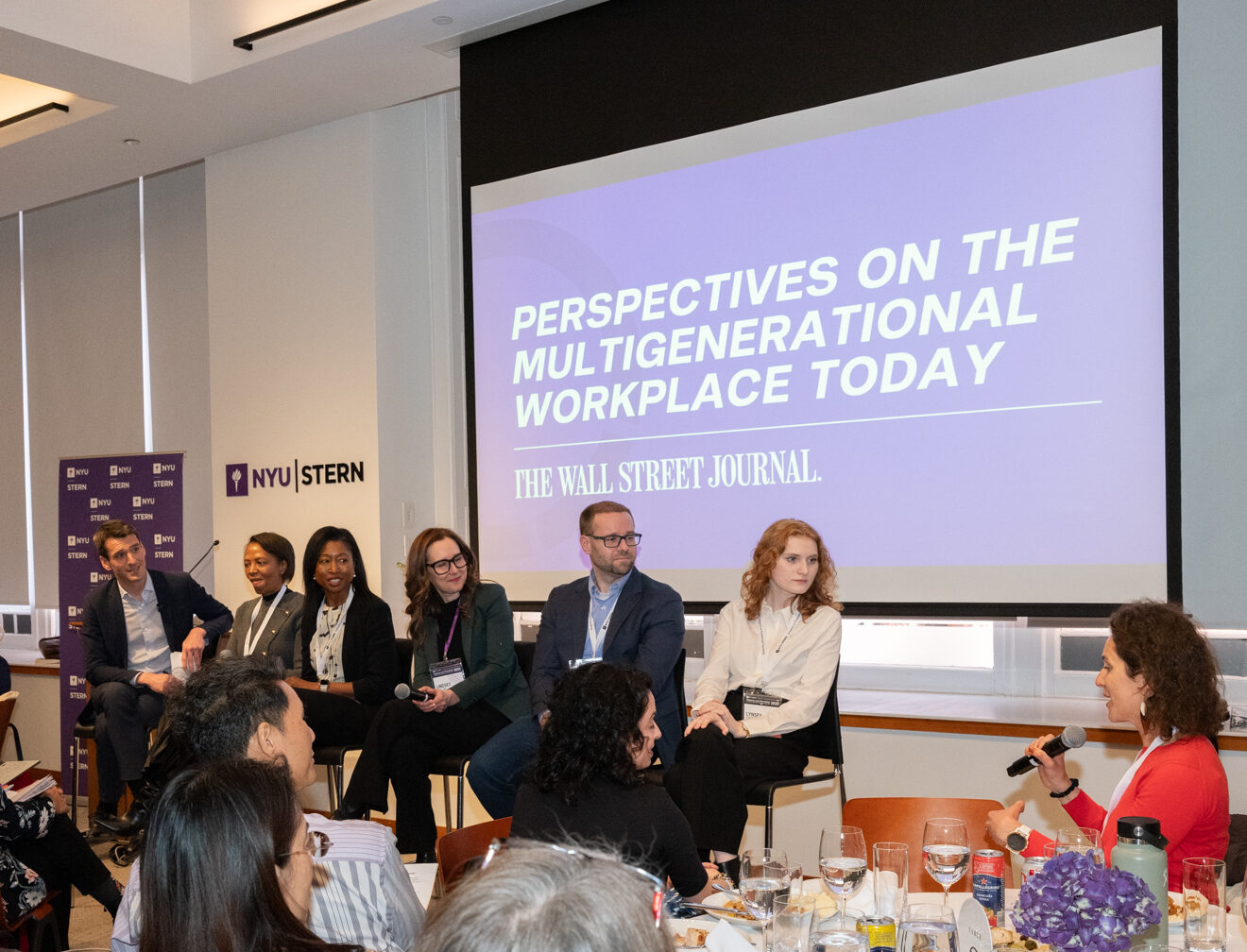
There were a thousand things different about them and one, at least, the same. They were nonprofit directors, HR officers, consultants, psychologists, journalists, researchers, quite a few university administrators, and even a college sophomore. All of them, it turns out, believe work should feel meaningful—maybe so they can be happier or help others be happy, maybe to boost their company’s bottom line or general productivity. Whatever the reason, around 150 of them from all over the country showed up in Lower Manhattan last week to explore bringing this vision to life.

The draw was the first annual conference of the Initiative on Purpose and Flourishing (IPF) on its home turf at New York University’s Stern School of Business. The theme of the March 27 event, “Purpose and Flourishing in the 5-Generation Workplace,” captures elements of the new initiative’s evolving focus, including wellbeing and career and an emphasis on the rising generation of workers. Just eight months since its founding, IPF is shaping up to be what might be called a think tank-plus, encompassing research, teaching, partnerships and events. And true to its business school sensibilities, it aims to translate theory to reality, bridging academia and practice.

“I love that this conversation can lead to actionable plans, programs, new ways of thinking, new ways of teaching,” IPF Director Suzy Welch said in her opening at the convening on Thursday. “We can help our young people, but also everybody, have ideas about how to find their purpose and live it and help organizations be a part of that process.”

“We can help our young people, but also everybody, have ideas about how to find their purpose and live it and help organizations be a part of that process.”

Suzy Welch, now a professor at Stern, unknowingly laid the foundation for IPF when she was still in school herself. Working as a crime reporter after college, she developed an interest in business journalism that led her to Harvard Business School. There, scholarship criteria had her studying around the clock to keep her grades up and debt down. “It made me an unpleasant student,” she said of her academic diligence. She remembered a peer chastising her for not attending a graduation party and, he told her, ‘not valuing fun.’ Incredulous at first, she started to wonder if he wasn’t right. Did she value fun? What did she value at all?

“I had no idea. I had never had those thoughts before,” she said. “I was growing up in a time where we did not sit around talking about those things, like what is the meaning of life, how do we flourish, what is purpose.” These new questions would guide her personal and professional life up to, and including, when she started teaching the class on them—literally. Before she launched the initiative, Welch designed a course called “Becoming You: Crafting the Authentic Life You Want and Need,” which she described as “a journey of self-discovery” and a chance for students to explore “a first cut at what their purpose might be.” 

Students responded to the material, and “Becoming You” earned a waitlist of hopeful participants. But something was missing, Welch found. She wanted to push the ideas beyond the classroom and individual students. She envisioned uniting thinkers and leaders in not only academia but business and nonprofit spaces, who were already tackling these issues—purposeful work, effective leadership, productivity—but on their own. “There should be a sort of a center where we all get together and talk about this,” Welch told then-Dean of Stern Raghu Sundaram. He agreed, and so began the plans for IPF.

An important step in getting this project off the ground was the addition of Senior Associate Director Dustin Liu to the IPF team. Liu joined from Stanford University’s Life Design Lab, where he was the associate director. The Life Design Lab promotes the work of “Design Your Life” (DYL), a Stanford course teaching students how to apply design principles to figure out their values and plot their futures. DYL, Liu said, is centered on “developing mindsets and behaviors through a particular framework”—the DYL framework—whereas IPF is an “umbrella” exploring various frameworks across jobs and institutions.

Liu said to think of IPF’s focus as a two-by-two matrix: “individual purpose” and “individual flourishing” on one edge and “organizational purpose” and “organizational flourishing” on the other. Liu and Welch, like DYL, are interested in how to help students thrive. They also want to home in on how people’s wellbeing influences the wellbeing of their workplace, and vice versa. “Those of you who are academics in the classroom know that when you look into the faces of the students, there’s a crisis,” Welch said at the IPF convening. “But it’s not just students.”

If the energy at the conference is any indication, IPF has identified a gap many are eager to help fill. The event brought into tangible focus the people IPF aims to connect and the concepts and practices they hope to promote. Audiences heard from, to name a few, a business professor about generational stereotypes that create divisions in the office where there could be alliances; a psychologist about the communication strategies that can cultivate more functional work relationships; and a corporate leader about management styles transforming employee productivity and retention. Many attendees worked in student-facing roles, and many within that group had a background in DYL. But not all. 

Whatever experience they arrived with, these like-minded people, having found each other at last, filled the conference room with the joyful buzz of early morning introductions and boisterous chatter that lasted all day. They didn’t sound like a group that will be keeping what they learned to themselves. 

Purposeful Information  

For more than a decade, colleges and universities have been relying on the Healthy Minds Study to help them understand the mental health of their students and those at other schools throughout the country. Indeed, this annual indicator and benchmark has become the bellwether for the state of college student mental health, capturing the dramatic increase in the prevalence of mental health issues among college students beginning around 2014.   

But as important as this survey data continues to be, the Healthy Minds Network’s principal investigators, Drs. Sarah Lipson and Daniel Eisenberg, stress that surveillance is only the start of a larger public health approach to helping every student on campus thrive. This mindset has led to strong partnerships with institutions and non-profits working to understand how mental health data can be interpreted and applied, particularly when it comes to policy changes and institutional investments.  

The latest example of this research-to-practice approach is a new report by the Healthy Minds Network, UNCF (United Negro College Fund), and the Steve Fund on the mental health and wellbeing of students at Historically Black Colleges and Univeristities (HBCUs) and Predominently Black Institutions (PBIs). Released earlier this month, the report, “Flourishing: Bolstering the Mental Health of Students at HBCUs and PBIs,” ties Black students at HBCUs to better mental health outcomes than both Black students at Predominantly White Institutions (PWIs) and a national sample of students of all races. 

Akilah Patterson, the study’s project manager and a Ph.D. candidate at the University of Michigan School of Public Health, said she was unsurprised by the results. Citing the strong sense of community HBCUs foster as a reason for students’ apparent wellbeing, she said, “nothing can really replace that.”

The concept and funding for the study came from UNCF, a major advocate and donor to HBCUs and their students. It partnered with the Healthy Minds Network to lead data collection and assessment, while the Steve Fund, a nonprofit promoting mental health among young people of color, contributed expertise.

Between spring and fall 2023, more than 2,500 students from 18 different HBCUs responded to a tailored version of the Healthy Minds Study. They answered questions from the standard Healthy Minds Study, along with a “Black College Mental Health Module,” added to provide insight into the Black college student experience.

The results suggest relatively better wellbeing among HBCU students across a number of scales. HBCU students report to be flourishing more (45% compared to 38% of Black students at PWIs and 36% of students nationally) and experiencing more campus belonging (83% compared to 72% of Black students at PWIs and 73% of students nationally).

The results suggest relatively better wellbeing among HBCU students across a number of scales.

While loneliness is endemic among students everywhere, significantly fewer students at HBCUs (56%) are experiencing “high loneliness” than Black students at PWIs (58%). Students at HBCUs are also less likely to keep negative feelings to themselves (74%) than Black students at PWIs (86%) or students nationally (83%).

Patterson said the wellbeing of HBCU students is an understudied area. “It’s not that it hasn’t been studied at all,” she explained, “but it hadn’t been studied in this way, on such a large scale, and also using some of the measures we chose to use.” 

In addition to insight into how HBCU students are already thriving, Patterson’s study suggests their institutions have room to improve support. Financial anxiety, for example, is the most reported stress factor among students at HBCUs. Twenty-three percent of HBCU students, compared to 18% of students nationally, say their financial situation is “always stressful”—an indicator correlated with greater risk of having one or more mental health problems.

Students’ financial struggles can be difficult for their institutions to tackle, Patterson said. But she hopes research like hers, and other projects going forward, encourage the kind of investment in HBCUs that, in turn, provides relief for the students. Empirically, she added, she believes the research “speaks for itself.” 

“We’ve been doing the work. HBCUs have been very committed for decades to the success and excellence of their students, and that’s not going to change.”

The Flourishing Factor

The spirit of this latest report from the Health Minds Network reflects an evolution of sorts for the data leader, along with many of its peers in the mental health research community. Their stronger focus on “flourishing” allows for greater examination of the many determinants that comprise mental health, such as financial wellbeing. 

In its 2023-2024 report, the Healthy Minds Network made headlines with news of slight improvements in student mental health, which had been trending negatively for several years. Lipson was particularly inspired by the 6% increase in student flourishing for several reasons, including the fact it is an outcome colleges mayhave some level of control over. 

“The web of causation for flourishing is much wider and often within an institution’s control,” she said. “When we think about what goes into flourishing—a sense of belonging, decreases in isolation, maximizing our built environment—there are levers here that institutions can pull, maybe not all of them, but more so than depression or anxiety.”

Flourishing has many definitions but is most often associated with healthy growth in a variety of domains. So anyone can flourish, with or without a mental health diagnosis. Additionally, while anxiety and depression are still alarmingly prevalent, not all students will experience either. From a public health perspective, flourishing is an outcome that is relevant to the entire population.  

Lipson said what is important about this measure, and indeed all of this research, is it helps administrators understand where to spend time and money based on what the evidence suggests is the best investment. To this end, the Healthy Minds Network has launched the creation of a best practices repository. While still a work in progress, the repository will provide that advice for a number of campus interventions.  

What is important about this research is it helps administrators understand where to spend time and money based on what the evidence suggests is the best investment. 

“What we should be investing in from a population, public health approach is a really difficult question given what little data currently exists,” Lipson said. “With the data repository, you can go to a publicly available resource and consider, ‘What are my options? What does the evidence look like? What schools have implemented this successfully, and who could I talk to there?’”

“Living a Life Worth Working”

Like today’s future workforce, Dr. Michelle R. Weise is bound to hold numerous roles in her already accomplished career. The former college professor turned ed tech executive worked at the Clayton Christensen Institute for Disruptive Innovation before becoming the chief innovation officer of Strada Education Network’s Institute for the Future of Work.

Weise is also the author of Long Life Learning: Preparing for Jobs That Don’t Even Exist Yet. In it, she argues for reimagining how we train learners and earners for the prolonged careers that come with longevity, though not necessarily in ways one might think. In this interview for LearningWell, Weise talks about what little structure exists for us to gain the knowledge we will continuously need. She advocates for changes within post-secondary education and the workforce that will help align one’s inner and outer lives and lead us to recognize our shared humanity in an increasingly isolated world.

LW: Your book suggests there are numerous jobs we might have in our lives. What has your own work life been like in that regard?

Weise: When I look back, I can see the stepping stones, but I didn’t really plan any of this out. It was a lot of pivoting, learning new skills, and then taking that newly acquired knowledge and launching to the next thing. My first job was as a tenure-track English professor. That was supposed to be my job for life, but I realized early on that it didn’t feel like the right calling for me. My first job outside of academia was for an ed tech startup that was helping service members transition out of the military into civilian careers. We were creating tools and services to help them translate their skills into the language of the labor market. Even though I didn’t know it back then, that focus on learners’ translation of their own skill sets has been a resonant theme throughout all of my work.

I ended up building out the higher education practice of Clayton Christensen’s think tank on disruptive innovation. That was, as you can imagine, incredibly formative for my thinking, research, and exposure to every burgeoning innovation in ed tech and workforce tech. I’ve since built out various innovation labs for universities and have also worked with a wide range of stakeholders in the learn-and-work ecosystem and even created the Strada Institute for the Future of Work for Strada Education Network. All of these innovation and thought leadership roles have been focused on connecting post-secondary education more closely to the workforce.

LW: Could you define “long life learning” and what you think the implications of that are for the workforce?

Weise: Our lifespans are extending, and our work lives are getting longer. People are staying in the workforce at historically high rates, well into their sixties and seventies. There’s been this conception that folks who are currently retiring only had a couple of jobs or maybe one job throughout their careers—the “gold watch generation”—but the data shows that’s not true. Even our early baby boomers are retiring with an average of 12 job changes under their belts. So for the rest of us, we can expect many more job changes and pivots to come. For younger generations, that may mean maybe 20 or 30 job changes over a lifetime. For me, the simple mental model of a longer life and longer work life brings into sharp relief that we have no architecture, no infrastructure, no systems really set up to help us keep up with a rapidly evolving future of work.

So, the book is really my attempt to put the decades-old concept of lifelong learning into action by laying out how we can begin to invest in the on- and off-ramps we’ll all need to move more seamlessly in and out of learning and work. How might we get just what we need and then keep moving along on the workforce highway without always having to make a tradeoff and forgo our wages in order to advance our education? What are the ways in which we can do this much more fluidly and in the flow of work?

LW: How can we begin to solve for that from both a preparation lens and a workforce lens?

Weise: I’ll start from a curricular perspective. In an ideal world, we’d like to hire talented people whom we could trust in highly ambiguous circumstances. We’d like to trust that they’d take in various kinds of information, signals, and analyses, make sense of all that, and then use good ethical judgment to inform their decision-making process. It’s a mix of both human and technical skills. We need people to be able to dance across disciplines, take ideas from another domain and use them in new ways. But it’s very hard to train someone to do this unless we teach them how to really deal with ambiguity.

In order to do that, we can’t keep teaching in silos. In our industrial learning complex, we silo everything we teach. We don’t illuminate the ways in which disciplines interact and overlap. For me, the future of teaching and learning will center on purpose learning—orienting learners around solving a problem they care about like poverty, hunger, or climate change, and in the process of struggling with that larger challenge, they learn why certain principles and disciplinary knowledge are necessary. They also learn how to transfer and apply knowledge from one domain to another.

The refrain in higher ed is that we teach people how to fish, but we don’t actually do this well. We teach people very specific content and problems within a discipline. We don’t help our learners understand the coherence across a vast array of courses as a body of understanding.

At the same time, in order for our learners to thrive in an increasingly uncertain future, especially now in an age of AI, they’re going to need to hone their human skills to complement the work of machines. The term “human skills” might make us think, “Oh, I’m human, I have these innate skills.” Yes, but they require deep practice. And for older adults in the workforce, where do they go to practice skills like emotional intelligence, communication, and systems thinking? The lack of these human skills make themselves known in the workplace when there’s friction, when there’s an inability to build strong and collaborative teams. We also need to be thinking about how we build the right kinds of learning experiences for working learners to actually deepen their human expertise and their character skills.

LW: What role does the workplace play?

Weise: If you think about a T-shaped learner, it’s having both those human broad-based skills and some technical or technological expertise. And if we return to the concept of a longer work life, we’re not only going to have to deepen our human skills over time. We’re also going to have to gain different kinds of expertise over time and get skilled up. Sometimes we’re going to need that new knowledge in a very shallow way—just enough to be dangerous. Other times, it will require deeper engagement. We need to do this in an affordable way, within the flow of work.

In my book, I lay out five principles needed for a healthier learning ecosystem, and the fourth is this idea of integrated earning and learning. Right now, when someone’s in the workplace and wants to skill up, we say, “Here’s some tuition reimbursement money. Go do it on your own time on top of this full-time job or multiple part-time jobs and on top of your caregiving activities. Be self-disciplined.” But we need to bring the onus for training back onto employers. It’s not just on post-secondary education to solve this problem.

In 1979, we used to offer workers something like two and a half weeks worth of training for new skills. According to Peter Capelli, by 1995, that went down to less than 10 hours per year. But those 10 hours weren’t even about building new skills for the future. It was for things like compliance training, risk mitigation, sexual harassment training, or discrimination training. When I was writing the book, Accenture had data that around 44% of employers had zero upskilling opportunities for their existing workforce. We have to begin to reimagine on-the-job training. Skilling people up has to be a shared responsibility about building skills for the future.

LW: You use the phrase “living a life worth working.” How would you interpret that?

Weise: My work has been oriented around issues like career navigation, skills gaps, skills building, precision education, and automation and AI’s impact on our careers. And at a certain point, I realized that something was missing. I call it “the soul of work,” but it’s this question of how do we align our inner lives with what it is that we do when we’re making some sort of contribution in the world? This incredibly human element has been missing from all the trending discussions about the future of work.

One of the things that has been helpful for me as I’ve been studying the loneliness epidemic more is this understanding of the ways in which we’re clearly searching for something more. I found this interesting data that in the US alone, the consumer wellness market has reached $480 billion a year. Globally, it’s close to $1.8 trillion. People are paying for detox cleanses, intermittent fasting, and even bone broths. We’re clearly in search of something, and this is happening along with the deterioration of our communities, family structures, and faith-based organizations. In the wake of all that, we’re feeling like something is missing. There’s some hole or aching need we need to fill.

And so when I talk about a ‘life worth working,’ it’s not that we all have to suddenly drop what we’re doing and pursue our passions. It’s about how we actually find moments of real authentic encounters, even in what can sometimes feel like mundane work or even in some things that are not necessarily compensated as paid work. How do we find the small moments of encounter that give us that feeling of purpose and meaning in our lives?

“When I talk about a ‘life worth working,’ it’s not that we all have to suddenly drop what we’re doing and pursue our passions. It’s about how we actually find moments of real authentic encounters, even in what can sometimes feel like mundane work.”

And that is really tough because studies are showing that we’re becoming more narcissistic and less empathetic. We are becoming so cloistered in ourselves that even small interactions are hard for us. 

I was thinking about how there have been all these return-to-work mandates recently, and I think in the minds of management, they’re thinking, “My people aren’t being as productive as they should be, so I need to bring them back in-person, so I can watch them and make sure they’ll be efficient and productive.” Those water-cooler moments and those serendipitous moments of connecting are being hailed as a way to get to greater productivity and deeper collaboration. But what I think we’re missing is that we need those moments of serendipity to actually build more of those small and authentic encounters because we have become so consumed with ourselves.

LW: Is this something we can teach or learn?

Weise: How to move towards this kind of service orientation and thinking about others rather than ourselves? I think it’s really hard. Our entire system is set up to build super individual high achievers, and then suddenly learners graduate from college, and we expect them to be great team players. I’ve always been impressed by how [Olin College] grads go through 20 to 30 different team-based projects connected to the real world by the time they leave. Why aren’t more schools doing this? It’s a way for us to help learners deepen their human skills and practice teaming and collaboration. In addition, by focusing on larger problems, learners must engage in design thinking. And the first step is empathy to understand the challenge they’re trying to solve for a company or an organization. They get to immerse themselves in acts of caring that are pointed away from themselves.

LW: You talk about human skills being an important part of mastering machines versus the other way around. What are your thoughts on the use of AI in higher education?

Wiese: People are getting really fearful about the use of AI, but instead of thinking about how it can replace humans, we should be leveraging this technology to fix a super unsexy problem: stitching together incredible amounts of data across our higher ed and workforce systems. We have so much data in various silos and legacy systems, and we don’t know how to tap into it all. GenAI gives us a way forward.

Think about how retail companies have built virtuous loops of information about us as consumers. Amazon’s doing randomized control trials on us every few seconds. In higher ed, we need to get smarter about our own people, our own prospective learners, to be able to offer them something that really taps into a pain point in their work lives.

This is where I see real potential for AI in higher education.

Navigate U

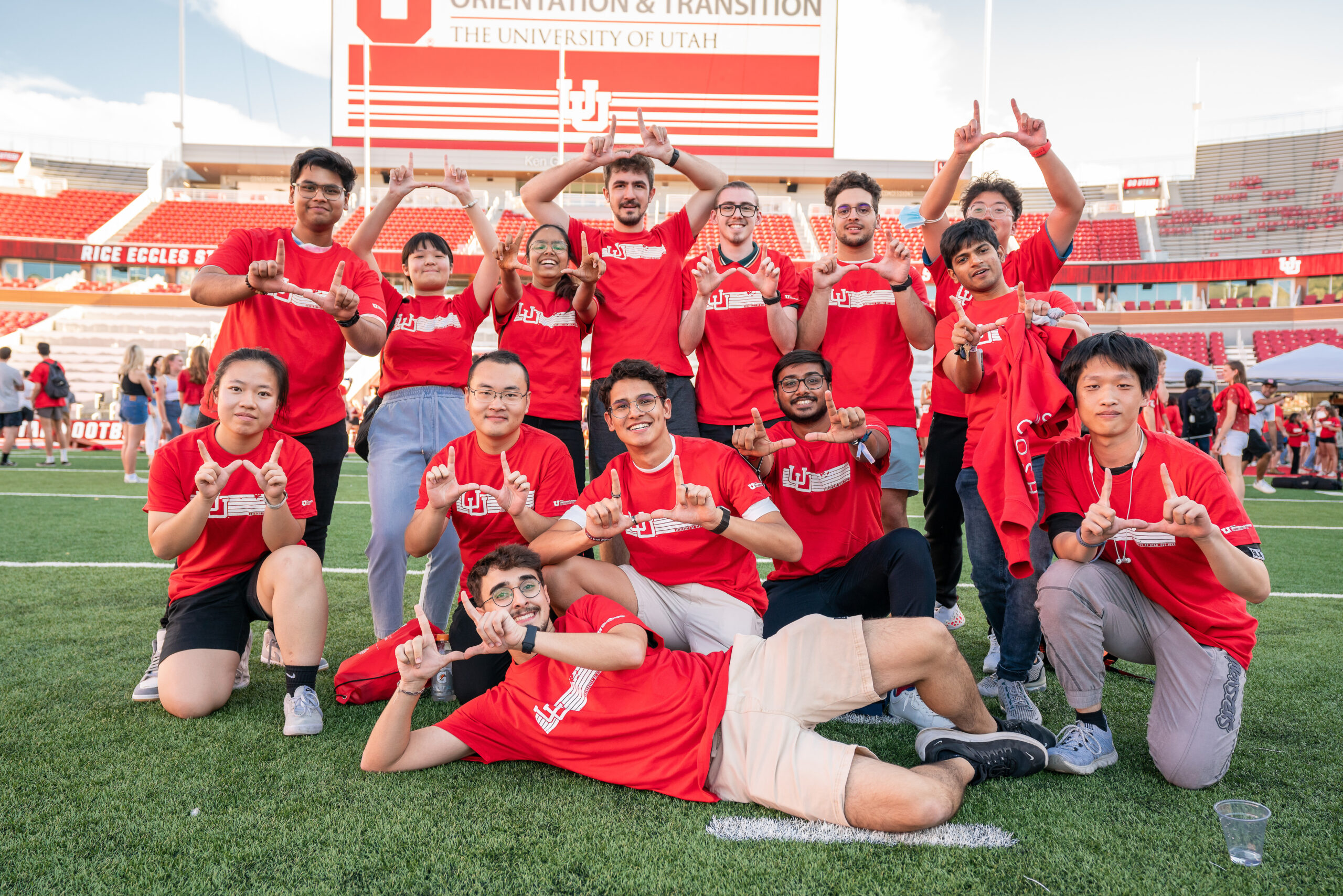
Around 2021, administrators at the University of Utah discovered an unsettling pattern while reviewing student data: In an effort to satisfy requirements and pass some mandatory courses, some students had needed to retake a class five, ten times, or more. In one example, administrators found that a student had spent over $50,000 taking a single math course. These repeated attempts went unflagged because academic advising and course tracking systems were siloed instead of fully integrated across departments. In effect, when it came to the university body, one hand didn’t know what the other was doing—and neither one was reaching out to the student struggling with the path toward graduation.

The revelation brought into focus the number of students struggling with key courses without sufficient support or intervention. But more broadly, it illuminated a systemic disconnect: a lack of coordination between advising, academic support, and course scheduling, which was likely contributing to Utah’s unsatisfactory retention and graduation rates. The path towards a solution was paved with integrated technology and data transparency.

“University policy hadn’t been updated in over 30 years and was kind of adrift, just stacking additional credits on top of requirements. No one had made the case about how that impacts degree completion, how that impacts debt, and tying those things together in a really simple, clear way,” says Chase Hagood, vice provost for student success, who was hired in 2021 to be part of the new initiative’s leadership. “But not everyone was behind the open sharing of data. What does it take for a whole university to come together to say, ‘We believe in the exceptional educational experience. What is it going to take to get us there?’ We joined the Innovation Alliance, and the Coalition for Transformational Education, and getting in those peer groups helped elevate the work we do.” 

University leaders recognized the need for a more integrated, proactive approach, beginning with more democratized data. Within two years—and the addition of a new president and provost—this recognition had become forged into a commitment, leveraging EAB’s Navigate360 as the CRM platform to connect the campus. This became the tech muscle behind Navigate U, a 2024 university-wide initiative aimed at improving metrics of student success, including retention and graduation rates. Utah is banking on software and data analysis to follow individual student performance, flag potential issues, and introduce  interventions—and on the horizon, even track behavior trends.  

Eight Pillars and Key Features

University leadership recognized that existing approaches had “topped out” their effectiveness at steering 32,700 students toward their graduation goals. A new comprehensive strategy was needed, one that put the data capabilities to work under pillars of priorities, each with key features of innovation. The pillars of Navigate U were designed to bring together student support services, streamline policies, and integrate data systems to provide real-time insights into student progress through a structured, coordinated, more supportive approach.

“This whole Navigate U method is about looking at the institution and figuring out how we can prepare as clear a pathway as possible to help the student through here in four to six years,” says Brandon Johnson, senior associate dean of student success and transformative experiences. “By asking those questions, we stop blaming the students. We stop blaming high school for lack of preparedness. If we admit a student into the university, we should do everything possible to make sure that they are as successful as they want to be.”

“If we admit a student into the university, we should do everything possible to make sure that they are as successful as they want to be.”

One key feature of Navigate U is its proactive advising system. Previously, students often had difficulty knowing where to go for guidance, as advising structures varied across colleges. Some students had clear academic roadmaps, while others struggled with course selection and degree planning. Navigate U introduced a centralized approach, ensuring that all students are assigned an advisor with clear, standardized expectations for advising practices. Advisors now have access to real-time student data, allowing them to identify students at risk of falling behind and intervene earlier. 

Another feature is the data integration and early alert system. In the past, crucial information about students—such as course performance, attendance patterns, and engagement with support services—was scattered across different departments. Navigate U centralizes this data through the EAB Navigate platform, enabling faculty and advisors to monitor student progress more effectively. This system can flag students who may need extra support, whether due to failing grades, repeated course withdrawals, or financial concerns. It connects students to resources like tutoring, coaching, and peer mentoring programs. It also promotes student engagement, recognizing that a strong sense of belonging is critical for success. First-year transition programs, on-campus housing opportunities, and community-building efforts have been expanded to support this goal.

Course availability has also been a major focus of Navigate U. Many students faced delays in graduation because required courses were either full or not offered frequently enough. The initiative introduced a strategic course scheduling system, using data to predict demand and ensure essential classes are available when students need them. Additionally, the university implemented new guidelines for course enrollment thresholds to spur the scheduling of courses based on historical data and anticipated demand, and identify courses with high demand to consider opening additional sections.

“One of the things with no institutional policy was monitoring thresholds,” says Hagood. “You might be running a class with six students over here, but in another college—or even within the same college—maybe a department head says, ‘No, you have to have at least 15.’ We had no across-the-board guidelines to help deans make the best use of resources and kind of press them to think about it. It wasn’t good for faculty, and it wasn’t good for students.”

The pillars also target academic wellness, engagement, transitions, and financial structures.

Goals and Metrics 

Graduation rates are a particular area targeted for improvement. At present, the six-year rate is around 66% (a previous peak of 70% declined during the COVID-19 pandemic). By addressing obstacles such as course bottlenecks and repetition, outdated policies, and inconsistent advising, the initiative aims to see 80% of students completing their degrees in six years by 2030. 

In tandem with this is the goal to increase the rate of retention. Currently, about 85% of first-year students return for their second year. With enhanced advising, course availability, and academic support, the university aims to raise this to 90% or higher, aligning with top public research institutions. 

The goals extend beyond graduation. With an improved focus on career readiness and job placement, Utah seeks to ensure that 90% or more of graduates secure employment or enroll in graduate school within six months of completing their degree. This effort includes strengthening connections between academic programs and career services, expanding internship opportunities, and incorporating career development into students’ academic experiences.

In tracking these key metrics and continuously refining its strategies, Navigate U intends to create a more efficient, supportive, and results-driven approach to student success. And with a new kind of tracking under development, the school hopes to gain a clearer picture of each student’s academic journey in order to provide targeted assistance before small setbacks become major obstacles.

The enhanced tracking aims to put more points of data into profiles to build a more comprehensive picture of the student life cycle: where they’re going, and where they’re not. 

“The next phase is working out how we incorporate swipe data from student affairs and event attendance, and then we can start to see this really interesting profile of the student. Are they using the library? Did they go to a coaching appointment? Did they meet with their advisor? Do they attend sporting events?” says Johnson. “If we start to see some gaps, we can launch some outreach to a student because we’re seeing them not only notengaged in some of these academic support resources, but they’re not engaging in campus life and wellness and belonging-fostering activities and events.” 

If a student had been missing class, for example, administrators could use their swipe history in the residence halls, dining halls, and gyms to get a picture of where they’re spending their time. And if they see the student is spending a lot of time swiping into the Student Union, they can send a coach, advisor, or mentor to informally reach out to them there. 

“The more we know about our students and how best to support them, the better it is for the student,” says Johnson. “I would love a day when we can create a spider web profile like you see on some of those career and personality assessments with different indicators and quadrants. You can see if it’s low or heavy in one area, then we can act on the areas that need to be filled in.”  

Johnson believes one of the greatest behind-the-scenes benefits of the Navigate U work might be the introspective thinking it encourages in faculty and administrators. It’s hard to look at a longstanding practice with fresh eyes if it isn’t considered broken. But that, he says, is where the work happens. 

“With some honest conversation, sometimes we come to see that something probably isn’t in the best interest of students after all. Instead of asking, ‘Why are we doing this?’—because there’s usually some answer for why—we try asking, ‘Do we really need to keep doing this? Is it something that’s benefitting us or the students?’” says Johnson. “Those questions are happening more often. And I think we’re fixing a lot of things.”

The University of Virginia Builds a Headquarters for Wellbeing

At noon three days a week, a room overlooking the pond at the University of Virginia falls into quiet meditation while the rest of campus churns with mid-day activity. Some students sit, some lay on the floor. A facilitator leads with guided thoughts and modes of breathing, but you’re welcome to do your own thing. After about 20 minutes, everyone is back on their way to lunch and afternoon classes.

“It’s very accessible to all kinds of people. It’s a nice break in the day, and it’s powerful for the people who have discovered it so far,” says Dearing Fife, a sophomore who organizes the sessions at the Contemplative Commons.

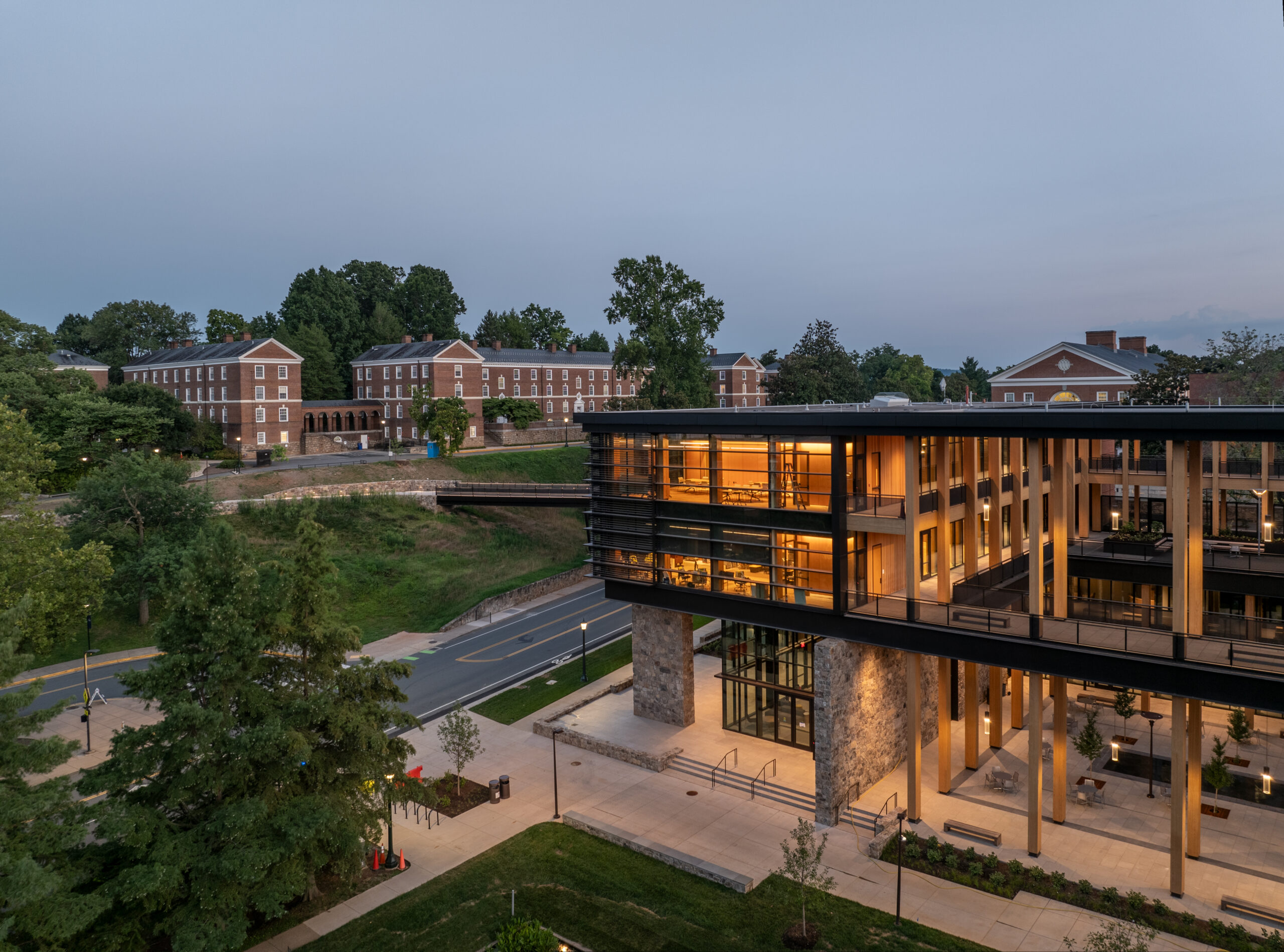
Dearing is a student advisor at the Commons, a new soaring glass and fieldstone building that is home to the Contemplative Sciences Center (CSC). For more than 12 years, the CSC had been operating from UVA’s religion department with multidisciplinary research, experiential learning, and mindfulness initiatives. The construction of the Commons represents more than an impressive new building to house a department and some activities. It is headquarters for the interdisciplinary face of wellbeing on campus—from grounding activities like yoga and meditation to scholarship on the many intersections of contemplation and nature, art, and technology.

The construction of the new Commons makes tangible President Ryan’s desire for UVA to be a top school for holistic student life while pushing boundaries on what higher education can look like in terms of mental health promotion. For many years, UVA had been the administrative backbone of the Flourishing Academic Network (FAN), an inter-institutional collaboration aimed at promoting student flourishing through higher education.

A Contemplative Commons

On the western edge of campus, the new 57,000-square-foot building sits beside the serene 11-acre pond and watershed area known as The Dell. Its U-shape wraps around a Ginkgo tree-lined courtyard, and connects to central campus via a pedestrian bridge over Emmet Street inspired by the High Line in New York, with benches and plantings. It’s hard to imagine a location better suited for a center dedicated to research, teaching, and outreach for contemplative experience.

“Our building is designed around the three themes of nature, art, and technology, and all three combine together to create contemplative opportunities for individuals,” says Kelly Crace, Executive Director of the Contemplative Sciences Center. “It’s intentionally multidisciplinary, creating wonderful spaces where students just love to come and study, whether they want to come into our art galleries, or come into our Conservatorium and experience light and sound in a variety of ways, or connect with nature through our biophilic design.”

The Commons houses, and reflects, work being done at UVA’s Contemplative Sciences Center. The facility’s purpose is to support student flourishing through a host of indoor-outdoor spaces, academic classrooms, immersive learning and events. It will soon include art installations and flexible studios that can be configured as classrooms, research labs, or even yoga studios.

Technology plays an interesting role in both design and practice in the Commons, used both to enhance mindfulness experiences and to create intentional tech-free spaces for deeper reflection. The Conservatory is an immersive room with floor to ceiling windows, sounds and light panels, with state-of-the-art audio to mimic natural soundscapes—think ocean waves, rainforests, waterfalls, wind, and buzzing bees. Other areas at the Commons are tech-free zones, encouraging students to disconnect altogether.

Innovative Classrooms, both labs and studios, are designed as multi-modal spaces that allow instructors to change the room setup based on the session’s needs. Classes can alternate between traditional seating, or more free-form setup using yoga mats or meditation cushions. Some rooms feature sprung floors, ideal for movement-based practices like Tai Chi, or facilities conducive to a Japanese tea ceremony. Others serve as academic classes that faculty members would prefer to hold in something other than a traditional classroom building.

“There’s one class that meets in the Commons, for example, on medical Spanish. This professor has her own deep contemplative practice, and she incorporates it into every class that she leads,” says Connie Kresge, chief of staff of the CSC. “She’s not just bringing in somebody who’s pre-med to learn a few vocabulary words. She is saying, ‘Okay, you are going to be the front line of working with humans. How do you imbue your practice with understanding of this population and a contemplative, compassionate approach?’ And so they also get the benefit of a setting like the Commons.”

Research and Practice

In a world increasingly defined by speed, competition, and information overload, the CSC represents a shift in higher education. Housed within UVA’s Provost’s Office, CSC benefits from strong institutional support, ensuring its programs are not peripheral but central to the university’s academic mission. As Michael Sheehy, CSC’s Director of Research, points out, UVA’s investment in contemplative education is unique among public universities, positioning it as a leader..

With its three-pronged mission, CSC is reshaping how students, faculty, and the broader academic community engage with education, wellbeing, and leadership. Work and programming at the Contemplative Sciences Center is organized around three pillars: Research, focus on advancing contemplative studies through scholarship; University Life, integrating mindfulness into students’ days; and Systems Change, expanding contemplative education globally through leadership and K-12 initiatives.

At the heart of CSC’s work is a research lab known as CIRCL, which stands for Contemplative Innovation, Research, and Collaboration Lab. There, scholars study many aspects of the ways meditation, nature, and technology shape our well-being from a collaborative, cross-disciplinary perspective.

One of the current projects examines how different environments impact contemplative experiences, explains Sheehy. As part of the methodology, participants will be studied meditating in five different settings, and researchers then track brain activity, heart rate, and emotional responses. “If you meditate in a garden, does it feel different than if you meditate in a featureless white room?” he  asks. “What happens in your brain and body when you practice mindfulness in nature?” Sheehy is also editor of the Journal of Contemplative Studies and also Contemplative Currents, which  are uniquely poised to cover both peer-reviewed academic studies and open public scholarship.

Research, academics, and collaborations go well beyond the study of nature and meditation. CSC is diving into diverse studies such as virtual reality experiences, lucid dreaming research, and exploration of leadership and public policy.

“We’re having professors coming in from our Batten School of Leadership and Public Policy to talk about policy and leadership from a contemplative perspective, professors from religion to come talk about Buddhism, and we’re exploring collaborative work of how we can do things with the school of data science,” says Crace. “What’s really cool is getting a sense of the breadth and diversity that’s possible. People might initially think, Oh, so this is where you do yoga, or this is where you do mindfulness, that type of thing. Yes, and we’re so much more than that. Being able to bring in that diversity of collaboration, I think, is really important.”

University life          

But the CSC isn’t just about research—it’s about making curiosity and mindfulness part of daily student routines to support an overall culture of thriving. The CSC hosts monthly salons, where students and faculty can discuss contemplative topics with leading interdisciplinary scholars.  A Citizen Leaders Fellowship offers students a year-long leadership opportunity to gain skills needed to flourish during their time at UVA and after graduation.

Beyond the lab and classroom, the CSC and Commons are uniquely poised to support student flourishing with a wide range of campus programming—beginning with a celebratory weekend of concerts, food and activities in April to mark the grand opening of the Commons. Going forward, a weekly calendar of programming and well-being initiatives include regular yoga, meditation, Tai Chi, reflective writing, and spaces to cultivate mindfulness and resilience.

It’s a bold push against what Crace calls the “stress-glorification culture” of modern academia.

People ask, Why would a university have a building for contemplation? They don’t ask, Why do you have a building for the arts, and a building for sports?

 “’I stayed up two nights. Well, I stayed up three.’ It’s this constant one upping, where we’re trying to find distinction through how hard I’m working,” he says. “It’s not only how hard I’m working, but it’s important for you to know how hard I’m working, and it just creates a very toxic culture that really disrupts flourishing. We want to be a disruption to that stress culture.”

Systems Change

Flourishing is a key word in the overall picture of contemplative sciences and its place in a larger ecosystem of institutions helping young adults maturing in a way that best supports their wellness and full potential. Appropriately enough, the Flourishing Academic Network (FAN) grew out of key individuals at UVA committed to flourishing, including David Germano, a religious historian at the University of Virginia and Crace’s predecessor as former director of CSC, and alumni Jeffrey Walker, a finance executive, philanthropist, and member of the board.

“What we’re trying to do with FAN is taking a system orientation and looking at how we can prepare students for the real world, and allow them to succeed in higher ed,” says Walker. “It means giving them tools when they arrive, and educating them about what kind of tools there are out there, working on things like social emotional learning models, meditation, yoga, body movement, breath practices, peer to peer support, and also managing ego and collaborative models, and looking at leadership models.”

For real systemic change, the third pillar of the CSC reaches beyond the campus into the wider scope of academia with FAN, and reaching K-12 classrooms and international leadership programs.

 “The systems change work can be thought of as expanding what we do reaching outward,” says Kresge. One major initiative is the Compassionate Schools Project, a groundbreaking K-12 mindfulness curriculum leading new practices in Louisville, Kentucky. Another is the Dalai Lama Fellows Program, which trains young leaders around the world in mindfulness-based social change. In 2024, CSC took 17 Fellows to meet His Holiness the Dalai Lama.

CSC is also working on a national initiative to integrate contemplative education into higher education policy. By partnering with education policymakers and university administrators, CSC hopes to make contemplative practices a core part of the American educational experience—and something both more easily understood and more widely undertaken.

“People ask, Why would a university have a building for contemplation? They don’t ask, Why do you have a building for the arts, and a building for sports? No one stops and says, what do you mean by arts?” says Kresge.. “We don’t have that barrier in our colloquial understand of the words arts and sports, but we do in our conversation of what contemplation is.”

Leaders like Kresge hope there would be a greater understanding of mindfulness and meditation as an ongoing tool and practice—like exercise—and not a one-time thing that can be taught in a seminar and crossed off a list.

Sheehy learned meditation from his grandmother when he was about 10 years old, and it made a lasting impression. “I’ve had the chance to live most of my life with access to knowledge about contemplative practices, because I’ve had experiential access to as a constant reference point,” he says. “That’s why I think the research we do is important, because we’re showing people how these practices wok, how powerful and empowering they can be, and give them agency over transforming their lives.”

Dearing Fife also had access to these practices at an early age, and the addition of the Contemplative Commons at UVA cements her belief she could not have found a better place for herself to attend school. A self-described “anxious kid,” she discovered meditation in middle school, and it’s been a core part of her life ever since. “Like brushing my teeth,” she says. “A non-negotiable.” She grew up knowing that learning to handle it was just going to be her thing.

“Everyone manages something in their life, and I have to manage my anxiety,” she says. She meditates once or twice a day, and believes it’s a tool many more college students would benefit from. She is aware of a first-year student who shows up to the noon meditations regularly, and likes to envision that it’s making a difference in her life—and that in a small way, as organizer of the sessions, Dearing contributes to that.

“It’s a big school, and I’m in Greek life, and that’s been great,” she says. “But I also wanted an academic realm where it’s like, This is my place, and this is where I’m going to impact the university,” she says. “And this, working at the Commons and CSC, is it.”

Life Lessons with John Bravman

Bucknell University President John Bravman personifies the saying “the harder you work, the luckier you are” and imparts that message to his students. With humility and humor, the career academic brings us through the key milestones in his life, from working to overcome a speech impediment as a child to being the “smart kid” in New York City public schools to his spectacular, yet uneven, success at Stanford, where he learned to be a great teacher well before he became a college president.    

Here is an excerpt from our interview:  

LW: To start, can you give a bit of background about yourself, your family, how you grew up, your education? From what I understand already, you have a very interesting story.

Bravman: Well, I doubt I do. But I grew up in New York City 67 years ago. I’m a first generation college student—second generation American but first in my family to go away to college. So my father was in World War II, and I grew up with parents from the postwar era, and I came of age in the early sixties. My earliest distinct memory is probably Kennedy being assassinated. So that’s the place in time. And everything that happened in the sixties influenced me somehow, some way. I had a love of science. My father was an accountant, but he liked science, too, and I probably picked it up from him. But things like going to the World’s Fair in ’64 and ’65 and going to the American Museum of Natural History in New York City, these were all big deals for me. And sure enough, I became a scientist.

LW: Where in the city were you educated?

Bravman: P.S. 34 Queens. Then I moved to Long Island for junior high and high school and went to public schools there, too. But it was quite a culture shock, moving from the city to the suburbs. It was just different. I’m sure there’s a lot of sociology and psychology and history and economics to explain why. We were not a wealthy family by any means, but we were never hungry. And for whatever reason, I grew up with the notion that smarter is better—that it’s good to be smart and work hard and all that kind of stuff. And probably, because I moved during those preteen-teenage years, when I went out to Long Island, it was all of a sudden, “Who’s better looking? Who has nicer clothes? Who’s more popular?” This was not a wealthy place, but just all of a sudden, it changed. I remember thinking about that but realizing, of course, that smart still mattered, and I had to do well in school and all that. But that was the first big cultural shock I experienced in my life.

LW: When you say being smart matters, and you saw that as a pathway to success, would you say your peers in the NYC public schools seemed to share that perspective more so than those in Long Island, who seemed more socially-oriented?

Bravman: Probably not. But my honest answer is that, from kindergarten through fifth grade, it felt like the extent to which you were looked up to by your peers came down to who is the smartest kid in class. And that felt very different on Long Island.

But I mean, I spent seven years on Long Island at three different schools, all public. And then I had the incredible good fortune of going to Stanford, where I ended up spending 35 continuous years. Believe it or not, I’ve often said that one of the best things that ever happened to me was a rejection. And I’ve reflected on that rejection throughout my life. I desperately wanted to go to MIT from high school because I’m a sciencey, nerdy geek. And that’s what you did if you grew up on the east coast. That’s where I could be the best of the best. Everyone knows MIT. And if you’re on the west coast, you went to Caltech.

But the story there is that a friend of mine in high school, who was also a nerdy kid, took a family vacation to California the summer after our junior year in high school. He came back with tales of these redwood trees, which I’d only seen in National Geographic, and the Pacific Ocean in Monterey Bay. I’d never been west of Pennsylvania. He told me about a school I’d never heard of called Stanford University, and he said, “We have to go there. It’s amazing.”

And of course, there was no internet back then. So I went down to the high school library, where we had a room forcollege books, and it turns out the Stanford Viewbook was missing. So I didn’t even see pictures of Stanford. All they had was their course catalog, which back then was just text. I illegally took that book home for the night because you’re supposed to leave them there. And I went through it, and I was so entranced by this book with no pictures that I designed my whole curriculum only to find out later that what I thought I was going to take were all junior-level classes, not freshman classes. Long story short, I did not get into MIT, but I got into Stanford, and my friend did not get into Stanford, where he really wanted to go. He went to MIT, was miserable, and dropped out.

I’m just saying, I’ll never, ever forget that rejection and the lesson of, “Okay, life knocks you down? You just keep going.”

LW: With that course catalogue, did you recognize the rigor of the courses right away? What attracted you to the curriculum?

Bravman: Well, I love books. Most of the books I own have nothing to do with science and engineering. I’ll have a real problem when I retire because I’ve now collected 5,000 books, and I have no place to put them. So honestly, I think I just liked this course catalog. It was words, and I had never read a course catalog. I remember sitting in my bedroom, reading page after page of these course descriptions. I thought, “This is amazing, and I want to learn all this stuff.” And then I went off to college for 20 years. 

LW: You must have been quite wowed, then, because your friend was not kidding—it is beautiful.

Bravman: Oh, yeah. I mean, it’s like 362 days a year of perfect weather. I’d never been on a plane before. And back then, Stanford had arranged charter planes from several cities on the east coast, so I was on a plane with 250 kids going to Stanford. I showed up on campus, and it was just the most amazing thing. I had a lot of financial aid. It included loans, scholarships, and a work requirement. So I was assigned to work in a kitchen. I probably picked that off a list. I liked to cook, even as a boy. But I remember we got to campus late, and within minutes of entering my dorm, someone came and told me that I was late for work because as a brand new freshman, I was supposed to work the first day on campus in the kitchen, helping make dinner. So I showed up, and Kay Malik, who was the head of the food service in Wilbur Hall at Stanford, she said, quite curtly, “You’re late for work. Don’t do it again.” So I didn’t exactly have a perfect start.

I loved Stanford. But the fact of the matter is I almost flunked out my sophomore year because I was not prepared for the rigor of the academic work. I quite honestly never really studied in high school because I didn’t have to. I had one B in ninth grade art. So I did not graduate with a perfect 4.0. So I graduated second in my class. My friend, who went to MIT, was one of six people with a 4.0. So I was technically ranked number seven, but I’ve always liked to say number two.

LW: What was it like to have been close to the smartest in your class in high school and then become average, or maybe even struggling to be average, in college?

Bravman: Well, I’d never met kids who went to private schools before. So I was dealing with that and people who went to Beverly Hills High, which is a public school but a very, very good one, resourced differently than my schools were. I don’t remember too much about that, but I remember being scared and disappointed in myself. I thought, “What am I going to do and what am I going to tell my parents?” And I’m sure kids today feel the same way. And they probably also experience certain emotions I didn’t. So I’ve tried to be a better and more sensitive advisor academically, but also as a boss, understanding that people have a variety of experiences. But I think that near failure was a really important learning lesson for me. And part of that is, “If you’re the smartest person in the room, you’re in the wrong room.” 

That’s also where I learned about advising. My advisor was an almost brand new professor at Stanford from Great Britain. He went to Cambridge. And so I learned a lot along the way, too, about England as a result of that relationship. But he was helpful and supportive, and I’ve never forgotten that. So obviously I didn’t flunk out, and I did well enough, and I ended up getting into the doctoral program there in engineering. 

When I started the doctoral program, my undergraduate advisor remained my advisor, but I also got a second advisor in electrical engineering, a different department. My department, material science, announced a new faculty search. And I remember saying to my advisor in electrical engineering, “Hey, look, did you see my department’s going to be hiring someone else? I wonder who they’re going to get.” And he looked at me and said, “I want you to apply for it.” I said, “That’s ridiculous. I’m not going to be a Stanford professor. Give me a break. I almost flunked out.” He said, “No, I want you to apply for it.” And he was an older professor. He’s still with us. He’s 85 and a giant in his field. He was a giant in his field then, and he said, “I want you to stay.”

So that advice and encouragement from two different advisors changed the course of my life. That whole advising experience has meant so much to me ever since because I know what it did for me. I ended up staying there for a total of 35 years before coming here to Bucknell in 2010. I lived off campus one year in graduate school and three years as a young professor. So 31 of 35 years, I lived on campus. And for 14 of those years, I think it is, I lived in an undergraduate dorm as what we call a “resident fellow.” So most of my life, I’ve lived on a college campus. So I went to college 50 years ago next September.

When I say it made my life, I mean, I’m not kidding. And obviously it took a lot of hard work—first to not get kicked out, secondly to get a position in the graduate program, and then to pass my Ph.D. qualifying exam, which I failed the first time and you only can take twice by policy. So I worked my butt off and passed the second time. And then I had to get on faculty, and then I had to earn tenure. And that is not trivial at university, let me tell you. Stanford’s policy is that you have to be one of the two best people in the world at your age in your field. And that’s not possible, really, but that’s the written standard. And of course, Stanford School of Engineering is incredibly famous in my area because of Silicon Valley. So I had the combination of thrills and chills every single day, and getting tenure was probably the achievement of my life until I became president here.

And I just reflect on that—to have gotten there as a first generation college kid, who almost flunked out and then didn’t pass his Ph.D. qualifying exam the first time. And I’m no genius, not even remotely close, but I know the value of working really hard and keeping a dream ahead of you and sacrificing. In my experience, working really hard is no guarantee, but it can make a difference. I’ve tried to be very sensitive to students who are struggling. Maybe they wouldn’t believe a college president almost flunked out of school. But it’s the God’s honest truth, and I want them to know that. And being an advisor doesn’t mean you have to be a pushover. You can be direct and strong without being strident, and you can be understanding of someone’s needs and foibles and weaknesses. And I can’t believe in September, I will have literally been in college for 50 years.

“[As an advisor] you can be direct and strong without being strident, and you can be understanding of someone’s needs and foibles and weaknesses.”

LW: That’s a great milestone. So when you almost failed, who was it that believed in you enough to keep you going?

Bravman: That’s a great question. It’s hard to answer. Obviously, my advisor’s support and some other faculty were important. But I did realize that I’d have to get my stuff together, or my life’s going to be very different.

LW: So you had a strong sense of agency.

Bravman: I was probably more scared shitless than anything else. I really was, and I was afraid of disappointing my parents, for sure. So I was in the process of applying to transfer to a couple schools back east—good but lesser schools—and not even thinking about, “Are they really going to take someone who’s almost flunked out?” Thankfully, I didn’t have to find out, but I learned that you can talk yourself quickly into procrastinating, and it usually doesn’t have a good end. So I learned that lesson painfully and learned that I had to discipline myself to partition the various aspects of life—fun and work and this and that—and to sleep as little as possible to maximize everything else. That’s probably the best answer I can give you, but I was really scared.

LW: Let’s talk about when you were recommended for, and ultimately earned, that coveted teaching position. You hadsomeone who really believed in you. What did that feel like?

Bravman: You know, all the prejudices about research institutions are often true. But this advisor, he was both at the absolute top of his field and the best teacher I ever had. That was a role model for me. And honestly, a lot of getting that job was just dumb luck—right person, right time. And I, in my naivete, just thought, “Gee, I wonder who they’re going to get.” It never entered my mind that I’d be on the Stanford faculty. And he just said, “John, I want you to apply.” And I don’t remember much else, but saying some quip about, “That’s ridiculous. I’m not like you. I can’t be you.” And now I’m one of two people in Stanford’s history to have their highest award for teaching and their highest award for service.

LW: What about the teaching? What do you think, given all you’ve told me, contributed to you being a great teacher?

Bravman: Well, I’ll tell you, I have a story there, too. It’s the same answer: total, utter fear of failure. My brother is older than me. He’s very outgoing. My sister’s younger and very outgoing, and I was the introvert. And my father was a very, very smart man. It’s such a shame he couldn’t go to college. I grew up with a speech impediment, and my father, when I was in second grade, bought a reel-to-reel tape recorder—which I still have and still works—and a microphone. And he made me read into the tape, and he made me listen to myself, which is painful to this day. But he wanted me to learn to overcome my speech impediment. And I never forgot that because I grew up just incredibly fearful of speaking in front of any crowd, all through college. And in part, that’s why I failed my Ph.D. qualifying exam.Because it’s oral the first time. It’s two-and-a-half hours in front of 10 professors. So I was scared out of my mind. Andsome of my speech issues, when you’re scared, they come to the fore. 

Fast forward to teaching, having had lots of not-so-great teachers at Stanford, as well as some great ones, I knew which I wanted to be. So when I started teaching, I probably prepared 10 to 12 hours per one hour lecture. We had, early on, a video camera in our department and a VHS machine. This was pretty advanced at the time. So I remember at midnight when the building was empty, videotaping myself, giving my low-level introductory material science lectures to an empty room on videotape and then watching it until two o’clock in the morning, learning what I did wrong. I was so scared of failure, and I really wanted to be a good teacher. The fact is, I have eight teaching awards,two of them national. So I like telling people who have these issues, honestly, if you knew my fear of talking in public and now I can stand in front of arbitrarily large and loud crowds, anyone can. 

The fact is I’m still a deep introvert. I don’t actually believe in fundamental change that way. You overcome and you adapt. I’m proud of what I did in teaching, and I think I’m a reasonably good public speaker now. I’m not very good at reading a script. But I want students who are struggling, especially with public speaking, but anything really, to know that if I can do this, believe me, you can.

LW: Well, you can’t win all those teaching awards without getting a positive response from the students themselves. They really are the ultimate judges on this. Do you have a sense of what about your teaching has resonated so muchwith students?

Bravman: I became a techno geek in terms of computers, as they arose. So the Macintosh 1984 came out the same year I joined the faculty, and everyone was using IBM PC. Those were released in 1980, but I started with a Mac. I was, for the most part, a bit ahead of my time with new software, new technology, and I took that into the classroom. So I think that was noticed.

I think it helps to be friendly and approachable and tell stories, like, “Hey, here’s my story. If I can do this, you can do this.” And hopefully I gave clear lectures. My department had very few majors. The big undergraduate courses were all kind of service courses. And so people didn’t really want to be in my classroom, but they had to be. And so that’s something to think about. And then at the graduate level, I ended up teaching things that, for the most part, very few people fundamentally like. They just have to do it as a doctoral student. Like crystallography, it’s very dry and not very exciting. So I worked hard at bringing in real life examples that people could relate to that still allowed me to explicate on the subjects. And so it’s those kinds of sensitivities, but also being in my office at midnight. Students would come see me at midnight because that’s more their hours than mine.

Of course, early on, you’re younger, so you’re closer to them. But what’s the lure of academics? Every year, the freshmen are the same age. Every year, I’m exactly one year older. It’s so unfair.

LW: Did you think early on in your career that you’d ever be a college president? Was that a holy grail that you always hoped to achieve?

Bravman: No. My dream job, having grown up in New York City, was to be the president of the American Museum of Natural History on Central Park West. The woman who was the president there was president for like 25 years. And I remember thinking, “Would you please just retire?” But seriously, being a college president is a tough job. And it always has been. But I’m who I am, and I’m not who I’m not, and I can only do what I do. So I just keep building as best I can.
Innovation and Financial Well-Being at CUNY

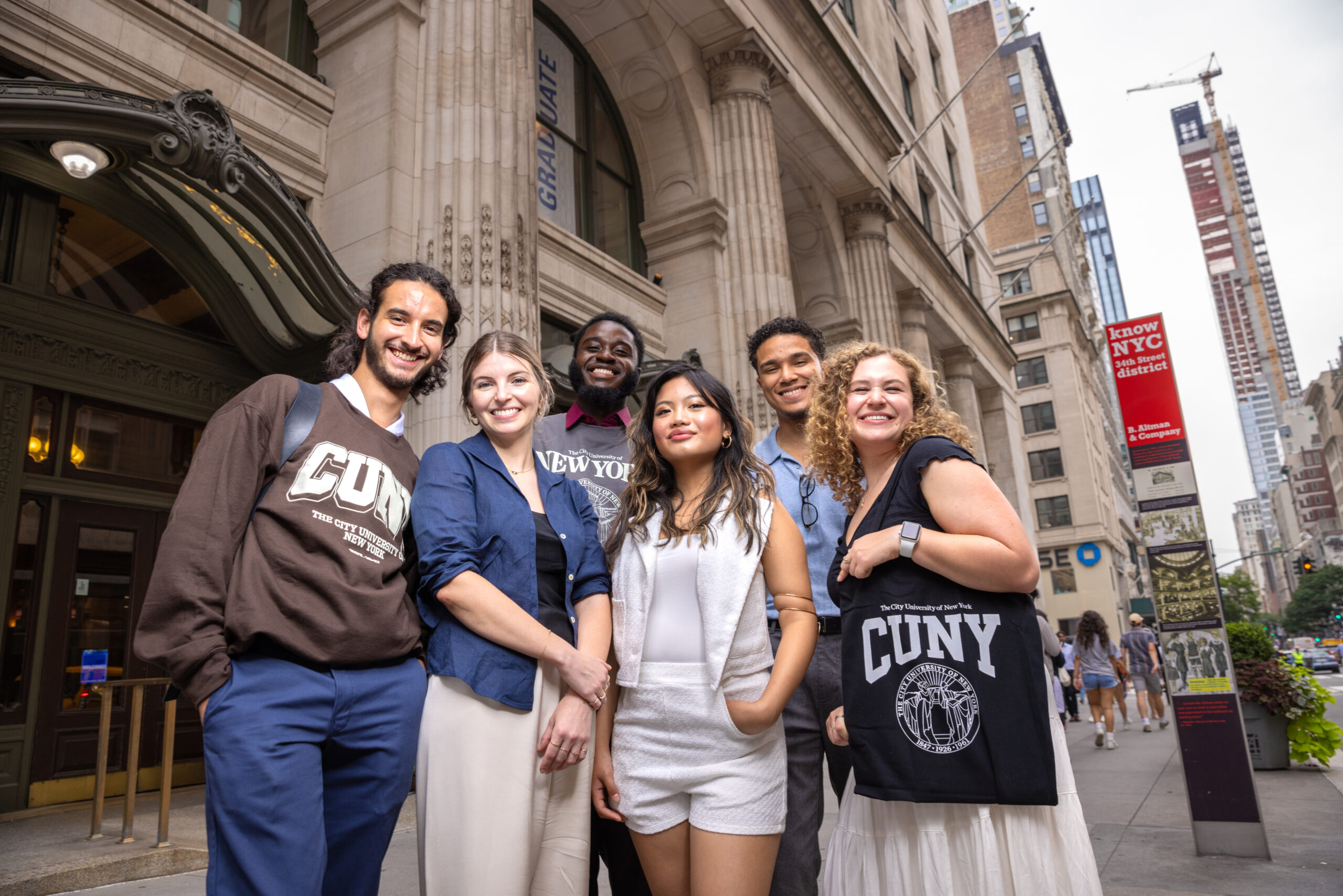
The spring semester at the City University of New York (CUNY) brings a fresh approach to a perennial problem. CUNY’s new Transfer Initiative enables students currently transferring for Fall 2025 to move anywhere within the system without sacrificing credits towards their major. The key is an automated process that shows them how their existing credits transfer immediately upon acceptance. 

The new initiative helps students avoid losing credit, time, and money when moving from associate’s to bachelor’s degree programs within the 25-college system. It is a culmination of a number of strategies at CUNY aimed directly at benefiting students, the majority of whom are low-income and/or first-generation. The person driving much of this innovation is Alicia M. Alvero, CUNY’s Interim Executive Vice Chancellor and University Provost. A first-generation American trained in Organizational Behavior Management, Alvero has the heart and the head to make systemic change at the country’s largest urban university. 

From streamlining advising to harnessing generative AI, Alvero is helping the colleges strengthen how they support students, particularly with factors such as time-to-degree and career alignment, which affect their financial well-being. In this interview with LearningWell, she discusses her own trajectory in higher ed, how those experiences helped guide her work in CUNY’s central office, and how organizational change can benefit the people who need it the most.  

LW: You wear a number of hats at CUNY. Tell me a little bit about your trajectory there and, in your own words, what the job entails.

Alvero: So I started in CUNY at Queens College as a faculty member of Organizational Behavior Management in 2003. And during that time, I was doing a lot of consulting work for organizations on both leadership training and improving workflow and efficiencies within businesses. And as with all faculty, once you get tenured, you get administrative responsibilities. And so sure enough, I ended up with administrative responsibilities and started to realize that all of these skills I was teaching to outside organizations, I could apply in-house to the psychology department, which at the time was the largest department. 

We would have a lot of students who would get denied graduation because they took a wrong course. And I thought, that’s a crazy time to find that out, when you’re applying for graduation. And so I started to think, how do we improve our advisement system within the department to eliminate that? That is, how do we get that information to students right away? How do we create work or course schedules that really meet the needs of our students? 

We’d get complaints from students saying, “I took this course, but it’s only offered Tuesday/Thursday, and it conflicts with another course that I need to graduate.” So I started really looking at how we were doing the work and then meeting the needs of the students. How do I ensure the right faculty, especially the part-time faculty, get assigned to courses for which they’re experts? We’d create a schedule and then try to fill all the adjuncts, but sometimes at the day and time of the course that aligned with their expertise, they were unavailable. And I thought that was a silly reason to lose this wonderful person.

And so I started making some changes in the department. I guess it started getting recognized by the college and the president and the provost. And they started saying, “Can you do this for the entire college?” And that was really my introduction to what it could be like to be an administrator for college. Then I became the Associate Provost for Academic and Faculty Affairs. Then our provost was retiring, and so it was announced that I’d be the interim. But before stepping into the role, our now former Executive Vice Chancellor University Provost, Wendy Hensel, was coming from Georgia State, and she reached out to me and said, “I really need somebody on my team who understands CUNY faculty, understands the system, because I’m an outsider.” And that’s how I came to the central office. I said I couldn’t pass up an opportunity to do what I love at a much larger scale. So I became a Vice Chancellor of Academic and Faculty Affairs for two-and-a-half years, and now I’m the Interim University Provost and Executive Vice Chancellor. 

LW: If you could identify one main priority of your work, is that to better facilitate a supportive, or student-friendly, way for students to get from entrance to success throughout their degrees?

Alvero: Yes, but it’s also about taking a holistic approach. It’s not just about making the process student-friendly. It’s about ensuring that our technologies, platforms, and policies are truly designed to support student success. Are our systems integrated in a way that makes life easier for students? For example, when a student transfers, does their information seamlessly transfer with them, or are they required to fill out unnecessary paperwork, even within CUNY?

We examine every step of the student experience—from entry to graduation—including the technologies we use, the policies in place, and the human factors like academic advisement. Gaps in policy can hinder student success, and some existing policies may not be functioning as intended. Additionally, students often receive contradictory information when moving between institutions, and we need to eliminate that confusion.

Our goal is to streamline information—through technology, well-designed policies, and well-trained advisors—so that students can make informed academic decisions and receive the right support at the right time. We shouldn’t wait until a student drops out to intervene. Instead, we should leverage predictive analytics and artificial intelligence to identify and support struggling students early on. It’s about a comprehensive, proactive approach, rather than a single initiative.

LW: And why would you say this support is particularly important at CUNY, which primarily serves first-gen and low-income students?

Alvero: The majority of our students don’t have the benefit of an expert in their home to guide them through the college process. When someone in a family has gone to college, they often understand—at least to some degree—what it takes to be successful. Most of our students don’t have that resource. And while attending college doesn’t automatically make someone an expert, any level of insight or support from someone who has navigated the system can make a significant difference.

Without that guidance, many of our students are left to advocate for themselves. But how can they effectively do that if they don’t even know the steps? That’s why it’s so critical for us, as a system, to proactively remove obstacles and provide the support they need, rather than expecting them to figure it out on their own.

LW: Could you give me an example of what some of those specific measures or supports look like? 

Alvero: For example, when a student transfers from one school to another, they often have to make a decision about which school they should go to. And there’s this misconception that, “Well, all 60 credits from my associate’s degree will transfer.” That is true. All 60 credits will transfer, but it’s how they transfer that makes the difference. Even if you’re transferring from accounting to accounting, credits that you thought would count towards the accounting degree could end up transferring as electives. That’s not useful. And so I bring this up because as a student, if I apply and get accepted to two schools, I should be going where the majority of my major credits are going to apply towards that major. But students often have to make this decision completely in the dark. 

We just automated that entire process. So now, say a student applies to three schools and gets accepted to two of them. They log into their account and see how each school will accept every one of their credits. That’s very powerful information. And the moment they’re admitted, it’s triggered, before they even commit to a school. Oftentimes, students used to accept admission and still not know this information because there was a delay in somebody getting it to them. So this is one example of support through information that helps make a well-informed decision.

LW: I imagine many students, from a financial perspective, may not have the luxury of saying, “Oh, well that course won’t add to my degree from a credential perspective, but it was fun.” They have to be really focused, right?

Alvero: Absolutely. And for students on financial aid, they lose their aid because aid is based off of a certain number of credits. So if you’re spending time taking credits that aren’t going to count, you already used the aid for those courses. And so whether it’s wasted dollars out of pocket or wasted financial aid dollars, what happens when you run out of aid and you can’t afford to pay out-of-pocket and now you can’t complete your degree because you took too many courses that wouldn’t apply?

We estimated that we’ll be saving students $1,220 with the new transfer initiative because of the average number of wasted credits for our students, which is in line with the national average.

“What happens when you run out of aid and you can’t afford to pay out-of-pocket and now you can’t complete your degree because you took too many courses that wouldn’t apply?”

LW: How about teaching and learning innovations? What are you working on inside the classroom?

Alvero: I’ll give a very obvious answer, but it is a priority, and it’s artificial intelligence. There’s just so much potential and so much that we’re exploring, and faculty are really very excited about ways in which they can use artificial intelligence to help their teaching, help students learn, but also teach students how to use AI, a skillset they’re going to need in the workforce. 

We recently asked faculty to submit proposals for creative ways of embedding artificial intelligence within their general education courses. And we received well over, I think, 40 applicant requests. We received more requests than we could grant because we provide faculty with a stipend. We want them to report back after the semester about how it went. Did they see a change in student learning outcomes? We want to know if we should be working with faculty to embed these strategies throughout, whether it’s within our math courses or English courses, where we see students struggle. We’ve not recovered since the pandemic with the learning loss, and students are really struggling in those gateway courses. And so not surprisingly, a lot of faculty are trying creative solutions in the classroom to try to improve student learning outcomes.

LW: There is evidence that avoiding remedial classes and going straight into regular classwork tends to have better outcomes for students. Do you think AI could be a tool to help students get up to speed? 

Alvero: CUNY actually moved away from traditional remedial classes for the very reason you mentioned. Instead, we now use a co-requisite model, where students who need extra support are placed in regular classes but with additional hours of support built in. So for example, if a course is usually three hours a week, this one might be five or six hours. In those extra hours, there are opportunities to use generative AI. Let me give you an example: A professor might provide slides to the students, and since CUNY has a license with Microsoft, students can access a tool called Microsoft Co-Pilot, which is a secure AI chatbot that requires a CUNY login. A student could use the tool to say, “Take these slides and create a 10-question multiple-choice quiz for me.” The goal is to help students use these tools to master the material. Of course, we also need to teach students critical thinking skills so they can spot errors, including those that might come from AI. But by using Co-Pilot and other tools we have secure university licenses, we minimize issues like AI hallucinations because the information is based on the class slides, not something random from a public AI platform. That’s just one example of how AI can be used in the co-requisite model to help students learn.

LW:. How are you guys thinking about student well-being? Do you see people, particularly from your seat in the central office, focusing on or investing in these issues?

Alvero: Absolutely, it is definitely at the forefront of most all of our conversations. We work closely with the university student senate so that we have a direct line of communication and they can express student concerns, but it’s about creating a really supportive and safe environment for our students. And how that’s defined—what those needs are—will vary from student to student. For financial well-being, it’s not just about ensuring that they have their basic needs met. It’s also, how do we provide them with financial literacy? Because getting a degree is great, but if they don’t come out with that degree understanding finances and how to manage them to help break that cycle, that’s on us, in my opinion. So we think about it in every single aspect—ensuring basic needs are met, ensuring if anything should happen to a student where they don’t feel safe that they have resources when they need them.

Of course, mental health is really important, but so is academic support, financial assistance, and access to basic needs. We have a program called CUNY Cares, which is based in the Bronx. It’s a one-stop shop where students can go to see all the benefits they qualify for in New York City, instead of having to go from agency to agency. It’s been incredibly impactful for our students because they have someone there to help them navigate this complicated process. They get guidance on things like, “Do I qualify? How do I get all of these services I might be eligible for?” The truth is, many of our students are eligible for far more services than they actually receive.

LW: CUNY is a very pluralistic environment. How do you make people feel welcome wherever they come from, particularly in today’s political climate? 

Alvero: CUNY offers a number of resources to support students from all backgrounds. For example, we have an office specifically for undocumented immigrant students, where they can get help with finding relevant support, both within CUNY and externally. Every campus has a dedicated contact to guide them through the process.

We also have a college language immersion program that’s open to anyone in the community interested in learning English. It not only helps with language skills but also provides college readiness, acting as a pipeline for students to move forward. This approach is really woven into the fabric of who we are as an institution.

LW: How about your focus on helping students connect with careers? Are you thinking, in addition to salary and similar benefits, about the importance of students finding purpose and meaning in their profession?

Alvero: Oh, absolutely. And this is another example of the holistic view. The way I see this, it’s not just about connecting them to the right career. It’s helping them from the beginning figure out the right career choice for them. And so in my dream, which is something I am planning to bring to fruition, students could have one place to really explore CUNY from A to Z. For career exploration, they could figure out what appeals to them, what might they do, and then be connected to what programs exist within CUNY. Because if I enroll at one CUNY school, they’re not going to have every single major. Maybe I realize that for what I’m aspiring to, I’m in the wrong CUNY school. Maybe I should have started somewhere else. How can we help students navigate that? 

And as I’m navigating what programs exist within CUNY academically, what internships opportunities are there? How can we connect students directly to our career partner industries? We’re doing a lot of work with that and integrating career milestones into academic degree maps. Currently, most degree maps are just, “Take these courses in this order if you want to graduate in X amount of time.” But what are the career milestones at different points in time? So it’s this holistic view of exploring careers, academic programs, and career milestones all within one place.

LW: Clearly advising takes a number of different forms at CUNY. How important is that? 

Alvero: CUNY now officially has a Senior University Director of Academic Advisement Initiatives that can help. The colleges are craving this. They’re all trying to do their very best, but until now, we haven’t shared best practices. How can we connect all of the advisors? We have an Academic Advisement Council. Every college has their Director of Academic Advisement, so they are at the forefront of these discussions.

The schools all have their own culture, their own things that their academic advisors must learn and navigate, but there’s also a level of consistency, especially with really critical information: the general education curriculum, appeals processes, how transfer works. These are things that are universal to all the colleges. So rather than having them spend time designing training, how can we serve in that capacity to provide really robust training and provide resources that are universal to all of them, so everybody’s on the same page with some of the foundational, critical information? 

LW: You seem to me like a very humble person, but that sounds like something you made happen?

Alvero: I don’t want credit. It’s a team effort. 

Formative Education at Boston College 

At a Boston College retreat, sophomores are asked three questions: What are you good at? What brings you joy? Who does the world need you to be? The exercise is part of a program called “Half-time” meant to help students begin a lifelong process of vocational discernment. For Jesuit universities such as BC, this type of formative education, defined as “educating whole persons for lives of meaning and purpose,” is part of the fabric. It is now the focus of a new academic department at BC called the Department of Formative Education (DFE). 

The department extends BC’s leadership in formative education, expanding the focus from the practice of undergraduate education to research on “life-wide and lifelong” formative education. Housed within the Lynch School of Education and Human Development, DFE features an undergraduate major (Transformative Educational Studies), a master’s program (Learning, Design, and Technology), and the first ever Ph.D. program in Formative Education.

“Our programs tackle big formative issues,” said Chris Higgins, the Department’s founding chair. “How can we nurture vision and values? What are the dispositions that sustain democracy? How do we co-evolve with technological tools? How can we cultivate a sustainable relationship to the earth? What does it mean to flourish as a human being?” 

Such questions, Higgins explained, demand an interdisciplinarity approach, spanning anthropology, design thinking, history, the learning sciences, philosophy, and the psychological humanities.

Stanton Wortham is the inaugural Charles F. Donovan, S.J., Dean of the Lynch School. An anthropologist by training, Wortham spent several years at the University of Pennsylvania, where he worked with scholars of varying disciplines within the liberal arts on how their expertise applied to education. When he arrived at BC, he was able to continue this work of integrating the liberal arts into scholarly inquiry on education, with the blessing of BC President Father Leahy. In creating the new department within the Lynch school at BC, Wortham was inspired by the Jesuit reverence for the liberal arts and its emphasis on formative education.  

“Most of our education ignores the multi-dimensional nature of how people learn,” he said. “Formative education is this notion that people have several different types of development—social, emotional, ethical, spiritual—and all of those things are going on in a young person’s life at the same time.”  

“Most of our education ignores the multi-dimensional nature of how people learn.”

Wortham believes the optimum form of human development is when all these dimensions are aligned—a state he refers to as “wholeness.” The other two pillars of formative education are purpose, which helps young people explore what will bring them both meaning and a living; and community, the recognition that this discernment about life’s purpose happens together with others. Character and ethics are naturally woven in.  

“Too often at an institution, we tell young people that if they just learn a lot of stuff and get a good job, then everything is going to be fine. And it’s just not true if you’re not connected to something that has bigger meaning,” said Wortham. “We can’t tell students what to believe, but it is our job to help them ask questions about what is ultimately important to them.”

Wortham envisioned a department known both for its research and its teaching. He wanted to convene a group of liberal arts faculty that would bring diverse disciplinary perspectives to the study of formative experience, practice, and aims. This research on holistic development then enriches courses aiming to inspire students to think about education in this formative way.  

To lead the department, Wortham recruited Higgins, a philosopher, who had been leading the Transformative Education Studies program (TES). Now part of the Department of Formative Education, TES is growing with 95 majors to date. “‘Transformative education’ names both what we study and how we study,” Higgins explained.

“Our courses explore questions about personal and social transformation. Questions such as, what does it mean to be an educated person? And what kind of schools do we need in a democratic society? At the same time, we want these classes themselves to be transformative experiences, spaces where our students can reflect on their own efforts to form themselves into somebody who can lead a flourishing life.” 

Higgins shares Wortham’s perspective that education has grown too narrow and instrumental. His recent book, Undeclared, calls out the contemporary university, with its “credentialing mindset,” for paying only lip service to the idea of general education. Far from being encouraged to explore, students get the message that they had better “pick a lane and step on the gas!” Instead, he offers a vision for an educational renaissance in which “soulcraft,” described as “the quest to understand, cultivate, and enact ourselves in lives worth living,” is the primary focus.  

Higgins’ creative energy is reflected in the department itself, down to its name which he said is intentionally ambiguous. “Formative education is open for interpretation,” he said. “I don’t want to determine the kinds of questions that my colleagues want to explore.” 

Those questions are wide-ranging and include topics one might not immediately think of. Professor Marina Bers studies how children can develop ethically and interpersonally through engagement with coding and robotics. Caity Bolton, a cultural anthropologist, is studying what holistic human and social development looks like through Islamic education in East Africa and the Arab World. DFE affiliate faculty member Belle Liang has developed a “purpose app” for college students.  

Just in its second year, the DFE doctoral program is already producing notable research. For example, Ph.D. student Harrison Mullen has received a grant from the N.C.A.A. to study the experience of athletes forced to retire from the sport that has been so central to them. Framing the issue in formative terms, Mullen considers how practices such as sports help us make sense of what it means to lead a worthwhile life. In interviews with retired athletes, he explores the deep sense of loss that accompanies this life transition.

At the Department of Formative Education, as at BC overall, personal reflection is fundamental. “It’s the Jesuit thing,” said Higgins. “We are devoted to careful study of the ‘what’ and the ‘how’—but we also never forget the ‘why’ and the ‘who.’ Why does this matter? And how does this help you understand who you are and what you stand for? 

Higgins offered examples of TES courses and their activities. “In ‘The Educational Conversation,’ we invite students to reflect on their key formative influences through an educational autobiography. In ‘Spiritual Exercises,’ we introduce students to a range of spiritual practices, starting with the exercises devised by the founder of the Jesuits, Ignatius of Loyola.”

For Wortham and Higgins, the time is ripe to reconsider the hyperfocus on academic achievement. They believe educators in a variety of settings are looking for a richer, formative language to describe their practices and aims. To this end, the Lynch School is launching the Transformative Education Lab, which will share research and best practices around whole-person education. Wortham and Higgins hope that the lab will extend Boston College’s leadership in formative education to new audiences, helping to recenter questions of meaning and value in educational debates. 

“Academic achievement is critical. Subject matter knowledge is critical,” said Wortham. “But these students we are teaching and testing are people. We need to consider their mental health, how they will build relationships with others—all the things that make them thrive as human beings.”

BC’s Messina College

Maaz Shaikh spent the summer before 11th grade at football camps, among college scouts, chasing hopes of a Division I career. Just a few weeks later, the wide receiver’s first ACL tear pushed his personal endzone, dreams of recruitment, down the field. When his senior season came and he underperformed, then tore his other ACL, he knew the clock had run out. 

Shaikh’s plans for college needed to change, or so he thought. Growing up in Cambridge, Mass., he had his eye on nearby Boston College (BC) but would have relied on an athletic scholarship to open those doors. “I really wanted to go, but we weren’t financially stable enough to afford a college with that high of a tuition,” Shaikh said.

Then his guidance counselor told him about Messina College, the two-year associate degree program at BC that would be welcoming its inaugural class in July 2024, shortly after Shaikh graduated from Cambridge Rindge and Latin School. Messina is BC’s ninth and newest college, created specifically for students like Shaikh from first-generation and low-income backgrounds. It offered him the financial aid he needed, along with the opportunity to transfer to a four-year bachelor’s program at BC afterward—no reapplying necessary—if he maintained a 3.4 GPA or higher.

As one of its first 100 students, Shaikh joins Messina in uncharted territory. While BC isn’t the first four-year university to offer an associate degree program, it is one of the most selective colleges to do so. Messina is also fully residential. With the will and the wealth, BC is able to invest in high-need students and their success in a way other low-cost, two-year undergraduate programs can’t afford. By the same token, its leaders are navigating challenges they can’t always predict with little by way of example. 

The groundwork for Messina began in 2020, when BC merged with Pine Manor, a private four-year college in Brookline, Mass. that served mostly local first-gen and low-income students. Four years later, and located on the Brookline campus, Messina is following in the tradition of Pine Manor, as well as BC, whose Jesuit founders helped educate Boston’s immigrants, most of whom were Irish Catholic. 

Fr. Erick Berrelleza, the founding Dean of Messina, said “human formation” is the mission that unites his college and BC as a whole. In the admissions process, BC recruits promising students perhaps short of qualifying for especially elite universities and standing to benefit most from Messina’s aid. All who finish the two years receive an associate degree from BC. Some will move onto a bachelor’s program. Others have the chance to get a feel for the undergraduate experience but may choose to move straight into their careers.

To fund tuition, Messina relies on federal and state aid but primarily BC’s contribution, including around $40,000 per student. (BC also put $35 million towards capital expenses to launch Messina.) This support distinguishes Messina from other associate programs, like traditional community colleges. Dr. Larry Galizio, President of the Community Colleges League of California, said there are constant funding issues within the system. Despite having the most low-income students, Galizio said, community colleges in California receive the least funding per student of any education sector in the state. “So it’s just like the United States, where the people who have the most get the most.”

Messina tries to flip that theory. Through a mix of grants, loans, and work-study opportunities, the financial aid office meets 100 percent of demonstrated need. The same goes for BC’s four-year programs, although tuition there is nearly $70,000 per year, compared to Messina’s $30,000 (not including room and board). Those at Messina with the greatest need take out a maximum $2,000 loan. Everyone receives a free laptop and coverage for textbooks. If students end up transferring into a four-year program at BC, it will continue to meet their full need. 

One condition to attend Messina is participation in summer courses. While building the residential community early on, this session gets students ahead on the 20 courses they need to take to graduate. Fewer classes during subsequent semesters help limit academic stress and offer more time for other activities amid the transition to college life.

Providing housing for all Messina students reflects BC’s core mission to teach to the whole student. “I think [formative education] happens in a residential environment,” Berrelleza said. Living on campus, students can get to know each other and staff and faculty in a way designed to identify anyone who may be struggling.  

“It’s a big family,” said Maaz Shaikh, whose high school class was five times the size of his college one. “If I need help, I can reach out to whoever, and they would obviously help me.” He mentioned relationships with not only students but the student life administrators, dining staff, and janitors. Because the class size is capped at 100 students, there is little room to fall through the cracks.  

If anything, Shaikh has had a “challenge with getting too much support,” he said, only half joking. Every time he passes the tutoring center, the director of student success checks in about how things are going for him. When Shaikh decided to change his major at the end of the first semester, he was able to set up a meeting and shift his entire schedule just days before the spring term. 

He’s also been attending a weekly mentoring group and a similar forum called “Soul Circle,” run by his resident minister. In both settings, students share their issues, whether they are school-related or not. “I would say coming into college, I didn’t really believe in that—that talking about my problems will make them ease off. But I would say I was completely wrong about it,” Shaikh said.

“In some ways, the least important part is the academic stuff,” Berrelleza said. “Even though they’re doing that, and there’s a tutoring center here… the most important work is just making sure we’re responding to them and their needs as people.” 

Yet the shared identity that bonds students at Messina’s Brookline campus can also be the barrier to feeling connected to BC’s main campus, a few miles away in Chestnut Hill, Mass. “It’s a really good thing that all of us are first-gen because we all share the same goal of—I think of it as creating a legacy—of trying something new and helping out our families,” Shaikh said. “I would say that is the number one thing that motivates us all and brings us all together. Whereas if I go to Boston College and I just see a bunch of white people around me, it’s different. It’s not the same.”

“It’s a really good thing that all of us are first-gen because we all share the same goal of—I think of it as creating a legacy—of trying something new and helping out our families.”

Students interested in transferring into a four-year bachelor’s at BC take a course on the Chestnut Hill campus during their second year. On the pre-med track, Shaikh is already attending class there. “It is very different when I go there. But I would say I don’t get treated differently,” Shaikh said, adding that he’s “not a very picky person.” He also participates in a number of clubs in Chestnut Hill, including as Messina representative for the Undergraduate Government of Boston College and first-year representative for the Muslim Student Association. 

All Messina students can engage in the spaces and extracurriculars in Chestnut Hill, except Division I sports, but some are more hesitant than Shaikh to do so. “For me, it’s easy to say, ‘Oh, we’re the same.’ But I know some people on our campus usually either go home or stay at Messina [as opposed to visiting Chestnut Hill].” Because of his position in student government, Shaikh finds his fellow students approach him with their concerns about, in his words, “being this standalone campus that’s mostly students of color.” 

Other issues at Messina have been more logistical and easier to address. Early on, when Shaikh and his Muslim peers found they needed more room for prayer, Messina allocated a space. For next year, there are plans to address the lack of air conditioning during summer classes and add another shuttle to Chestnut Hill to accommodate the second and incoming class. 

At this point, Berrelleza is focused on improving the existing Messina program, not growing it. Meanwhile, he’s taking calls from universities interested in implementing their own Messina-like work. Berrelleza encourages the effort but stresses the importance of replicating the residential element. “It’s an investment. It’s added resources to house and feed the students here, but I think it makes a world of difference for the type of education you can provide them.”

“It’s an investment. It’s added resources to house and feed the students here, but I think it makes a world of difference for the type of education you can provide them.”

As for Shaikh, who’s already started building a foundation in Chestnut Hill, his potential transfer to BC still presents questions. He wonders how his community at Messina, and the even smaller subset of students within it who want to pursue a bachelor’s at BC, will change, merge, or perhaps dissolve into a much larger campus. “Will I still be friends with the people that I’m not too close to over here? Or will I become closer friends with them because I know them more than everyone else?” he asked aloud. 

“We’ll see.”