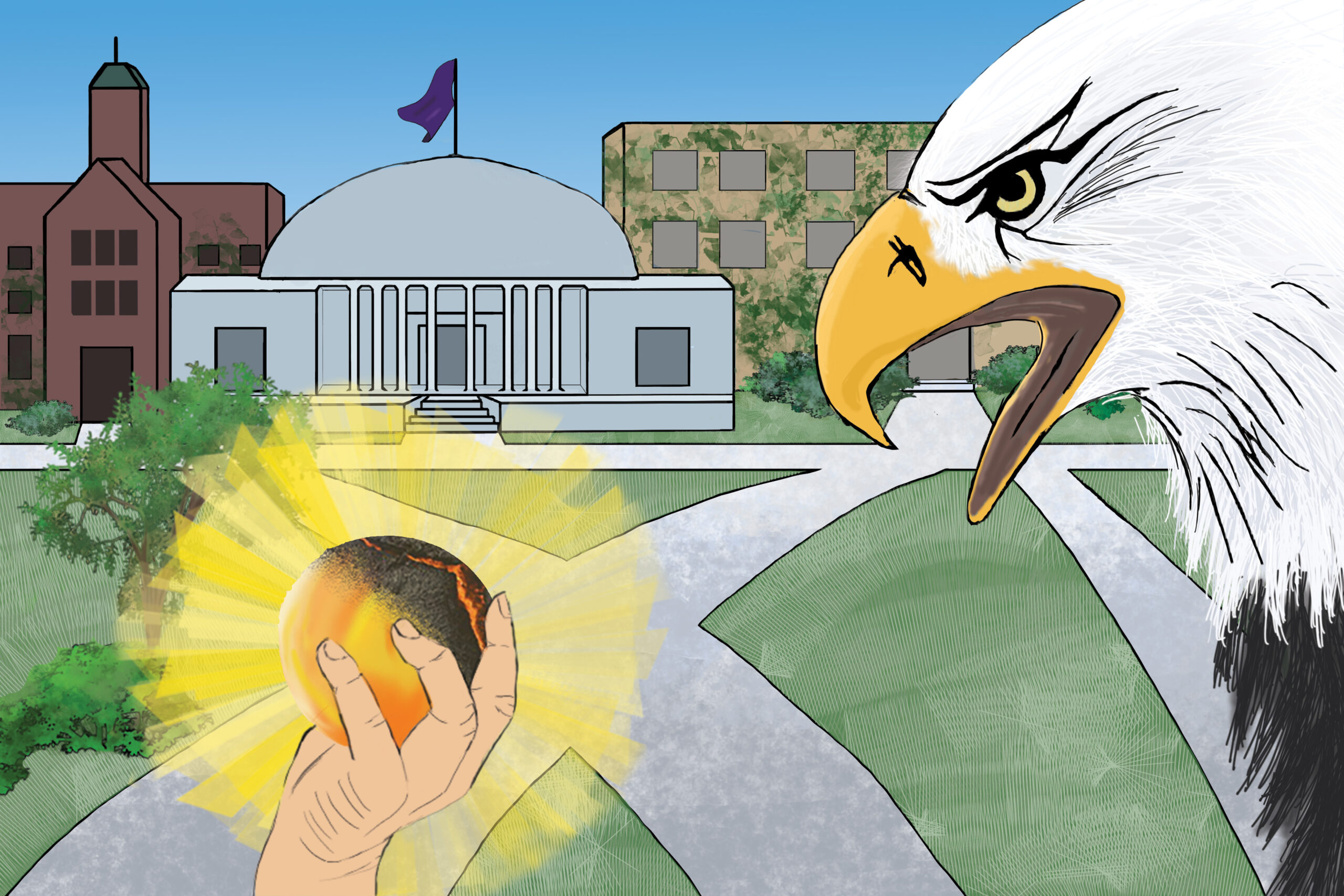
“Woven In”

New research out of Vassar College links institutional efforts to address student mental health with higher graduation rates. 

The article, “‘Woven in’: Mental Health and College Graduation Rates,” published in The Journal of College Student Retention, pinpoints four mental health interventions common among colleges with “higher-than-expected” graduation rates—that is, rates higher than predicted based on factors like endowment per student, instructional expenses per student, and more.

For other schools interested in improving retention, the authors, who include Vassar President Elizabeth Bradley, suggest implementing these practices may be a step in the right direction.

Retention at four-year colleges is an ongoing concern, as less than half of students are graduating within six years of matriculating. Still, the number of students applying to these programs has risen, along with the price tag to attend.

Previous research shows mental health issues, along with a range of financial, social, and academic factors, can stand in the way of students’ graduating on time or at all. What mental health strategies colleges should use to curb these negative outcomes, however, has been less clear. 

The researchers behind “‘Woven in’” set out to determine these strategies by conducting case studies of five colleges with model graduation rates. The schools selected remain anonymous throughout the paper but reflect diversity in terms of student body size, geography, and “ownership type” (public, nonprofit, or for-profit).

Each case study involved a site visit and interviews with between 28 and 41 people, including administrators, faculty, and students. The interviewees answered general questions about school culture and experience, as well as more targeted ones about retention-related programs.  

Together, the responses highlight four practices, shared among the colleges, for tackling student mental health on campus: 

1. “Recognition of the breadth and depth of mental health needs” 

At each of the five schools, researchers found a proclivity to name student mental health as an increasing problem on campus. Both staff and students recognized the issue and proposed possible reasons for it. An Associate Vice Chancellor suggested mental health concerns were more often responsible for educational leaves of absence, which can delay graduation, than academic reasons.

2. “Proactive Approaches: Early Detection and Outreach”

Another commonality between the schools was a proactive approach to mental health. Each had measures in place to reach struggling students before their problems became serious. Some ran formal programs to report concerns about students and assigned a point person to intervene. Others cultivated a strong culture of faculty referrals. 

Regarding retention strategies, one Vice Provost mentioned the value of mid-semester reports, which faculty at his school complete on behalf of their students and turn into the dean’s offices. “Sometimes we pick up care issues where a student will say, ‘You’re right. I’m not doing well.’”

3. “Diversity of Mental Health Resources and Quality Improvement”

Every school also offered a wide range of services, recognizing the diversity of needs and importance of adapting to meet new ones. “I think the myriad of mental health resources that [the college] has contributed to why people stay at [the college] and why our graduation rates are high,” a student said. “Because if you are struggling, you will get the help that you need.” 

Services included not only traditional counseling but education, recovery, and maintenance programming. They also addressed “identity-related needs,” specifically around race and ethnicity. 

4. “Embedding Mental Health in the Larger Social System”

Finally, all five schools integrated mental health services into “the larger social support and academic structures,” the authors wrote. Administrators and faculty alike expressed commitment to student wellbeing and working together to address it. By confronting these problems across offices and departments, they could foster a culture that normalized talking about mental health and asking for help. 

“Whether in the classroom or beyond, ‘[Mental health] is always kind of woven in.’”

As one administrator said, whether in the classroom or beyond, “[Mental health] is always kind of woven in.” 

Walter Mondale and Me

I started at the University of Wisconsin in the fall of 2001, just a week before 9/11. For me, and so many other first-year college students, this was a defining feature of the next four years. I was busy with work, internships, and other activities at a large public university and found that while I had many great professors, I don’t recall developing significant relationships with any of them, nor did I in graduate school, with the exception of one class. 

While attending the University of Minnesota’s Humphrey Institute of Public Affairs in 2006, I was selected for a seminar course led by former Vice President Walter Mondale and supervised by Professor Larry Jacobs. The class was featured in the documentary Fritz: The Walter Mondale Story. As part of the class, students identified different sections of Mondale’s biography and did original research based on his newly released papers at the Minnesota Historical Society. I chose to research his role as campaign manager for his friend and mentor Hubert Humphrey, who had waged an unsuccessful presidential bid in the tumultuous year of 1968. It was a fascinating experience to learn about such an important period in American history with so many epic characters like Bobby Kennedy, Lyndon Johnson, Richard Nixon, and Eugene McCarthy; and to get a sense of what life was like in a year of protests, assassinations, and war. I’ve always wanted to turn my paper into a book (someday).

Mr. Mondale was an engaging professor, generous with his time and willingness to share his personal experiences. In one of my memorable email exchanges with him, I asked him what lessons he took with him from 1968 that he used in his own campaigns. Besides the need to run a disciplined campaign (Humphrey’s campaigns were an apparent study in disarray), Mr. Mondale stressed the need to be yourself, work hard, and be kind. He remembered Hubert Humphrey as one of the most gifted orators of the 20th century, a superlative he said he would emulate but never achieve. In his email, he wrote:

“Humphrey was a magnificent speaker and performer. I couldn’t match that so I tried to compensate by working carefully on my speeches, doing some of my own research and reading, and connecting with people through friendship and kindness. We were very close friends but very different personalities. I did not try to be a Humphrey clone; I tried to be myself as unimpressive as that was and is.” 

“From him, I learned that you don’t need to be gifted to do great things.”

Besides his obvious humility, I was struck by his comment about “connecting with people through friendship and kindness” and the need to be diligent and work hard. From him, I learned that you don’t need to be gifted to do great things. As a fellow small-town Midwesterner interested in a career in public service, I was really inspired by him and could relate to his approach. I found him to be the ideal of what I thought of a public servant to be—honest, grounded, generous, smart, and always focused on improving people’s lives. He also had a great sense of humor that most people didn’t know. The class was a defining experience of my time in higher education. 

Embracing Neurodivergent Learners with Kelly Field, The Chronicle of Higher Education

On this month’s episode of LearningWell Radio, Kelly Field discusses her new report, “The Neurodivergent Campus,” for the Chronicle of Higher Education. The interview provides evidence and information about neurodiversity (students with autism, ADHD and certain learning disorders), and explores the needs and assets of this growing category of college students.

Listen now on Spotify or Apple Podcasts.

Principled Innovation 

Higher education has long debated its role in character development. Religious schools, secure in their subjectivity, have made producing people of good character part of their core mission. But for public universities serving diverse populations, the entire concept can be fraught, starting with the language itself. How are we defining character? And should values and principles be part of a student’s education? 

Arizona State University appears to have threaded the needle on character education with an initiative called “Principled Innovation” – a framework for ethical decision-making that can be used by individuals or in community settings. It is based on “pro-social” values that lead to defendable outcomes like “what’s good for humanity” without being overly prescriptive. Under the leadership of President Michael Crow, ASU has added Principled Innovation to the list of design aspirations that drive the university, calling it “the ability to create change guided by values and ethical understanding.”

Ted Cross is ASU’s Executive Director of University Affairs and Crow’s point person for the roll-out of Principled Innovation. He says character education is best understood as a reflective process that enables students to flourish – in a way that is flexible and individualized.

“We want people to improve themselves,” said Cross. “Positive psychology has a take on that; philosophy has its own angle. We packaged all of that into an inter-disciplinary approach that helps faculty, staff, and students ground decisions and actions in values and character.”

Informed by the Jubilee Centre’s Framework for Character Education in Schools at the University of Birmingham, Principled Innovation includes four domains of practice – Moral, Civic, Performance, and Intellectual – each of which encompass certain character “assets” or virtues meant to guide one’s ability to create positive change in the world. ASU’s institutional commitment is expressed through Principled Innovation as a guiding principle, while the practice of Principled Innovation is supported through a pedagogical approach, engaging tools and resources, communities of practice, and curricular and co-curricular activities. 

Building the Framework

The design lab for Principled Innovation was ASU’s Mary Lou Fulton Teachers College. In 2017, the dean of the college, Carol Basile, was concerned by the state of K-12 education systems and decided to change things from the inside out – through addressing the education workforce and teacher and leader preparation. She came to the conclusion that to do so, character education needed to be included. To understand how, she enlisted Cristy Guleserian, a colleague at the college who is now its Executive Director of Principled Innovation. 

“We asked ourselves, ‘What could it mean for a college of education at a public university to integrate a character education framework into the systems of teacher and leader preparation?’ said Guleserian. “In having these conversations, we realized it couldn’t just be integrated into a curriculum to teach future educators about character. It had to be our approach to everything we do and something that we embraced as a college community.” 

With this as their north star, Guleserian and her team worked intentionally with faculty, staff, students, and community partners and eventually incorporated the practices and assets of what would become Principled Innovation into everything they did, from fostering culture and environments to teaching, advising, and student services. But getting to an agreed-upon understanding of what all this would look like involved cultivating authentic relationships through a series of one-on-one discussions and all-college design sessions – a process Guleserian described as equal parts invigorating and challenging.  

“There was a lot of skepticism at first – a lot of questions about whose character, whose values, and whose virtues we were talking about. I remember spending about an hour going back and forth about one word,” she said.

In one of the sessions, a participant offered what would be a break-through in the log jam. “We need to ‘ASU-ize’ this,” he said. The group understood him to mean “co-create” a concept that more explicitly reflected ASU’s diverse community and well-publicized mission.  

“We recognized that innovation is at the core of what we do here at ASU and our charter holds us responsible for being inclusive for the well-being of the communities we serve. So the framing of Principled Innovation was born from that shared purpose,” said Guleserian.

The framework is intentionally flexible. In an essay for the book The Necessity of Character, ASU President Michael Crow and Ted Cross write, “By refusing to adhere to a single philosophical or religious worldview, ASU has made room for students to draw on their different backgrounds as they engage with our character education initiatives. Only by remaining flexible in this way have we been able to secure ‘buy-in’ across the university.”

At a research university known for outside the box thinking, Crow has made innovation part of ASU’s nomenclature. But the decision to include it in the title was more than just good branding. Principled Innovation proposes the notion that “just because you can innovate, doesn’t mean you should,” reflecting a growing national movement to infuse character into the critical actions of scientists and others in the innovation community.    

When asked if there could be “Unprincipled Innovation,” Cross said “definitely.” 

“It’s not enough to be innovative if you don’t innovate with purpose and principle. It’s not enough to help people learn how to make a good living if we’re not helping them learn how to live good lives, whatever that means to them,” he said. 

“It’s not enough to be innovative if you don’t innovate with purpose and principle. It’s not enough to help people learn how to make a good living if we’re not helping them learn how to live good lives.”

Principled Innovation in Practice

Building on the work of Mary Lou Fulton Teachers College (now called College for Teaching and Learning Innovation), Principled Innovation is currently practiced in ten colleges at ASU, including the W. P. Carey School of Business and the Watts College of Public Service and Community Solutions, as well as the Office of the Provost and Educational Outreach and Student Services. All of this work uses the framework and assets for reflective practices and community practice that lead to positive change.  

“The framework asks, ‘What are some of the possible intended or unintended outcomes of the decisions we make and how can we mitigate some of the possible negative consequences before we take action?’” said Guleserian.

A good indication of how the framework may influence ASU’s pedagogy is the launch of the Principled Innovation Academy, which is housed in University College. The curricular program involving human-centered problem-solving methods and team pitch competitions has already engaged with 750 students.  

Cross calls the program “shark tank meets design thinking meets character education,” where students create and pitch ideas using the Principled Innovation framework. Last year’s winner was a career recommendation engine for students that works by asking them questions like, “What are your work values? What are your personal values? And how would that map to your career?” 

It is clear that the careful work that went into developing Principled Innovation at ASU helped propel it from a concept within one school to a major design principle for the entire university. But for advocates like Cross and Guleserian, the buy-in it has received at the country’s largest public university says something about the times we are in. 

“The U.S. is so deeply divided that we are talking past each other,” said Cross. “There’s a lot of anger and aggression and mistrust. But if we can engage multiple perspectives in the way we design and create things, the way we teach and collaborate, it helps us to develop environments of trust and belonging.”