The Jed Foundation/SHEEO Mental Health and Equity Initiative

In 2023, the State Higher Education Executive Officers Association (SHEEO) and The Jed Foundation (JED) launched a learning community across state higher education agencies and systems  to better support college student mental health and determinants such as equity and belonging. In late April, SHEEO and JED will host a convening in Minneapolis, “The Wellness Blueprint: Cultivating Foundations for Statewide Student Mental Health Policy,” with the purpose of continuing the development and implementation of state- and system-wide policy recommendations to advance student mental health and wellness. The hope is after a year-long collaboration, states will have moved the needle on a problem that lies at the intersection of each organization’s area of advocacy and expertise: mental health challenges remain the number one reason students stop out or consider stopping out of their post-secondary programs.

Dr. John Lane is the Vice President for Academic Affairs and Equity Initiatives at SHEEO, where he leads policy and project development in educational equity, academic programs, and student success. SHEEO works with state higher education officers to promote equitable higher education attainment for all Americans. 

“Whether these challenges are crisis circumstances or are accumulated over time and hidden, students identify mental health as the primary challenge to their academic persistence and achievement,” says Lane. The issue is exacerbated for low-income students, many of whom will never return to school, and are often laden with debt and the result is no degree to show for it.  

Last year, states submitted grant proposals detailing their plans and commitments to mental health as a facet of equity in higher education, as well as their efforts to engage internal stakeholders, such as a state Department of Public Health. Five states — Arizona, Louisiana, Oregon, Pennsylvania, and Texas — were selected to receive $25,000 grants to support their work to implement mental health solutions tailored to their unique contexts over a 15-month period. The objective of the partnership was to provide states with the resources to explore how mental health and equity are being addressed and to share their findings through cross-state collaboration. 

The Jed Foundation brings decades of research and expertise in suicide prevention and student mental health to the table. It is also another example of an expanding focus for the non-profit, which has recently added a public affairs and advocacy component to its work with colleges and high schools.  The JED Equitable Implementation Framework and the JED Campus Program will be used to guide state policymakers in creating a space for states to identify best practices, refine strategies, and work toward inter-state collaboration. The Jed Foundation has a longstanding precedent of centering student mental health as an academic issue, making its partnership with SHEEO an opportunity for the organizations to implement robust, research-supported policy change, study best practices as tailored to states’ unique resources and needs, and improve student outcomes by working directly with policymakers. 

“There is no rulebook right now for investing in student mental health at the state level. We are building as we climb.”

Dr. Zainab Okolo is the Senior Vice President of Policy, Advocacy, and Government Relations at the Jed Foundation. Okolo says the mission of the learning community is to help guide state systems in centering mental health in state and federal policy. “What we found at JED was a gap and an opportunity,” she says. “In response to the mental health crisis that was exacerbated during the pandemic, we saw many state-level leaders begin to directly invest in mental health. Governors had clear new line items around mental health — but there wasn’t any guidance on how to actually move the needle on mental health, or whether or not the investments being made at the state level were answering the questions around how we destigmatize mental health, how we expand resources, and how we ensure that students, particularly within school settings, are having their mental health needs met so they can continue to thrive as they pursue their degrees.” In having conversations with their partners at SHEEO, an imperative emerged to ensure that state policymakers had the means to support the work that they were already investing in. The priority was there, Okolo says, but procedural clarity wasn’t: “There is no rulebook right now for investing in student mental health at the state level. We are building as we climb.”

A Just Design

The mental health learning community comes at a time when mental health is a steadfast feature of public discourse and a topic of conversation on the federal stage. “There is a great opportunity here to take advantage of the attention that is being rightly paid to this work, as recently as the President’s State of the Union address,” says Lane.“We are so fortunate to do this work now; we have the Surgeon General whose platform is mental health, and the Secretary of Education who cares about the wellbeing and mental health of college students, and wants to know how to best sustain support for students and for systems that are supporting them.” 

According to Okolo, bringing states together on these issues highlights the similarities of their positions even as they navigate different political landscapes. “They’re all grappling with very similar questions. How do you scale crisis response? What specific policy levers need to be in place in order to continue this work, even beyond this kind of mental health Renaissance moment? How do we flag for our federal stakeholders and leaders that we need harder lines of funding to continue on even beyond these next couple of years? The learning community creates a space for states to collaborate and learn from each other.”

The five states selected for the learning community project — Texas, Oregon, Pennsylvania, Arizona, and Louisiana — represent a diverse range of education policy, resources, and student demographics. “We were deliberate about the variety of states,” says Lane. “The topography of the states is representative of a deeper conversation about how we tailor our work to the unique circumstances of each state. The political landscape varies greatly across these five states. So does the availability of resources, the governance model and the engagement profile. So, states work really hard to build consensus among their stakeholders, and regardless of the model, try to provide direction to help set important way points.”

Texas is one of several U.S. states to implement changes to its diversity, equity, and inclusion (DEI) policies within the last year. Senate Bill 17 banned all DEI programming from public colleges and universities in the state, creating  potential mental health risks for students who relied on affinity groups and identity-based spaces to cultivate a sense of inclusion and belonging on campus. These changes to DEI policies went into effect after the launch of the learning community, Okolo points out, and only reinforce the importance of adaptability and community engagement. When mental health initiatives find themselves in the crosshairs of fraught political divides, they reveal a unique area of bipartisanship. 

“The interesting thing about working within these political contexts is that this work remains bipartisan,” Okolo explains. “We see clarity around the importance of mental health echoed across states. What’s not bipartisan is the approach to issues around parental access, data, and funding. So the approach is not bipartisan, but the issue and the framing of the issue remains undoubtedly bipartisan. We want to keep it that way and lean into that opportunity by learning about how to do this work no matter the political ground that we find ourselves in.”

The public spirit, Lane and Okolo say, has not changed even where laws have. DEI “is directly adjacent to our mental health work, and it influences the scope of our reach when it comes to identifying needs based on race,” says Okolo. “What I’m happy to see, though, is that Texas made a commitment to making mental health resources accessible to all. What the ban might mean is that the language, how we frame it, what we call it, may change. But it doesn’t change the intent of the work.”

The mental health learning community leans into designing equitable futures within the contexts of each state. This, Lane says, calls for new approaches to address the systemic biases and inequity that are known contributors to the lack of access to mental health supports and can therefore serve as deterrents to student success and degree attainment. As a result, new projects at SHEEO include more dialogue about “just design.” According to Lane, “If you know pre-existing structures, and best efforts in the past have resulted in the need for current work and equity to try to mitigate disparities, then, if we have new solutions without addressing those original systemic circumstances, we could accidentally perpetuate the disparities that equity efforts are meant to close.” 

“The topography of the states is representative of a deeper conversation about how we tailor our work to the unique circumstances of each state. The political landscape varies greatly across these five states. So does the availability of resources, the governance model and the engagement profile.”

In order to address systemic discrimination and avoid repeating previously unsuccessful — and potentially harmful — initiatives, Lane says states must raise questions about designing systems and environments. A just design, he says, is one that centers community engagement, student voices, and adaptability to different states and institutions. The SHEEO/JED collaboration is currently building a student panel to foreground the student experience in policy reform. The goal is to not only amplify student voices, but to give students a seat at the table of changemaking. 

“Our goal to center student voices goes beyond the traditional model, which often includes bringing on students who share a narrative in the first-person,” Lane says. “My feeling is that too often we resume the policy work without taking an important next step, and that next step is giving students a sense of agency so that they are at the table with us as thought partners and are mentored in collaborating around policy in a way that helps us in the present, that gives them development opportunities for the future and really enriches the work that we’re doing.”

Lane and Okolo are looking forward to the late April conference to collectively assess how much has been accomplished and to provide a best practices guide. “What we are hoping to achieve with the best practices guide is a bit of a north star and a guardrail context on what to consider when implementing and scaling mental health work within your state,” Okolo says. “What are the blind spots? Who are the unsung heroes and key stakeholders that should be at the table when making these decisions? What opportunities do you have to triage off campus? What community-based organizations do you have at your fingertips to close the gap between resources on your campus and ensuring that students get the support that they need? Those kinds of strategic levers are what we hope to outline, so that if the state never engages with us directly, they have a way of navigating this work within their state context.”

New survey shows stop-out rates remain steady; emotional stress, mental health are main drivers

A new survey report from the Lumina Foundation-Gallup State of Higher Education study shows that the number of students considering leaving their post-secondary positions has remained about the same as last year and that emotional stress and personal mental health continue to top the list of drivers, just ahead of cost. The survey also showed that Black and Hispanic students are more likely than their White peers to report they have considered leaving school (Hispanic (42%) and Black (40%) compared to White (31%)). 

Stephanie Marken, the senior partner of Gallup’s education division and author of the report, says the findings within the more than 14,000-person survey are particularly instructive for colleges and universities keeping a watchful eye on both overall retention and efforts to increase enrollment for underrepresented groups.

“One of the most interesting findings from my perspective is that people are about as likely as they were last year to consider stopping out in general, about 1 in 3,” said Marken, referring to data in the 2023 Lumina-Gallup survey.  The report notes that postsecondary enrollment, although up slightly due to increases for community college and short-term credential programs, have been steadily declining for the past four years. The fact that the number of those considering stopping out has also remained steady, indicates initial losses due to the pandemic may be more of a trend than a disruption.   

“This is alarming on a number of levels,” said Marken. “We know that from a social mobility perspective, from an economic perspective, people who complete a college degree are far more likely to be thriving in their lives. Whether it’s their career, their financial future, or their general wellbeing. The group that is even more disadvantaged is the “some college, no degree” cohort (those who stop out and never come back) who have huge amounts of student loans and nothing to show for it.” 

The report finds that consideration (of leaving) among Blacks and Hispanics has improved slightly but is still higher than among their White peers.  Marken sees the losses among this group as even more problematic when considering the outsized gain disadvantaged groups, including women, receive from a college degree.  

“We know that from a social mobility perspective, from an economic perspective, people who complete a college degree are far more likely to be thriving in their lives.“

“When we think about people who have been historically marginalized in our workplaces, in our communities, in our institutions, as Black and Hispanic individuals have been, we see that the lift those individuals experience is significant when it comes to receiving a college education,” she said.  “They enter the workplace in a very different situation from a pay perspective, even more so than their white peers.”  

Marken says the consistency among all racial/ethnic groups about the primary reasons for considering leaving school (emotional stress, mental health) is particularly concerning. 

“The fact that emotional stress and personal mental health are universal reasons (for consideration of leaving) and have remained as high as they are is a good reminder that all students are struggling and the core foundational need to stay enrolled is to have a strong sense of wellbeing,” she said. “We know that for Black and Hispanic students, because more of them are considering stopping out, it’s a really high need within those communities.”  

The recent survey is the latest in a series within the Lumina Foundation-Gallup State of Higher Education study.  Begun in 2020, the research first looked at the learning experiences of enrolled students amidst the pandemic but expanded to include non-enrolled individuals or those who have left college in an effort to understand what drove them to opt-out or stop out.  Marken says learning more about these dynamics will help colleges and universities better understand how to get them back. 

“This is a good reminder that the core foundational need to stay enrolled is to have a strong sense of wellbeing.”

The latest report surveyed 6,015 currently enrolled students, about 5,012 Us adults who were previously enrolled in an education program after high school but had not completed a degree, and 3,005 adults who never enrolled in higher education.  The survey showed that about six in 10 Black and Hispanic unenrolled U.S. adults report they have considered enrolling in the past two years and that Certificate and Associate programs are most attractive to Black and Hispanic Americans.  

Marken sees this as good news and tracks it to 2019 Gallup research that showed that 66% of Hispanics and 65% of Blacks said that a college education was very important compared to just 44% of Whites.  

“All of this research is really aimed at figuring out how do we keep more of these individuals within higher education – those who want to be in higher ed and who perceive it to be a highly valuable experience — so they don’t stop out temporarily or permanently.”

Filling the Research Gap on Student Health and Wellbeing

Last August, as Kent State University students were busy reconnecting with friends and settling into another year of college, professors John Gunstad and Karin Coifman were launching a research initiative that could improve their wellbeing and that of the thousands of students who come after them. The new Student Life Study is the largest and most ambitious investigation into the health and wellbeing of college students ever conducted. It will collect a high-dimensional data set on a group of 10,000 students and follow them throughout their lifetimes, providing real-time data on student mental and physical health. Gunstad and Coifman believe a study of this magnitude will eventually identify best-practice interventions, provide immediate access to health and wellness resources, re-structure university programming and decision-making, and even predict outcomes after graduation. 

“Our goal is to create a comprehensive understanding of what it’s like to be a modern-day college student in order to help them live happier and healthier lives,” said Dr. Gunstad. 

Longitudinal, population-scale research projects, like the Harvard Study of Adult Development, can provide a treasure trove of data as they follow individuals over the course of their lifetimes. But no studies of this scope and intensity have ever focused on college students. Dr. Karin Coifman is a clinical psychologist whose research focuses on following people over extended periods of time, particularly through stages of stress—including normative, developmental stressors like the transition into college. Dr. John Gunstad is a clinical neurologist interested in tracking changes in the brain over the course of a lifetime. Their combined expertise is now fully dedicated to helping improve the overall wellbeing of college students by looking at all the contributing factors – including mental and physical health, social belonging, academic and career success and equity and inclusion. 

An unmet need

The Student Life Study’s abstract states that “Current students represent a unique generation, the first raised entirely within the broader context of social media. Presently, U.S. colleges and universities do not have adequate resources to address this increased demand and existing surveillance and broad-scope interventional tools are limited. The Kent State Student Life Study (SLS) is designed to investigate complex and dynamical developmental shifts in psychological health and functioning in this generation of college students.” By understanding the unique social, cultural, and psychological challenges faced by these students, Dr. Coifman and Dr. Gunstad believe that universities can better accommodate their needs and support their development. 

A population-scale study of this magnitude and with this intensity of measurement has never been conducted on college students.

As Dr. Coifman explains, “college is a developmental period when the bad habits that drive many health concerns later in life are formed. There’s a shift that happens when kids leave home and come onto the college campus. They come with their history. They come with their risk. They come with their experiences and certainly patterns of behavior. But those things dynamically shift during the college years, and we don’t yet understand exactly how that occurs—which means we’re not very good at intervening.” 

Both Dr. Gunstad and Dr. Coifman speak passionately about the research methodology and the rigor of the study. The Student Life Study aims to gather data on a sample of 10,000 college students—not only while they are on campus, but after graduation and throughout their lives. The research methods range from surveys and video responses to physical health assessments, the combination of which is itself precedent setting. The model of the study involves both tracking behaviors and testing methods of intervention, discovering what works in real time. When something works, the researchers will make it available without delay—an intervention found to be effective will be available to all students and continuously refined. 

The process of data collection is equally rigorous, agile and ever evolving. “To capture developmental processes, you have to use a dynamic model for research,” Dr. Coifman says. “It’s often called a measurement burst framework, where you do these fits of intense measurement, and then you wait, and then you do them again, and then you wait and repeat. We’re doing that within a platform that’s really comfortable for this population. We rely on a lot of remote assessment, such as surveys delivered through the smartphone, as well as a process called ecological momentary assessment, a technique that allows researchers to observe behaviors and experiences in real time.”

In the Student Life Study, this assessment takes place during one week of each semester, when students will report their behaviors and experiences 5 times a day for a period of 7 days. “We’ve paired these periods of ecological momentary assessment with passive biosensing,” Dr. Coifman explains. This means hardware and software integration, pairing survey data with health data collected by a Garmin device such as a Fitbit or Apple watch. 

The study has “enormous scientific potential,” Dr. Coifman explains, in part due to the scope and methods of data collection. A population-scale study of this magnitude and with this intensity of measurement has never been conducted on college students. It allows the researchers to make better, more nuanced scientific inferences. “There are lots of population-scale studies following individuals over the course of their lifetimes, but the intensity of measurement is gathering data maybe once or twice a year. We are doing continuous, intensive sampling, and we’re also collecting biological data that other samples haven’t.” 

Phase 1 of the study began last fall and involves measuring the health, social behavior and academic performance of 10,000 college students during their time on campus. Phase 2 will follow these same students after graduation, studying how their physical health, mental and emotional wellbeing, social and professional lives play out over the course of their lifetimes. The researchers will use information gathered in both phases to identify predictors of successful outcomes, develop effective interventions for issues like substance abuse or mental health concerns, and understand how students’ college years affect the rest of their lives. 

The ultimate goal of the Student Life Study is to work with university administrators and decision-makers at Kent State and beyond to implement resources and best practices based on the findings of the study.

“We’re trying to capture all domains of operations,” Dr. Coifman says. “We are, of course, interested in psychological states, but we’re also interested in basic biological functions. We want to know how people are sleeping, how they’re eating, how they’re moving; what their social networks look like and how they experience social connection.” Additionally, the researchers will collect data on difficult experiences in students’ lives—as well as how they think about those experiences, and how different ways of thinking about difficult experiences affect life outcomes. At the end of every semester, students complete a survey detailing the primary stressors they encountered, as well as completing a video prompt where they discuss those sources of stress. They use the same method to record positive experiences and achievements. The video offers a platform for narrative response and, importantly, a window into the way students think. 

“Often what people say is much less useful for predicting outcomes than how they say it,” Dr. Coifman explains, adding that “subtle things, like how people use words or how the syntax moves in their phrasing” can help researchers glean qualitative information about how they are processing positive or negative events and emotions. Beneath the content of what students say, the psychology of how they feel about what they are saying opens another world of interpretation. 

With this ambitious undertaking comes a tremendous potential for meaningful change. The ultimate goal of the study is to work with university administrators and decision-makers at Kent State and beyond to implement resources and best practices based on the findings of the study. Dr. Gunstad emphasizes that helping universities reallocate their resources to better serve students in an important benefit. “Universities have limited funds for programming to help students succeed,” he says, noting that much of that funding is misallocated to interventions whose efficacy is unproven. “If we can help universities be smart about how they use those funds, we can create better outcomes for students.”

The Student Life Study is funded by a competitive “Game Changer” award sponsored by the Division of Research and Economic Development at Kent State University, which provides internal pilot funds to research projects at the university. When Phase 1 launched in August of 2023, the Student Life Study had amassed around $450,000 in funding to cover the first two years of the study. Dr. Coifman and Dr. Gunstad are grateful for the university’s investment into the program, and they agree that Kent State is the ideal setting for an initiative of this size, scope and potential outcome. 

With nearly 35,000 students across 8 campuses, the university’s geographic spread includes both rural and urban campuses in Ohio. Additionally, more than a third of Kent State students are first-generation college students, and a longitudinal study could have meaningful implications for that population of students. “These are individuals who are the first in their families to make their way into college,” Dr. Gunstad says. “Being able to capture information on that group is critically valuable to their development, and also valuable to us as a country and a society.” 

Dr. Gunstad also points out that past longitudinal and life course studies have typically looked at populations on the east and west coasts. Kent State’s midwestern location means that the study will fill in what past research has missed: “flyover country,” as Dr. Gunstad affectionately puts it. 

Additionally, Dr. Coifman emphasizes institutional support as a crucial element to the study’s success. “The potential of the study is in the commitment of this institution to this project. We are reaping the tremendous benefit of many institutional resources. I suspect that lots of institutions are very concerned with the fact that it’s incredibly hard to meet the needs of students today, and they simply have inadequate funding available to do it. The gap between the need and the resources is just getting wider and wider,” she says. Institutional investment into the Student Life Study may eventually mean that those limited resources can be reallocated to better serve students at colleges and universities across the country.

To learn more about the Kent State University Student Life Study, visit https://www.kent.edu/student-life-study. 

Mindfulness: Coming to a College Near You

Around the turn of the century, psychiatrist Holly Rogers noticed an emerging trend among her student clients at Duke University. Many of them were coming into the student counseling center with a variety of mental health problems driven by what seemed to be a lack of resilience; an inability to sit with discomfort, distress or disappointment. She concluded that helping her students develop the coping skills needed to confront these emotions would lead to a myriad of benefits, including alleviating what would soon grow to be a capacity crisis at college counseling centers across the country. 

Nearly a quarter century later, Rogers’ professional observation has become a personal mandate to help address some of what today’s college students are struggling with – including anxiety, depression and loneliness. She is even more convinced today that practices such as mindfulness can help many college students regulate their own wellbeing in a world that has only become more stressful. She and her colleague, Libby Webb, the former associate director of counseling and psychological services at Duke, founded the Mindfulness Institute for Emerging Adults (MIEA) to bring the evidence-based program in contemplative practices developed at Duke to colleges and universities around the country.

“Something more has got to be done,” said Rogers, MD. “There needs to be a top-level paradigm shift to change the culture on our campuses so we don’t have academic success over here with all its metrics and then ‘here’s a few things we do for wellness.’”  

Rates of anxiety and depression reported by college students have been on the rise for more than a decade, and the responsibility of addressing the crisis has been largely laid at the door of college counseling centers. But capacity problems have coincided with a growing recognition that subclinical emotional issues can and should be addressed by opening up the circle of care on campus, and that combatting the college mental health crisis requires adding a preventative, public health approach, along with a treatment response. Enter mindfulness. 

Holly Rogers, MD
Libby Webb, MSW

Like many ubiquitous terms, mindfulness could stand to be better explained before it can be fully embraced. Based on age-old contemplative practices found in most religions, notably Buddhism, mindfulness is defined as a mental state achieved by focusing one’s awareness on the present moment, while acknowledging one’s feelings, thoughts, and sensations. Its broad appeal in today’s frenzied world is its ability to calm the mind through practices such as mindful breathing, meditation, body scans, and intentions of gratitude. 

“Mindfulness is the skill and capacity to bring our minds to the present as opposed to galloping towards the future or dwelling in the past,” said Webb, MSW. “And doing so with a non-judgmental awareness of where our minds tend to go. You just notice it and bring your attention back to the present.”

Mindfulness has become a big business, complete with YouTube channels and celebrity endorsements, and it is clear the practice can work for people of any age. But Rogers and Webb believe it is particularly beneficial for emerging adults: traditional college-age students who are navigating emotional land mines such as test anxiety, social media-induced self-doubt, and vulnerability to substance use. “What we know about this developmental stage is that it is filled with ambiguity,” said Webb. “‘Who am I? What do I care about? Who am I going to love?’ And we know that the brain doesn’t like ambiguity. It detects a threat, so it’s a time of high unease.” 

Webb says that because their brains are still fluid, young people are more adept at flexing into other patterned behaviors if exposed to them. Skills-based practices like mindfulness can calm their brains, which helps them make better choices, examine their purpose, and identify what is important to them. In 2023, the American Council on Education strongly endorsed mindfulness programs with supervised practice in its report, “What Works for Improving Mental Health in Higher Education,” adding to a strong body of evidence already in the literature.

“Research is showing us more and more that this capacity to be in the moment reduces suffering and improves attention,” said Webb.

For several years, Duke offered the program developed by Rogers and her colleague Margaret Maytan, MD, in the form of a four-week, opt-in course, involving a teacher and group discussion.  While it was slow to catch on, it eventually took on waiting lists. They called it Koru, a Maori word used for an unfurling fern frond symbolizing stability in the center of unfolding growth. With refinements to the curriculum over the years, they began an effort to assess its effectiveness in 2012. The results of its randomized controlled trial were published in the Journal of American College Health and became that publication’s most downloaded article in 2014, around the same time the Healthy Minds survey showed a solid upward trend in mental health problems among college students. In the trial, students who had taken Koru reported a reduction in stress, an increase in restfulness, and a greater sense of self-compassion, among other findings.  

Skills-based practices like mindfulness can calm their brains, which helps them make better choices, examine their purpose, and identify what is important to them.

Interest in practices like Koru on college campuses has grown steadily since then, motivating Rogers and Webb to leave their positions at Duke to focus full-time on expanding the program through a “train the trainer” model. Individuals from other universities began coming to the center, recently renamed MIEA, in Durham, NC, where they receive training to become MIEA-certified teachers and then go back to their campuses and offer the courses in a variety of forms. 

Since the pandemic, MIEA has offered the certification program online, which has accelerated the number of schools and individuals participating in the program. Rogers said that MIEA has now trained 1,500 teachers in 14 different countries and taught over 70,000 students. Institutions range from the Ivies to community colleges. You don’t have to have a clinical background to become a MIEA teacher, only some background in contemplative practices. If you don’t, they will help you cultivate one.  

MIEA’s first non-Duke client was Harvard University, which continues to offer a variety of classes each semester and has 12 MIEA-certified teachers within its Center for Wellness and Health Promotion. “I have been teaching MIEA classes for over 10 years,” said Amanda Ayers, MPH, Harvard’s Director of Health Promotion. “It is such a joy to see the changes that students make in just four weeks. They are able to be more present in their everyday lives, spend less time on social media, and are kinder to themselves.” 

How mindfulness practices are taught and who chooses to teach them illustrates their versatility and low barrier to access. In an environment as siloed as a college campus, mindfulness curriculum like that offered through MIEA can weave through departments and requirements – a credit-bearing course here, an elective there. Mindfulness teachers are often connected to traditional fields like health promotion but can include anyone in any discipline who sees the value of improving student wellbeing. Evidence on the connection between mindfulness and attention attracts professors and academic advisors worried about student disengagement and burnout.

“You can embed this curriculum into your first-year seminars, your physical education classes, or as an extra credit elective,” said Rogers. “We have faculty in business schools who are offering the curriculum in conjunction with their academic material.”

The individualized nature of the MIEA program is both an advantage and a challenge. The curriculum, which comes with an app and a teacher dashboard, takes different forms at different price points. To date, MIEA’s business model is to sell the program to individuals within schools such as faculty or staff working in the wellness center who might use professional development funds to pay for it. Rogers points out that this case-by-case model lacks the consistency and traction needed to make mindfulness a universal benefit. Professors get busy. Funds dry up. The team is now offering the MIEA program directly to institutions at a much larger scale, hoping the urgency of student mental health will spur a university-wide commitment to wellbeing.  

“We’re asking universities to make a commitment both to us and to their teachers if they want to really make a difference on their campus,” said Rogers.  

Mindfulness in Action

Eric Teske directs the Office of Health and Wellness Promotion at Indiana University, Indianapolis. His interest in the MIEA program came from his desire to “take pressure off of the counseling center” by offering a program that could be taught by trained teachers to students who could be helped in non-clinical contexts. After hearing a presentation by Libby Webb during the pandemic, Teske was determined to get a number of people on campus trained and certified through MIEA. Making it a free professional development opportunity was an added incentive. He funded the trainings through a grant from the state’s Division of Mental Health and Addiction.  

“In helping students understand their own thoughts and feelings, we are equipping them with self-regulatory skills, self-management, and that is all part of alcohol and drug prevention,” said Teske, MS, CHWC, who urges institutions in other states to explore the use of similar public funding.

The person who brought Libby Webb to IU was Nancy Barton, MS, a senior lecturer in the School of Health and Human Sciences’ Department of Kinesiology. With a background in meditation, Barton had been interested in becoming MIEA certified but didn’t find the time to pursue it until the pandemic,when the online option provided an opportunity — and even more students were reaching out for help. 

“Once I got it [the certification], I really wanted to work with my university to see it take off,” she said.  “So many people would say to me, ‘I am really worried about the mental health of my students, but I don’t know what to do.’ Now I could say,‘here’s something you can do.’”

Teske and Barton were part of the university’s Wellness Coalition, an ad hoc group of wellness enthusiasts who informally met to strategize about tactics to use on campus. Another member was Lisa Angermeier, PhD, MCHES, a senior faculty fellow in the Institute for Engaged Learning, which focuses on first-year experience and high impact practices. Together, they led an effort to embed the MIEA curriculum as a pilot program into selected sections of the first-year seminar. Now, the course is not just a credit-bearing option in the Department of Kinesiology, but a required course for first-year students.

“We wanted to offer students more tools, right from the beginning of their college experience to help them deal with the stress they will encounter,” said Angermeier. “But we also see this as something they can take with them and use for the rest of their lives.” 

An assessment of the program indicates that 62% of the first-year students found the program to be valuable. The team considers this statistic a positive outcome, considering that students do not opt-in to the program. Requiring mindfulness courses is a matter of debate among experts, with some saying it takes away from the self-agency of the practice, but Angermeierviews it as a way to plant a seed of self-care, even for those students who may be reluctant. Equity was another driver. 

“Oftentimes with opt-in programs, we see that the students that get there first come in with more social capital while those who lag behind lose out,” she said. “These are the students who often need it the most.”  

Valencia College in Orlando, Florida is also utilizing the MIEA curriculum. One of the largest, multi-campus community colleges in the country, Valencia is diverse, both in terms of its students and in the broad range of developmental stages in which they come to campus. Marcia Roman, EdD, ThM, is a counselor and faculty member at Valencia, where she and her colleagues do case management-type work, connecting students to clinicians when necessary and providing workshops and skills-based training. She said the MIEA curriculum “blended beautifully” with their model.  

“Our students can learn basic skills that you might even describe as mechanical – like how to breathe in a way that activates the parasympathetic nervous system, which will calm them down – but it’s more than that. For some, it has been life-changing. With mindfulness, they can move through the difficulty in their lives as opposed to all the manner of ways we try to bypass it. And they can do so without tremendous cost and with little risk.”  

The accessibility of mindfulness is one of its biggest selling points and something Rogers and Webb are promoting before potential higher education clients. Vivien Roman-Hampton, MSW, LICSW, is MIEA’s new Director of Outreach and Teacher Development. Part of her job is encouraging MIEA teachers to become trainers with a particular focus on bringing in people with diverse backgrounds.  

Roman-Hampton believes that when colleges and universities offer these services to students of all backgrounds and abilities, it says to them, “We see you and we want to support you.”

“My focus is on ensuring that the practices are accessible to anyone who isn’t what we would call ‘mainstream,’” she said.

Her interest in MIEA is personal. A clinician who works with clients from marginalized communities and is from one herself, Roman-Hampton was drawn to MIEA’s work because of its low cost and long-term benefit. “So much about self-care costs money, and that becomes a barrier to people,” she said. But Roman-Hampton initially questioned the lack of diversity among the training staff, which she said would be an issue for her clients. When she expressed her concern to Rogers and Webb, they encouraged her to help diversify the practice, and she joined them officially two years ago.    

Roman-Hampton believes that when colleges and universities offer these services to students of all backgrounds and abilities, it says to students, “We see you and we want to support you.”

Asked if mindfulness programs offer a particular benefit for marginalized groups, she said, “I think the practice allows us to sit with things that might be really difficult — like how the world sees us versus how we really are. And while we can most definitely work to create change, it is also exhausting, and not everyone will change as a result. But that doesn’t mean we have to keep absorbing it the way we have historically. Mindfulness is a way to sit with suffering but not let it destroy you.”

Loss, Grief and Homework

Listen to this story:

When Joey left his hometown to attend a prestigious out-of-state university, his mother was in hospice care for a rare sarcoma, a terminal cancer affecting the body’s soft tissues and bones. Two weeks into his freshman year, her nurses warned the family that Joey’s mother was in the final days of her life. Joey returned home, and his mother died the next day.

Joey’s mom had encouraged him to go to college, find community, and engage academically and socially with his campus. In the wake of her death, he no longer knew what that looked like. Joey went back to school one week after losing his mother, uncertain of his options and fearing the academic consequences of missing classes. When he emailed a dean at his university to explain his weeklong absence, an administrative assistant wrote back, asking Joey to provide a copy of his mother’s obituary.

“I didn’t want to dig myself into a deep hole in my first semester,” Joey says. “My university didn’t really know what to do with me, so I went back after a week. That’s when things really started to go downhill.” He describes feeling “indirectly rushed” to return to campus, having no knowledge of the university’s academic accommodations or leave policies. No one from his university’s administration reached out to make Joey aware of his options for support in or out of the classroom. He did not know until his second semester, after months of depression and isolation had taken a toll on his transcript, that he could have been graded on a Pass/Fail basis, allowing him to proceed with a clean slate. 

“My grades were very poor,” he recalls. “I had no study habits whatsoever. Seeing my GPA, seeing that it didn’t reflect the kind of student I am, it just made me more depressed. And then socially, it also took a huge toll. I was living in my dorm room most of the time.” Watching his grades drop over the course of his first semester, Joey says, compounded the cycle of anxiety, overwhelm, and pain—but what choice did he have? Without clarity on his university’s policies on grief and bereavement, Joey believed his only option was to keep going, soldiering on through the daily slog of academia, held to the same standard as his peers.

Death is a sensitive subject even for family and close friends, often leaving us at a loss for words, choosing to say nothing for fear of saying the wrong thing—so how should a college or university respond when a student loses a loved one? That question, at once ethical and practical, is the driving force behind UGrieve, a new initiative by the Parmenter Foundation designed to help colleges support students as they navigate the loss of a loved one while balancing academic and social commitments at a time when they may be living away from home for the first time. 

Established in 1949 as a provider of medical care in MetroWest Massachusetts, the Parmenter Foundation offers end-of-life and bereavement programs, resources and education, as well as grant funding for other nonprofits that provide services such as grief support groups for all ages, guidance for educators, and hospice care. The foundation launched UGrieve with interviews of three college students who describe feeling isolated, disoriented, and unsupported while grieving on campus.

Video provided by the Parmenter Foundation.

“Our understanding, based on anecdotes from bereaved students, parents, and also counselors and administrators, is that higher education institutions do not have systems, policies or protocols in place to support students who have experienced a death in their family,” says Angela Crocker, Executive Director of the Parmenter Foundation. “It seems colleges and universities can be accommodating to students who are grieving, but only if the students know what to ask for and whom to ask.” 

The confusion and ambiguity that accompanies students reentering campus life after losing a loved one is an additional stressor for grieving families. “We’ve talked to moms who have lost a husband who say, I’m grieving. I’m in shock. And then my son needs to go back to school, and I feel like I’m sending him into a black hole, and nobody’s looking out for him,’” says Jennifer Siegal, Communications and Programs Manager at the Parmenter Foundation.

The fear of sending a student back into a “black hole” of grief and bereavement protocol is far from unfounded, as Joey’s experience lays bare. Colleges tend to be pro-active only when a death (usually of a student) occurs on campus, assuming that what happens at home falls outside their institutional responsibility. As a result, according to Crocker, bereaved students are not only emotionally gutted, but often left feeling pulled between family and school obligations. 

“Colleges and universities can be accommodating to students who are grieving, but only if the students know what to ask for and whom to ask.” 

Joey’s older sister was their mother’s primary caretaker while their dad worked, he says. She made the preemptive decision to take the entire fall semester off from school, because she did not know when her mother would pass away. Joey describes feeling torn, longing to be at home to grieve with his loved ones but fearing falling behind in his academics. He reminded himself that his mother had encouraged him to make friends and “make his mark” on campus, something that seemed impossible as he struggled just to stay afloat.

“When college students have to confront the loss of a family member, they are immediately pulled between their two worlds of school and family life,” said Crocker, who noted the chasm is even wider for international students. “This pull is aggravated by geographic factors, multi-faceted academic demands, and oftentimes by the uncertain timeline at the end of their loved one’s life. No one is prepared for this. Colleges and universities need to understand this painful dynamic and provide balance and support—not demands—to students who are grieving.” 

Another barrier is the disconnect around bereavement and mental health support on campus. Siegal and Crocker emphasize that bereavement is a component of mental health, yet as colleges have increased cultural awareness and attention to mental health, grief and bereavement have been largely excluded from the conversation—despite the fact that the death of a loved one is correlated with a higher risk of depression, anxiety, post-traumatic stress disorder, and compromised physical health due to chronic stress.

How to Help

Colleges and universities do recognize the need. According to Siegal, administrators and decision-makers in higher education have expressed uncertainty surrounding best practices—they, too, operate in the dark, without a clear, universal protocol for students. “We saw that there was a demand for support in this area,” Siegal says, “so we started to put a program and initiative together. We interviewed students and created the video just so people could see that there really is a case for this work, and data show there are hundreds of thousands of students losing a loved one each year. This is not a small problem.”

“When college students have to confront the loss of a family member, they are immediately pulled between their two worlds of school and family life. Colleges and universities need to understand this painful dynamic and provide balance and support—not demands—to students who are grieving.”

The UGrieve program provides data and information about bereavement and makes recommendations to colleges on how to “build compassionate campuses” through policy changes. The UGrieve program urges colleges and universities to implement a “point person” to inform students of their options, communicate with professors, and coordinate accommodations as needed. The point person, she says, would ensure that grieving students will not be forced to make hurried decisions about their academic futures without full knowledge of the school’s policies and the resources available to them. “College students who have suffered a loss experience a sense of grief and isolation that inhibits them from navigating their classwork, effectively communicating with professors and accessing even the resources that are readily available on campus,” says Crocker. “Colleges and universities can overcome this disconnect by assigning a single point of contact to guide a grieving student on every accommodation available to them.”

Additionally, Siegal says, universities can implement training programs for faculty, staff, and students to make it easier for them to approach conversations with people who have lost loved ones. “It can be awkward,” Siegal acknowledges. “If someone brings up the death of a loved one, a roommate or professor won’t always know what to say.” Trainings and educational resources, she says, can create a grief-ready campus. The UGrieve mission is to “build compassionate campuses” where bereaved students are not neglected as they struggle to navigate classwork and social lives in a time of grief. On a compassionate campus, faculty will be better prepared to accommodate students who lose a parent, caregiver, or sibling. Bereaved students will have a point person to direct them to campus resources. Roommates and friends will be better equipped to recognize signs of isolation and depression.

UGrieve suggests that the first step to creating compassionate and informed campuses is to include grief and bereavement in conversations about mental health, including legal conversations. In 2023, several U.S. senators, including Massachusetts’ Edward Markey, introduced the Student Mental Health Rights Act, which would require the Department of Education to issue guidance to institutions of higher education to ensure compliance with federal law on mental health disabilities. But for some students, there is a glaring gap in the legislation: “It mandates colleges to provide accommodations for students who have anxiety, depression, substance use disorder, and they don’t include bereavement,” says Siegal. “So we’re working to compel them to include bereavement in the legislation. The accommodations they are proposing for supporting students with mental health struggles are very similar to what we are recommending for students who are grieving.”

With advocacy and hands-on resources, the Parmenter Foundation hopes all colleges and universities will examine the strength of their bereavement programs and consider them an important part of creating compassionate campuses.

After his mother was diagnosed with cancer, Joey says, “She fought till the very end. She wasn’t willing to give up or back down without a fight. It’s still a huge inspiration. When I’m thinking about giving up, or when I’m at my lowest point, I always think: What would my mom say? What would my mom do?

When Joey returned to school for the second semester of his freshman year, he arranged a meeting with the dean of students and the dean of the business school. He described his experience, telling them that it was the experience of many students who were suffering in silence, not knowing where to turn for help. He says the deans listened: they wanted to do better. They listened to a student who had felt neglected, left to fend for himself—and they took his suggestions seriously, proposing new protocols for grief support with the goal of making campus resources clear and accessible to all students.

Now a finance major with a minor in economics, Joey has cultivated a sense of belonging and hope on campus, living a life beyond his dorm room. “I don’t hate this school,” he says. “I love being here. It’s a great fit for me. I just wanted to make it better.” He has worked with UGrieve to build a compassionate campus for future students, who he says he hopes “will be treated the exact opposite” of how he was. For Joey, a compassionate campus is one where students can spend time at home to grieve with their families, knowing that they will be accommodated and welcomed back to campus; where students know who to reach out to and where to go for help; where professors have built-in procedures to grant extensions and forgive missed work when a student loses a family member or caregiver. And a place where an administrator will be less likely to ask a student for his mother’s obituary as proof of death.

To learn more about UGrieve, visit https://parmenterfoundation.org/ugrieve/.

UR Well

For the first 30 minutes, University of Rochester academic advisor Hana Goldstein thought her advisee seemed totally fine. Suddenly, she broke down in tears. 

“I was about to say to her, ‘Okay, have a great day. We’ll chat in a couple of weeks.’ And then she just started crying,” Goldstein said. “She opened up to me.”

It’s not uncommon for Goldstein to find her one-on-one sessions with students veering from the academic to the personal. Some students are quick to tell her about an issue they’re facing outside the classroom, she said, while others choke back those troubles, at least initially. “You never know what someone’s going through.”

There is a growing acknowledgement on college campuses that student mental health is influenced by a community of care, and not just one office or service. But taking a more public health approach to college mental health suggests all community members must be prepared to respond if a person reaches out or breaks down. At the University of Rochester, a new wellbeing initiative hopes to fill that need with a curriculum-based training program that helps faculty and staff support struggling students, and each other, in a way beyond “report and refer.”   

This fall, the Health Promotion Office at the University of Rochester launched the Well-being for Life and Learning Training Program, designed for student support staff like Goldstein, who are hungry for tools to support struggling students. The opt-in, self-paced program requires participating faculty and staff to take four core and two elective workshops on a range of wellbeing topics from supportive communities and suicide prevention to intercultural communication and religious diversity.

At its core, the Well-being for Life and Learning Program is a student success initiative, born from the understanding that if students are living better, they will learn better. Rochester’s Health Promotion Specialist for Student Well-Being, Rebecca Block, leads the Well-being for Life and Learning Training Program. She said faculty and student support staff interactions are particularly important to this work. 

Photo by J. Adam Fenster / University of Rochester

In 2021, when the Boston University School of Public Health, Mary Christie Institute, and Healthy Minds Network published a report on The Role of Faculty in Student Mental Health, Block found statistical support for the challenges she’d witnessed teachers confront first-hand. Of the more than 16,000 faculty surveyed, nearly 80% said they’d spoken to students about their mental health in the last year, while only 51% said they could confidently identify a student in distress. The majority (73%) said they would welcome opportunities to improve their skills in this area.

“That report made it more acceptable, I think, at a research institution to say, ‘Okay, this data came out of this study with over 12 universities’ faculty reporting this issue. This means that we should do something about it,’” Block said. 

That same year, in 2021, Block launched the Support Student Mental Health workshop series, bringing together ten experts to lead sessions on topics including trauma-informed pedagogy, recognizing students in distress, and educator self-compassion. By spring, 2023, the Health Promotion Office was polling Rochester’s faculty and staff, finding 85% had spoken to students about their mental health in the last year, but more than half had never received formal training to “navigate discussions with students in distress.”

Upon the success of the workshop series, Block began considering an even more formal, expanded platform to provide faculty and staff with the tools to support not only student mental well-being but their own well-being and that of the community generally. The result, launched this fall, was the Well-being for Life and Learning Training, complete with two unique tracks for faculty and staff, respectively, and offered both online and in-person. By showing faculty and staff how to care for not only struggling students but also themselves, the course tries to relieve some of the pressures that might otherwise detract from their own wellness and ability to teach. 

“This is really the first thing I’ve done that’s really focused on students’ well-being and mental health and how we as staff people can actually make an impact on their lives.”

Block said she first became passionate about faculty wellness as a teacher in New York secondary schools. She noticed how instructors’ stress, often internalized from their students, affected teaching. “Working in those classrooms really was the pivotal moment for me. I was like, ‘These kids are not going to learn. They’re not going to be well if their teachers are not able to regulate their own emotions, if they’re not able to support students in the ways that they need.”

For Amy McDonald, director of Rochester’s Health Promotion Office, one of the primary functions of the Well-being for Life and Learning Training Program is its contribution to a more institutional approach to student mental health and wellness. Historically, McDonald said she’s found a gap between the 70 or 80 health education programs run every year at Rochester and the reality of student health outcomes. “We were working so hard to help these students on an individual level, but it really wasn’t impacting their health. So, we really started to shift our thinking to, ‘How can we take a more systems and settings approach to this?’”

“Because we can teach them skills and give them the knowledge,” McDonald added, “but if they don’t live and exist in an environment that supports those choices and makes those choices easy, it’s going to be impossible for them to achieve that well-being.”

So far, the Well-being for Life and Learning Program has managed to draw employees from a variety of areas on campus with diverse levels of expertise in mental health care. Before enrolling, Hana Goldstein, for example, had already participated in a range of trainings and certifications to inform her student care as an academic advisor. Still, she said she was able to find workshops covering issues she had yet to explore in depth, including addressing grief and loss with students.

Because Health Promotion staff designed these workshops specifically for faculty and student support staff at the University of Rochester, Goldstein said she thinks they’ve chosen facilitators well-suited to advise their unique audience. She said she appreciated the leader of the elective workshop on “Compassion Fatigue” coming from Rochester’s Employee Assistance Program, which manages mental health services for employees. “Compassion fatigue can kind of seem like, ‘Oh, it’s just about self-care, and feel a bit redundant at times,’” Goldstein explained. “It was nice to hear about it from the perspective of someone who is not necessarily student-facing, but from someone who is more staff- and faculty-facing.”

Other staff who have participated, like Claudia Pietrzak, the user experience and social media manager for Rochester’s River Campus libraries, arrived at the workshops with a more limited background in mental health training. “This is really the first thing [I’ve done],” Pietrzak explained. “I mean, I have done safe space training and racial justice training here at Rochester and at previous institutions, but nothing that’s really focused on students’ wellbeing and mental health and how we as staff people can actually make an impact on their lives.”

The opportunity for formal training was exciting for Pietrzak, who said she would otherwise approach the mental health issues of students like those of friends. “It’s kind of like, ‘Well, I know what I would do for a friend, but I don’t know what I can do or what I should do as this person that I am on campus—where I’m an adult, even though I don’t often feel like it.”

In the four workshops she’s taken since early October, Pietrzak has already found practical applications in her everyday life. The suicide prevention course left “an impression on me [where] I know more what to look out for when working with other people and I know more about what it is I can do,” she said. The same compassion fatigue class that Goldstein took also came in handy, Pietrzak said, as she had just recently spoken to a coworker struggling under the weight of students’ rising stress levels as finals neared.

“The session on compassion fatigue was really good because, as a friend to this colleague, I felt very empathetic towards her, but I’m also kind of stressed out, too. So it’s like, ‘How do I take care of myself and not absorb this person’s stress?’” The course reaffirmed the importance of setting boundaries, Pietrzak said, to help her avoid ‘sinking with the ship.’ 

Moving forward, Rebecca Block hopes the Health Promotion Office will be able to connect the impact of the training to improved student success outcomes. “How can we tie GPAs or graduation rates or retention rates to students that attend classes from the people that have completed the training?” she said. “Is there any correlation there?”

For now, at least anecdotally, the Health Promotion team feels heartened by the positive feedback from the community, as they try to raise awareness around the initiative. “I worked with one of our athletic trainers a couple weeks ago, and he was going to bring [the program] to the director of athletics to see if it could be mandated that all head coaches complete the training,” Amy McDonald said.

“So that would be our goal—that it’s seen as something that is so beneficial that it’s required for employees to take.”

The Practical Wisdom of Elizabeth Cracco, PhD

Elizabeth “Betsy” Cracco does not take herself too seriously, avoids jargon, and explains public health and community wellbeing strategies with analogies involving frogs and ponds and building houses.  

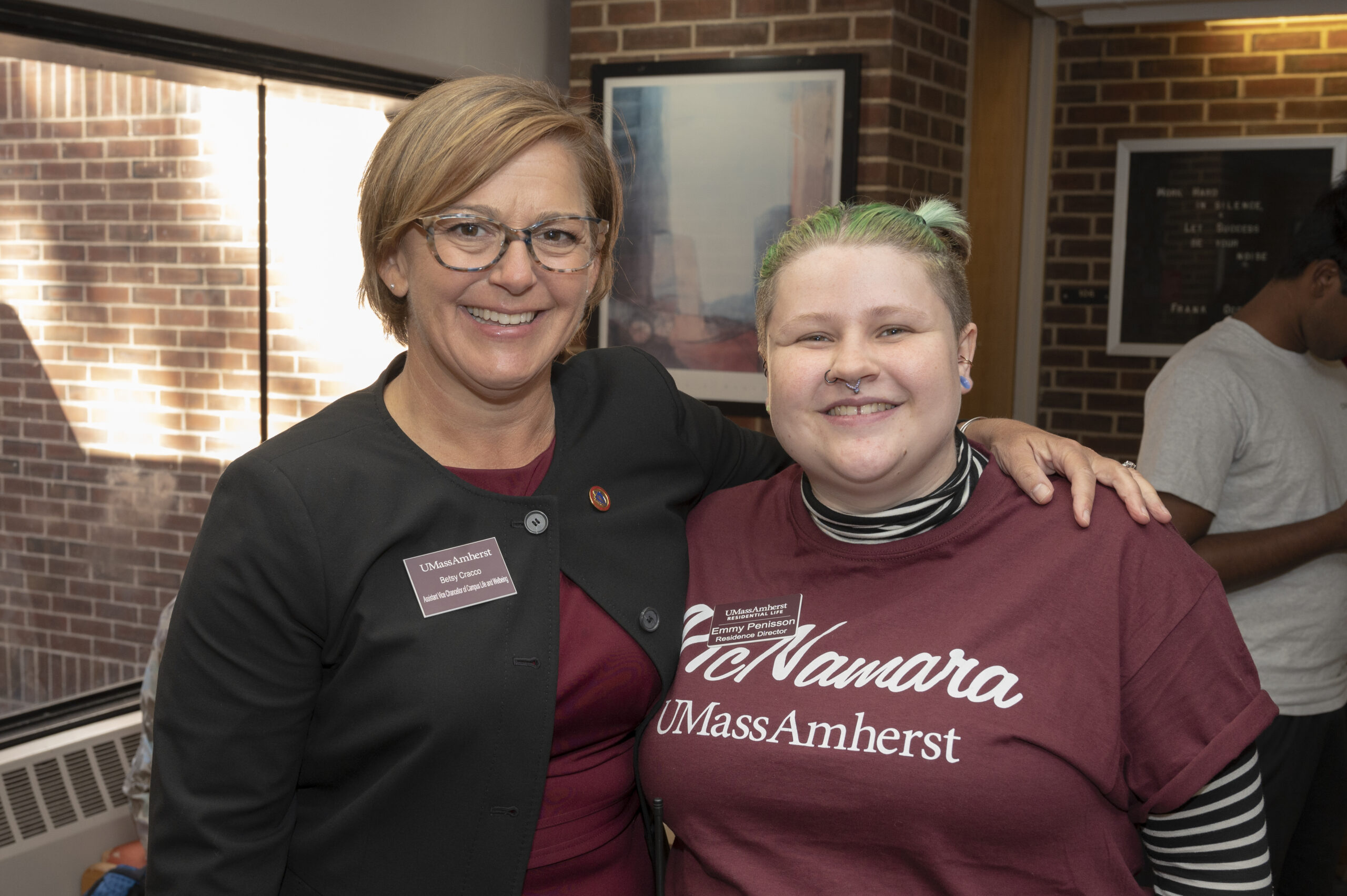
Cracco’s plain-speaking approach may serve her well as she continues her role as assistant vice chancellor for Campus Life and Wellbeing, a newly-created position at the University of Massachusetts, Amherst, aimed at one of the biggest challenges facing higher education today — improving wellbeing among a generation of students reporting high rates of anxiety, depression, and loneliness. Cracco’s office oversees Recreation and Wellbeing, Residential Life, and the Center for Counseling and Psychological Health, a three-legged stool supporting students’ psychological and physical health.  She said the nexus of all of these domains underpins her mission.  

“One of the biggest prescription pads we have is making connections and creating a sense of belonging–and you can’t do that from a seat in the counseling center alone,” she said. 

Cracco said cabinet-level wellness positions like hers are becoming more common on college campuses, due to the increased concern over student mental health and the growing acknowledgment that what has been called the campus mental health crisis is more of a public health problem, meaning multiple departments need to get involved to address it. In many ways, Cracco’s professional trajectory aligns with this expanded view. 

After graduating from College of the Holy Cross in Worcester, Massachusetts, Cracco received a master’s degree in counseling from Boston College, then a doctorate in counseling psychology from the University of Wisconsin Madison.  Holy Cross, a Jesuit school, had a strong sense of community and it was there that she took an interest in mind-body practices and attending retreats. Her first job was in residential life, living in a dorm, where she quickly learned that the position functioned as a way for students to share their personal stories, from eating disorders to relationship issues.  Her professional training included the relational culture model out of Wellesley College, a feminist ideology that puts the emphasis on the individual in context within the community. This led her to apply a public health approach to her work. 

“It occurs to you after you go from client to client in direct care that something else is wrong,” she said. “There is a systemic problem here we need to think about.  In other words, if all of the frogs in the pond are sick, why are we still asking, ‘What’s wrong with this frog?’” 

Cracco said her metaphorical move up-stream started early. When she was head of counseling at the University of Connecticut, she began a retreat program called C2 for “Connect and Challenge,” involving whitewater rafting, storytelling, and meditation. When the new position of (then called) executive director of wellness opened at UMass Amherst, the state flagship campus, Cracco went for it.  In her pitch presentation, her first slide included Maya Angelou’s advice on what we need to ask each other when we move into any social setting:  “Do you see me? Do I know that you care about me? Is it important I am here?” 

“If all of the frogs in the pond are sick, why are we still asking, ‘What’s wrong with this frog?’”

“If we could enact this same approach at a community level, it would mean that no matter what your struggles are, you would be held and you would not be alone because your community mates would be there, many going through the same struggles,” said Cracco. 

When she got the job in 2019, Cracco asked herself, “Am I hired to create a cohesion across three units on a campus, or am I hired to promote wellbeing across the entire campus?” She figured, either way, it was about crossing silos and making connections, something that became surprisingly possible during the pandemic and would lead to UMass signing on to the Okanagan Charter: An International Charter for Health Promoting Universities and Colleges. 

“During the pandemic, we really demonstrated how we could work together as a campus and how the academic side of the house can provide real, on-the-ground services. The public health students, the nursing students, they ran the clinics, gave the vaccinations, all of it.  After that, our dean of public health, dean of nursing, and vice chancellor of student affairs got together and said, ‘How can we keep this going?’  We figured the starting point was signing on to the Okanagan Charter.” 

Having the buy-in from then Chancellor, Kumble Subbaswamy, a prerequisite in signing the charter, meant that everyone on campus had some responsibility to promote wellbeing, including faculty.  Cracco said the tie-in to student success helped make the case.  

“You are not going to do well academically if you never sleep, eat trash, and have no social life, and we need to communicate that to students,” she said. “We all need to get out of the boxes we’ve made.” 

As an example of out-of-the-box thinking, Cracco’s team introduced a curriculum developed by the Benson-Henry Institute for Mind Body Medicine at Mass General Hospital, called Positivity and Relaxation.  The nine-session, credit-bearing course is taught in small groups and helps students self-regulate around anxiety in particular, but also depression.  It is not an alternative to therapy for those who need it, but an option for all students on campus. Cracco said they are running 300 to 400 students a year through these small group sessions and they’re receiving data on its effectiveness from the school of public health. 

“You are not going to do well academically if you never sleep, eat trash, and have no social life, and we need to communicate that to students.”

“We are seeing tremendous reductions in stress, increases in wellbeing, even increases in sense of belonging,” said Cracco.  

The course is funded by her office, but not owned and operated by any one department.  As she tinkers with its scale, Cracco is working with professionals within and beyond campus on developing other courses, some involving storytelling, and working closely with a colleague on courses specific to building resilience and belonging in students of color. As big a fan as she is of retreats, she said representation is an important consideration to watch in mind-body practices. “Who is teaching these practices?” she asks. “How do students feel when they are in them? There’s definitely a privileged, “Lululemon” subculture that exists here and we need to be aware of that.” 

As far as other programs go, whether it’s pond fire chats or another unnamed project involving swings she is secretly plotting, Cracco is full force as long as it is about making connections and forming relationships.  One of her latest efforts is to create quiet dining spaces for groups to eat “family style.”   

“We should be structuring connections at every turn,” she said. Asked about how this work plays out in the classroom, Cracco made an interesting point about technologies like ChatGPT. 

“We are no longer in a system where we have a person who has all the knowledge and people who receive that knowledge, because knowledge is everywhere,” she said. “Now, the process of learning is the process of learning together, like we do in the real world, and that is going to force a structure that is more communal, more experiential.”  

Cracco is optimistic about the wellness work taking place at UMass: “I think people are getting the upstream thing,” she said.  At the same time, the down-to-earth Cracco is realistic about how much can be done, given what she calls “the tyranny of time.” As an example, she leans into her first higher ed job in residential life and compares that to the myriad of duties and trainings that those professionals now need to complete.   

“What these people really want to be doing is making space for students,” she said. “We need professional staff to attend to those crisis situations, and these can be incredibly time consuming. How do we develop the human capital to make space for connection beyond, before and apart from the crises?”

New report on the enduring impact of COVID on the mental wellbeing of emerging adults

In a new paper sponsored by the Ruderman Family Foundation, Jeffrey Arnett, PhD, details the disproportionate and enduring impact of COVID-19 on the mental wellbeing of “emerging adults.” Arnett, a senior research scholar at Clark University, is a uniquely appropriate author for the paper, as he coined the term “emerging adults” over 20 years ago to describe young people in their twenties who exist in the “space between adolescence and young adulthood.” Arnett is also the executive director of the Society for the Study of Emerging Adulthood (SSEA), and author of Emerging Adulthood: The Winding Road from the Late Teens Through the Twenties.

In The Mental Health Effects of COVID-19- A Continuing Crisis, Especially for Emerging Adults ages 18-29, Arnett examined national data from before and during the COVID-19 pandemic from sources such as the CDC, the National Center for Health Statistics, the U.S. Bureau of the Census, the National Opinion Research Center, and the Pew Research Center, as well as numerous longitudinal studies from the literature.  His research showed that psychological distress was consistently higher for young adults ages 18-29 than all older age groups from March 2020 to September 2022, despite that group being at lowest risk physically from the disease.

“You would think that it would be the older people who would be the most affected in their mental health, because they were the most at risk for hospitalization and death during the pandemic, and they still are,” said Arnett in a June interview for the Mary Christie Institute’s podcast, the Quadcast. “It’s actually just the opposite. The oldest Americans are the ones who are least likely to report symptoms of anxiety and depression. Meanwhile, the emerging adults, the 18- to 29-year-olds, were the most affected in terms of their mental health.”

While Arnett said he was initially surprised by the data, he posited a few justifications in the report, starting with the outsize influence of the pandemic’s disruption on people in the midst of an intense developmental period.  While life disruptions were not unique to the age group, Arnett said, “from age 18 to 29, you’re trying to build the structure of an adult life. That’s the age where most people are getting the education that’s going to form the basis of a long-term occupation or profession, when people are moving out of their parents’ household, learning how to function as an adult on their own. It’s the age when people are having romantic relationships, thinking about what they want in a partner. And suddenly, all of this is blown up.”

In the report, Arnett pointed out that this population experienced disruptions or changes to the five features distinctive to the emerging adulthood life stage: identity explorations, during which they explore who they are, “trying out various possible futures;” instability, which was greatly exacerbated by the pandemic; self-focus (specifically in relation to parental ties waning), which veered into loneliness when they were cut off from their friends; feeling in between childhood and adulthood, which was extended during this time period; and optimism and high hopes about future possibilities, which were dimmed by the circumstances surrounding the pandemic.

“You would think that it would be older people who would be the most affected in their mental health, because they were the most at risk for hospitalization and death during the pandemic but it’s actually just the opposite.”

But, while there are clear, reasonable causes for the intense reaction to the initial disruption of the pandemic by emerging adults, Arnett said he was mystified that their rates of anxiety and depression have remained so high. In the paper, he noted that the rates of anxiety and depression for emerging adults remained as high in early 2023 as at the peak of the pandemic before vaccines were available–nearly 40% for anxiety disorder and nearly 35% for depression. (In fact, symptoms have remained above pre-pandemic levels for all adult age groups.) That pattern is continuing even now as the pandemic has waned, the report states. “Even after life has returned to normal in most ways, rates of anxiety and depression are nearly as high as they were at the peak of the pandemic. That was shocking,” he said. “Why do people still feel so bad even though life appears to have gone back to normal in so many ways?” he continued.

The report also highlights subgroups of emerging adults that have disproportionately borne the brunt of the pandemic from a mental wellbeing perspective: women and Asian Americans. Even though young women’s rates of depression and anxiety were already higher than young men before the pandemic, the report states, the gap between them has grown since the pandemic began. Arnett noted that this follows a long-standing pattern in mental health research, in which females report worse mental health outcomes across the spectrum. However, he called the widening of the difference “striking.”

Disturbingly, the pandemic triggered a racist backlash against Asian Americans, which may account for their disproportionate worsening of mental health. In addition to higher rates of mental health issues, most Asian Americans also reported believing that violence against their ethnic group is increasing; almost three quarters said they worry sometimes, almost every day, or every day that they might be threatened or attacked due to their ethnicity.

The paper outlines five recommendations for addressing the current mental health crisis and preparing for the next pandemic. Arnett recommends: reforming the mental health delivery system; expanding and improving teletherapy services; creating a website of resources for parents of emerging adults; improving online learning techniques; and holding a national conference of practitioners and policymakers at colleges and universities that examines which policies and programs were effective and which were not. He also recommends further examination into the phenomenon of why these levels of distress are not subsiding for emerging adults, including in-depth qualitative research with the young people themselves. 

“We need to urgently go forward with interviewing people, not just survey data, not just ‘tell me on a scale of one to five how anxious you feel or how depressed you feel,’ but ‘tell me in your own words why you’re still distressed.’”

Young Professionals of Color Speak Out About Workplace Climates

Understanding how young graduates of color experience their predominantly White workplaces is a critical part of creating flourishing cultures within increasingly diverse work environments.  As corporations and organizations continue to work at this with varying success, the Steve Fund has released a new report that can help guide their efforts.  

In “Supporting the Successful Transition of Young People of Color into the Workforce,” The Steve Fund surveyed 160 young professionals of color on cultural dynamics that affect their wellbeing and, as an extension, their job performance, satisfaction, and retention. The results showed that half of those surveyed reported experiencing microaggressions at their places of employment; and half said they do not feel a sense of inclusion or belonging. These and other findings send a strong message to employers about the DEI work that lies ahead, despite increased efforts on the part of employers to attract and retain professionals of color. 

“We know that employers face challenges reaching recruitment and retention goals and young people of color face challenges transitioning into the workforce,” said Evan Rose, president and co-founder of the Steve Fund, the nation’s leading organization focused on supporting the mental health and emotional wellbeing of young people of color.  “These interrelated challenges present us with an opportunity to leverage the talents of a diverse workforce for growth and support young employees of color in inclusive and culturally responsive ways.”

In addition to the survey findings, the new report outlines a detailed framework for how employers can respond to what young professionals of color are reporting while creating more inclusive workplaces that will help attract and retain young people of color.  Like the “Equity in Mental Health Framework,” which has helped colleges and universities customize strategies that support the mental health of college students of color, the Steve Fund has taken a similar approach for young people transitioning into the workforce, helping employers better prepare for them with tools and resources that foster equity, inclusion, accountability, and mental health.  

“A key benefit to this work is that it connects what colleges and universities are doing to support the mental health and wellbeing of students of color with what employers want and need to do in the workplace,” said Dr. Paula Johnson, president of Wellesley College, a liberal arts college that has been a leader in inclusive excellence, with a focus on students’ mental health. “By drawing those connections and building on the mutual learning that results, we can work to maintain the gains we’ve made with young people of color who enter work environments that may hamper their sense of belonging and impede their ability to thrive.”

Stress, Belonging, and Mental Health

Marcus had been a few months into his first job out of college when he was asked to join his boss and a few other colleagues for lunch.  He remembers being excited to be included among the group of executives and was feeling good about the way he had handled himself.  Then, one of the executives complimented him on being articulate, saying, as if with surprise, “Wow, you really have an excellent vocabulary.” Marcus, who is Black, felt the familiar sting.  “After that, I was completely deflated,” he said.  “I just wanted to get out of there.”  Not long after the incident, he switched jobs. 

An underlying issue that influences these findings is the lack of diversity within the corporate workforce.

Unfortunately, Marcus’ experience is all too common as the Steve Fund survey bears out. Participants were asked to respond to questions relating to four key workplace dynamics: perception of workplace discrimination; experiences of isolation and belonging; need for psychological safety; and importance of cultural competence.   Among the findings, 50% reported experiencing microaggressions, 30% said work stress impacts their emotional wellness, 50% said they don’t feel a sense of inclusion and belonging at their place of employment, and 30% reported spending time looking for another job.   

Other findings are instructive in helping employers understand where, specifically, professionals of color are looking for change.  Half of young professionals said that management doesn’t foster a workplace that allows employees to be themselves; half also report not knowing where to go if they experience discrimination; and 41% said they do not have access to culturally competent mental health resources.  One in three young employees does not feel emotionally supported at work.

An underlying issue that influences these findings is the lack of diversity within the corporate workforce—a tenacious problem that leaders throughout the country are continuing to grapple with.  According to the report, Blacks make up about 10% of college degree holders, but only 3.2% of executives/senior level managers.  Employees of color also have high attrition rates. People of color and younger employees were more likely to have quit their jobs in 2021; feeling disrespected was a key reason for leaving.  The report cites more than three in ten young employees of color (Black and Latinx) experience discrimination at work, leading to increased levels of stress, anxiety, and hopelessness.  

The upside of creating workplaces that disrupt these trends is not lost on competitive companies, which is why organizations are reaching out to sources like the Steve Fund for help. The report cites research showing that workplaces that cultivate a culture of belonging experience higher levels of creativity, innovation, and profitability.  Employees who feel emotionally supported at work are less likely to experience mental health symptoms, less likely to underperform, have higher job satisfaction, and are more likely to stay at their companies. 

“Marcus, who is Black, felt the familiar sting. ‘After that, I was completely deflated,’ he said. ‘I just wanted to get out of there.’ Not long after the incident, he switched jobs.”

“It’s pretty simple,” said Dr. Jessica Isom. “Any time a person cares about something and is invested in something, they are going to show up better as an individual, contribute better as a team member, and overall contribute to a better outcome. That has to be grounded in what we all need as humans, which are genuine, authentic interactions. That’s what we thrive on.  And I think everybody can appreciate that.”  Isom said the absence of those positive interactions in the workplace, coupled with mental health strains brought on by systemic racism, cause young professionals of color to protect themselves by leaving. 

Dr. Isom is a board-certified community psychiatrist and one of the Steve Fund’s multicultural mental health experts. She holds a faculty role at the Yale School of Medicine, where she also trained, and co-directs the Social Justice and Health Equity Curriculum (SJHE), addressing workforce development of psychiatrists to address mental health disparities.  

“Conversations around building diverse workplaces tend to focus on desiring diversity, which is really focused on recruitment, the idea of inviting people in,” she said. “What we need to be thinking about is how to be a good host, and that means understanding who you are inviting in and what their needs are.”  

Tracy Burns, chief executive officer of the Northeast Human Resources Association (NEHRA), agrees that as earnest as employers are to attract diverse talent, more focus needs to be placed on how that talent is received and how those employees of color experience workplace cultures.  “Efforts to attract young professionals of color do not end when the offer is accepted. Employers need to build a comprehensive and sustainable approach that takes into consideration the “whole person” and fosters an environment where differences are recognized, respected, and even celebrated. This report offers both critical data that all employers should be aware of as well as concrete recommendations that can help direct your DEI efforts towards a more meaningful outcome.”

“(This work) has to be grounded in what we all need as humans, which are genuine, authentic interactions. That’s what we thrive on. And I think everybody can appreciate that.”

The Steve Fund report recommends a myriad of strategies, ranging from overarching principles like weaving mental health and racial equity into the corporate blueprint and empowering leadership to support healthy workplaces to specific strategies that address each of the issues uncovered in the survey.  These include equipping managers to make wellness at work an everyday priority; investing in mentoring at every stage in career development; and creating “wellness mentors” who are peers trained by multicultural mental health experts to provide culturally competent support and connect employees to resources.  

Dr. Isom provides an example of changes employers can make as she imagines a different outcome for Marcus and his boss at the corporate lunch.  “One of the recommendations in the report is about building a senior leadership bench that is able to facilitate the progression of young people of color.  It is even more important that individuals in leadership positions reduce their level of obliviousness to their own experiences and then arm themselves with what’s necessary to support a young person of color throughout their journey.  Because of their power and influence, their actions will have a ripple effect throughout the whole organization.”   

The Steve Fund’s mission is to promote the mental health and emotional wellbeing of young people of color as they transition from adolescence into higher education, throughout their higher education experience, and as they transition into the workforce so they can attain personal, academic, and career success and achieve their full potential. The Steve Fund works with colleges and universities, nonprofits, researchers, mental health experts, families, and young people to promote programs and strategies that build understanding and assistance for the mental and emotional health of the nation’s young people of color.

When Supporters Struggle

The chair of the department wasn’t herself. This was clear to her advisees, who noticed their professor becoming disengaged and disorganized, and inconsistent in following through with paperwork and information. They suspected it might have something to do with the campus tragedy: A student in one of the professor’s classes had died by suicide earlier in the year, and she was taking it hard.

“I wanted to tell her how sorry I was, but I didn’t want to make her more upset,” said a sophomore advisee. “So, I found other ways to get the information instead of bothering her.”

There is much concern these days about the mental health of college students, and with good reason. During the 2020–2021 school year, more than 60% of college students matched the criteria for at least one mental health problem, according to a study by the Healthy Minds Network (HMN), and meeting demands for treatment is a challenge for counseling centers. 

Less discussed, however, is the mental health of the faculty and staff. As the adults who see the students regularly, they are uniquely positioned to see whether their students are thriving, or seem out of sorts, or even attending class consistently. Which is an added stressor in work upended by the pandemic, on a career path already paved with unusual professional strain.

 “There’s an old saying, ‘A good teacher is like a candle—it consumes itself to light the way for others,’” said a sociology professor in Washington, D.C. “I don’t think whoever coined that phrase had this kind of ‘consuming’ in mind.” 

These days, faculty members are consumed with whether the students are okay, why they aren’t showing up for class, and how to handle the deluge of requests for accommodations, extensions, and exceptions. Recent political, racial, and harassment tensions have brought not just campus unrest, but also inquiries, investigations, and lawsuits. Many professors’ own work and research went dead in the water with COVID. The sociology professor counted four colleagues who’d either retired early in the wake of COVID or left teaching for the private sector, citing better pay and a more sane work-life balance. “Most of the burnout I’m hearing about doesn’t even have much to do with teaching itself.”

Or as one English department head put it, “The job you’re responsible for today is not the same job you got hired for 20 years ago.”

Studying the teachers: Who’s supporting the supporters?

After its survey of student mental health, HMN partnered with the Boston University School of Public Health (BUSPH) and the Mary Christie Institute (MCI) on a survey of faculty perspectives on the state of student mental and behavioral health. Findings published in 2022 show that about 80% of faculty members reported having had conversations in the past year with students about their mental health. And one in five reported that supporting students in emotional distress has taken a toll on their own mental health. 

“Classroom environments are one of the only places that every student is actually present. So, the vast majority of faculty are in this role of contact in some capacity,” said Sarah Lipson, an associate professor at BUSPH and a principal investigator of the study. “It was really important to have data to say we know that faculty are already playing a role in supporting student mental health; we no longer need to guess as to whether or not that’s happening. And I think probably without data we would underestimate how common it is.” 

“There’s an old saying, ‘A good teacher is like a candle—it consumes itself to light the way for others,’ I don’t think whoever coined that phrase had this kind of ‘consuming’ in mind.”

It isn’t surprising that faculty members report feeling like their work goes well beyond typical job hours and boundaries; student expectations of faculty extend further than the classroom. According to a Student Voice survey by College Pulse with Inside Higher Ed, students are looking to their professors for more than course content. More than half sought introductions to people working in their fields of interest, while 45% wanted professors to hear them on personal matters and to consider making accommodations because of them; and 28% hoped for help navigating college life. 

Navigating college life can cover a lot of ground for an unhappy student looking for a helping hand. Last fall, a professor at Texas Christian University received a disturbing email from a student saying thank you for everything the professor had done for him, but closing by saying he was going to jump off a parking garage. TCU had lost a student in a similar way a few years before, and kicked into emergency mode trying to locate the student and stake out all the possible garages. As it turns out, the student’s walking route toward the football stadium garage passed the counseling center where he’d just begun an on-campus IOP (Intensive Outpatient Program). He made a spontaneous decision to go into the counseling center instead, said Eric Wood, director of mental health counseling at TCU—a significant benefit to having an on-campus IOP. Still, the email and frantic galvanizing was a shot of adrenaline that carries the lasting weight of stress and responsibility—pressure felt by faculty and staff, and of course, counselors.

Greg Eells was the beloved director of Cornell University’s counseling center for more than 15 years. In March of 2019, he left to take a similar position at the University of Pennsylvania. His marching orders there: to increase capacity; decrease the time between a first consultation and a first counseling appointment; better distinguish short-term care, long-term care, and other kinds of wellness care; and expand the availability of phone, video, texting and app-based technologies that can be accessed anywhere, at any time, to support students in crisis. Eells also taught both graduate and undergraduate students in courses on counseling and psychology. No small balancing act, but he was a known superstar. Eells had also served as chair of the Mental Health Section of the American College Health Association, and won the Association for University and College Counseling Center Director’s Award for Excellence. 

The September after his move, both campuses were shocked to learn that he’d jumped to his death from a building near his new home in Philadelphia. His suicide devastated colleagues, and sparked soul-searching about the pressures of being a campus therapist, a constant watchdog. It also opened up a thoughtful dialogue on expectations we hold of the people looked upon to always be the strongest in the room.

An editorial in The Daily Pennsylvanian expressed well the pressure on caregivers to have it all together, all the time. 

“The capacity of helpers to give sound advice, to listen attentively, and to go out of their way to help others leads us to believe they must be healthy themselves. The qualities we attribute to the helpers in our lives ultimately feed into the assumption they are immune to the problems and emotions we all face,” the editorial wrote. “While it may be easy to assume that helpers are invincible, it’s also dangerous. It’s one of the reasons we don’t think to check in with them and don’t remind ourselves that they’re human, too. People who give a lot of themselves to help others can experience pain, love, and hurt as we all do.”

COVID habits and harms 

It’s been well documented that COVID was a strange and challenging time for education. From the university professor’s standpoint, it was a two-headed beast: learning to host classes online, from your side of the unfamiliar platform, and trying to remain connected with the struggling people in the squares on the other side. Being a faculty member during COVID meant having students who may or may not show up for class, and not knowing why. It meant not knowing who was living on campus or off, with or without a decent support network (or wifi network). It meant all the complicated communications that come with masking, especially hard for students with hearing loss or for whom English isn’t a first language. And now, post-COVID, it means contending with lackluster student commitment, and not knowing how much of the ongoing absenteeism, missing skills, and requests for grade leniency should be excused with accommodations. 

“One of the ancillary effects many of my colleagues talk about is that students don’t seem to believe in deadlines anymore, and it’s like the time online made it seem as though you don’t really have to come to campus anymore,” said John Hess, a senior lecturer in the English department at UMass Boston. He lost his youngest brother early during the pandemic, and was very empathetic to COVID’s effects on students and their families. “The faculty really, really care a great deal. They worry about their students and are very committed to student success. And so, when students don’t come to class, or when they don’t get the work done on time, it’s not just that it annoys us; it’s that they’re cheating themselves and missing out.”

Professors were also a natural target for student frustration during the pandemic. After all, they were the single point of official school contact via squares on a computer. 

“During the midst of COVID, you definitely saw a lot of high expectation of instant responses and a lot of demands, for lack of a better word, about how things should be,” said Eric Wood, director of TCU’s counseling center. “There was a lot of pressure for faculty and administration to know all the answers. Everyone was scrambling, and students would say, ‘You should know the answer.’ It’s a global pandemic. But kids were expecting immediate support and help.”

And if professors weren’t able to provide answers or respond in a satisfying way, their ratings went down—ratings that are taken into consideration for performance reviews and tenure. 

“Anonymous reviews can be brutal,” said David Kroll, professor of Pharmacology and director of Master’s & Certificate Programs at University of Colorado Skaggs School of Pharmacy & Pharmaceutical Sciences. Kroll, a sometime contributor to Forbes magazine, wrote a 2013 article “Top 10 reasons Why Being a University Professor is a Stressful Job.” Anonymous reviews—which influence everything from tenure, publication, and grant applications—were one of them, as was the business of securing funding for one’s research, which COVID has only exacerbated. 

Professors were also a natural target for student frustration during the pandemic. After all, they were the single point of official school contact via squares on a computer.

“Faculty are expected to bring in grant funding for their own research. Research flatlined during COVID. You have your research team, you have your lab, and all of a sudden, you can’t do any of it. If another university is managing to do it, then you are at a competitive disadvantage,” he said. “And funding is an issue that has gotten worse since then because of the rise in costs. So, they also have a financial pressure that’s a barrier to the tenure process. We lost someone recently because they couldn’t get funding for their research. Being a faculty member in the sciences is like being a small business owner.”

Wellness in the sciences and beyond

The sciences have unique pressures, based on funding and research-related outcomes. This in part prompted eLife, a global nonprofit committed to improving the way research is reviewed and communicated, to undertake a 2020 report on mental health in academia. The report focused on those who support colleagues struggling with their mental health. Of 1,500 faculty members surveyed at varying roles and levels of seniority, two-thirds of respondents said they had supported two or more coworkers who were struggling. Of those who identified as being early-career research academics, 47% said they were struggling with their own mental health at the same time. Of more senior respondents, nearly 25% said they were struggling themselves.

“I am repeatedly frustrated by my (often male) colleagues’ stated belief that ‘there is no mental health problem’ at our institution,” wrote one female mid-career respondent in the survey. “They don’t know about it because their trainees come to me, not to them, with their issues. I receive no institutional recognition for this role.”

In an essay that accompanied the report, an associate professor at the Brain Mind Institute at the Ecole Polytechnique Fédérale de Lausanne in Lausanne, Switzerland wrote with striking honesty about the stress and mental health challenges that contributed to two heart attacks. He was not yet 50 years old. 

“As young scientists taking on a faculty position, we quickly transition from being a team member to a team leader; from never worrying about securing funding to being overwhelmed with grant deadlines; from managing a single project to planning and guiding the work and careers of several students and post-docs; from worrying about ourselves to being absorbed in worrying about everything except our wellness. The great majority of us have never developed a course or taught classes on our own, yet we are all expected to assume these responsibilities,” wrote Hilal A. Lashuel, associate professor and director of the Laboratory of Molecular and Chemical Biology of Neurodegeneration. 

“The life of a professor is a constant balancing act, where we try to juggle personal and professional responsibilities under the pervasive stress of managing expectations in an often hypercompetitive culture. There is always a fear that we may drop the ball, a sense that if that were to happen, we would be alone and the only one to blame,” he said. 

Climbing with no clear footing

Achieving tenure is, for most professors, the natural progression and Holy Grail. Tenure track positions are hard to secure; they don’t open up very often, and they represent a financial and professional security that’s hard to replicate in other industries. And yet, it’s an elusive and constantly moving target. This is why, COVID aside, it’s a career path paved with unusually high stress and unpredictability.

“The importance of tenure can’t be overstated. That sort of freedom is remarkable. Pre-tenure, your entire life is centered on getting tenure, in terms of your research, however that’s defined. That is the central focus of your life. Everything counts, but you never know exactly what the bar is, even if it’s explained to you. There are no real guarantees,” explained one music department chair at a highly selective university. “It’s ultimately a question of how you are viewed by other people in your field. What’s your personal reputation? And it really has very little to do with your teaching, per se. If you are an amazing researcher and a terrible teacher, you will still get tenure. If you’re a mediocre researcher and a wonderful teacher, you will not get tenure.” 

Or, as another professor put it, once you have tenure, you’re free to finally speak your mind.

But the shine on tenure is seeing some tarnish these days, with the nation’s political climate impacting freedom of speech in academia. Even back in 2013, Kroll included it on his Top 10 list for Forbes, and he said it’s even more true today. 

“We cannot take care of our students if we do not learn how to take care of ourselves.”

“The political climate is attacking academic freedoms, minimizing the protections of tenure. Universities are finding ways of getting rid of people whose views they don’t agree with,” Kroll said. “I know faculty members who’ve decided they’d rather work in the private sector for that reason.”

If you are a faculty member who then gets asked to be a department head, you have an entirely new learning curve ahead—and you are largely on your own. Learning to become an administrator is not something professors are born knowing how to do, and there’s rarely instruction or mentoring.

“Becoming an administrator is an entirely different skill set in a career where you’re not trained to do this,” explained the music department chair. “Suddenly, overnight, you’re a manager. The first couple of years I made mistakes, or just approaches that were not productive, so I’ve learned what does and what does not work. Truly on-the-job training. Some larger departments are able to have associate chairs and steps to start to train their faculty. But if you’re a small department, you usually don’t have that option.”

His learning curve included a lot of travel for fundraising, a lot of communication around the Black Lives Matter and Me Too movements, and being the department’s point person on about 40 cases in litigation, going back through events of the past 15 years. “As luck would have it, for me, there were additional stressors that are particular to this moment in history, even before the pandemic. I was completely burned out, and I was overdue for a break,” he said. He ended up taking an emergency sabbatical. “A lot of hard aspects of teaching have nothing to do with teaching. And it wears you down.”

Supportive solutions

Many institutions continue to offer expanded and innovative mental health benefits and services to faculty and administration—though unlike students, in most cases, they need to travel beyond the campus to take advantage of them. It’s not as if a professor is likely to sit elbow-to-elbow with their students in the Counseling and Psychological Services (CAPS) office, waiting to meet with a counselor who is their own colleague at the school. Some universities have changed their offerings to include an in-house Employee Assistance Program (EAP), or a personalized referral service to identify local counselors who have strength in a desired specialty. 

But the most pressing request identified by the BUSPH survey is for training in being an effective supporter, as 73% of faculty say they would welcome additional professional development on the topic of student mental health. Responses make clear that faculty feel a responsibility to help students dealing with mental health concerns, which contradicts a long-held assumption that faculty do not see this as “their job.” Additionally, peer support and ambassador programs that involve training staff and faculty would help them recognize and respond to mental health crises in their colleagues.

But at the end of the day, it’s up to the individual to be willing to reach out for help. 

“As faculty, we cannot take care of our students,” wrote Hilal A Lashuel of Ecole Polytechnique Fédérale de Lausanne, “if we do not learn how to take care of ourselves.”