“Embrace Your Freedom”

Philip Glotzbach’s new book Embrace Your Freedom: Winning Strategies to Succeed in College and Life has as many lessons as it does audiences. As its title implies, it is written primarily for graduating high school students anxiously hovering between post-admissions and their first year of college, but it also speaks to their parents, who will undoubtedly read along, with advice about letting go that is not always easy to hear. Those in the field will connect themes such as “why are you going to college?” and “fall in love with your fallback school“ with some of the biggest challenges in higher education today such as skyrocketing tuition, inflated rankings, and student wellbeing.  

With a non-didactic tone, Glotzbach combines the experience and authority of a college president with the hindsight and candor of one who no longer holds the title. His advice to first-year students on making the most of this seminal period has a fair share of practical information, as well as wisdom rooted in philosophy, developmental theory, and political science. As he writes plainly about personal responsibility and pride in achievement, he reminds students we are all shouldered by our communities. Perhaps most distinctive is Glotzbach’s message about freedom itself, something students may first take to be about the absence of external controls, but which the book quickly clarifies as the joy that comes from setting and reaching goals that align with who you are as a person. His book is available for pre-order now (Simon & Schuster, Barnes & Noble, Amazon, Post Hill Press, etc.); its publication date is July 9, 2024.

You have been in academia for decades and a college president for seventeen years. What motivated you to write this book and what are your hopes and dreams for it?

I wrote it, frankly, as a labor of love. Over my career, my greatest pleasure came in seeing how undergraduates develop both intellectually and personally over those four years. It was especially satisfying to see that transformation reflected through the joy in their parents’ eyes. This book came out of talks that I gave to new students and parents every year at Skidmore in which I offered my best advice about how to realize this promise of a college education. Following those talks, I would repeatedly get asked for copies of my remarks – which I never really had available to share in any formal way. So, I knew I wanted to capture those exchanges in some fashion. 

In the book, I approach that same audience in a conversational way – not to preach at them or talk down to them, but to talk directly to them in a way that is accessible. At the same time, I wanted to have enough substantive content in the book so that, if a college decided to use it as the common read for the incoming class, faculty members could actually enjoy teaching it. It isn’t just, “Hey, here’s how to do your laundry.” Frankly, I’d love for people to review Embrace Your Freedom and say, “This book should be required reading for all new students.”

You have many important messages in the book, but what would you say is the overarching theme?

I’ve always believed that what students most need coming into college is just to pause and think about where they are at this stage of their life and how to take charge of moving forward toward where they want to go. That’s a major theme that recurs throughout: You’re in charge; you’re responsible for your life. What does that mean? You’re responsible both for what you think and for what you do. I’ve always thought those ideas are very important for new students to consider. 

I think they’re even more important today for a couple of reasons. So many students go through such a frenzy getting into college. It’s just such an anxiety-producing experience with too many thinking that if they didn’t get into their first choice school their life is over. What I am trying to encourage young people to do is look beyond all that, come through to the other side of that angst, and embrace what’s about to happen to them – and a lot of it is going to be very positive. But this is a very anxiety-ridden generation. They have been really closely engaged with their parents (or their parents have been engaged with them). Their parents have probably organized their lives in a very directed way over the years, and with all the right intentions. Given this background, and particularly coming out of COVID – which really threw a monkey wrench into their educational process – I think that the messages in this book are especially important for this generation. 

“Going to college should be an intentional project – not just the expected next step after high school.”

Now, all of a sudden, they’re away at college. What are they supposed to do? And how are they going to do it! I remind them that they are in charge of their life, even if so many cultural and social forces have been telling them that they’re not – even if people have been telling them that they’re victims. Ultimately, they have to take charge of their own life if they’re going to realize the opportunities that are before them. This book makes that case and offers a lot of practical guidance about just how to do so. It suggests ways to deal with the sometimes scary aspects of that freedom.

Given what you’re saying, it is not surprising that you wrote the book for both students and parents. Do you also have a strong message for them?

The two chapters for parents are, first, how to partner with your student and, second, how to let go. And I’ll come back to those chapters in a moment. I’ve always intended to include parents in this book because, when I was giving those talks at Skidmore, they were sitting there too. I very much wanted them to hear what I said to the students. Now I want parents to read all the student chapters, because they tell a coherent story about what their students should be focussed on as undergraduates: understanding some key concepts (like freedom, liberal education, etc.), making big plans, following through to execute those plans, taking good risks, understanding the ethical dimension of their lives, and winning a “victory for humanity.” Parents have always had an enormous investment in their kids’ lives, but even more so today. One crucial role they can play now is to reinforce these ideas with their kids.

And of course, today’s parents have their own questions. How do they navigate the (probably) unfamiliar landscape of their kid’s college? How should they engage with all those different people who are there to try to help their student, without being overly intrusive in their kid’s life? I try to help them think through these issues, in the context of partnering with their student. It may sound paradoxical to say partner and then let go, but the idea is for their partnership with their child to evolve – to take a new form that’s more appropriate for the relationship they will have post-college. So, one of the most important chapters is about letting go and how to do it, while acknowledging that it’s not easy. 

For one thing, we all know that college is enormously expensive. Many parents are literally mortgaging their lives to pay for it, and they want to make sure that this train isn’t going to go off the tracks. And what if it does? Parents are in closer communication with their kids today than in the past. So, if their student is having trouble, they’re likely to hear about it. How should they react to that situation? What’s their appropriate role? Part of what I’m saying in the parent section is, “Give them the space to handle their own problems to learn from those experiences.” But there are times when it is appropriate for parents to become more active in working with the school. I give some very practical advice here as well, such as: “Contact the school at an appropriate organizational level. I.e., don’t call their professors; don’t call their roommate’s parents or the RA in their residence hall.” The primary message is: “Don’t get between your student and the people they should be working with on a day-to-day basis.”

Can you explain the title “Embrace your Freedom” – it’s not what most people, particularly students, would think, is it? 

For the traditional age student, when you go off to college, all of a sudden you have a lot more freedom or autonomy than you did even a few months ago. But becoming a mature, fully-functioning adult doesn’t happen automatically…or overnight. There’s a lot you have to learn and go through. And so my contention in this book is that if you start off thinking about some of these ideas – beginning with the concept of freedom – you will be better positioned to do the work of becoming a mature adult.

You’re in charge; you’re responsible for your life. What does that mean?”

That’s why I talk about two different ways of interpreting freedom – beginning with the “negative interpretation,” which is just the absence of constraints. Which is our typical way of looking at it, right? Freedom means nobody’s telling me what to do. Well, that’s fine; it’s important. But the more meaningful and mature concept of freedom is what I call the “positive interpretation,” which is freedom as self-regulation. It requires taking charge of yourself and deciding what you want to do and how you do it, which is more difficult than just throwing off the constraints of your earlier life. 

In the book, I quote the Eastern European physician and poet Miroslav Holub, who says that “a marathon runner is more free than a vagabond, and a cosmonaut than a sage in a state of levitation.” To be a marathon runner, you have to devote yourself to an extended program of intense training and preparation to get ready to run your race. It requires a whole lot of self-regulation. But when you get to the point where you actually can run 26.2 miles, you experience a level of freedom or ability that you never would’ve had if you hadn’t put in all that work. And the second part of this message is that you’re necessarily doing this in the context of a community. You can’t do these things alone. And that fact, in turn, entails certain obligations to that community.

The notion of embracing your freedom really has to include this positive sense of freedom. And as you go through the book, that idea recurs as a motif. Every time I talk about taking charge of this or that aspect of your life, it’s another example of embracing your freedom. So again, it’s moving beyond the limited conception of freedom in which you no longer have anybody to tell you what to do, and finding out what it is that you want to do. What are your goals? What are you trying to get out of this college experience? Then what do you need to do to accomplish those objectives? What sequence of events has to occur? And, by the way, what does all that have to do with your decisions about drinking and sex and other aspects of your life (e.g., eating well and getting enough sleep)? How do those choices affect your ability to do the things you most want to do?

I also say to the students, “Look, you don’t have to have all the answers right away. You don’t need to have worked out all your big plans in your first year – and certainly not in your first semester/quarter. And be prepared to change your mind as you go along. But do start thinking about all this from day one. In Chapter 9, “Begin Now!” – which I think is one of the most important ones – I urge students to realize that their college career begins on that very first day. Not next semester or quarter. Not next year. That’s a good moment to begin thinking about where you want this journey to take you. 

One of the most vivid ways to do so is to envision yourself at your college commencement, the beginning of the next phase of your adult life. At that point, as you look back over your undergraduate career – and as people are asking you questions about how you’ve spent your time – what will you be proud of? What might you regret? What will you have done to gain the maximum benefit from this once-in-a-lifetime opportunity?

One of the questions you ask students upfront is “Why are you going to college at all?” – what are you getting at here? 

Going to college should be an intentional project – not just the expected next step after high school. So ask, “Okay, just why am I going to college? What do I hope to get out of it – especially given what it’s going to cost in time, energy, and money? How do I expect my college education to help me move to the next step in my life?” Again, it’s not at all necessary – or likely! or even desirable! – to have all the answers at this point. And whatever answers you might have are likely to change. But it really helps focus your mind to ask these questions – and to realize that there are other options (e.g., a gap year, military service, volunteer service, trade school, and many others). Let’s be clear: I’m not in the least trying to discourage anyone from going to college. But they will be much more likely to succeed – to come away feeling proud of what they’ve accomplished – if they do it on purpose.

Why do you begin, in Chapter 1, with liberal education?

This book emphasizes the various dimensions of what an undergrad career should offer to students. The first chapter talks about the power of becoming broadly educated. For one thing, this outcome is enormously important if one is to thrive in the professional world today’s graduates will be entering. I include several stories of students I have known whose life pathways illustrate this point. For example, one young man who initially wanted to be a writer ended up working on the New York Times’ digital site as a senior software engineer. Today he’s running his own software company. He didn’t study computer science in college, and he certainly didn’t think about it as a potential career. But he gained a broad liberal education, and above all he learned how to keep learning.

My argument is that in the context of today’s professional world, the more narrow your course of studies in college, the shorter its shelf life. Because when you get out there, the professional world is going to continue changing. It’s evolving at a pace that is hard for any of us to wrap our heads around. So, you have to be intellectually flexible. You have to be able to access – and synthesize – knowledge and information from a variety of areas. And once again, you have to be able to continue learning.

In sum, the traditional skills you learn in a liberal education will set you up for life: critical thinking, reading, drawing upon different areas of knowledge, understanding how different areas of inquiry create knowledge in their own ways, appreciating what different cultures have to teach us and valuing the humanity of people who might present as being different from us, developing your creative imagination and the capacity to communicate effectively, and so on. 

“Colleges and universities don’t just create personal good.  They also create social good.”

Another idea I emphasize is the value of studying a subject – choosing a major, minor, or concentration – that inspires your passion. If passion drives what you’re doing, you’re more likely to excel. Studies have shown that students who choose a major based on their interests do better in college (and they do better in the rest of their lives, as well!), as opposed to students who choose a major just because they think it’s going to get them a well-paying job. Choose a course of study based on your interests so you can really get into it and get the most out of it. Be fortified with the complementary capacity to think broadly. Then you’ll be prepared for whatever the professional world throws at you. 

You talk in the book about the responsibility of becoming a good citizen as part of a student’s education. That’s not always the first thing today’s students are hearing from their administrations.  

As a college or university president, it’s easy to succumb to the temptation of saying “let me tell you about the great jobs our graduates are getting.” That’s not unimportant. Sure, we want our students to be gainfully employed. But if that’s all we are saying, we’re ignoring the other critical goal of a college education, which is why the second half of Chapter 1 addresses the topic of citizenship. And why I quote Thomas Dewey who wrote, “Democracy needs to be reborn every generation. And education is its midwife.” 

Colleges and universities don’t just create personal good. They also create social good. The people who graduate from colleges and universities in this country become citizens of our democracy, often leading citizens in both private and public life. And, in fact, the intellectual abilities and knowledge that position a graduate to thrive as a professional are precisely the same as those required to function as an informed, caring, and responsible citizen. We need them to do so today, perhaps more than ever before. So, as I’m advising students to become intentional stewards of their own education; I am also challenging them to educate themselves to become effective citizens of our democracy. 

And what does that mean? You should be able to participate in political discussions in a constructive way, including listening actively to what someone else is saying, and not just shouting across the room at them. You should be intentional about accessing good sources of information. You need to know what it would take to change your mind on a given political topic. And college should be the best place to develop those skills. If you look at the mission statements of most colleges and universities, you’re likely to find some reference to responsible citizenship or leadership. But that doesn’t mean those values are automatically prominent in the experience of their students. 

So, what I’m saying to students is, “Yes, it’s really important that you prepare yourself for the professional world. But it’s equally important – and in some ways, even more important – that you prepare yourself to be an informed, caring, responsible citizen. And you may have to do that work yourself. Your college or university may not show you what you have to do. But if you pay attention to what I’m talking about in the book, you will be well positioned to claim that part of your college education as well. You will graduate as someone well prepared to participate as an effective, caring, responsible, informed citizen of our democratic republic.”

You have two chapters dedicated to wellbeing – one on the body and one on the mind – and it also seems to be a theme woven throughout the book. What are some big takeaways there?

One of the places where I really expanded the book (beyond those original talks) was in thinking about the notion of wellbeing. I have no illusions that any book for new students will “fix” all their problems or guarantee they won’t make some mistakes along the way. That’s just part of what happens at this stage of our lives. What I am trying to do, however, is first, to provide as much science-based information as I can about a range of topics relating to physical and mental wellbeing. And second, to encourage students to use this information to make good choices as much as they can…and to get help when they need it. 

I also bring up the subject of happiness. There’s been no shortage of commentary about happiness in popular culture, and it’s very much on the minds of today’s students. But it’s so important to realize that genuine happiness – as opposed to, say, pleasure – is elusive. If you pursue it, it’s likely to run away from you. And you’re not going to catch it. The way we become truly happy is by finding a purpose in life and doing meaningful work with other people. That’s how we make it possible for happiness to find us. So that’s why I encourage college students to think in those terms – to find a cause to embrace (along with their freedom). Chapter 8, specifically, talks about giving back and paying it forward. I tell them that, as a college graduate, you’ll be part of approximately 40% of the American population who has a bachelor’s degree. Only 40%. That alway sounds like a pretty small number to me. And if you look to the world at large, there are about 8 billion people out there, and probably fewer than 10% have a college degree. This means you’re in a position of privilege – not entitlement, but privilege – just by virtue of having this opportunity. So my challenge to students is: “What are you going to do with it?” Or, as I asked before (quoting Horace Mann), “What ‘victory for humanity’ are you going to win?” This is a question all of us should consider, but it’s particularly relevant for college students. If we go to college to realize both personal and social goods, then it’s incumbent upon us to ask: “What am I prepared to do to leave the world a better place than I found it?”
Questions to Live By

Read by Laura Walker, President of Bennington College and former CEO and President of New York Public Radio

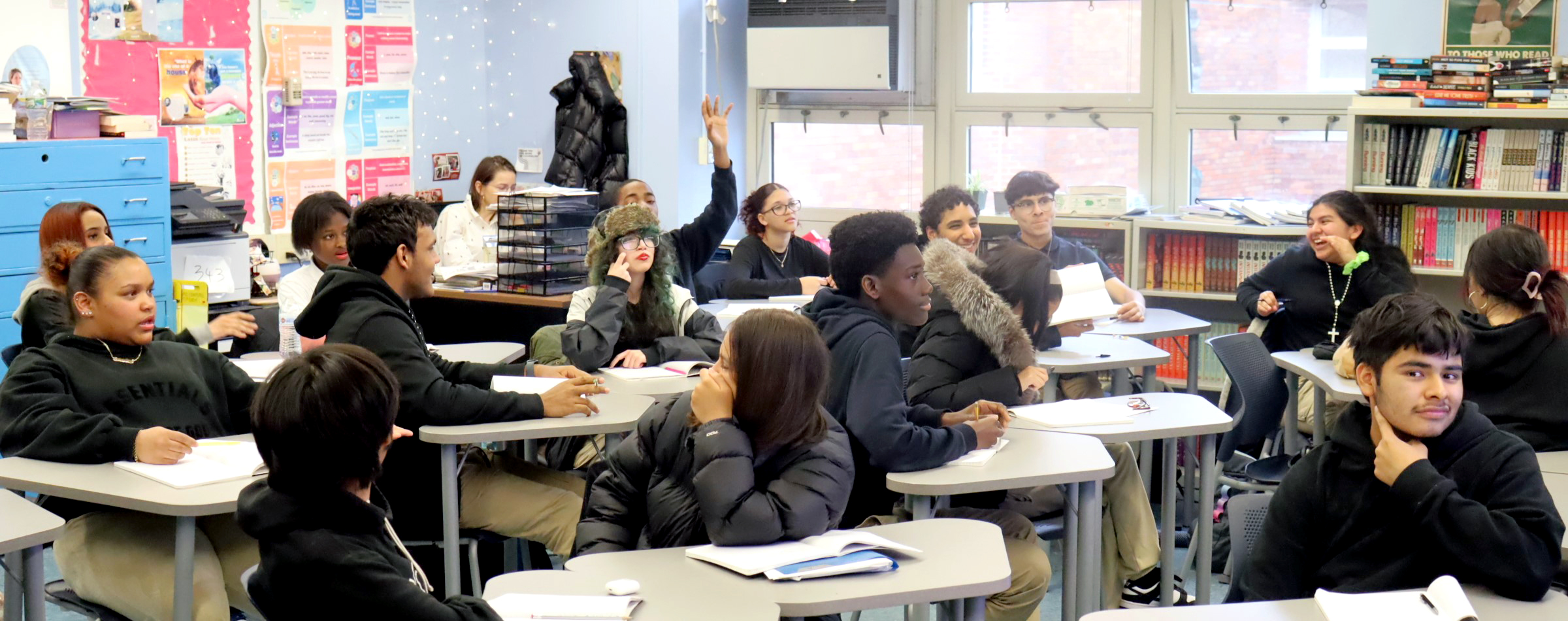
It is 8th period at the Bronx Latin School and twenty or so sophomores are taking turns attempting to answer some of life’s biggest questions: “What is purpose?” “Is life about me or is it about others?” “Why does it take courage to be yourself?” As hands go up and down across the classroom, some common themes emerge: vulnerability, interconnectedness, and acceptance. There is not a phone in sight. 

These students are taking the QUESTion Class, an evidence-based course offered in public high schools in low-income neighborhoods that gives young people the opportunity for self-reflection and personal development. Now in 10 schools in New York City, the curriculum uses a method whereby a series of questions — categorized by theme and developmentally sequenced — help students explore and form their own identities and strengthen their sense of agency in school and life. With superlative outcomes, both formal and anecdotal, the QUESTion Class may be one answer to how to prepare children to become adults in a complex and challenging world. 

“I think the class allows students to realize they can be resilient and that they have these inner strengths to make it through difficult situations,” said Matthew DeLeo, the students’ teacher at the Bronx Latin School and a trained QUESTion Class instructor. “It helps them realize that they’re stronger and more capable than they might otherwise have thought.”

The class is part of a larger effort known as the QUESTion Project, an initiative of the Open Future Institute, a non-profit founded by Gerard Senehi and his wife Francesca Rusciani. The project is, in many ways, the result of the founders’ personal quest to provide better support for the emotional development of emerging adults, something he says “allows them to understand themselves and what they choose to do rather than simply follow a script.” The class was designed for students with less of life’s advantages but its ability to build character and confidence is widely applicable and, many would say, universally lacking. 

“I know from my own experience, there’s not enough support out there to figure out who you are as a person and how that influences your decisions in life,” said Senehi. 

Senehi is an academic and entrepreneur who, himself, has held a number of identities. An alumnus of Amherst College with a master’s degree in education, Senehi has been a social worker, a teacher, and a successful entertainer doing mystery shows to help off-set his non-profit work. His role as a mentalist has made him appreciate the process of discovery that students experience in taking the QUESTion Class.

“One of the things we learned early on was the importance of making room for the unknown,” he said. “Questions about purpose and identity are really profound and intangible and we need to let students know they don’t need to have an answer but to be true explorers.”

The questions themselves are designed to empower the agency of students by encouraging intrinsic thinking as opposed to skill-building.

The QUESTion Project includes the QUESTion Academy, in which teacher training, professional development, and coaching take place and the QUESTion Leadership Program where students take leadership roles including co-teaching the class. The curriculum took four years to develop and was originally co-created and piloted with college students at the Florida State University and Amherst College, as well as students from public schools in the South Bronx where word spread to other public high schools. All of them are “Title I” schools that receive federal assistance to provide quality education to children from low-income families. A portion of the schools are college prep, where principals often look for tools to support first generation students in their transition to college. 

“What principals tell us is that it helps students with motivation for college but also with the skills needed to stay in college, which is a big issue for public school students,” he said. 

Senehi says the program’s approach – and the questions themselves – are designed to empower the agency of students by encouraging intrinsic thinking as opposed to skill-building. An advocate of learner-centered pedagogy, he differentiates this work from other social and emotional programs that might recommend the right choices, versus connecting them with the agency to understand those choices for themselves. It is a dynamic that can be jarring, but ultimately transformative for students. 

“I remember in my first QUESTion class I was like ‘whoa, why am I speaking more than the teacher?’ ‘Why are other kids telling me how they feel?’” says Alexander, a graduate of the Bronx Center for Science and Mathematics, now at SUNY Purchase studying acting. “In American education, we don’t really get to see students as the captains of their learning.” 

The QUESTion Class curriculum is 80 lessons, divided into five core units with different themes, topics and perspectives. They are Choice, Purpose, Fearlessness, Interconnectedness, and A Bigger Picture. In Choice, students might explore aspects of freedom and responsibility, and how the choices they make may affect others. Within the Fearlessness section, students begin to understand their fears within the context of others and explore the role of fearlessness in being true to themselves. Each curricular unit builds upon the others, and by the end of the course, students consider “a bigger picture” with a closing session in which they explore their place in a larger world. 

If there is a foundational pillar, it is purpose, or bringing meaning to your life in a way that is outside yourself, for which there is a well-documented connection to wellbeing. Purpose scholar William Damon, whose team from Stanford did a formal assessment of the program, wrote, “Alumni demonstrated that the QUESTion Class was effective in nurturing their sense of purpose and their feeling of being connected to others through their shared humanity. They learned to see purpose as a driving force now and throughout their lives.” Damon called the students he observed in the Bronx “as insightful, engaged, thoughtful, and articulate as any group of students I have ever seen.” 

The principal of the Bronx Latin school, Annette Fiorentino, said she had been searching for the QUESTion Project long before she knew what it was. Bronx Latin is a public high school in a low-income neighborhood of New York City with a large percentage of college-bound students. 100% of them are students of color, largely Latinx and Black. 

“When we share our opinions, we don’t divide ourselves.”

“Some of our top students, going to top universities, would come back to the Bronx in between terms and just seem so lost,” she said. “Some of them wanted to drop out of school. They weren’t sure who they were. They weren’t sure where they were going or what they wanted to study. I knew I needed a program to better prepare them emotionally for college and a principal friend of mine said, ‘Annette, you need the QUESTion Class.’” 

Fiorentino says the class gives students confidence in who they are and builds a resilience muscle to flex when things get tough. The process helps prepare students for the real world of college, particularly in PWI’s (Predominantly White Institutions) with cultures and norms that are unfamiliar to first generation college students whose families can’t tell them about the sudden discomfort they might experience. 

“I grew up with mostly Black and Brown people,” said Alexander. “The way we speak to each other is very different than the way I do now, now that I am in a PWI. There are certain things I need to be mindful about within this community and certain things I need to advocate for myself about. Taking the QUESTion Class gave me the fearlessness I need to be able to go up to someone who is different from me and be able to have those conversations that may be difficult or uncomfortable.” 

For Fiorentino, what started out as a college transition tool became so much more. She is particularly impressed by the value of the interconnectedness unit which was critical in addressing loneliness during the pandemic and helps students learn to see others through their shared humanity, not through their labels. 

“I think after they go through this program, they really understand that we’re more alike than we are different,” she said. Asked if she was familiar with other types of social and emotional learning programs, she said, “nothing as powerful as this.”

In a review of the program by Stanford’s Center for Adolescence, Senior Researcher Heather Malin wrote, “Students who participate in the QUESTion Class gain confidence in their ability to navigate a path forward through their choices, while becoming more comfortable with an uncertain future. As they engage with their most important questions with peers, their feelings of isolation start to dissipate. They connect with a sense of direction based on their own understanding of the meaning of life and the purpose they hope to fulfill. Most striking to us has been seeing their fears and concerns for the future replaced by a sense of joy, positivity and confidence about the possibilities ahead.”

Among the results of the report’s alumni survey, 89% of respondents said the class provided opportunities to think deeply about the future choices they were making, take responsibility for their choices, or explore the unlimited choices available to them; 78% said the class provided opportunities or greater capacity for being open to or accepting of perspectives of others, recognizing the humanity of others, and seeing connection with others despite our differences; 100% said it helped them improve their autonomy and agency. 

The report cites additional research on the value of purpose education among students, particularly those who’ve grown up in poverty and the added benefit this holds for others and for society. “Society benefits when individuals pursue a life of beyond-the-self purpose. Communities benefit from the prosocial activities of their members, and from being made up of individuals who are living lives of purpose.” 

Matthew DeLeo doesn’t need an assessment report to understand the impact the QUESTion Class has on his students, or on others. He sees it every day during 8th period when they file in ready to get to work. Sometimes students who aren’t even in the class will ask to sit in. Now in his eighth year of teaching the course, Deleo said the class has been a learning process for him personally. “It was the students’ growth and development – and the way they express what the program has done for them – that has enabled me to learn and grow as their teacher.” 

One afternoon in March, Gerard Senehi visited DeLeo’s class to ask, “What has this class helped you with?” The first indication may have been the level of seriousness the students gave to Senehi’s question. The room was silent. All eyes were on the visitor. Slowly, the hands went up. Some students asked for clarification: “What do you mean by helped me?” Others jumped right in: “It makes you OK with who you are, who you were, and who you want to be.” Another student added, “It opens up more doors to get to know yourself.” 

Asked if the class is a little like therapy, some answered yes, in that it allows them to share thoughts they have inside that they can’t always speak with their families about. Hearing other students share similar thoughts lets them know they are not alone. Other links to mental health and wellbeing include comments such as “there is no judgment here” and “it is a place of comfort.” 

Senehi’s last question moves the conversation from the individual to the collective. “How is it different here than what you see happening in the world outside in terms of polarization?” The answers to this are eerily spot-on and reflect a wisdom beyond their years. “When we share our opinions, we don’t divide ourselves.” “We’re not judging and we’re able to listen.” “In this class, it feels like there is no right or wrong, just people sharing their point of view,” all said with a remarkable lack of self-importance. 

As they burst into the crowded hallway after class, it is impossible not to hope that what they take with them that day will stay with them for the rest of their lives.

A Collective Approach to Wellbeing

In 2015, colleagues at the University of Washington designed a novel framework to promote wellbeing on campus. The UW Resilience Lab aims to cultivate a culture of resilience that goes beyond the individual and reaches across the university’s three campuses and surrounding communities. A member of the Flourishing Academic Network (FAN), the lab drives systemic change through pedagogy and curriculum, interdisciplinary collaboration, research, strategic projects, and community engagement – all designed to help students thrive. 

The lab’s collective approach joins faculty, staff, and students with a wide range of academic backgrounds — Buddhist studies, economics, medicine — into conversation with one another. It is a living example of how, when bringing different people and departments together, colleges and universities have an opportunity to transcend individualistic ideas of wellness and instead engage community members in productive dialogue. At the University of Washington, that dialogue is driving systemic change.

Kizz Prusia, MPA, is the Community Impact Manager at the UW Resilience Lab. He describes a resilient campus as one that embodies a quality of spaciousness. “Is there space and psychological safety for students to engage in dialogue with each other and with faculty across disciplines and status or levels of hierarchy and power?” he asks. “Are there tools available to practice wellbeing and compassion?” Prusia’s work, much like the work of the lab as a whole, extends into many areas of campus life. The lab values collaboration and fosters symbiotic relationships with other offices and programs — the Evans School of Public Policy and Governance; the School of Social Work; the Center for Communication, Difference, and Equity; and the Center for Child and Family Development, to name a few. That collective approach sets them apart, Prusia says. “I’ve seen centers and groups, here and at other institutions, that are insular and siloed. In the Resilience Lab, we think about individual wellbeing, but we also think about our collective ability to adapt and learn together; to shift wellbeing from an individual responsibility to a community effort.” 

Institutional Memory

Interdisciplinary initiatives maximize the Resilience Lab’s reach and impact across a large, multi-campus university. They also generate a new “institutional memory,” Prusia says, by embedding the culture of compassion and resilience into all domains of the student experience, planting the seeds of lasting change.

One such initiative, Resistance through Resilience (RTR), is the product of a collaboration between the Resilience Lab and the Center for Communication, Difference, and Equity. RTR is a new training and speaker series that engages community members on and off campus in the application of mindfulness practices to interrupt racism and its intersections. One example is discussions on examining the meaning of resilience in the lives of minoritized students, for whom resilience often connotes “toughing it out” through challenging circumstances — “muscling through,” Prusia says, sometimes at great costs. Working to change that definition, Resistance through Resilience expands the conversation around what resilience looks like for students of color, LGBTQ+ students, and other marginalized groups by exploring “different ways to resist what exists,” Prusia explains.

“We are looking at how systems operate, how we can make sense of an organizational culture, and where individual actors fit inside that broader context.”

“Those conversations have talked about joy, about rest, about resilience, and about radical listening,” he says. RTR promotes wellbeing through conversations around power, privilege, and the environments in which students and community members develop, learn, and thrive. The initiative highlights the Resilience Lab’s commitment to understanding the roles of both individuals and systems: with regard to anti-racist pedagogy, whole-person wellbeing, and community engagement, Prusia explains, “We are looking at how systems operate, how we can make sense of an organizational culture, and where individual actors fit inside that broader context.”

The Resilience Lab also provides seed grants in partnership with the Campus Sustainability Fund. The grants are an opportunity for anyone in the community, including students, faculty, staff, and community partners, to apply for grant funding for a proposed project relating to sustainability, mindfulness, resilience, or anti-racism. Examples of recent grant recipients include the Critical Conversations Collective (CCC), a space for interdisciplinary doctoral students of color to engage in peer mentoring, and Embodying Abolition, a faculty-led project designing innovative pedagogy and curriculum that challenge systems of incarceration.

The Be REAL initiative is a collaborative project from the Resilience Lab and the Center for Child and Family Development. Be REAL (REsilient Attitudes and Living — the name predates the popular app) got its start as a research project in undergraduate residence halls studying the efficacy of “preventative tools to help students manage stress, understand their own needs and relate to others with compassion,” Prusia explains. The six-week program equips students and staff with cognitive skills and mindful techniques that help them flourish in their daily lives and respond mindfully to challenging situations. In partnership with the Center for Child and Family Development, Be REAL’s curriculum is in the process of being adapted to fit the needs of high school students and extend the culture of wellbeing beyond campus.

As faculty, staff, and students across the country gradually returned to in-person learning as pandemic restrictions lifted, the Resilience Lab published Well-Being for Life and Learning, a guidebook organized around four pillars of an engaged and resilient university: teaching for equity and access, nurturing social connectedness, building coping skills, and connecting to the environment. The guidebook represents a community approach to taking resilience and wellbeing from optimistic concepts to fully-realized, implementable practices. While the guide provides a framework for best practices, the Resilience Lab’s work is, by design, not one-size-fits-all. 

“Is there space and psychological safety for students to engage in dialogue with each other and with faculty across disciplines and status or levels of hierarchy and power?”

“We don’t expect that every department will implement the guidebook in the same ways or at the same time,” Prusia says. “Instead, we try to work with faculty and staff in a way that works for them. Maybe it’s not the whole guidebook — maybe it’s taking one practice and building a skillset around that.” This adaptability makes wellbeing tools practical and accessible to all community members.

Pedagogy and Curriculum

Integrating resilience into university curriculum “can be a light lift and as manageable  as professors implementing a mindfulness practice at the start of class, being intentional about co-creating the learning environment with students, or just bringing resilience into the classroom as a topic to consider,” Prusia explains. Most recently at UW, this integration has involved guest speakers and visiting artists who engage with questions of wellbeing in its many intricate forms. For some faculty, this approach has taken off — and taken their curriculum down unforeseen paths. 

Marc Bamuthi Joseph is a poet, dancer, and artist-in-residence at the University of Washington’s Meany Center for Performing Arts for the duration of the 2023-2024 academic year. Joseph brought to campus his original Carnival of the Animals, a multimedia performance that “navigates the reality of the political jungle by embodying shifting societal values and our relationship to democracy” through poetry, dance, and music. Joseph’s residency at the University of Washington explores “what it means to go from art to wellness, from artistic joy to collective wellness,” Prusia says. Through multimedia performance art, Joseph hosts a conversation that asks viewers to consider art’s place in creating collective change. One professor in the Evans School of Public Policy and Governance saw a resonant connection between Joseph’s art and her coursework and invited her whole class of graduate students to the performance. From a government course to a multigenre stage production, the professor cultivated a nimble, adaptive, and innovative learning experience that embodies the Resilience Lab’s vision of the compassionate campus. 

If the University of Washington is any indication, that vision, when rigorously explored and thoughtfully implemented, can blossom into tangible change. Where wellbeing is a collective responsibility and a shared opportunity, the culture shifts to embrace it.

How to Build a Global Citizen

Listen to this article, read by Ezza Naveed.

The year is (sometime in the future), and a network of global leaders are working together across continents, languages, and disciplines on some of the world’s biggest problems. Be they scientists, artists, industry executives or NGO directors, they are particularly well-equipped with the skills needed to navigate a world with diverse cultures and common threats. Within their toolbox of competencies are empathy, agency, open-mindedness and grit. 

This is not a utopian fantasy, but rather the strategic vision that centers Mike Magee, PhD, and his students at Minerva University, a recently formed, selective institution aimed at developing the global leaders of the future. 

“Our mission is to develop leaders, problem-solvers, and entrepreneurs from every corner of the globe and to weave them together as one community committed to a world that is safe, sustainable and equitable,” said Magee, President of Minerva. 

Accredited in 2021, the university was originally called The Minerva Schools at Keck Graduate Institute, founded by Ben Nelson and operated by the Minerva Institute for Research and Scholarship, where former US Senator and President Emeritus of the New School Bob Kerry served as executive chairman. Based in San Francisco, Minerva utilizes a hybrid platform of online learning and study away to engage high achieving students from around the world in a different kind of education. Within their regular studies, students work on location-based assignments in seven international cities. 

By design, it is the world’s most diverse university: less than 15% of its 600 students are from the US, and many come from low-income communities. Minerva has also been ranked “the world’s most innovative university,” and for good reason. To achieve a goal as ambitious as Magee describes within a system as traditional as higher education, Minerva had to reinvent pretty much everything. With minimal infrastructure, an unusual faculty profile, and a unique pedagogy, Minerva offers a fresh approach to higher education at a time of deep frustration with the status quo. 

College — reimagined 

One of the most obvious differences between Minerva and its elite peers is the environment in which students learn. Large, theater-style lecture halls do not exist. In fact, the school has minimal infrastructure which keeps the tuition about half that of many colleges. Classes of no more than 20 students are live and online and involve pre-class work and full participation. The goal is to create intimate learning environments that are dialogue based where students build relationships with peers and professors, even as they are mostly remote. After spending their first year in San Francisco taking the same general education curriculum, students move in cohorts to an additional 6 cities each semester: Berlin, Buenos Aires, Seoul, Taipei, and London.

“It’s a very special type of person who wants to work here.”

“From the beginning, we decided we were not going to build beautiful campuses. We were going to intentionally teach young people to treat economically and culturally vibrant cities as their campuses – to use their libraries, museums and labs and to immerse themselves in their cultures.”

Another feature that sets Minerva apart is the kind of people it attracts. Michael Horn is a trustee at Minerva and has been involved with the school since the beginning. “I see Minerva as a disruptive entrant into the elite higher education segment,” said Horn, who has authored several books including one with Clayton Christenson, considered the father of disruptive innovation theory. “It puts the learner and their needs first and prepares them for a complex world in a way that’s much more front and center than other higher ed institutions who are often asking themselves ‘Are we a research-first institution? Why do we exist?’ At Minerva, we are very clear. We are a learning institution.” 

A former international relations professor at the University of Southern California, Dollie   Davis taught in one of those large lecture halls and eventually left higher ed feeling unfulfilled. She worked in the non-profit sector until the chance to join Minerva lured her back to teaching. She is now Minerva’s dean of faculty.

“It’s a very special type of person who wants to work here,” she said. “We don’t have a publishing requirement and we don’t have tenure. Without the requirement to publish, we focus primarily on teaching. We care about our specific model of teaching and being engaged with our students.”

Davis says everything about Minerva is intentional which translates into a collective “buy-in” of the unusual culture. 

“The students know they are coming into a challenging university where classes are taught in the active learning style,” she said. “They know that they are going to be called on so as soon as they log on, they’re ready to go. It’s on us, the faculty, to promote a strong sense of community and a safe space in the classroom so they feel comfortable sharing new ideas. That’s a big part of our training.” 

Minerva professors are trained in an active learning pedagogy and the technology that enables it. With students and professors throughout the world, Minerva’s digital platform is critical, and the university is quick to distinguish it from the online accommodations colleges were forced to make due to the pandemic. The platform delivers real-time information to faculty and students during classroom discussion, which allows them to display material for the purpose of informing the conversation. Students and faculty see one another on a digital “stage” and can be moved around the screen. If students have worked together on a pre-class project and need to present, the professor can visually pair them with their material alongside them. Davis believes a digital theater can be more intimate than an actual classroom where it is easier to hide. 

Magee says many schools use online learning simply for knowledge transmission when they can be working the technology around the science of learning. “The technology should enable the pedagogy you choose. What do we want the classroom experience to be like? What type of outcomes are we trying to achieve for students?” In Minerva’s case, it is the evidence that emerging adults retain more knowledge from experiences and dialogue than they do from simply receiving information. 

An important distinction in the curriculum is the relevance of real-world problems which students work on in location-based assignments. Students in Buenos Aires taking Dean Davis’s economics class, for example, will attend a financial museum and discuss the history of the city’s economy and policies with the local experts there. Students who take sustainability courses on topics like energy or water can apply what they learn to projects they will work on in Seoul or Berlin. The variation in these experiences teaches students how different people and systems respond to similar challenges. 

To build their cultural competencies, students learn to master what the school calls “HC’s” – 75 habits and concepts that are basic tools for critical thinking and effective communication that students will use across their lifetime. They are particularly important when working across differences – a foundational principle in global citizen-building. Students are introduced to the HC’s in their first year and are assessed on them throughout their time at Minerva. Davis says the HC’s are continuously “pulled” throughout class and are referenced by hashtags that get students to think instantaneously. 

“When talking about a geopolitical conflict, I might say “hashtag – audience” to remind students of how what they’re saying affects others; or “hashtag – break it down” when we are working on problem-solving,” she said. 

The HC’s include personal characteristics such as purpose and resilience, which are linked to improved mental health and wellbeing, something that is highly valued at a school that asks a lot of its students. “Our curriculum is intentionally designed to build resilience in students and have them grow in those ways,” said Horn. “Resilience is incredibly important to wellbeing because things aren’t always going to be great, and it is how you respond that is important.” 

Magee said the challenges students face in becoming global citizens are not minimal. “I don’t want to give the impression that any of this is easy,” he said. “It’s really hard when you have young people who are by and large between the ages of 17 and 22 and they’re wary of one another and they’re still trying to develop their own sense of how the world works. And there’s a lot they still need to know about history and politics and identity.”

“If anyone wants to ‘do Minerva,’ you should be prepared that it will upend much of what you know about the world,” said Ezza Naveed, a Minerva alumnus of the class of 2021.

Naveed was a highschool student in her native Pakistan when she told her guidance counselor she was not interested in a traditional four-year university. “If it were up to me, I would have traveled the world instead of going to college – I think it would teach me more,” she said. But her mother had other ideas and so her guidance counselor suggested an alternative — Minerva. Naveed was an excellent student, though her grades had slipped that year due to a significant personal loss. She had achieved much in her young life including working on class poverty within her community, which she wrote about in her application. She was overjoyed when she was accepted.

“I think Minerva saw in me someone who, if given this education, was going to run with it and make a difference in people’s lives,” she said.

Naveed now says Minerva was the exciting, soul- searching, transformational experience she had hoped for, building her sense of empathy and understanding of different cultures and helping her discover new parts of herself. 

“The most formative experiences in my life happened in all of these cities around the world, in all these unique cultures where I learned new customs and made best friends for life,” she said. In Seoul, she joined the local debate team at Hanyang University and was amazed that she became a quarter finalist for the Seoul National Debate Tournament. During her trek to Patagonia whilst living in Buenos Aires, and doing solo hikes by herself, she realized something. “I, as a woman, can compete and do anything, anywhere in the world,” she remembers thinking, countering the cultural narrative she grew up with about the inferior capabilities of women. 

“For me, Minerva was about ‘unlearning that,’” she said. 

Naveed wrote her Minerva capstone on gender immobility of Pakistani women. “I was always passionate about this issue, but I wasn’t confident in my ability to bring that forward,” she said. “Minerva gave me that toolbox. I lived in 5 out of the 7 countries where I got to see what ‘normal’ was like for women in different parts of the world.”

When she returned to Pakistan after graduation, she sensed that her peers did not get the same opportunities and had not grown in the same ways, even those she considered “really smart.” She attributes that to a systemic and personal investment gap in their education. “At Minerva, my professors knew me so well, the staff knew me so well. They were so invested in my success, and they really cared for us, my friends cared for me, it was just a deeply caring community. I realized that’s not a universal thing.” Shortly after graduating, she formed a partnership with Codematics, a tech company in Pakistan to teach low-income students, aged 18 to 25, for her project “Young Leaders Program” at Urraan, both hard tech skills like coding but also personal, pragmatic skills like public speaking, how to pitch an idea and networking. She is particularly proud of the outcomes she has seen in her female students.

“I think Minerva saw in me someone who, if given this education, was going to run with it and make a difference in people’s lives.”

Naveed is now a student at Harvard Graduate School of Education where she runs the student organization, Women’s Education Movement which recently hosted a leadership forum for School of Leadership Afghanistan, Afghanistan’s first and only boarding school for girls.  She continues to feel the personal growth that occurred when at Minerva – “My friends and I can literally go anywhere and figure it out” — but she cautions that the school is not for everyone.

When asked about the challenges she encountered, Narveed is candid about the emotional toll it can take on students, particularly those, like her, who had suffered a loss or were emotionally vulnerable.

“The mental, emotional load of it was really tiring,” she said. “We had to uproot and reroute and establish community from scratch in all these places — and then there was the pandemic — it really took a toll on me, mentally, emotionally and physically.” Naveed said students, particularly in the early classes, felt particularly dependent on one another and their professors. “The only sense of stability came from our own friendship and community.”

The school has worked on strengthening its mental health services platform which included coordinating therapy appointments around countries and time zones which Naveed said was a problem early on. Her ability to put these challenges in the context of her overall experience hints at the resilience Minerva believes is a part of global leadership.

“It can be challenging but it is extremely worth it. If I could go back and do it all again, I absolutely would.” 

Expanding the pipeline

If there was one thing Magee would change about Minerva it would be to make it available to more students around the world which reflects a deep personal commitment to and experience with educational equity. An academic for many years, Magee left higher ed to found a network of new, racially integrated public schools in Rhode Island before coming to Minerva. 

“Since I was a child, I’ve been really fascinated by and passionate about the role that schools can play in bringing young people together from lots of different backgrounds and across many lines of difference into community and belonging with each other.”

Magee acknowledges that the rigorous pedagogy and international campus require a certain level of skill and maturity, (as Ezza Narveed points out, it’s not for everyone), but he hopes to open Minerva up to more students for whom the unique method would be beneficial. Last year, the school grew its student body by 20% and plans to do the same in the coming year. With faculty that can be onboarded anywhere in the world and ample real estate available in their host cities, Minerva’s model makes it easy to expand.

“I think it’s fair to say that none of us is satisfied with limiting this to 600 students,” said Michael Horn. 

In regard to being a prototype for change, Magee hopes other institutions will acknowledge the value of low capital costs to solve one of higher education’s biggest barriers, the rising cost of tuition. Magee blames the current unaffordability of higher ed for many Americans, and the resulting decline in public support for it, on a growing trend toward a business model more akin to a luxury brand or a country club membership. “The elite institutions started this trend by intentionally constraining supply, astronomically raising prices, emphasizing their elitism and not thinking about how to create an experience that is more available and less alienating,” he said. Magee believes the strategy pays off for the relatively few institutions whose alumni will enjoy a lifetime of social capital but is a debilitating trend for the rest. 

“It has really broken higher education in America.” 

If Minerva can offer an alternative path, one that can be scaled to reach far more of the future global citizens the world needs, Magee is happy to share it. His focus on growth also reveals a desire to prove something to those who may interpret “innovative” as “experimental.”  

“I think we can do a real service to higher ed by growing to a size where we’re a little less easy to dismiss.”

The Furman Advantage

When Elizabeth Davis became President of Furman University in 2014, she looked to promote what was most distinctive about the small liberal arts school in Greenville, South Carolina. Furman had its share of awards and recognitions but Davis was seeking to capture what her listening tour had convinced her was a very different college experience for students, faculty and staff.  

Engaged, student-centered learning was part of Furman’s culture as far back as the early 1930’s.  Internships and study away had been available since the late 1960’s and undergraduate students had been offered research opportunities for decades. The faculty-as-mentor concept had been embraced at Furman long before it was linked to life-long wellbeing but no one was really talking about it. It occurred to Davis that combining all of these elements provided an advantage waiting to be named at a time when student emotional and behavioral health was becoming a national concern. 

“I had become really interested in the Gallup Purdue work that identified the big six experiences that you need to have in college in order to thrive in life and work and it was clear to me that many of our students were getting all six,” she said.  “We had faculty and staff who were interested in creating that kind of environment for our students and I thought this was really a differentiator.” 

The problem, according to Davis and her team, was bigger than finding the right slogan. In order to make Furman’s engaged learning culture an institutional asset, and a true promise to its students, they needed to increase the percentage of them who were experiencing these high impact practices. That meant informing more students about what was available and reducing the barriers to participation for students who, for whatever reason, were not taking part. 

In October, 2016, Furman launched a new strategic plan called The Furman Advantage (TFA).  Equal parts pedagogy and programming, TFA is a four-year individualized educational experience that progresses developmentally, is guided by specially trained advisors and exposes all students to engaged learning experiences like undergraduate research, study away, and internships. Underpinning all of it is a commitment to reflection — urging students to consider questions such as “What am I good at?” “What do I most care about?” 

The journey begins with Pathways, a two-year, 4 credit class of 15 students, taught by a professor or trained staff member who becomes a student’s pre-major advisor. Its curriculum covers topics like study skills, time management, and academic integrity, while exploring concepts such as belonging, identity, and empathy. Once their major is declared in year two, students spend years three and four on engaged learning experiences, and career and post-graduate exploration and preparation.  

“All of the things that were part of the core from a liberal arts education are in there,” said Beth Pontari, Provost at Furman and one of the lead architects of TFA. “It was just sort of highlighting and amplifying the things we care deeply about and ensuring access for all students by providing a level playing field that is foundational.”

Nothing says “we care about you,” like a personalized, developmentally-appropriate pathway of curricular and co-curricular activities.

The Furman Advantage has its own significant advantage in that it was funded by an extraordinary gift from The Duke Endowment. Now celebrating its 100th anniversary, the Duke Endowment was established by industrialist James B. Duke to continuously fund, among other pursuits, four schools in North and South Carolina: Duke University, Davidson College, Furman University, and Johnson C. Smith University.  The unusual funding relationship allows the schools to experiment with concepts before they are proven.   

“We work really closely with the leaders of all four institutions to understand what their institutional priorities are and then determine how The Duke Endowment can best support them,”  said Kristi Walters, director of higher education at The Duke Endowment which funded the Furman Advantage in three large grants totaling around $75 million over several years.  “Our hope is that our support leads to high value education across all the schools.” 

At Furman, the Endowment’s backing fueled an institutional transformation that is difficult to achieve in higher education.  While The Furman Advantage is perceived as more of an iteration than a major change, making it the dominant nomenclature at the school took years of hard work that involved perennial challenges like getting faculty buy-in, aligning independent departments around common goals, and hoping the students would respond. 

Photos courtesy of Furman University

Building the Advantage

Nothing says “we care about you” like a personalized, developmentally-appropriate pathway of curricular and co-curricular activities curated with the help of an engaged advisor. But the team at Furman does not want TFA to be confused with coddling students. In fact, when Elizabeth Davis was looking at Furman with fresh eyes, a group of administrators, faculty, researchers and practitioners were already participating in a multi-institutional effort to address what they saw as a lack of resilience among students.  

Early strategic discussions involving all Duke Endowment-funded schools concluded that student mental health was among each of their highest concerns. They agreed the best cumulative response was to focus on preventative strategies rather than service delivery only.  Hearing this, the Endowment agreed to fund a $3.4 million, five-year project called The Student Resilience and Well-Being Project with a mission “to better understand the challenges students face in college and to identify individual, interpersonal and institutional factors that promote and detract from student well-being in the face of challenge and stress.”  The aim was not to make things easier for students but to help them cope with the stresses of college and to develop the skills that would help them flourish in school and beyond. 

The project was launched in 2014 and involved nearly 20 faculty and administrators across the institutions focused on tracking the undergraduate class of 2018 through their entire collegiate experience.  It collected data on more than 6,600 variables across 11 waves of data collection from more than 2,000 students.  Some say the study itself did not reach its full potential due to pandemic-related disruptions, but the individual schools have benefited from the findings in a number of ways. 

By all accounts, Furman took the Resiliency Project, and the data it provided, very seriously.  Pontari says while academic rigor is expected at Furman, they were surprised to see that the level of academic stress reported by students, and continuing throughout their four years, was higher at Furman than at the other schools. Advising was another red flag. Furman had faculty advising only and as committed as many were to the practice, quality advising was reported to be inconsistent, leaving outcomes up to what they called “the advising lottery.”  

“When you see the data, you know what you’re dealing with and these were things we were not going to ignore,” said Pontari, who, through The Duke Endowment, hired Gallup to provide a baseline of knowledge about students’ experiences at Furman. For Davis, the Resiliency Project provided more material for the strategic initiative. Not only did the project identify key challenges that would make their way into TFA, it strengthened another one of Furman’s little known and unusual assets – the collaboration between academic and student affairs. In the Resiliency Project, Psychology professors found themselves working alongside mental health practitioners. Student affairs professionals and academic deans got to know and respect one another through years of working groups. 

Photos courtesy of Furman University

Throughout the process, Pontari, who at the time was Associate Provost of Engaged Learning, worked hand in hand with Connie Carson, Furman’s Vice President of Student Affairs. Many, including Davis, consider their continued partnership to be one of the most important outcomes of the multi-year research project.

“The two domains of a student’s life – the in-class/out-of-class thing – they can either work well together or they can play against each other.”

“Beth and Connie developed a learning relationship that was so important to what we ended up doing,” she said. “The academic side got to learn what student life brings to the table.  It’s not all fun and games. It’s a real understanding of student development theory.” 

Carson sees the alignment as something that institutions can choose to value.   

“Higher education can be very competitive with lots of curiosity about who gets credit,” she said. “The two domains of a student’s life – the in-class/out-of-class thing – they can either work well together or they can play against each other.  Here, all we cared about was the impact on the student and so we said, ‘let’s make this an asset.’”

That asset is woven throughout The Furman Advantage, starting with Pathways, which involves both student affairs personnel and faculty as student advisors as well as teachers of a specially designed curriculum for first and second year students.  Based on a five year pilot that involved a student control group, Pathways is a best-practice boot camp of sorts where new students get exposed to college life, its stressors and opportunities, and build both academic and emotional skills. Students meet once a week for a 50 minute class led by their Pathways program advisor and a peer mentor who are trained to discuss issues like conflict resolution as easily as they are how to choose a major. Faculty and staff are compensated for their time, either through a stipend or by folding the course into their teaching load.  

 “The Furman Advantage concept was really thinking about – how do we engage in this developmental model and create it in a way where students will understand what they need to be doing and when in order to reach the goal of being prepared for work and life,” said Michelle Horhota, a psychologist and faculty member who is Furman’s first Associate Dean of Mentoring and Advising. “The Pathways program is the glue that holds it all together.”

Results from the Pathways pilot showed a 3% increase in first-year to sophomore retention, an 11% increase in first-year to sophomore retention in students of color; improvements in advising satisfaction among first-year students and increased utilization in services like career development and counseling. Surveys also showed a 9% increase in first-years’ sense of belonging; a 10% increase in feeling that they matter; and a 5% increase in first-years reporting they strongly agree that professors care about them as individuals. 

By design, Pathways exposes students to engaging learning experiences, but Pontari points out that “just because they know about them, doesn’t mean they will participate in them.” She says one of her most important roles at Furman has been to eliminate the barriers to participation, the most common of which are money and time. The school’s summer fellowship program began to include compensation for students who rely on summer income for undergraduate research and internships. It created a flexible study away program and on campus internships for athletes whose schedules did not allow for significant time away. 

Participation in Furman’s big three – study away, internships and undergraduate research — is now at around 95% which comes close to Davis’ original goal, though the cultural change is ongoing.  Not everyone on campus envisioned TFA as clearly as its leaders did and Davis says more work needs to be done to articulate the concept both internally and externally, particularly with faculty, many of whom voted against making Pathways a graduation requirement. 

Tim Fehler has been a history professor at Furman for nearly 30 years.  He said he “backed into” TFA by having been the Director of Undergraduate Research and Internships in the early 2000’s. He talks about his own “conversion” from the inside-the-classroom mindset to an understanding of how the intentionality of TFA might affect student development as well as the integrity of teaching at Furman. 

Fehler had been working with students on summer research projects for years, despite being in the humanities which didn’t naturally lend itself to the practice.   

“Doing research with me or in the chemistry department doesn’t mean you’re going to become a professor, in fact, most of our students will not,” he said. “But what they learn is just as valuable. Working in research helps you understand yourself and your abilities and your approach to problems. And it got me to see that students can do this kind of work and the effect it can have on them.”  

But despite leading these efforts and even joining The Furman Advantage committee, Fehler said even he had to be convinced about some of its components. 

“I understood research but when it came to internship applications, I was kind of like ‘who cares?’ – isn’t this just a job?” 

Fehler says it took reading the student’s reflections on their experiences with internships to understand that they were an opportunity to get students to think about who they are and who they will eventually become, not just another bullet point on a resume.  

Asked about faculty buy-in for TFA and the Pathways program in particular, Fehler said it was mixed with a fair amount of “eye rolling.” He says that while Furman was always a place that put teaching first, many saw Pathways as a separate duty that was placed on them and could distract them from what the university was really going to reward. For younger faculty, getting tenure is still the primary goal.  

“Some faculty still have that kind of expectation that this student-facing component is not quite what I went to graduate school for,” said Fehler.  “However, when faculty can witness the growth potential among students, we see how these activities can improve our work both in the classroom and professionally, plus the mentorship experiences can become deeper and richer.”

As Furman continues on its cultural journey, results from the Gallup study delivered good news. Furman alumni surpassed the national average in Gallup’s “Big Six” college experiences. The survey also found that Furman students are 3.4 times more likely to be engaged at work and 2.9 times more likely to be thriving in wellbeing.

Folks at Furman now call TFA an educational philosophy, as opposed to an initiative. “It’s just the way we do things now,” said Davis. Those in higher education who hope to follow Furman’s example might ask “Would Furman’s success with TFA be possible without its deep history of engaged learning? or the significant financial support of the Duke Endowment?”   

Davis says changing the philosophy around the co-dependence of activities inside and outside of the classroom remains the biggest lift even for a school that was ready for it.  In regards to funding, she acknowledges that it allowed them to accomplish a great deal quickly but encourages other schools to look at what Furman has already paid for. “We spent years having faculty and staff develop Pathways,” she said. “Now it exists.” 

Asked if she thinks The Furman Advantage is an even bigger advantage at a time when the value of higher education is in question, Davis is cautiously optimistic.  

“There is perceived value – rankings and acceptance rates and whatever you see on the web site – and then there is real value,” she said. “We can influence perceived value to some degree, but we really have to keep working on what the real value is – being able to sustain the promises we make to prospective students.” 

A Global Mindset

When Leïlah Sory was a structural engineering student at Montreal’s McGill University, she won a scholarship in 2020 to participate in a sustainability program hosted in Toronto. There, 140 students from universities throughout Canada were divided into small interdisciplinary teams exploring sustainability challenges in global communities. Sory’s cohort focused on transportation solutions for San José, Costa Rica.

For several days, they combined what they knew from their respective fields of study, guided by industry professionals and community experts, to design an electric bus infrastructure to support underserved parts of the capital city. 

“We were teamed up to develop a project based on pairing our interests with SDGs [UN Sustainable Development Goals] that are critical there. Because I study engineering, I was paired with a project that focuses on the UN Sustainable Cities and Communities goal,” says Sory. Originally from Burkina Faso, she came with an appreciation for collaborating on projects pertaining to the communities that were foreign to her. But this project brought new aspects of that lesson home. “Everyone has different backgrounds and knowledge they can contribute and learn from one another. But you also need to remember the importance of the specific community and think about what their needs really are before you start thinking about a solution straightaway.”  

When she returned to McGill, she had gained more than hands-on, real-world problem-solving experience and a digital portfolio. She came away with a new way of looking at sustainable development, a mentoring network, and a place in a budding alumni network of young people developing critical skills and passions in a world ready and waiting. 

The program that enabled Sory to focus on the challenge in Costa Rica was How to Change the World, a London-based social enterprise connecting diverse students, educators, industry professionals, and community stakeholders in experiential learning programs.The goals are as pragmatic as they are lofty: Namely, tackling some of the world’s thorniest sustainability challenges while training students in the skills of tomorrow, and introducing them to the companies that will need them. Students use the 17 UN SDGs as their north star addressing substantive global issues – poverty, transportation, education, climate change, waste management — on the local level, designed to target specific communities all around the world.

It started—as many things do that later catch fire—as a college course. Prof. Jason Blackstock started as a quantum physicist in Silicon Valley, originally from Canada, and then made his way via a master’s in public administration from the Harvard Kennedy School to work on global climate and sustainability policy. In 2012 he was invited to the University College of London (UCL) to set up a new department encompassing science, technology, engineering, and policy-making, and to examine critical bits missing in current disciplines. UCL queried both employers about what recent graduates were missing when they started in the workforce, and alumni about what they wished they’d learned in their years as students.  The answers came back from across disciplines – accounting and engineering, business and computer science: there had not been nearly enough exploration of real-world problems to prepare recent graduates. Employers had to retrain them to learn how to tackle problems when there were no answers in the back of a textbook. Alumni felt the solutions required more than technical excellence in their fields; they needed collaboration with people in entirely different disciplines, an understanding of what they did – and how it would be useful in concert with their expertise.

The final ask from the Dean was not what Blackstock had expected. “When all the input came back, he told me, ‘We’ve got all this data. Can you add one course to the program that addresses that please?’ ’” Blackstock recalls. “And I told him, ‘What you want is me to teach students how to change the world in one course.’ And he was like, ‘Yes. And you should call it that.’”

UCL’s Engineering program had just completed a rebranding, and conveniently enough, the side of the building had been painted with the motto, UCL Engineering – Change the World. For the pilot course, students would be assigned project-based work challenges in highly interdisciplinary teams, combining their shared technical excellence on corporate challenges, government challenges, economic challenges…anything, really. 

Blackstock asked students, ‘What kind of things would they like to work on?’

“It was summarized best by one young British student who stood up and said, ‘Well sir, you old people broke the planet. We’d like to know how to fix it, please.” 

In 2014, the initially 500-student program began tackling stubborn sustainability challenges for communities around the world. It flourished for several years, and in 2016 it became a required capstone for over a dozen engineering and business degree programs. By then word had spread through conferences and summits to a wider horizon of universities, and the requests began to trickle in: Could you do one for us?

In 2019, Blackstock spun the program out of UCL as an independent social enterprise, partnering with global entrepreneur Alana Heath, who’d spent a decade mobilizing businesses as a force for good across the financial inclusion, energy access and impact investing sectors. In their newly formed enterprise, partnerships were developed with communities, professionals, and educators who could bring object lessons to life.

​“We’d officially launched,” recalls Heath. “It was February 2020, and we had almost 150 students from more than a dozen Canadian universities gathered in Toronto for a fantastic in-person program. And when the program finished, we’d run this incredible experience, and basically flew back into lockdown.” The response from participants and stakeholders was overwhelmingly positive. But the model had to shift immediately. “We had a bunch of deans very excited about what we’d done, getting rave reviews and feedback from their students. And they said to us, ‘We’re all online right now. Can you figure out how to do what you just did in person, virtually? Our students really need these types of opportunities.’” 

“Companies need both current employees and a future talent pipeline who are able to apply a sustainability lens to their work.”

“Need” is an apt word. In January 2023, new research released by the Boston Consulting Group (BCG) examined some of the employee-talent obstacles that stand in the way of global companies reaching their sustainability goals. From 2017 to 2022, the number of large companies setting science-based targets grew by 36 times, to over 4,200 companies. But only 17 percent are on target to meet those goals. BCG partnered with Microsoft to research the experience of 15 companies trying to reach their goals, a project that included polling sustainability leaders at a wider selection of companies. 

Responses showed that companies are relying heavily on their internal talent. Of sustainability leaders surveyed, 68 percent are “homegrown” (hired from within the company), while just 32 percent are brought in from the outside. Sixty percent of people on sustainability teams say they were not hired for their sustainability expertise; 32 percent consider themselves an expert in another field, while 28 percent did not consider themselves an expert in any field.

​“There’s a massive sustainability skills gap within industries and corporations today,” says Blackstock. “Businesses are hungry for talent, and hungry to upskill and develop their employees to understand how to apply a sustainability lens. That’s the only way companies can hit the sustainability targets they’ve set – and that regulations are increasingly requiring them to hit.”

​The most common corporate-sustainability pitfall Blackstock hears about is having the whole effort rest on one individual or department instead of having knowledge, and accountability, spread throughout multiple departments. “It’s a great way to fail ethically, having one sustainability officer burdened with the success of something no one else understands or acts upon. But more than 75% of corporate leaders today expect every job will have a sustainability component by 2050,” Blackstock says. “That’s why we support the idea that every employee should have a sustainability lens to their work.”

To support companies with this challenge, How to Change the World is now developing programs that combine students from higher ed with working early career professionals from the companies. This provides businesses with a way of upskilling their existing workforce, investing in their future talent pipeline, and generating innovative ideas that can help them reach their sustainability targets – and ideally develop new sustainable products and services along the way.

This model has strong benefits for higher ed, Blackstock says, because the students get to learn and engage directly with the companies they want to go work for. To support this connection, How to Change the World has also started running Careers Nights, bringing program alumni together with sustainability professionals and leaders and interested companies. Two of the most common questions he gets from participants who feel their career-view expanding after an eye-opening project: How can I get a job with a sustainability angle? And, What’s the role of private industry here?

“That’s generating just a huge amount of interest, sort of a built-in recruiting process. It’s integrated as a follow-on from our boot camps and courses to provide a bridge between higher ed and the future of sustainable work,” says Heath.

“If you can bring higher ed to the table with the students bringing in new ideas, employers can pick the best-fit ones to hire,” she says. “It’s that mix of value that can significantly benefit businesses.”

Post-covid, the virtual programs that grew to take the place of in-person ones had the same practical problem-solving focus through the lens of sustainability. Blackstock initially worried that remote programs wouldn’t pack the same punch as they did in person. But in fact, he found that they had all that and more. 

“It proved to be as good, and in some ways better than, our in-person experiences. We didn’t try to replicate the in-person ones. We really asked ourselves, ‘What’s different about virtual? How can we access extra benefits and still retain the human connection and real-life problems?’” he says. “You’re not going to get the hugs, but whole new virtual collaboration skills can bloom, and that’s going to be needed in the future, too.”

“I chose to join How to Change the World exactly because I was seeking a connection to the real world. We need to be mindful of never losing track of the big picture.”

As How to Change the World continued to grow, the target audience of their programs was also expanding. Students were being trained in the same creative questioning and community-oriented approach, with a growing understanding of the sustainability skills needed for the solutions, as well as the careers they wanted to step into. Companies were increasingly interested, very much in need of the types of skilled students stepping out of these programs. Educators were interested in learning too; foundational lessons in guiding experiential learning ‘at scale’ is a valuable form of professional development, while increasing knowledge base in sustainability for themselves as well. 

​Francesco Ambrogi is a teaching fellow in mechanical engineering at Queen’s University in Ontario. When he was a second-year PhD there, he received a departmental email looking for engineers to volunteer as teaching associates for university students participating in a How to Change the World bootcamp. He signed up, thinking, ‘I like teaching, I’d love to get more experience and learn about this.’ Since then, he’s become a teaching member and course lead for many How to Change the World programs, and calls it tremendously influential in his development as a professor. 

​“It’s had a huge effect on my career. I’ve taken a lot of what I learn from How To Change The World and implemented it in my own classes,” Ambrogi says. He cites the skillful use of virtual resources, so important for how students learn today, from short-form video and online resources to synchronous, collaborative virtual discussions with industry leaders and visionaries, a wider range of whom are accessible to How to Change the World in virtual format than in-person programs. He reserves the most praise for the multidisciplinary approach.

“It forces students to go out of their little comfort zone, which is mainly engineering, and expands a discussion with someone from business school and law school and the biological sciences, which I think is the key to actually solving any real problems these days,” says Ambrogi. “Otherwise, you could go through four years of undergraduate studies never having the opportunity to brainstorm with class members in other fields. You iterate the process, and the new ideas are kind of raw, but it’s exactly through this kind of repeated process that the solution comes up.”

​The lens of sustainability, he admits, wasn’t one that had been a focus in his studies, something he’s grateful to have changed.

​“I never heard much about it, to be honest. When you’re working on your PhD you’re so focused on your small tiny problem. My research area is very abstract, computer simulations of fluid flows, and can be very isolated,” he says. “So I chose to join How to Change the World exactly because I was seeking a connection to the real world. We need to be mindful of never losing track of the big picture. We need to go in that direction now more than ever, because of climate change and pollution and the economy, and at the end of the day, we’re teaching students how to solve problems. You never know what the course might spark in their mind, what they might be able to do.”

A few months ago, Blackstock and Heath received a message through LinkedIn from a student who’d participated in a 2021 bootcamp. She’d wanted to reach out and let them know How to Change the World had changed her life. The University of British Columbia student, Anastasia Kiku, had worked on a coastal community challenge for Lagos. Now, she was co-founder of a startup providing reusable containers for take-out food service and had just been named one of Forbes’ 30 Under 30. 

“The most influential part of the program for me was an introduction to systems thinking,” says Kiku, of reusables.com. “There were so many lasting lessons. Before you implement something, you really have to work within the local context to understand what the core problems are. You can’t assume what the answer is. And to address one area, like customer behavior change, you have to move one piece of the puzzle at a time, instead of closing your eyes and creating policy.” 

To her, the real value of the program is creating an excellent experience by bridging academic ideas with very tangible problems, in terms of both employability and inspiration. 

​“It’s all about that transformational experience for the student, and how we help create it,” Blackstock says. “How do we make an educational experience about more than how to do math or thermodynamics? Okay, checkmark, you’ve learned the basics. But if you don’t know how to connect it, and it hasn’t been given meaning and purpose, you’ve missed a piece. You can always go back and learn bits of math you missed. But it’s harder to relearn purpose.”

Filling the Research Gap on Student Health and Wellbeing

Last August, as Kent State University students were busy reconnecting with friends and settling into another year of college, professors John Gunstad and Karin Coifman were launching a research initiative that could improve their wellbeing and that of the thousands of students who come after them. The new Student Life Study is the largest and most ambitious investigation into the health and wellbeing of college students ever conducted. It will collect a high-dimensional data set on a group of 10,000 students and follow them throughout their lifetimes, providing real-time data on student mental and physical health. Gunstad and Coifman believe a study of this magnitude will eventually identify best-practice interventions, provide immediate access to health and wellness resources, re-structure university programming and decision-making, and even predict outcomes after graduation. 

“Our goal is to create a comprehensive understanding of what it’s like to be a modern-day college student in order to help them live happier and healthier lives,” said Dr. Gunstad. 

Longitudinal, population-scale research projects, like the Harvard Study of Adult Development, can provide a treasure trove of data as they follow individuals over the course of their lifetimes. But no studies of this scope and intensity have ever focused on college students. Dr. Karin Coifman is a clinical psychologist whose research focuses on following people over extended periods of time, particularly through stages of stress—including normative, developmental stressors like the transition into college. Dr. John Gunstad is a clinical neurologist interested in tracking changes in the brain over the course of a lifetime. Their combined expertise is now fully dedicated to helping improve the overall wellbeing of college students by looking at all the contributing factors – including mental and physical health, social belonging, academic and career success and equity and inclusion. 

An unmet need

The Student Life Study’s abstract states that “Current students represent a unique generation, the first raised entirely within the broader context of social media. Presently, U.S. colleges and universities do not have adequate resources to address this increased demand and existing surveillance and broad-scope interventional tools are limited. The Kent State Student Life Study (SLS) is designed to investigate complex and dynamical developmental shifts in psychological health and functioning in this generation of college students.” By understanding the unique social, cultural, and psychological challenges faced by these students, Dr. Coifman and Dr. Gunstad believe that universities can better accommodate their needs and support their development. 

A population-scale study of this magnitude and with this intensity of measurement has never been conducted on college students.

As Dr. Coifman explains, “college is a developmental period when the bad habits that drive many health concerns later in life are formed. There’s a shift that happens when kids leave home and come onto the college campus. They come with their history. They come with their risk. They come with their experiences and certainly patterns of behavior. But those things dynamically shift during the college years, and we don’t yet understand exactly how that occurs—which means we’re not very good at intervening.” 

Both Dr. Gunstad and Dr. Coifman speak passionately about the research methodology and the rigor of the study. The Student Life Study aims to gather data on a sample of 10,000 college students—not only while they are on campus, but after graduation and throughout their lives. The research methods range from surveys and video responses to physical health assessments, the combination of which is itself precedent setting. The model of the study involves both tracking behaviors and testing methods of intervention, discovering what works in real time. When something works, the researchers will make it available without delay—an intervention found to be effective will be available to all students and continuously refined. 

The process of data collection is equally rigorous, agile and ever evolving. “To capture developmental processes, you have to use a dynamic model for research,” Dr. Coifman says. “It’s often called a measurement burst framework, where you do these fits of intense measurement, and then you wait, and then you do them again, and then you wait and repeat. We’re doing that within a platform that’s really comfortable for this population. We rely on a lot of remote assessment, such as surveys delivered through the smartphone, as well as a process called ecological momentary assessment, a technique that allows researchers to observe behaviors and experiences in real time.”

In the Student Life Study, this assessment takes place during one week of each semester, when students will report their behaviors and experiences 5 times a day for a period of 7 days. “We’ve paired these periods of ecological momentary assessment with passive biosensing,” Dr. Coifman explains. This means hardware and software integration, pairing survey data with health data collected by a Garmin device such as a Fitbit or Apple watch. 

The study has “enormous scientific potential,” Dr. Coifman explains, in part due to the scope and methods of data collection. A population-scale study of this magnitude and with this intensity of measurement has never been conducted on college students. It allows the researchers to make better, more nuanced scientific inferences. “There are lots of population-scale studies following individuals over the course of their lifetimes, but the intensity of measurement is gathering data maybe once or twice a year. We are doing continuous, intensive sampling, and we’re also collecting biological data that other samples haven’t.” 

Phase 1 of the study began last fall and involves measuring the health, social behavior and academic performance of 10,000 college students during their time on campus. Phase 2 will follow these same students after graduation, studying how their physical health, mental and emotional wellbeing, social and professional lives play out over the course of their lifetimes. The researchers will use information gathered in both phases to identify predictors of successful outcomes, develop effective interventions for issues like substance abuse or mental health concerns, and understand how students’ college years affect the rest of their lives. 

The ultimate goal of the Student Life Study is to work with university administrators and decision-makers at Kent State and beyond to implement resources and best practices based on the findings of the study.

“We’re trying to capture all domains of operations,” Dr. Coifman says. “We are, of course, interested in psychological states, but we’re also interested in basic biological functions. We want to know how people are sleeping, how they’re eating, how they’re moving; what their social networks look like and how they experience social connection.” Additionally, the researchers will collect data on difficult experiences in students’ lives—as well as how they think about those experiences, and how different ways of thinking about difficult experiences affect life outcomes. At the end of every semester, students complete a survey detailing the primary stressors they encountered, as well as completing a video prompt where they discuss those sources of stress. They use the same method to record positive experiences and achievements. The video offers a platform for narrative response and, importantly, a window into the way students think. 

“Often what people say is much less useful for predicting outcomes than how they say it,” Dr. Coifman explains, adding that “subtle things, like how people use words or how the syntax moves in their phrasing” can help researchers glean qualitative information about how they are processing positive or negative events and emotions. Beneath the content of what students say, the psychology of how they feel about what they are saying opens another world of interpretation. 

With this ambitious undertaking comes a tremendous potential for meaningful change. The ultimate goal of the study is to work with university administrators and decision-makers at Kent State and beyond to implement resources and best practices based on the findings of the study. Dr. Gunstad emphasizes that helping universities reallocate their resources to better serve students in an important benefit. “Universities have limited funds for programming to help students succeed,” he says, noting that much of that funding is misallocated to interventions whose efficacy is unproven. “If we can help universities be smart about how they use those funds, we can create better outcomes for students.”

The Student Life Study is funded by a competitive “Game Changer” award sponsored by the Division of Research and Economic Development at Kent State University, which provides internal pilot funds to research projects at the university. When Phase 1 launched in August of 2023, the Student Life Study had amassed around $450,000 in funding to cover the first two years of the study. Dr. Coifman and Dr. Gunstad are grateful for the university’s investment into the program, and they agree that Kent State is the ideal setting for an initiative of this size, scope and potential outcome. 

With nearly 35,000 students across 8 campuses, the university’s geographic spread includes both rural and urban campuses in Ohio. Additionally, more than a third of Kent State students are first-generation college students, and a longitudinal study could have meaningful implications for that population of students. “These are individuals who are the first in their families to make their way into college,” Dr. Gunstad says. “Being able to capture information on that group is critically valuable to their development, and also valuable to us as a country and a society.” 

Dr. Gunstad also points out that past longitudinal and life course studies have typically looked at populations on the east and west coasts. Kent State’s midwestern location means that the study will fill in what past research has missed: “flyover country,” as Dr. Gunstad affectionately puts it. 

Additionally, Dr. Coifman emphasizes institutional support as a crucial element to the study’s success. “The potential of the study is in the commitment of this institution to this project. We are reaping the tremendous benefit of many institutional resources. I suspect that lots of institutions are very concerned with the fact that it’s incredibly hard to meet the needs of students today, and they simply have inadequate funding available to do it. The gap between the need and the resources is just getting wider and wider,” she says. Institutional investment into the Student Life Study may eventually mean that those limited resources can be reallocated to better serve students at colleges and universities across the country.

To learn more about the Kent State University Student Life Study, visit https://www.kent.edu/student-life-study. 

Identity, Work, and Purpose

Clayton Spencer served as the President of Bates College from 2012 to 2023. A lawyer by training, Clayton was the vice president for policy at Harvard for seven years, and she has also served as chief education counsel to the U.S. Senate Committee on Labor and Human Resources.

“Purpose in Work and Life” by Clayton Spencer first appeared in Virtues and Vocations: Spring 2024.

Thinking About Work

When I arrived in Lewiston, Maine in the summer of 2012 to become the eighth president of Bates College, I was captivated by its grand landscape of manufacturing. Enormous mill buildings, most now quiet, line the city’s river and canals, their perfect rectangular forms, huge courses of impeccable brickwork, and row upon row of tall, symmetrical windows embodying the very essence of the industry they made possible. The number and sheer scale of these buildings speak to the might of Lewiston and its sister city Auburn as a textile and shoe manufacturing hub well into the twentieth century. The beauty and precision with which these structures were crafted reflect “industry” in a different sense—namely, the diligence and skill of the human beings who built the mills and ultimately worked within their walls.

It didn’t take long for me to realize that I had landed myself in a world whose deep logic involved “work.” Work as a beacon of hope for generations of French-speaking Canadians who saw in the mills of Maine the promise of a paycheck and a means to build new lives. Work as a source of vibrancy and community in a new country. Work in its most concrete form—making things.

Yet, I was charged with the seemingly cerebral task of leading an excellent undergraduate college devoted to the liberal arts and justly proud of its strong academic culture. How, then, was I to think about the work of the liberal arts in this particular setting? To be sure, a liberal arts education is not primarily about making things, but might it, in fact, involve making?

I found a compelling starting point in the words of Peter Gomes—Harvard professor, theologian, long-time minister of the university’s Memorial Church, and, as it happens, a Bates graduate. He died in 2011, after forty years spent sharing his wisdom with successive generations of Harvard undergraduates. About the aims of a Harvard education, he famously said: “We put the making of a better person ahead of the making of a brighter person, or a better mousetrap.”1 According to Gomes, we do this by helping students figure out what kind of life they wish to lead: “What is my purpose? How can my life be better? How can I help to make a better world? These are the questions worth asking, and college is one of the few places that allows you, even requires you, to do so.”2

The Logic of Purposeful Work

If motivating and equipping our students to live lives of meaning and contribution is a core purpose of the liberal arts, then work is central to the project. Whatever a person’s particular interests, choices, or constraints, most people wish to figure out a way to stay healthy and happy, to nourish human connection, and to leave the world—or at least their corner of it—better than they found it. For many people, this means, among other things, finding work that contributes to an overall sense of fulfillment, while also furnishing the practical and financial means to sustain a life.

The most important dimension of the Purposeful Work approach is the sense of agency and confidence it fosters in students.

Which is why preparing students for work and career should not be—as it has been for far too long at many excellent colleges and universities—an afterthought relegated to the waning months of senior year. (Remember the binders of banking jobs?) Nor can it be addressed by tactics alone—online hiring platforms, access to alumni networks, job shadows, internships, or industry info sessions. These practical tools are important, but only as part of a framework that locates questions about work where they belong—at the center, not on the outskirts, of the project of the liberal arts.

Purposeful work, as we came to think about it at Bates, is not a kind of work. It is not found “out there” inherent in a particular type of job or career. It can be paid or unpaid, within a family or for an outside organization, part-time or full-time, manual or intellectual, artistic or managerial. It is not “do-gooder” work, though for some individuals it might be. Rather, purposeful work is about aligning who you are with what you do and how you choose to move through the world.

Because life is a journey and we evolve over time, even as the world and ourworlds also evolve, the answers to the question of how we wish to live our lives change over the lifespan. But the essence of the exercise—learning to navigate the dynamic relationship between “self” and “world”—remains the core pursuit.

In a liberal arts setting, we give our students a great deal of choice about which courses they will take, what they will major in, and how they will populate their college experience outside the classroom. We also do our best to give them the tools to approach their choices with self-awareness, diligence, and discernment so that they can carve out a path, in college, first, and ultimately in life, that will be authentically their own.

The concept and methodology of the Purposeful Work program are built on these core principles. It is not, for instance, about exhorting students to “find their passion.” Just as purpose is not found “out there” inherent in certain types of work and not in others, it also does not typically reside within a person as a pre-existing passion waiting to be liberated. Unless, perhaps, you are Albert Einstein, or Toni Morrison, or Yo-Yo Ma.

For most ordinary mortals, purpose tends to emerge in the “doing.” This is how Richard Courtemanche, a handsewer in one of the shoe factories of Lewiston, described his purposeful work.

An average handsew[er], back in those days, in the ’60s, would probably do about twenty pairs a day. A good handsewer would do around thirty pairs a day, as he was considered to be fast.

A real fast guy, we’re talking, you know . . . thirty-five to forty pairs. I would do around sixty pairs a day, for many years. Myself and Vern, Vernon Daigle, locally, were probably the fastest handsewers. That was unheard of, what we could do. We did it because it was, it came natural, what other people would do, unnatural. So he was a good man. I learned from him, because he used to handsew quite a few years before me. I used to watch, and I’d say, I can do the same thing. And then from there I picked up the tricks that my dad used to show me, then I picked up some others, then after that, I loved it.3

Richard Courtemanche did not start with a passion for shoemaking that he unleashed on the world. Rather he waded in, he paid attention, he learned the skills, and then along the way he discovered that he was really good at stitching shoes. Only “after that,” did he come to love his work. In other words, the passion did not precede the engagement with work, it was the other way around.

Learning a set of skills or a base of knowledge is a fundamental aspect of identity formation, of becoming fully human. I can sew shoes. This is what I do. This is who I am. I am proud of it. “Myself and Vern . . . . That was unheard of, what we could do.”

For our students, most of whom have a luxury of choice that Richard Courtemanche could only dream of, purpose emerges (or not) as you try different things and get your hands dirty. But this only happens if exploration is paired with reflection. The Purposeful Work team at Bates works with students beginning in first-year orientation to ease them into the notion that the starting point for making life choices is understanding who you are and what matters to you. The staff use various tools and strategies to help students gain an awareness of their interests, strengths, and values—what brings them joy, what kind of things they know they are good at, where they are, or are not, confident in their abilities, what sorts of things they might like to try, and how much risk are they willing to take, to name a few examples.

Unquestionably, the most important dimension of the Purposeful Work approach is the sense of agency and confidence it fosters in students as they make their way through various cycles of exploration, reflection, and adaptation. These elements are specific and concrete, and students internalize the process. Based on what you’ve figured out about yourself, what kinds of work would you like to explore? Once in an internship or a job shadow, how was the experience for you, and do you wish to pursue it further? If it feels like the right field, but the wrong role, you refine your choice for your next opportunity. If the experience does not feel right at all, you move on, consciously rejecting pathways that do not align.

Learning a set of skills or a base of knowledge is a fundamental aspect of identity formation, of becoming fully human.

Not only is the Purposeful Work program built on the core values of the liberal arts, it also reinforces them. The emphasis on self-knowledge as the starting point, and the structured approaches used to develop it, puts students in the habit of making conscious choices about many aspects of their college experience—whether in the classes they choose, the activities they jump into, or the leadership responsibilities they take on. Students begin to think of their college experience itself as their “purposeful work” during the undergraduate years, even as they look toward how they will find it after graduation.4

This well-scaffolded approach is proving to be powerful for all students. It is particularly important, however, for students who may be the first in their families to go to college or have not had much exposure to a broad range of careers. From the beginning, Bates conceived of the Purposeful Work program as an important piece of its equity promise to all students. Bates is committed to providing broad access to the education it offers, and it has become much more intentional about supporting all students for academic success and full participation in the college experience. Purposeful Work adds another piece of the puzzle. A well-thought-out and well-executed approach to helping students bridge from college to work and career ensures that all students—not only those whose parents are able to connect them to networks of opportunity—have the skills and confidence to seek out career opportunities commensurate in scope and ambition with the education they have received.

Testing Our Assumptions

Bates developed its Purposeful Work program based on the intrinsic logic of a liberal arts education. Yet, the link between finding purpose in work and overall fulfillment resonates far beyond a particular set of colleges and universities and the students who attend them.

In the fall of 2018, Bates partnered with the Gallup organization to conduct a survey of nationally representative college graduates, of varying ages, career stages, and types of higher education experience, to examine how they think about purpose and work.5 Since the mid 20th-century, Gallup has explored global measures of well-being in terms of five interrelated elements: purpose well-being, social well-being, financial well-being, community well-being, and physical well-being. In examining the relationships among these, Gallup identified purpose (defined as liking what you do every day and learning or doing something interesting each day) as the most important element given its disproportionate impact on one’s overall well-being.

The Bates/Gallup study was designed to build on the existing research related to purpose well-being by specifically examining the extent to which college graduates seek purpose in their work. The findings were striking. Eighty percent of college graduates say that it is very important (37%) or extremely important (43%) to derive a sense of purpose from their work. Yet less than half succeed in finding purposeful work, and purposeful work was found to be particularly important to the younger workforce. Reflection and self-understanding are central to finding purpose—graduates who align their work with their interests, values, and strengths are three times more likely to experience high purpose than those with low levels of reflection. Finally, graduates with high purpose in work are almost ten times more likely to have high overall well-being. Only 6% of those who have low levels of purpose in their work have high levels of well-being, whereas fully 59% of those with high purpose in work have high well-being.

I offer this study not as the definitive word on a topic as deep and rich as “purpose.” Rather, I mean to describe the impulse we had at Bates, as we moved forward in developing the Purposeful Work program, to pressure-test our assumptions with a broader audience not necessarily steeped in the goals and methods of a liberal arts education.

Concluding Thoughts

We live in a world defined increasingly by complexity, uncertainty, and rapid change, where a college graduate can expect to have multiple distinct jobs before the age of 50. It is no longer sufficient or even plausible, therefore, to prepare our students for work or career based on the availability of a particular kind of first job, or on the notion of “career” as a stable and well-defined pathway through life. Instead, the ability to sustain work over a lifetime will increasingly depend on individual agency that combines the content knowledge, cognitive skills, and interpersonal abilities required for employment with a mindset of informed self-determination and adaptability.

Far from being irrelevant to preparing students for work and career, these are precisely the strengths that a liberal arts education brings to the table.

The Purposeful Work program at Bates reflects the efforts and contributions of many, including faculty, staff, students, parents, alumni, and outside experts. It began with an idea and generative discussions on campus, followed by the appointment of the “Purposeful Work Working Group” that crafted its report and recommendations in 2013-14, further program development led by a small design team reporting to the President, and the creation of the Center for Purposeful Work in the fall of 2018.

To find out more about the Bates Center for Purposeful Work, visit https://www.bates.edu/purposeful-work.

To learn about other efforts across higher education focused on the education of the whole person for growth and transformation, visit https://thecte.org.

Notes

  1. Gomes, Peter, Never Give Up! And Other Sermons Preached at Harvard, 2008–2010, ed. Cynthia Wight Rossano, Cambridge Memorial Church, Harvard University, 2011, p. 21.
  2. Ibid., p. 41.
  3. Richard Courtemanche, “Portraits and Voices: Shoemaking Skills of Generations,” Exhibition, Museum L-A, Lewiston, Maine (2012).
  4. Almost half of Bates faculty have formally integrated aspects of Purposeful Work into their classes, and all Bates students at this point engage with the program over the course of their college, many in multiple ways.
  5. The final report of the Bates/Gallup survey may be found in full here: bates.edu/purposeful-work.

Find Your Purpose, if You Know What That Means

Listen to this article

Purpose is a ubiquitous word these days on college campuses. From solicited statements on applications, to alignment with one’s major, to leadership and career development, purpose is popping up in nearly every domain in higher education. There is an entire field dedicated to purpose in the social sciences and abundant research as to its benefits, and yet, what does purpose really mean to someone who is 18, or 20 or 25? 

Answering that question and applying it in the university setting has become the life’s work of Anthony (Tony) Burrow, a developmental psychologist and professor at Cornell University who runs the Purpose and Identity Processing Lab. He and his team of doctoral students are building a foundation of scientific evidence, measurement, and translation that informs the understanding of purpose so it can be incorporated into people’s lives, particularly adolescents and emerging adults. 

“Research on this topic is growing and the evidence so far is clear that having a sense of purpose promotes health and wellbeing, longevity, stronger relationships, and even increases one’s earnings,” he said. “But too few of us on college campuses are familiar enough with this literature to use it effectively to engage students in courses and experiences.”

Part of the problem is the varying definitions of purpose and the way young people are assumed to know what it is and how to incorporate it into their lives. From Aristotle to Einstein to Stanford’s William Damon, brilliant thinkers have put their mark on the term. But the rest of us, particularly the college students who are frequently asked about it, may only know it as a good thing to have or strive for without any practical application. “There is a tendency for people to assume everyone shares a similar understanding of what is meant by ‘purpose’, but when you really dig into things, people don’t always mean the same thing,” said Burrow. 

Burrow teaches a class called “Translating the Science of Purpose” to help decipher different interpretations of purpose. It starts with examining the deep body of literature around purpose: “its scholarly definitions, its demonstrated role in life’s outcomes, and what it is related to or unrelated to.” The second part of the class examines how we communicate about purpose, a powerful term that’s fluidity can be used to anyone’s advantage as often happens with political narratives. A collective sense of purpose can be called upon to evoke hope and change or a return to making things great again. 

“Purpose isn’t so much a north star as it is perhaps a compass.”

Burrow says exploring identity is an important step to understanding purpose, (hence the lab’s name), though, as a developmentalist, he is less concerned about who you are in the current moment than who you will eventually become. “We’re trying to unpack how people understand themselves,” he said. “How is that when people start to engage with the world around them, they are able to internalize some features to say ‘that’s me—that’s who I am.’ Yet, in other cases, engagements do not become meaningful aspects of ourselves? The intricacies of identity processes are fascinating.” 

For young people, these questions are particularly important, and often vexing. Burrow gives an example from his own background. “My grandfather grew up on a farm, with relatively few options of vocation available beyond being a farmer himself; and indeed he became one. For him, his identity and role were perhaps foreclosed due to lack of options. By contrast, identity may be much more of an asset today. For example, most universities offer long menus of majors and minors for young people to choose from. How should we expect they successfully navigate these choices if they don’t know something about who they are? Today, identity may be more of a requirement for navigating the experiential landscape.” 

Burrow says identity and purpose are linked, but identity is often confused with purpose when, according to Burrow, it is actually codified by it. “Identities are important because they reveal insights into a person’s motivations, interests, values, and goals,” said Burrow. “But alone, those things can be static and fixed in a particular time. Whereas a sense of purpose can organize and orient aspects of your identity toward the future, and make clearer the broader intentions that drive your behavior and decisions in everyday life.’”

Part of how the lab team defines and communicates about purpose comes from studying what they believe it is not. It is associated with altruism which is often an avenue on the purpose infrastructure but it is not a prerequisite to having purpose. Researcher William Damon defines purpose as a generalized intention to accomplish something meaningful to the self with consequences to the world beyond that. While Burrow respects the definition of his friend and colleague, he sees the prosocial aspects of this definition as but one type of purpose, among many other types available to people. A purpose could be imbued with many contents and motivations for pursuing it. Some of them will be socially desirable and others may be less so—but we shouldn’t diminish the impact of purpose for the person holding it by calling it something different. 

“By purpose, I don’t necessarily mean one role, or singular interest, or one ultimate value. Instead, purpose can be thought of as being capable of taking stock of all of those things when we put them together. It is a center of gravity for the various aspects of who we are and where we are heading. What does that look like? It looks bigger than merely setting goals.” 

Goals often get used interchangeably with purpose, but Burrow cautions against reducing them to synonyms. Whereas goals can be accomplished, doing so does not lend itself easily to knowing what ought to happen next. It is a sense of purpose that can help align goal pursuit and clarify that once a goal is achieved, which goals ought to follow. 

For Burrow, purpose is a continuous prospective state of mind – or, an intention – that propels you forward but is not ever actually accomplished. This is consistent with the theorizing of other purpose researchers like Todd Kashdan and Patrick McKnight, who articulated that purpose isn’t so much a north star as it is perhaps a compass. That is, it is a personal resource that allows you to move steadily forward through life in the direction you intend to set course. 

“To apply purpose in a practical way, the question we should be asking students is not ‘what is your purpose?’ but ‘when do you feel most purposeful?’”

On its web site, the Purpose and Identity Processing Lab states,“We believe everyone has the potential to cultivate a sense of purpose,” with links to research papers that chronicle how it can be done in a variety of settings. Burrow believes weaving purpose more thoroughly and explicitly into the tapestry of student experiences is critical work for colleges and universities. 

“Those of us privileged to work on college campuses have a front row seat to the development tasks of adolescence and emerging adulthood– observing how students answer questions like ‘who am I? what is my place in the world?, what will I contribute to it?’” said Burrow. “Without more intentionally engaging students’ sense of purpose we are leaving something important on the field. If we bother to ask students to articulate a purpose statement in admissions, why wouldn’t we ensure that we follow-up with them about how well we are helping them pursue it throughout their studies? To me, this seems absolutely vital.”

But fuzzy interpretations of purpose have allowed institutions to drop the ball on this. Evoking the term throughout the college experience might be good messaging but without the work behind it, purpose is more of a platitude than the self-organizing benefit Burrow describes. To apply purpose in a practical way,he believes the question we should be asking students is not “what is your purpose?” but “when do you feel most purposeful?” The question for colleges should then be “under what conditions on this campus do people feel most purposeful?” That way, patterns of behaviors and routines that lead to purposefulness can be identified, replicated, and more strategically integrated with course contents and experiential opportunities. 

Burrow says that Gen Z students are ripe for this kind of intervention. He and his team run the Contribution Project where students at Cornell, and now neighboring SUNY schools, offer ideas on who or what they would contribute to if given $400 to pursue their idea. One student identified buying plane tickets for their roommate’s parents who couldn’t afford to come to graduation. Expecting a handful of students to sign up when he first introduced the idea, Burrow was pleasantly surprised that close to 200 students responded. He now invites administrators, faculty and staff to participate in an end of project showcase event to provide a window into the ways students see themselves contributing. “We could be building classes and programs around what students showed us they want to do in the world. Above and beyond their role as students, leveraging their emerging identities as contributors may provide inroads into deepening their learning and connections with key concepts.”

Mindfulness: Coming to a College Near You

Around the turn of the century, psychiatrist Holly Rogers noticed an emerging trend among her student clients at Duke University. Many of them were coming into the student counseling center with a variety of mental health problems driven by what seemed to be a lack of resilience; an inability to sit with discomfort, distress or disappointment. She concluded that helping her students develop the coping skills needed to confront these emotions would lead to a myriad of benefits, including alleviating what would soon grow to be a capacity crisis at college counseling centers across the country. 

Nearly a quarter century later, Rogers’ professional observation has become a personal mandate to help address some of what today’s college students are struggling with – including anxiety, depression and loneliness. She is even more convinced today that practices such as mindfulness can help many college students regulate their own wellbeing in a world that has only become more stressful. She and her colleague, Libby Webb, the former associate director of counseling and psychological services at Duke, founded the Mindfulness Institute for Emerging Adults (MIEA) to bring the evidence-based program in contemplative practices developed at Duke to colleges and universities around the country.

“Something more has got to be done,” said Rogers, MD. “There needs to be a top-level paradigm shift to change the culture on our campuses so we don’t have academic success over here with all its metrics and then ‘here’s a few things we do for wellness.’”  

Rates of anxiety and depression reported by college students have been on the rise for more than a decade, and the responsibility of addressing the crisis has been largely laid at the door of college counseling centers. But capacity problems have coincided with a growing recognition that subclinical emotional issues can and should be addressed by opening up the circle of care on campus, and that combatting the college mental health crisis requires adding a preventative, public health approach, along with a treatment response. Enter mindfulness. 

Holly Rogers, MD
Libby Webb, MSW

Like many ubiquitous terms, mindfulness could stand to be better explained before it can be fully embraced. Based on age-old contemplative practices found in most religions, notably Buddhism, mindfulness is defined as a mental state achieved by focusing one’s awareness on the present moment, while acknowledging one’s feelings, thoughts, and sensations. Its broad appeal in today’s frenzied world is its ability to calm the mind through practices such as mindful breathing, meditation, body scans, and intentions of gratitude. 

“Mindfulness is the skill and capacity to bring our minds to the present as opposed to galloping towards the future or dwelling in the past,” said Webb, MSW. “And doing so with a non-judgmental awareness of where our minds tend to go. You just notice it and bring your attention back to the present.”

Mindfulness has become a big business, complete with YouTube channels and celebrity endorsements, and it is clear the practice can work for people of any age. But Rogers and Webb believe it is particularly beneficial for emerging adults: traditional college-age students who are navigating emotional land mines such as test anxiety, social media-induced self-doubt, and vulnerability to substance use. “What we know about this developmental stage is that it is filled with ambiguity,” said Webb. “‘Who am I? What do I care about? Who am I going to love?’ And we know that the brain doesn’t like ambiguity. It detects a threat, so it’s a time of high unease.” 

Webb says that because their brains are still fluid, young people are more adept at flexing into other patterned behaviors if exposed to them. Skills-based practices like mindfulness can calm their brains, which helps them make better choices, examine their purpose, and identify what is important to them. In 2023, the American Council on Education strongly endorsed mindfulness programs with supervised practice in its report, “What Works for Improving Mental Health in Higher Education,” adding to a strong body of evidence already in the literature.

“Research is showing us more and more that this capacity to be in the moment reduces suffering and improves attention,” said Webb.

For several years, Duke offered the program developed by Rogers and her colleague Margaret Maytan, MD, in the form of a four-week, opt-in course, involving a teacher and group discussion.  While it was slow to catch on, it eventually took on waiting lists. They called it Koru, a Maori word used for an unfurling fern frond symbolizing stability in the center of unfolding growth. With refinements to the curriculum over the years, they began an effort to assess its effectiveness in 2012. The results of its randomized controlled trial were published in the Journal of American College Health and became that publication’s most downloaded article in 2014, around the same time the Healthy Minds survey showed a solid upward trend in mental health problems among college students. In the trial, students who had taken Koru reported a reduction in stress, an increase in restfulness, and a greater sense of self-compassion, among other findings.  

Skills-based practices like mindfulness can calm their brains, which helps them make better choices, examine their purpose, and identify what is important to them.

Interest in practices like Koru on college campuses has grown steadily since then, motivating Rogers and Webb to leave their positions at Duke to focus full-time on expanding the program through a “train the trainer” model. Individuals from other universities began coming to the center, recently renamed MIEA, in Durham, NC, where they receive training to become MIEA-certified teachers and then go back to their campuses and offer the courses in a variety of forms. 

Since the pandemic, MIEA has offered the certification program online, which has accelerated the number of schools and individuals participating in the program. Rogers said that MIEA has now trained 1,500 teachers in 14 different countries and taught over 70,000 students. Institutions range from the Ivies to community colleges. You don’t have to have a clinical background to become a MIEA teacher, only some background in contemplative practices. If you don’t, they will help you cultivate one.  

MIEA’s first non-Duke client was Harvard University, which continues to offer a variety of classes each semester and has 12 MIEA-certified teachers within its Center for Wellness and Health Promotion. “I have been teaching MIEA classes for over 10 years,” said Amanda Ayers, MPH, Harvard’s Director of Health Promotion. “It is such a joy to see the changes that students make in just four weeks. They are able to be more present in their everyday lives, spend less time on social media, and are kinder to themselves.” 

How mindfulness practices are taught and who chooses to teach them illustrates their versatility and low barrier to access. In an environment as siloed as a college campus, mindfulness curriculum like that offered through MIEA can weave through departments and requirements – a credit-bearing course here, an elective there. Mindfulness teachers are often connected to traditional fields like health promotion but can include anyone in any discipline who sees the value of improving student wellbeing. Evidence on the connection between mindfulness and attention attracts professors and academic advisors worried about student disengagement and burnout.

“You can embed this curriculum into your first-year seminars, your physical education classes, or as an extra credit elective,” said Rogers. “We have faculty in business schools who are offering the curriculum in conjunction with their academic material.”

The individualized nature of the MIEA program is both an advantage and a challenge. The curriculum, which comes with an app and a teacher dashboard, takes different forms at different price points. To date, MIEA’s business model is to sell the program to individuals within schools such as faculty or staff working in the wellness center who might use professional development funds to pay for it. Rogers points out that this case-by-case model lacks the consistency and traction needed to make mindfulness a universal benefit. Professors get busy. Funds dry up. The team is now offering the MIEA program directly to institutions at a much larger scale, hoping the urgency of student mental health will spur a university-wide commitment to wellbeing.  

“We’re asking universities to make a commitment both to us and to their teachers if they want to really make a difference on their campus,” said Rogers.  

Mindfulness in Action

Eric Teske directs the Office of Health and Wellness Promotion at Indiana University, Indianapolis. His interest in the MIEA program came from his desire to “take pressure off of the counseling center” by offering a program that could be taught by trained teachers to students who could be helped in non-clinical contexts. After hearing a presentation by Libby Webb during the pandemic, Teske was determined to get a number of people on campus trained and certified through MIEA. Making it a free professional development opportunity was an added incentive. He funded the trainings through a grant from the state’s Division of Mental Health and Addiction.  

“In helping students understand their own thoughts and feelings, we are equipping them with self-regulatory skills, self-management, and that is all part of alcohol and drug prevention,” said Teske, MS, CHWC, who urges institutions in other states to explore the use of similar public funding.

The person who brought Libby Webb to IU was Nancy Barton, MS, a senior lecturer in the School of Health and Human Sciences’ Department of Kinesiology. With a background in meditation, Barton had been interested in becoming MIEA certified but didn’t find the time to pursue it until the pandemic,when the online option provided an opportunity — and even more students were reaching out for help. 

“Once I got it [the certification], I really wanted to work with my university to see it take off,” she said.  “So many people would say to me, ‘I am really worried about the mental health of my students, but I don’t know what to do.’ Now I could say,‘here’s something you can do.’”

Teske and Barton were part of the university’s Wellness Coalition, an ad hoc group of wellness enthusiasts who informally met to strategize about tactics to use on campus. Another member was Lisa Angermeier, PhD, MCHES, a senior faculty fellow in the Institute for Engaged Learning, which focuses on first-year experience and high impact practices. Together, they led an effort to embed the MIEA curriculum as a pilot program into selected sections of the first-year seminar. Now, the course is not just a credit-bearing option in the Department of Kinesiology, but a required course for first-year students.

“We wanted to offer students more tools, right from the beginning of their college experience to help them deal with the stress they will encounter,” said Angermeier. “But we also see this as something they can take with them and use for the rest of their lives.” 

An assessment of the program indicates that 62% of the first-year students found the program to be valuable. The team considers this statistic a positive outcome, considering that students do not opt-in to the program. Requiring mindfulness courses is a matter of debate among experts, with some saying it takes away from the self-agency of the practice, but Angermeierviews it as a way to plant a seed of self-care, even for those students who may be reluctant. Equity was another driver. 

“Oftentimes with opt-in programs, we see that the students that get there first come in with more social capital while those who lag behind lose out,” she said. “These are the students who often need it the most.”  

Valencia College in Orlando, Florida is also utilizing the MIEA curriculum. One of the largest, multi-campus community colleges in the country, Valencia is diverse, both in terms of its students and in the broad range of developmental stages in which they come to campus. Marcia Roman, EdD, ThM, is a counselor and faculty member at Valencia, where she and her colleagues do case management-type work, connecting students to clinicians when necessary and providing workshops and skills-based training. She said the MIEA curriculum “blended beautifully” with their model.  

“Our students can learn basic skills that you might even describe as mechanical – like how to breathe in a way that activates the parasympathetic nervous system, which will calm them down – but it’s more than that. For some, it has been life-changing. With mindfulness, they can move through the difficulty in their lives as opposed to all the manner of ways we try to bypass it. And they can do so without tremendous cost and with little risk.”  

The accessibility of mindfulness is one of its biggest selling points and something Rogers and Webb are promoting before potential higher education clients. Vivien Roman-Hampton, MSW, LICSW, is MIEA’s new Director of Outreach and Teacher Development. Part of her job is encouraging MIEA teachers to become trainers with a particular focus on bringing in people with diverse backgrounds.  

Roman-Hampton believes that when colleges and universities offer these services to students of all backgrounds and abilities, it says to them, “We see you and we want to support you.”

“My focus is on ensuring that the practices are accessible to anyone who isn’t what we would call ‘mainstream,’” she said.

Her interest in MIEA is personal. A clinician who works with clients from marginalized communities and is from one herself, Roman-Hampton was drawn to MIEA’s work because of its low cost and long-term benefit. “So much about self-care costs money, and that becomes a barrier to people,” she said. But Roman-Hampton initially questioned the lack of diversity among the training staff, which she said would be an issue for her clients. When she expressed her concern to Rogers and Webb, they encouraged her to help diversify the practice, and she joined them officially two years ago.    

Roman-Hampton believes that when colleges and universities offer these services to students of all backgrounds and abilities, it says to students, “We see you and we want to support you.”

Asked if mindfulness programs offer a particular benefit for marginalized groups, she said, “I think the practice allows us to sit with things that might be really difficult — like how the world sees us versus how we really are. And while we can most definitely work to create change, it is also exhausting, and not everyone will change as a result. But that doesn’t mean we have to keep absorbing it the way we have historically. Mindfulness is a way to sit with suffering but not let it destroy you.”