Principled Innovation 

Higher education has long debated its role in character development. Religious schools, secure in their subjectivity, have made producing people of good character part of their core mission. But for public universities serving diverse populations, the entire concept can be fraught, starting with the language itself. How are we defining character? And should values and principles be part of a student’s education? 

Arizona State University appears to have threaded the needle on character education with an initiative called “Principled Innovation” – a framework for ethical decision-making that can be used by individuals or in community settings. It is based on “pro-social” values that lead to defendable outcomes like “what’s good for humanity” without being overly prescriptive. Under the leadership of President Michael Crow, ASU has added Principled Innovation to the list of design aspirations that drive the university, calling it “the ability to create change guided by values and ethical understanding.”

Ted Cross is ASU’s Executive Director of University Affairs and Crow’s point person for the roll-out of Principled Innovation. He says character education is best understood as a reflective process that enables students to flourish – in a way that is flexible and individualized.

“We want people to improve themselves,” said Cross. “Positive psychology has a take on that; philosophy has its own angle. We packaged all of that into an inter-disciplinary approach that helps faculty, staff, and students ground decisions and actions in values and character.”

Informed by the Jubilee Centre’s Framework for Character Education in Schools at the University of Birmingham, Principled Innovation includes four domains of practice – Moral, Civic, Performance, and Intellectual – each of which encompass certain character “assets” or virtues meant to guide one’s ability to create positive change in the world. ASU’s institutional commitment is expressed through Principled Innovation as a guiding principle, while the practice of Principled Innovation is supported through a pedagogical approach, engaging tools and resources, communities of practice, and curricular and co-curricular activities. 

Building the Framework

The design lab for Principled Innovation was ASU’s Mary Lou Fulton Teachers College. In 2017, the dean of the college, Carol Basile, was concerned by the state of K-12 education systems and decided to change things from the inside out – through addressing the education workforce and teacher and leader preparation. She came to the conclusion that to do so, character education needed to be included. To understand how, she enlisted Cristy Guleserian, a colleague at the college who is now its Executive Director of Principled Innovation. 

“We asked ourselves, ‘What could it mean for a college of education at a public university to integrate a character education framework into the systems of teacher and leader preparation?’ said Guleserian. “In having these conversations, we realized it couldn’t just be integrated into a curriculum to teach future educators about character. It had to be our approach to everything we do and something that we embraced as a college community.” 

With this as their north star, Guleserian and her team worked intentionally with faculty, staff, students, and community partners and eventually incorporated the practices and assets of what would become Principled Innovation into everything they did, from fostering culture and environments to teaching, advising, and student services. But getting to an agreed-upon understanding of what all this would look like involved cultivating authentic relationships through a series of one-on-one discussions and all-college design sessions – a process Guleserian described as equal parts invigorating and challenging.  

“There was a lot of skepticism at first – a lot of questions about whose character, whose values, and whose virtues we were talking about. I remember spending about an hour going back and forth about one word,” she said.

In one of the sessions, a participant offered what would be a break-through in the log jam. “We need to ‘ASU-ize’ this,” he said. The group understood him to mean “co-create” a concept that more explicitly reflected ASU’s diverse community and well-publicized mission.  

“We recognized that innovation is at the core of what we do here at ASU and our charter holds us responsible for being inclusive for the well-being of the communities we serve. So the framing of Principled Innovation was born from that shared purpose,” said Guleserian.

The framework is intentionally flexible. In an essay for the book The Necessity of Character, ASU President Michael Crow and Ted Cross write, “By refusing to adhere to a single philosophical or religious worldview, ASU has made room for students to draw on their different backgrounds as they engage with our character education initiatives. Only by remaining flexible in this way have we been able to secure ‘buy-in’ across the university.”

At a research university known for outside the box thinking, Crow has made innovation part of ASU’s nomenclature. But the decision to include it in the title was more than just good branding. Principled Innovation proposes the notion that “just because you can innovate, doesn’t mean you should,” reflecting a growing national movement to infuse character into the critical actions of scientists and others in the innovation community.    

When asked if there could be “Unprincipled Innovation,” Cross said “definitely.” 

“It’s not enough to be innovative if you don’t innovate with purpose and principle. It’s not enough to help people learn how to make a good living if we’re not helping them learn how to live good lives, whatever that means to them,” he said. 

“It’s not enough to be innovative if you don’t innovate with purpose and principle. It’s not enough to help people learn how to make a good living if we’re not helping them learn how to live good lives.”

Principled Innovation in Practice

Building on the work of Mary Lou Fulton Teachers College (now called College for Teaching and Learning Innovation), Principled Innovation is currently practiced in ten colleges at ASU, including the W. P. Carey School of Business and the Watts College of Public Service and Community Solutions, as well as the Office of the Provost and Educational Outreach and Student Services. All of this work uses the framework and assets for reflective practices and community practice that lead to positive change.  

“The framework asks, ‘What are some of the possible intended or unintended outcomes of the decisions we make and how can we mitigate some of the possible negative consequences before we take action?’” said Guleserian.

A good indication of how the framework may influence ASU’s pedagogy is the launch of the Principled Innovation Academy, which is housed in University College. The curricular program involving human-centered problem-solving methods and team pitch competitions has already engaged with 750 students.  

Cross calls the program “shark tank meets design thinking meets character education,” where students create and pitch ideas using the Principled Innovation framework. Last year’s winner was a career recommendation engine for students that works by asking them questions like, “What are your work values? What are your personal values? And how would that map to your career?” 

It is clear that the careful work that went into developing Principled Innovation at ASU helped propel it from a concept within one school to a major design principle for the entire university. But for advocates like Cross and Guleserian, the buy-in it has received at the country’s largest public university says something about the times we are in. 

“The U.S. is so deeply divided that we are talking past each other,” said Cross. “There’s a lot of anger and aggression and mistrust. But if we can engage multiple perspectives in the way we design and create things, the way we teach and collaborate, it helps us to develop environments of trust and belonging.”

Influencers for Life

A continuation of our series on answers to the question:  “What experience or person in college most influenced your development as a human being?”

When Carter Jones left for college, he was thrilled to be moving on to the next chapter of his life, until a familiar anxiety dampened his excitement.  Would he fit in? – “like, really fit in” – as a student of color in a predominantly white school? He’d done it before, attending a suburban high school 15 miles outside his home in the city. His friends there had his back, but every new situation is a do-over when it comes to belonging. 

On one of the first days of school, Carter met Derrick, also a first-year student, and the two connected immediately. What they did not share in background (Derrick is White, from the suburbs, Carter is Black and Dominican from the inner city), they made up for in their mutual passions – sports, music, technology, and where to get the best pizza. The two became close friends. 

Halfway through that first year, Derrick shared with Carter that he had been struggling with his mental health. Like Carter, he had been worried about finding his place in a new environment. He  seemed preoccupied with his body image, though Carter said, “he looked fine to me.” In fact, Carter wasn’t aware how distressed his friend had become until he told him he was leaving school. It was then that Derrick explained that in his senior year of high school, he was so despondent, he had barely gone to school at all.   

When Derrick left college for home, it could have been the end of their friendship, but in many ways, it was just the beginning.

“I was like ‘are you kidding me?’ Here I find this great friend to go through school with and suddenly he leaves,” said Carter. “It was so disappointing.”

When Derrick left college for home, it could have been the end of their friendship, but in many ways, it was just the beginning. 

Then Carter did what Carter does.  He made it work.  Derrick lived in a town not far from campus and Carter found a way to visit often.  They’d watch football together, eat junk food and hang out. Soon, the family came to expect his Sunday visits and Derrick’s dad, Don, would pick Carter up at school and drop him off after dinner.  On those rides, they’d talk, and Carter was surprised to learn that Don, a successful businessman, had little money growing up.  He had put himself through college – the same college –  with loans and part-time jobs.  He could not afford to party in the dorms like the other students and, he, too, could feel out of place. 

“His upbringing was more like mine,” said Carter. “He was scaping by, hoping the next loan would come in to pay tuition.”

Derrick made the decision to return to school around the same time Carter was struggling to secure the money for that semester’s tuition.  “I am not going back without my best friend,” he told Carter, and they went to Don for advice.  Don created a financial plan for Carter that included working with aid officers, even the school’s president, to streamline tuition and allow for online participation so that Carter could graduate with a degree in computer science. When he needed an internship one summer, Don connected Carter with one of his own friends from college who was in technology.  

“His support for me was unbelievable,” said Carter.  “But it wasn’t just opening doors.  He was really invested in how I did and checked in all the time about my grades, how I was doing socially. I thanked him over and over again and he’d just say – stop, you are like a son to me.”

Asked how Don’s support changed his outlook on life, Carter said “Before, I felt like I was just getting by, not caring much about how I did but knowing how much faith Don had in me, it made me think of myself differently.  I began to really care about doing well. It mattered to me.”

Six years later, Derrick and Carter remain best friends and Carter continues to be part of Don’s family.  Carter may not ever know the depth of Don’s gratitude for showing up for his son, or how much of himself he saw in Carter, though it would benefit him for the rest of his life. But that’s not what this story is about – nor how it started.  It is about two college kids who find friendship and are smart or lucky enough to hold onto it. 

“It is amazing to me what relationships can do for your life,” said Carter. 

Names have been changed for this story.

Is Unpaid Unfair?

When Guillermo Creamer got an unpaid internship in the office of the DC mayor a decade ago, he was thrilled. He found a live-in nanny position that would provide housing and took babysitting gigs on the weekend to pay for food and metro fares.

There was just one problem: the job had a dress code, and Creamer only had one suit – a tannish-green number that was neutral enough, but stood out among the blacks and blues. He had the suit dry cleaned often – at no small expense – but eventually a colleague took notice and called him out for wearing it every day.

“That was such an embarrassing day,” recalled Creamer, who now works as director of residential programs at a nonprofit in Worcester, Massachusetts, where he grew up, the son of South American immigrants.

The experience, and a subsequent unpaid internship in the US House of Representatives, led Creamer to co-found Pay Our Interns, a nonprofit with a mission to end unpaid internships, and the tagline “Experience Doesn’t Pay the bills.”

For Creamer, the work was personal. He has a younger sister and never wanted her to go through what he went through – to be ridiculed for not having proper business attire, he said.

But his opposition to unpaid internships is also philosophical. Requiring interns to work for free puts poorer college students, who often have to work to pay for college, at a disadvantage over wealthier ones, who tend to have family resources to fall back on, Creamer and other critics of the practice argue. Those who can’t forgo a paycheck (or cobble together side gigs, like Creamer) can miss out an internship that could set them on a path to financial stability.

“We want to create an equitable workforce pipeline, and internships are the beginning of that pipeline,” Creamer said.

Pay Our Interns decided to start with the Congressional internship program, arguing that a program that prepares future political leaders should be accessible to all students. It tailored its messaging to each political party, telling Democratic lawmakers that paying interns would help them diversity their workforce, and Republican ones that it would provide opportunity to members of the working class.  

“We want to create an equitable workforce pipeline, and internships are the beginning of that pipeline.”

The group had some success, convincing Congress and the White House to allocate money to pay their interns. It hoped that other employers would follow Washington’s lead.

Is Unpaid Unfair to Students?

Yet ten years after Creamer was shamed over his single suit, roughly one third of internships remain unpaid, with roughly one million students working for free each year, studies suggest. Millions more say they want an internship, but don’t get one, due to barriers such as insufficient supply, inadequate pay or the competing demands of work and school.

These statistics matter because participating in an internship – especially a paid one – has been shown to lead to stronger labor-market outcomes. Students who have an internship in college are less likely to be unemployed or underemployed five years after graduation than students who don’t, studies show. Both paid and unpaid interns receive more job offers, but paid interns get more, and have higher starting salaries, too.

Given the exclusionary nature of unpaid internships, some colleges have refused to include them in their job listings. Some have endorsed a recent campaign by the National Association of Colleges and Employers, dubbed “Unpaid is Unfair,” that calls on Congress to pass legislation requiring that internships be paid.

“It’s a way to democratize access to internships,” said Mary Gatta, the association’s director of research and public policy.

But not everyone is convinced that unpaid internships should be abolished. Those who argue for preserving them say that students are “paid in experience,” and that interns should be willing to exchange their labor for training and professional connections. They point out that some employers can’t afford to pay their interns and warn that ordering them to do so will cause some to cancel their internships altogether, deepening the existing shortage.

“It’s a terrible idea,” said Bryan Caplan, a professor of economics at George Mason University. “You’re cutting out one of the main ways people get training.”

Caplan sees great hypocrisy in colleges’ charging students for classes he considers pointless, while condemning companies for providing training for free.       “There’s a massive double standard,” he said. “Here at least students learn real stuff and they don’t even have to pay for it.”

Even some proponents of paying interns say it would be a mistake to outlaw unpaid internships as long as accreditors and licensing agencies require students in certain professional programs – like psychology and social work – to complete practicum training to graduate.

“While ethically on the right track, we shouldn’t even consider banning them until we figure out how to replace those unpaid positions,” said Matthew T. Hora, a professor at the University of Wisconsin-Madison and founding director of the Center for Research on College-Workforce Transitions.

Hora, who has conducted extensive research on unpaid internships, says he’s long been frustrated by colleges’ “unbridled embrace” of internships, and wishes they’d stop pushing them so hard.

“There just aren’t enough positions available and they’re out of reach of the vast majority of students,” he said.

NACE acknowledges that some employers aren’t in a position to pay their interns, and suggests that policy makers provide financial and other support to smaller for-profit, and nonprofit organizations. In the meantime, Gatta recommends that colleges work with community groups and chambers of commerce to identify funds that could support students with unpaid internships, such as foundation grants or federal work study dollars.

The Rewards and Challenges of Internship

The benefits of internships for both students and employers are well documented. By taking part in an internship, students gain insight into potential career paths, develop industry-specific skills, and build valuable professional networks. The practical, hands-on, experience gives them an edge in the job market – and the confidence and competencies they’ll need to succeed in it.

For employers, internships are a way to recruit and retain early-career talent. NACE’s annual survey of employers has consistently found that more than half of interns convert to full-time employees and that three quarters of those converts are still with the organization after a year, compared to just over half of non-intern employees.

Colleges confronting questions about their value can also benefit from student internships, research by the Strada Education Foundation suggests. It found that four-year college graduates who complete work-based learning are more likely to say their education helped them achieve their goals and was worth the cost.

Surveys show that students are well aware of the rewards associated with an internship. In fact, seventy percent of freshmen say they plan to take one. Yet fewer than half of students complete one by the end of senior year, and less than a quarter find a paid one, Strada’s research shows.

In 2023, an estimated 3.6 million students completed internships, but another 4.6 million wanted an internship and didn’t get one, according to the Business Higher-Education Forum.

That gap is at least partly due to the challenges employers face in creating and sustaining internships. These include not having appropriate work for interns or lacking the staff to supervise them, the Forum’s interviews with employers show.

Employers may also question whether an internship will provide a good return on their investment, said Nicole Smith, research professor and chief economist at the Center on Education and the Workforce, at Georgetown University. 

“There’s a cost in terms of the personnel and time invested, and you don’t know if the person will stay with the firm,” Smith said.

Given that uncertainty, employers may wonder “Am I training for me, or for my competitor?” Smith said.      

The available internship slots aren’t evenly distributed, either. Studies by NACE have found that women, Black, Hispanic and first-generation students are underrepresented in paid internships, while white, male and continuing generation students are overrepresented. There’s some evidence that students of color are over-represented in unpaid internships, though Hora cautions that it’s far from definitive.

The reasons for these disparities aren’t entirely understood, but there are a few prominent theories.

One popular explanation is that Black, Hispanic and first-generation students are more likely than other demographic groups to be classified as “low-income,” and can’t afford to give up a steady job for a short-term internship – even a paid one. In other words, they’re not applying in equal numbers.

 Another possibility is that first-generation students and students of color have less of the “social capital” needed to secure internships, which are frequently advertised through “whisper networks.”

And a third theory is that students of color and women are less likely to be paid because they cluster in majors associated with government and the non-profit sector, where paid internships are rarer.

Racial and gender gaps in internship participation may also reflect employers’ recruiting practices. If companies are drawing candidates from colleges that disproportionately enroll wealthier and white students, they’re less likely to end up with a racially- and socio-economically diverse applicant pool.

Yet even as students struggle to secure internships,  one in three employers say some of their slots are going unfilled.

That disconnect may be due to poor marketing on the part of employers, or to a mismatch between what companies are seeking and what students have to offer. In the Business Higher Education Forum’s interviews with employers, some companies said they couldn’t find candidates with the qualifications they wanted, according to Candace Williams, its director of regional initiatives.

Bringing the Bargaining Power         

So what can be done to broaden access to internships – and to paid internships, in particular?

Requiring employers to pay their interns, as NACE and others have proposed, could help diversify the applicant pool, making internships possible for more low-income students.

But with Trump and other business-friendly Republicans on the verge of controlling both the White House and Congress, a ban on unpaid internships isn’t likely to pass anytime soon.

Meanwhile, a growing number of colleges are setting aside funds for stipends to support students in unpaid internships. A recent survey by NACE found that more than a third of institutions now offer such stipends.

Karen Garcia, a junior at the University of Wisconsin whose family immigrated to the US from Mexico six years ago, used the $1,000 she received through her college’s “SuccessWorks” program to buy a coat and dressier shoes for her summer 2024 internship at the Department of Corrections. The money also helped cover gas for the car she used to get to the job, where she helped out on cases involving Spanish speakers. Without the grant, she said, “I would have had to lean on my parents, and they don’t earn that much money.”

Yet competition for colleges’ limited funds can be fierce, and only two percent of colleges provide the aid for any or all unpaid internships, the survey found. And while subsidy programs are an efficient way to get money to students, they often aren’t sustainable, especially if they rely on grants or alumni donations.

Recognizing this, some colleges are exerting pressure on employers to pay their interns, threatening to drop their “preferred employer” status, said Laura Love, who leads the work-based learning agenda at Strada.

“Colleges may have more bargaining power and influence than they think,” Love said.

At George Mason University, Saskia Campbell, executive director of university career services, uses data to persuade employers to pay her students. She shows them how pay increases the quality and diversity of the applicant pool and points to what competitors are paying their interns. She tells them they’ll get “more dedication and focus” from their interns if they’re not juggling a paid job on the side.

While some employers seem swayed by her descriptions of the financial strain students are under, “a lot of times it requires making the business case for them,” Campbell said.

If an employer says they don’t have the budget to pay their interns, she’ll push for “something is better than nothing.”

Campbell says many employers mistakenly assume that academic credit is a reasonable alternative to pay. They don’t always register that “not only are they not getting paid – they’re actually paying for the experience.”

Still, the work of expanding paid internship can’t fall solely on colleges. Among the think tanks and advocacy groups that promote internships there’s a consensus that it will take employers, government, and colleges working together to grow the field. And achieving such collaboration won’t be easy, said Su Jin Jez, CEO of California Competes, which has conducted interviews with both colleges and employers.

Though all three parties value internships, they value it for different reasons, she said. Colleges may think that employers will respond to arguments that internships will diversify their workforce, for example, when they’re really just interested in sourcing the top entry-level talent.

That “misalignment in values,” mirrors differences in structure and culture that can make cooperation difficult, Jez said.

Moving beyond the Traditional Model

As companies and colleges navigate these challenges, they’re also experimenting with alternatives to the traditional internship model.

Among the innovations that have taken root are “micro-internships” –  short-term, paid assignments that provide many of the benefits of regular internships without the long-term commitment.

Micro-internships function as sort of speed-dating for students and employers, allowing each party to see if the other is a good match, said Jeffrey Moss, CEO of Parker Dewey, which pioneered the approach a decade ago. The company has partnerships with 800 colleges, he said.

Moss believes micro-internships level the playing field, allowing students who might not have family connections, a 4.0 GPA, or an elite-college pedigree the chance to prove themselves to a prospective employer. Their short-term nature also makes them a way for students to try out different professions, to find one that brings them a sense of purpose.

At the same time, colleges are finding ways to make on-campus work more meaningful. Under one new program, students working in on-campus jobs at The University of New Hampshire can opt into a professional development program that offers regular meetings with a supervisor and the opportunity to earn micro-credentials in skills like communication and leadership.

Gretchen Heaton, associate vice provost of career and professional success and high-impact practices, said the program teaches students to articulate the skills they’ve gained through on-campus employment.

“Students often believe that unless it’s a ‘real job,’ it shouldn’t go on the resume,” Heaton said. “This is a way for students to talk about value in a way employers will understand.”

At Clemson University, the longstanding University Professional Internship and Co-op (UPIC) program matches students with paid positions submitted by faculty and staff, then links their work to a series of career competencies.

The program not only increases students’ odds of having a job when they graduate, but also aids in retention, according to O’Neil B. Burton, executive director of Clemson’s Center for Career and Professional Development.

“Our first-gen and Pell-eligible students don’t have to take a waitressing jobs or clerk at a mini mart. They can work on campus for somebody who recognizes that their class work comes first,” Burton said. “That can make the difference between being able to stay in school and persist to graduation and having to drop out and work.”

Guillermo Creamer, for his part, never finished college. He dropped out of American University a year shy of graduating because he couldn’t manage the tuition, he said. Pay Our Interns, the organization he helped create in 2016, has been dormant since its co-founder and executive director Carlos Mark Vera stepped down a little over a year ago.

Creamer said funders have shifted their attention away from diversity, equity and inclusion initiatives as opposition to DEI continues its march on higher education. For now, he believes the best place for Pay Our Interns to be is on the sidelines, monitoring the moves of the incoming administration.

But Creamer said he and his organization haven’t given up on ending unpaid internships and will spring into action if anything threatens the gains they’ve made so far.

“You can’t pay the rent with ‘experience,’” said Creamer. “Unpaid internships are an inequitable injustice.”
Be REAL

College students consistently report feeling anxious and overwhelmed, many of them untethered by high levels of stress and the perception that they, alone, are struggling. What if colleges and universities offered these, and all students, a preventative well-being course where they learned resilience and coping skills, realistic perceptions of stress, and self-care? Would their levels of anxiety lessen? Would they feel more grounded?

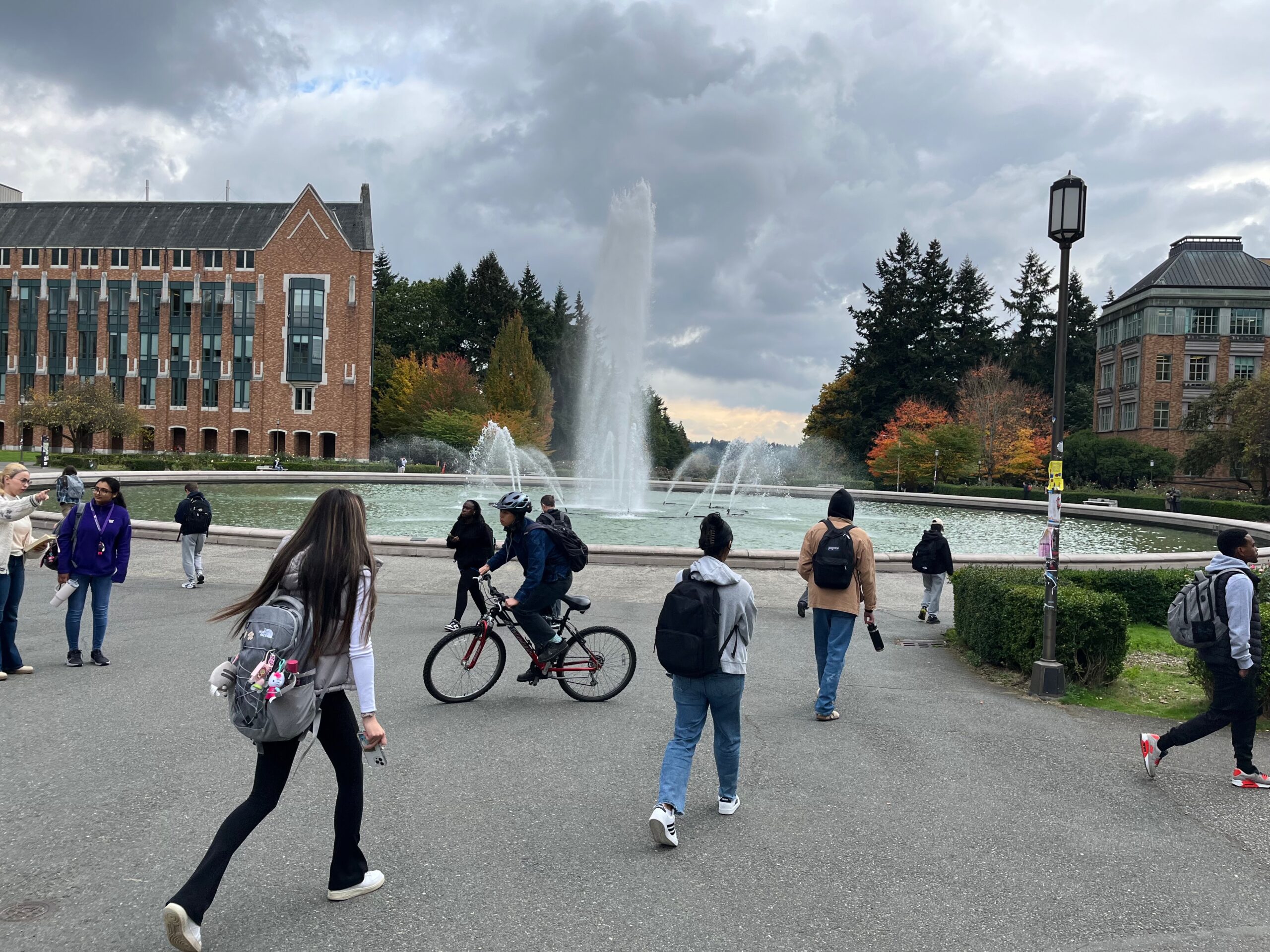
This is the theory behind Be REAL, a mindfulness-based cognitive-behavioral coping program developed at the Center for Child and Family Well-being at the University of Washington (UW). The Be REAL Program (REsilient Attitudes & Living), is a six-week course that teaches students and staff a variety of skills that help improve well-being, starting with the acknowledgement that struggling is part of living.

While it partnered with the UW counseling center during the initial study, Be REAL is not a clinical solution. Rather, it is a population-based, preventative strategy aimed at helping all students thrive. 

“I think we are seeing a strong need to go from an individual approach to supporting mental health and well-being to a collective and a community approach,” said Sara McDermott, who leads the Be REAL training at the research center. “This is really important because our well-being is not related to one thing.  It’s related to our relationships, our stress levels, our politics, the food we have on the table, if we feel safe.”

The design of the Be REAL program is as sensible as its name. Typically, groups of students convene once a week for 90 minutes to learn mindfulness, stress management and cognitive behavioral skills that help with focus and executive functioning as well as self-compassion and compassion to others. In a combination of activities that build on themselves, the program is aimed at increasing students’ resilience by strengthening key protective factors, such as effective coping, perceptions of stress, and self-kindness, all of which can be in low supply among high performing students in demanding academic environments.

Originally launched as a study with a cohort of students living in residential halls at UW, the course is now available in a variety of settings. The flexibility built into the program is designed to meet students where they are, literally – whether it be dorms, classrooms or academic advising sessions.  As a general studies course, Be REAL can be a credit-bearing class for psychology students, or a mid-year elective for students needing to pick up one credit. (The Be REAL promotional video is featured on UW’s academic department web sites.) As a co-curricular program, it can be offered as a student support option for staff in residential life, advising, disability services, or any student-facing group.

“We are training folks in this work that already have relationships with students so we are supporting them in a way that is coming from the community,” said McDermott.  “That speaks volumes about how we can offer a collective approach to well-being.”

This “task-sharing model” does not require clinical skills but instead involves training people who work with students to facilitate groups, or to incorporate practices from the program into their work. Staff take the course themselves as part of their training to deliver the program in an effort to relate to and interpret what the students are experiencing which McDermott says is a benefit to both parties. “It’s really empowering to be able to say to students ‘Yeah, I tried that practice, and I found it really hard to do when you’re feeling a lot of different things.’”

McDermott says the program can also offer an opportunity for students to break out of the prescriptive patterns their majors demand. The self-compassion dynamic, and the sense of shared humanity, offers a different kind of learning experience. In an evaluation of the program, one student wrote, “the course created a space within academia where I felt seen and heard.”

99% of the students agreed that the program helped them learn ways for reducing stress.  

One of the program’s unique advantages is its position within a major university research center. Since its launch, the Be REAL program has been studied by researchers at UW’s Center for Child and Family Well-being and funded by patrons such as the Maritz Family Foundation and Brad and Judy Chase.  The  third study included 325 undergraduate students and 100 staff members at UW.  The published results noted, “Compared to students in the assessment-only group, students participating in Be REAL showed significant improvements in mindfulness, self-compassion, flourishing, resilience, happiness, emotion regulation problems, executive control, active coping, social connection, and depression and anxiety symptoms. These effects were maintained at follow-up.” 

In 2017 and 2018, the program conducted an evaluation in the UW residential halls and found that compared to students who had not yet received the program  students who participated in Be REAL reported improved well-being measures, including mindfulness, executive control, active coping, self-compassion, social connectedness, resilience and flourishing.  A majority of these changes were maintained at a three-month follow-up. 99% of the students agreed that the program helped them learn ways for reducing stress.  These and subsequent studies recommend the task-sharing model as an opportunity to include the entire campus community in the work of improving student and staff well-being.

McDermott says the proven efficacy of the program is both personally and practically rewarding.  With evidence comes additional funding and with funding, the program can expand.  Be REAL is now being offered in other colleges in addition to UW as well as with high-school-age teens. 

To learn more about the Be REAL program, including training opportunities to bring this program to your campus, contact, Sara McDermott, Be REAL Program Manager at saramcd@uw.edu

Growing Pains Through Time

Alexis Redding’s career has many interconnections. She was a college counselor who became a developmental psychologist to better understand why her students were struggling, despite their good choices. She now teaches her students at the Harvard Graduate School of Education about the kinds of emotional supports first year college students need but don’t often articulate. As the faculty chair of the school’s Mental Health in Higher Education Professional Education Program, she brings her training as a counselor to the necessary task of addressing student mental health from a variety of touch points.

In her recent book “The End of Adolescence: The Lost Art of Delaying Adulthood,” Redding continues to demonstrate the interconnectedness of life. With co-author Nancy Hill, she makes a strong case for giving young people the time and the license to become authentic authors of their own lives, as opposed to being “fast-tracked” into adulthood. Through a uniquely effective research method, the authors are able to reject the narrative that today’s students are over-protected and under-prepared by showing that becoming an adult has always been emotionally difficult. In addition to evidence within the literature, Redding and Hill review abandoned tapes of interviews with the Harvard and Radcliffe Class of 1975 and conclude that there are far more similarities than differences between that cohort and today’s Gen Z students.

Now, Redding and Hill are working on an extension of that research that involves reconnecting with the class of 1975 and interviewing Harvard classes of 2025 and 2026. The work is not yet complete but in our interview for LearningWell, we get a glimpse into what they are continuing to learn about the important developmental period known as “the college years.”

Here is an excerpt from our interview.

How did your experience as a college counselor and then a graduate school professor motivate you to write the book?

From my vantage point as a college counselor, I became concerned about how much our students were struggling emotionally in college, especially during  the transition to school. And, while the struggles they experienced were quite similar to each other, no one seemed to be talking about them. Consequently, our students described feeling very alone and even worried they were doing something wrong. Once I saw this pattern, I knew that I could better prepare my high school students in advance, but I worried that we were missing opportunities to ease the transition and normalize these challenges for all students once they arrived at school. I wanted to do work to help ease the transition more broadly.

It all starts with how we talk about college. The story young people hear, far too often, is about college being the ‘best four years’ of their lives. The gap between what they expect and the reality can be profound. We don’t talk enough about what is going to be hard or help them develop strategies for navigating these predictable obstacles. And we do them a disservice by not being candid about the challenges they will encounter. Today, I train future student affairs practitioners to help build meaningful support structures and foster the kinds of conversations that I wish my own students had found at college so many years ago.

One motivation for writing our book was to help normalize these challenges for students, for their parents, for faculty members, and for student affairs practitioners as well. We want to empower students and everyone who cares about them to understand what it’s really going to be like and to give them the language to talk about it openly. It’s great to see how this simple change can have such a profound impact.

The way you do that is amazing – revealing what college students of almost five decades ago were feeling from interviews done on the class of 1975. Did you and your co-principal investigator go looking for this kind of information?

Not at all! I discovered that these interviews existed when I was doing research on achievement culture in an old attic building here at Harvard. I came across some misplaced pieces of paper that suggested a study had been done about the college experience in the 1970s that no one ever wrote about. I wanted to know more. (My father was an archeologist, and he trained this sort of curiosity in me.) It took about nine months to figure out where these data had come from, and then to track down the recordings of the interviews. Nobody thought they still existed. But, after many months of calling up box after box from archival storage and going through the attic and the basement to find all the data, I put the entire study back together again and even found the original recordings. We had incredible sound technicians lift the student voices off these degrading old reel-to-reel tapes and we eventually listened to these student interviews from 1972-1975 on our iPhones.

Were you surprised at what you discovered?

Nancy and I went in thinking we would study what was different between college in the 1970s and college today. We thought it would be an incredible time capsule to document what had changed over nearly half a century. It was startling when we began to listen to the recordings because there was so little actual difference. Both of us were struck by how similar those students were to the students who we advise and teach today. It was an interesting puzzle for us. I even coded the data three different times using three different analytic techniques because we were looking for differences. But what we kept coming back to was similarity. And eventually, we realized, that was a powerful conclusion that really contradicted a lot of our popular narratives about “kids today.”

Remarkably, in all the archival work, I ultimately found the documents that told us why the original research team abandoned the study. We had assumed it was because Dr. William Perry, who led the original study, had retired. But then we found minutes from the meeting where they made the decision. It turns out that the motivation for the project was to replicate a study they conducted in the 1950s because they had also assumed they would find that “kids today” were so different 25 years later. What they determined through their analysis was that there was essentially no difference in the developmental experience between those two cohorts. For them, this was a failure. Of course, that was the exact conclusion we had already come to through our analysis decades later, but we had a different take. We were excited to understand why there were such meaningful similarities and to unpack that in our research.

Recognizing the parallels around loneliness and isolation across generations can help us better understand what is ‘typical’ and what is a genuine ‘crisis.’ 

Whenever we present this work, people inevitably ask, “but what about social media? What about covid?” And, of course, we asked those questions too. It would be silly to imagine those realities don’t impact our lived experiences. Of course they do! But what stays the same is the developmental experience, the process of figuring out who you are and asking the big questions: “Who am I? Who do I want to be? What do I want my life to look like?” That experience is not tied to a specific decade or a specific moment in time, despite how much has changed between the generations.

What implications do you think this has for addressing some of the emotional and behavioral health struggles college students report today?

For me, it’s most important to recognize that college has always been hard for a lot of people and that these challenges are predictable and follow some established patterns. One of the things we documented in our research was the profound sense of loneliness that was reported, especially in the first two years. And students talk about those challenges in similar ways between the 1975 and the 2025 cohorts. Recognizing the parallels around loneliness and isolation across generations can help us better understand what is ‘typical’ and what is a genuine ‘crisis.’ As soon as a student calls home to say they’re having trouble or questioning if they fit in at school, family members can immediately – and understandably – panic. But if we understand that this is an expected challenge and that this is indeed typical of the student experience, we can have very different conversations before that call happens and we can respond in ways that can be more helpful in the moment as well.

A strong theme in the book is our needing to give students time to pause the fast tracks of their lives and discover who they are. How did your research influence this conclusion?

One of the biggest similarities across the two cohorts is the intense pressure young people feel to have it all figured out on day one. Students in both generations also struggle to navigate differences between what they envision for the future and what their parents expect, what their friends are doing, and what society says. It can be hard to take action when their goals diverge from those external stories. Trusting their internal voice is growth edge for students in this age group and something we can scaffold.

We tend to push students to make decisions about their future before they are ready. And our students get very mixed messages from us, especially when they’re coming into a place with a liberal arts curriculum. They are told: “it’s time to explore, it’s time to test out different ways of knowing and learning.” But we simultaneously say, “Be careful! If you don’t take this course now, the door will close. You won’t stay on track and you will miss out.” If we believe that students need more time for exploration, our curriculum genuinely needs to allow for that.

This story now continues. Tell us about your current work?

We are still fascinated by the similarities across the generations, but we are seeking to identify meaningful differences and continue to test our hypotheses as well. With that in mind, we are replicating the study with the classes of 2025 and 2026. We are using the exact same protocol, interviewing students annually an asking just one single question, “what stood out to you from the academic year?” We are three years into that work now. As in the original study, we are only following Harvard students so we have a one-to-one comparison, but the hope is, of course, to be able to expand and study at very different institutions that are more representative of college students as a whole. This is really just the first step.

The other exciting follow up is that we were granted permission to reopen the original study, and so we’ve spent the last two years interviewing the original participants from the Class of 1975. It is such a gift to get to do this work. The last time we heard from these participants was in June of 1975 when they were 22 or 23 years old, graduating and making decisions about going to grad school or the workforce. Now we meet them in their early seventies and they are at another pivot point – retirement. And few of them thought about this study at all in the 45 years in between. So, we can capture their stories in two very distinctive and pivotal moments in their lives.

The students who found their way to mentors had the help they needed to ask meaningful questions — What do I really want to do?

We first ask these participants to tell us the story of their life as they would tell it today. Then we ask them if they want to listen to their recordings and meet their younger selves. It’s a fascinating time capsule of their lives from about 19-23 years old. They write reflections after each of the four recordings, and then they come back and participate in an interview to make meaning of both what they heard and how it’s different and similar from their recollections.

What are you learning?

It’s too early to share anything beyond top line takeaways, (we’re just now wrapping up the interviews), but one of the important things that we are hearing has to do with how they remember their time in college. None of them remember college being as hard as what they hear themselves talking about on the recordings. That’s simply not the story that they have told themselves for almost half a century. They forgot how lonely they felt. And that’s totally natural – knowing that things turned out ok softened the intensity of the emotions that they felt in the moment.

The other thing that has emerged from this work, and something Nancy and I care deeply about: a confirmation of the importance of mentorship. The students who found their way to mentors had the help they needed to ask meaningful questions — What do I really want to do? How do I translate my interests into a vocation? Having followed up with these students 50 years later, we were able to see how much even the smallest mentoring interaction mattered to their lives.

Unfortunately, too many students – in both generations – don’t have meaningful mentoring experiences. In the absence of genuine mentorship, it is too easy to land on a default path. Colleges and universities can be more intentional about creating opportunities for students to have a range of mentoring experience – not just the big, long-term relationships we tend to prioritize now. The small-scale mentorship interactions matter a lot – even 50 years later!

Influencers for Life

Maggie Messina graduated from the Cox School of Business at Southern Methodist University (SMU) in 2022. She works in Private Client Business Development at Cambridge Associates in Boston. Here is her response to the question: “What experience or person in college most influenced your development as a human being?”

College is a formative experience for all. It’s a time when you leave the safety of your hometown, the friends you’ve known forever, and all that is familiar to you. Amidst the unfamiliar faces and places, you begin to search for belonging. For me, during my first two years of college, an unexpected yet incredibly meaningful place of connection was the dining hall. 

At the heart of my dining hall experience was Derek, the welcoming presence at the swipe station. Derek wasn’t just the person who checked my student ID as I walked in—he became a constant source of positivity and encouragement during my transition to college life. As a freshman finding my footing, Derek always greeted me with an enthusiastic high five and hello. During the whirlwind of sorority rush week, he congratulated me when I got into my top-choice sorority, Tri Delta, even throwing his hands into a triangle to represent it everytime I walked through the doors wearing all my new merch. 

Derek wasn’t just the person who checked my student ID —he became a constant source of positivity and encouragement during my transition to college life. 

But it wasn’t just the celebratory moments that made Derek special—it was the way he showed up for me during the tough times. When I felt homesick or defeated by a bad grade, Derek was there with encouraging words and a hug that always made the day seem a little brighter. 

What I learned most from Derek is that kindness matters. Small gestures—like smiling and waving at someone as they pass, holding the door open for a stranger, or offering a pencil to your classmate when they forget—can have a ripple effect far beyond what we can see. Today, as a young professional, I strive to embody that same sense of kindness. It’s one of my current firm’s values, and I take pride in representing it every day. 

A Constellation of Support

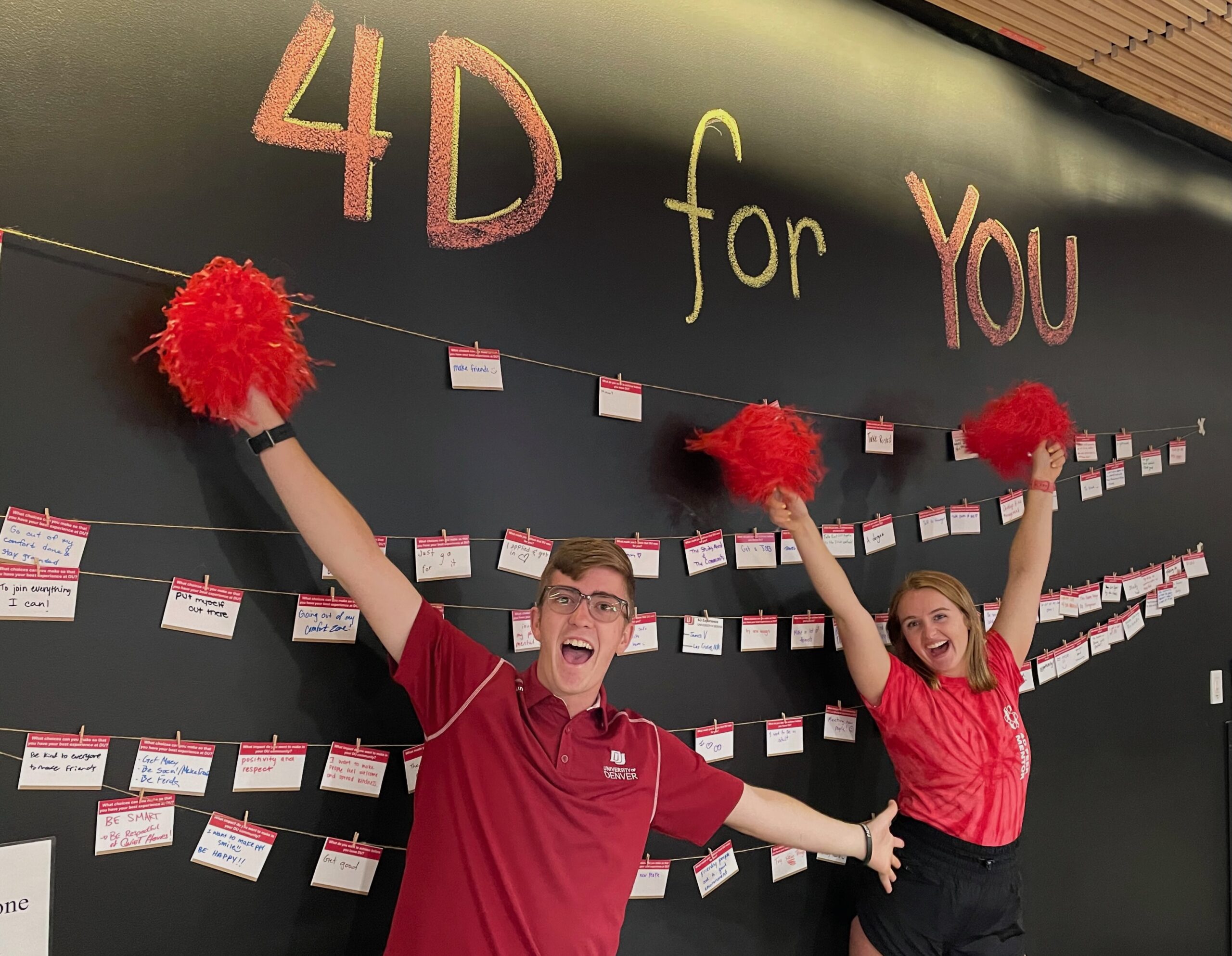
When University of Denver (DU) was named Princeton Review’s #1 “school most loved by its students” this year, junior Libby Williamson was not surprised. She’d arrived as a freshman in 2021, when the school had recently added a student-centered learning pilot called the 4D Experience.  One of the hallmarks of 4D is the peer mentor program, and that mentorship was one of the things that had made the campus feel so accessible and supportive during her first year. Today, that program is central to her own identification as a peer mentor and leader, and to her personal and professional development.

“I think 4D and its emphasis on mentorship is so valuable to the student experience,” says Williamson, a communications major. “It’s this holistic approach to a college education that focuses on more than just academics, prioritizing my growth as an individual and as a confident, well-rounded professional by the time I graduate.”

The pilot of the 4D Experience launched in fall 2020 as an educational philosophy of living and learning, both inside and outside the classroom, based on four dimensions of development. But to understand 4D, and its goals that are simultaneously lofty and practical, it helps to understand the social context. The University of Denver, like many other institutions, was facing the pressures of higher education in flux.

A Turning Point

When DU was designing its strategic future vision in 2016, the message was steeped in positivity: to affirm its strengths and engagement and expand upon them. But it was no small coincidence that the motivation to reconceive the school’s vision was coming at a time of larger challenges, and change.

The chancellor at the time, Rebecca Chopp, believed the university was ready for a turning point, an opportunity to evolve with a new vision within the larger storm brewing in higher education over a host of issues from cost and value to free speech.  In 2014, the school’s Strategic Issues Panel published a report titled “Unsettling Times: Higher Education in an Era of Change.” It cited a growing list of perceived shortcomings in American higher education, from the rapidly rising cost of tuition to the alleged failure to provide a meaningful—or practical—education for students. “The report is intended to appropriately define the urgency of the moment,” states the opening letter from the panel’s leaders, “and also to stimulate the collective creativity of the academic community.”

The resulting strategic vision, DU Impact 2025, offered broad strokes for a rollout in a range of transformative directions. But it was the next chancellor—after Chopp’s tenure was cut short by illness—who nurtured the innovative shape this transformation would take.

In 2021, Chancellor Jeremy Haefner described the 4D vision this way: “DU is rebooting the student experience by retaining the engagement students yearn for while being intentional about the skills they need to build lives of purpose.”

Through a holistic approach to learning and personal development, the 4D Experience identifies four interconnected dimensions for student evolution: intellectual growth, purpose-driven careers, well-being, and character exploration.

Laura Perille, Executive Director of the 4D Experience, collaborated with campus partners to create a taxonomy and build out what these dimensions would mean. “What are the habits of thinking and doing associated with each of these dimensions to help people understand how they were already mapping to this work in their pedagogy and practice, but then also initiate conversations around, how can we further advance this work?” she says.

The program challenges conventional achievement-based educational models by prioritizing reflection, mentorship, and practical application alongside academic prowess—noteworthy, for a R1-ranked doctoral institution. Through its innovative framework, DU nurtures graduates to emerge equipped not only for professional success but for meaningful and fulfilling lives. With an intentional, co-curricular environment, the 4D Experience guides students to connect the dots of passion and purpose, building their educational pathways alongside mentors. Those mentors, advisors, and peers become a new student’s “constellation of support,” based on their unique interests, needs, and goals.

“Why a holistic, 4D experience? Because we want our students to have lives of purpose and careers of fulfillment, and we want them to be servants of the public good,” wrote Chancellor Haefner in his Spring 2021 message. “But the world is complicated. Climate change, increasing wealth inequity and injustice are pervasive challenges. Students need more than just a great intellectual and academic journey; they also need experiences from which they can build comprehensive life skills. This is what the 4D experience aspires to deliver.”

1. Advancing Intellectual Growth

At the heart of the 4D Experience is the belief that intellectual growth is more than a measure of academic performance. It is about fostering curiosity, critical thinking, and interdisciplinary connections that prepare students to navigate complex global challenges.

DU’s First-Year Seminar (FSEM) program was an existing program and opportune environment to introduce 4D, and this dimension. These small, topic-focused seminars are designed to ease new students’ transition into college-level learning while encouraging them to think deeply about their goals and values. Heather Martin, a Writing Program instructor and FSEM faculty member, has reimagined her course to align with the new 4D framework. This approach encourages students to connect their academic pursuits with broader life questions with intention from day one.

“My seminar focuses on transitions, both personal and academic. We use texts like Bruce Feiler’s Life Is in the Transitions and Stanford’s Designing Your Life to think about how we experience transitions,” Martin explained. “What are ways we can reflect and process our transitions and be intentional going forward? It’s a real complement to how we welcome students into the DU community. And it also sets up the conversations that will be incorporated in the course content in different ways throughout the campus.”  

One of the tools DU employs to enhance intellectual growth is the e-portfolio system. Students create digital portfolios that document their learning, track their progress across disciplines, and showcase their academic achievements. They can be shared with faculty for assessments and provide a platform to display their skills to an external audience, such as a job interviewer. The portfolios encourage students to see their education as a whole rather than a collection of disconnected courses. “It’s integrated learning framed around the four dimensional experience as buckets to integrate learning,” says Martin. “It’s really exciting to see them thinking with more intentionality about their college experience.”

The program challenges conventional achievement-based educational models by prioritizing reflection, mentorship, and practical application alongside academic prowess.

Beyond the classroom, DU offers a range of high-impact practices designed to deepen intellectual engagement. Internships, research opportunities, and study abroad programs enable students to apply their learning in real-world contexts. “Across the arc of educational experiences, we look at the kinds of moments that may already be pre-existing, where we can build out additional touch points that are engaging students in conversations about practical applications of their studies,” says Perille.

DU’s commitment to intellectual growth extends to its faculty as well. Professional development workshops provide instructors with tools to incorporate reflective practices and interdisciplinary learning into their teaching, and Infusion Grants support faculty and staff with seed funding for projects that enhance the 4D Experience of DU undergraduate or graduate students. “It seemed disingenuous to talk about student thriving without recognizing that faculty and staff are responsible for delivering these kinds of high impact experiences,” says Perille.

2. Pursuing Careers and Lives of Purpose

The second pillar of the 4D Experience prepares students for purposeful and fulfilling careers. By aligning academic learning with professional aspirations, DU ensures that graduates are equipped to navigate the complexities of the modern workforce. But first, it helps students reflect on their interests and values, guiding them to choose majors and career paths that align with their passions.

The Major + Career Exploration Lab, for example, is a quarterly session open to all students to help them discover strategies for matching their interests and values to potential careers, then determining the major that will best set them on that path. Are you unsure what you want to major in? asks the signup page for the event. Have you declared a major but want to confirm that it’s truly for you?

“We encourage students to think about their ‘why’—what motivates them and how they want to contribute to the world. What are the issues that animate you? What do you find yourself drawn to engage in?” Perille says. “We’re getting them to actually think about their ‘why’ as the driving force of thinking about potential careers and majors.”

When Williamson thought about what drew her engagement on campus, she targeted her experiences as a peer mentor and student coordinator. Those roles have given her valuable skills that have fueled her thinking about careers, including possibly working in higher education. “These roles have taught me leadership, organization, and problem-solving—all of which are transferable to the professional world, whatever I end up choosing to do,” she said.

DU also integrates purpose-driven learning into student employment. Through the 4D Reflective Supervision Model, supervisors help student employees connect their campus work to their broader educational and career goals. This intentional approach ensures that even part-time jobs become meaningful learning experiences. Internships, co-op programs, and community engagement opportunities further enhance students’ career readiness. These experiences provide hands-on learning while helping students build networks and explore potential career paths.

This emphasis on purpose-driven careers aligns with broader trends in education and employment, where adaptability, creativity, and emotional intelligence are increasingly valued. It also serves as DU’s answer to contemporary critics of American higher education by creating a more direct link and intentional link between areas of interest, areas of experience, choice of major, and applications of all three in the workforce.

3 Promoting Well-Being

The 4D Experience prioritizes a culture of compassion, making mental, physical, and emotional health essential components of student development alongside academic and professional success. DU built in access to resources students need to thrive, from counseling services and wellness workshops to programs in meditation, fitness, and stress management.

Faculty members like Martin also address well-being in their classrooms. “We talk openly about thriving—what it looks like, how to achieve it, and how to sustain it,” she said. By normalizing these conversations, DU reduces the stigma around mental health and fosters a supportive campus culture—and makes it less surprising when 4D topics arise in core classes. “I think sometimes it can be challenging for students who are high achieving, and they’re accustomed to a certain model of learning that they’re really good at,” she says. “I’m pushing them to think a little bit outside of that previous experience.”

In addition to being a source of academic support, peer mentors are trained to be personal and professional sources of support, and to recognize signs of stress or burnout. On the national level, peer mentorship has been linked to positively impacting student outcomes and addressing systemic barriers to success, and programs are on the rise. Just last month, the Association of Public and Land-Grant Universities (APLU) launched a mentorship initiative, designed to support APLU member universities in developing and implementing sustainable peer mentorship models using technology-enabled solutions.

The university has also developed initiatives to support faculty and staff, recognizing that their well-being is essential to creating a thriving campus community. Workshops on topics such as compassion, collaboration, and stress management provide employees with tools to care for themselves and others.

4 Exploring Character

Character exploration is a vital dimension of the 4D Experience, encouraging students to reflect on their values, develop resilience, and cultivate a sense of purpose while navigating the complexities of modern life with integrity.

DU’s Kennedy Mountain Campus is a unique asset in the university’s toolbox that provides students a place to go—up into the woods—for targeted learning and personal character development outside the classroom. The 724-acre property, a gift from a donor, had previously been the largest Girl Scout camp in Colorado. Now part of DU’s facilities, the Kennedy Mountain Campus is home to the First Ascent Program, an immersive weekend retreat for first-year students that challenges them to step outside their comfort zones and reflect on what matters most to them. The Mountain Campus bordering Roosevelt National Forest offers opportunities for hiking, mindfulness, and community-building, encouraging students to recharge and reflect, strengthening their overall resilience, and connecting with their peers on a deeper level.

In academic settings, character exploration is woven into courses like Martin’s FSEM seminar, which includes reflective writing assignments on topics such as personal values and life philosophy. “The 4D framework makes it easier to bring these discussions into the classroom,” Martin said. “It helps students see the connections between their academic learning and their personal growth.”

Character development is also a dimension that grows out of the mentorship program. Libby Williamson, a junior and peer mentor, was so inspired by her experience, and having absorbed the character modeling by her mentor, that she applied to become a mentor herself, and eventually rose to the role of student coordinator. Mentoring peers, she explains, requires a unique set of skills. “It’s not just about giving advice—it’s about building trust and having meaningful conversations. You’re helping someone discover their own solutions rather than handing them answers.” The mentorship program also provides a space for students to develop leadership, with training in communication, conflict resolution, and emotional intelligence, all of which contribute to their personal and professional growth. For Williamson, these experiences have been transformative: “Mentoring has taught me so much about empathy, patience, and the importance of listening.”

Thinking Today about the Student of the Future

When Perille and others worked to build out the 4D Experience from its pilot stage, they wanted to make sure it reached across all sectors of the campus, and that it be more than a program—something more ingrained, as a shared philosophy.

“We were always thinking, how do we do this at scale in a way that doesn’t exist just in one program, but becomes part of the ethos of the institution? How are we advancing culture change in this vein of holistic student learning and development?” she recalls.

One goal is to generate widespread buy-in, creating a shared language. That would indicate more than a collection of people participating in a program; it would be a community creating a prototype for the student of the future. 

Ultimately, I would say my role is more than curriculum, or education,” says Perille. “It’s one of change management.”

Influencers for Life

In a new series for LearningWell, we ask a variety of college graduates, of different backgrounds, ages, and professions, “What experience or person in college most influenced your development as a human being?”  Our aim is to share stories that show the different influences that shape people’s lives during their education and as they navigate the process of becoming adults.  In doing so, we hope to gain insight and guidance, whether it’s identifying common themes or abandoning long-held beliefs.  

We hope that you, as readers, ask yourselves the same question.  For me, it was an invitation from a fellow student to join a group traveling to New York City to attend a meeting of what is now called the Young Democrats of America. I was a freshly minted political science major immersed in the required curriculum when I found myself off campus with peers who were discussing the direction of the country during the Reagan era. When the conversation turned to me, I spoke up, despite my shyness and the fact that my knowledge on the subject was largely limited to political theory. But something about that experience made me think  “I am someone who is politically active.”  It remains part of who I am today.

We start our series with Richard Miller, President Emeritus of Olin College of Engineering and the founding director of the Coalition for Transformational Education. Miller has dedicated his career to strengthening and expanding higher education’s influence on personal formation and is fond of saying  “A good education changes what you know.  A great education changes who you are.”

Richard Miller and Mel Ramey

LW: “What experience or person in college most influenced your development as a human being?” 

There are several people throughout my education that shaped who I am as a person, but the most relevant is Professor Melvin R. Ramey of the University of California at Davis, where I obtained my Bachelor’s degree in 1971. Mel and I arrived at UC Davis at the same time, in the fall of 1967. He had just finished his Ph.D. at Carnegie Mellon and was a new assistant professor of civil engineering, and I was just enrolling in college, having graduated from Tranquillity Union High School in June of that year. I was assigned to Mel Ramey as my faculty advisor, and I was in his first cohort of student advisees.

Mel was the second  African American faculty member at UCD. While this had some relevance to his personal faculty responsibilities, this had very little effect on me. What was much more significant was the fact that Mel had been a nationally competitive athlete at Penn State in two sports (basketball and track and field), was simultaneously an athletic coach and faculty representative to the NCAA at UCD. Mel coached track and field and several of his mentees won national medals for their performance. While this might seem irrelevant, it is central to his impact on my life and career.

He changed my life and contributed to my lifelong commitment to student wellbeing.

I grew up on a farm with almost no one in my extended family on either side who went to college. Our rural high school did not even offer calculus (and only occasionally offered a weak course in physics) which are both the prerequisites for engineering. About half of our student population at TUHS were migrant farm laborers. While I graduated #2 in my class and got into UCD, Mel knew I was not prepared.  He did, however, see potential in me and drove me to take the most challenging classes which eventually prepared me for a fellowship to MIT for my Master’s degree. I would never have made this journey without his inspiration.

Mel understood that to be an effective teacher you need the same mindset and motivations as a coach. To him, these were essentially identical. A coach takes responsibility for inspiring and mentoring each athlete in his care to achieve their full potential. This can at times involve invasive questions, pushing you when appropriate, and supporting you when appropriate, and never letting you give up. He certainly did this for me and was such an important part of my life that although I changed majors 5 times as an undergraduate (and I did not graduate in civil engineering) I retained Mel Ramey as my undergraduate advisor. My respect for Mel was such that I would rather die than disappoint him.

Mel’s interest in me was authentic and permanent. His values and his example were widely recognized among many students at UCD. His example inspired me to want to pursue a Ph.D. and become a faculty member. I learned so many important life lessons from Mel. For example, every time you walk into a classroom and pick up a piece of chalk, you are not just teaching engineering principles; you are also shaping the attitudes, behavior and beliefs of the students in your class. Later, I learned many other UCD students and athletes were similarly inspired by Mel. One of his former students was a 3-time Olympic medalist in long jump. At a public ceremony in Mel’s honor, he credited Mel with always filling him with joy and wisdom and helping him become all that he is today. While he never shared with me the personal hardships he may have faced due to his race (our conversations were never about him), his life inspired optimism, hard work, and resilience. He changed my life and contributed to my lifelong commitment to student wellbeing .

We became good friends. He visited me in Iowa, after I became Dean of Engineering there, and played ping pong in the basement with our daughters.  I Invited him to be a member of the President’s Council when I was at Olin and we taught a course together in structural analysis and design when he took a sabbatical to Olin about a decade ago.

Mel’s family also remained close. His wife, Felicenne, who recently passed away, was Dean of the Business School at Sacramento State University, and his daughter, Daina Ramey Berry, has become Dean of Humanities and Fine Arts at UC Santa Barbara, where I began my career on the faculty in 1975. She has sought my mentorship from time to time as a form of “full circle” payback and a way for me to honor her father’s contributions to my life.  Mel passed away from brain cancer a few years ago. This memorial/obituary posted on the UC Davis website, available here is a fitting tribute to a remarkable person whose life greatly impacted my own.

Learning from President Cauce

Ana Mari Cauce has been president of the University of Washington for nine years. During that period, she has steered the public research university through rising rates of mental health issues among college students, a global pandemic, student protests over war and injustice, and declining public faith in higher education. But while these challenges have made many higher education leaders justifiably reticent, Cauce remains forthcoming and remarkably clear.  

In an interview in her office on the Seattle campus, Cauce considers a host of questions within a context drawn from research as well as her own experiences in life. She weaves stories about her family, her early career, and her own education through serious topics like free speech, DEI and careerism in higher education. In doing so, she demonstrates the important skill of learning one’s truth, which has earned her a reputation for being the real deal.

Cauce believes guaranteeing free tuition relieves a psychological barrier for students and families who are fearful of “sticker shock” and the debt students incur as a result. In addition to free tuition, most Husky Promise students receive additional aid to cover cost of attendance, including housing, transportation, and books. However, none are offered aid to cover the full cost of all expenses and are responsible for some costs, although they can be covered through jobs, which can be provided on campus. Cauce says it helps with retention because students have skin in the game and is an important message for taxpayers who support the school.

Low-income students also have a host of supports at UW from basic needs to academic advising. Cauce is adamant that getting in is not enough. “We are serving a class of students that weren’t making it to the university, and they need more help,” she said. The support is paying off. When asked what she is most proud of at UW, Cauce mentions closing the graduation gap. There is very little difference between the school’s Pell-eligible and non-Pell-eligible 6-year graduation rate.

Struggling to pay for college is something Cauce has personal experience with growing up in a college-going home with financial challenges.  Her father was the minister of education in Cuba before the family fled to Florida in the 1960s where he then got a job in a factory. Cauce lived at home and worked while on scholarship at the University of Miami.  Her brother started out in community college and eventually earned a full scholarship to Duke only after a mentor recognized his talent and helped him apply for aid.

“There was no question that we were going to college,” she said. “The real question was how were we going to pay for it. My parents didn’t understand the system.  School was free in Cuba.”

When she graduated from university, Cauce intended to take on the world as an investigative journalist a la Woodward and Bernstein but changed course when a good paying research job emerged in a lab.  Her love of research and human development led her to a career in clinical psychology and a PhD from Yale.

But Cauce says her experience as a minority student in an elite institution left her with “zero self-esteem,” and no doubt contributed to her passion for inclusion.

“I say to students all the time, the world is not small and private. It is big and public,” she said.

Indeed, Cauce’s down-to-earth style is refreshing for someone working in a sector increasingly viewed as out of touch with everyday people. While she defends the support students of marginalized identities receive through DEI programs– “That’s what those offices are there for.  This work must be done” — she is less concerned about how they are organized. She also sees the need to view diversity more broadly.  “I’m not sure higher ed has done a good enough job at that,” she said.

As a clinical psychologist, Cauce addressed the rising rates of mental health issues among students early on in her presidency with increased clinical supports. But in discussing mental health, she also emphasizes the need for coping skills. 

“Nine out of ten times what messes you up is not the problem itself, it is the way you cope with it,” she said.

I say to students all the time, the world is not small and private. It is big and public.

The university has a Resilience Lab which promotes wellbeing through research, education and strategic programs and initiatives. It includes a six-week program which equips participants with cognitive skills to manage stressful emotions and situations, and mindfulness skills to strengthen self-awareness and empathy.

Asked how to create a sense of belonging in a school so large, Cauce says there are myriad ways for students to “find their people” and believes navigating large environments like a public university teaches important life skills.  “I wonder if we don’t do our students a disservice with too much handholding,” she said. 

Cauce is predictably pragmatic on the debate about the value and purpose of college.  “We do have to justify what we’re doing and why it makes a difference if we’re getting public money, and all of us do,” she said. 

As to the question of whether you go to college to get a job or to grow as a person, Cauce said, “I think this idea that it’s careerism versus knowledge for life is a false dichotomy. It’s really important not to be narrow-based in our teaching because we need to be giving people an education where they are life-long learners and informed citizens.  But there is nothing wrong with the fact that our students want jobs. As DuBois said, ‘It’s not just about making a living, it’s about making a life. But if you can’t make a living, you can’t make a life.’”

Ana Mari Cauce will retire from UW in June of 2025.

The Flourishing University

What if higher education made student wellbeing a goal on par with graduation rates and GPA’s? That is the organizing vision behind the Flourishing Academic Network (FAN), a group of centers, institutes, and universities across the United States and Canada dedicated to embedding flourishing throughout higher education for the benefit of students, communities and society.

The idea to gather like-minded institutions into a flourishing collaborative grew from the pioneering efforts of four big thinkers at three separate universities. David Germano, a religious historian at the University of Virginia and former Director of the school’s Contemplative Sciences Center, was determined to connect the work he was doing in mindfulness and flourishing to the emerging crisis in college student mental health.

Germano was joined in this purpose by colleagues Richard Davidson, William James and Vilas Professor of Psychology and Psychiatry and Director of the Center for Healthy Minds at the University of Wisconsin; Mark Greenberg, former Director of the Prevention Research Center at Pennsylvania State University; and Rob Roeser, the Bennett Pierce Professor of Caring and Compassion at Penn State. The scholars came from different disciplines but shared a common belief that embedding flourishing concepts into the college experience was both a pragmatic approach to addressing mental health issues among students and a moral imperative for higher education.

A major contribution of the alliance was the creation of “The Art and Science of Human Flourishing,” an interdisciplinary course they created that helps students develop skills and perspectives that support individual and collective flourishing, defined as “living a fulfilling life of meaning, purpose and a sense of belonging.” 

The course was launched in 2017 at all three universities. With consistent outcome data showing significant improvement in mental health symptoms among participants, the collaborators soon formed what they called “The Flourishing Academic Network” to welcome more colleges and universities into the learning community. But like so many initiatives thrown off course by the pandemic, the 2020 national conference of interested universities was delayed until 2022. The changes within FAN schools that occurred during that gap brought starts and stops to the new network but the desire to work collaboratively to apply the science of flourishing to the lives of college students remained strong among the group.

While still nascent, the Flourishing Academic Network is now finding its footing with plans for in-person convenings and ongoing collaboration among 20 or so members.  Some believe the current vulnerabilities within the sector may be an opening to include student flourishing as a primary goal of higher education, though not without disruption.

The FAN charter underlying the organization’s mission states, “We believe centering student wellbeing and flourishing, bridging the gap between student affairs and academics, and changing how higher education systems operate and are designed can establish new pathways for flourishing.”

The following is the first in a series of features on FAN member institutions.

The Renée Crown Wellness Institute:

The administrative backbone of the FAN is now at the Renée Crown Wellness Institute at the University of Colorado Boulder.  With a mission “to promote the wellness of young people and the systems and adults who support them through interdisciplinary research-practice partnerships,” the Institute is one of 12 research centers within the university.  It was founded in 2019 just months before the onset of the pandemic and while many organizations immediately shut down, the Crown Institute went to work providing resources that were in high demand. In the fall of 2020, undergraduate students within schools at CU Boulder were required to take a course, developed by the Crown Institute and its collaborators, called “Health, Society and Wellness in COVID-19 Times.” 

Designed by faculty members of diverse disciplines working collaboratively with undergraduate students, the course not only supported the CU Boulder community during stressful times, it put on display the methods and mission of a very different kind of university research institute. 

Some believe the current vulnerabilities within the higher ed sector may be an opening to include student flourishing as a primary goal, though not without disruption. 

Dr. Sona Dimidjian is the Director of the Crown Institute, and a professor in the Department of Psychology and Neuroscience at CU Boulder. She has both a PhD in clinical psychology and master’s in social work and worked as a therapist with adolescents for many years. “Our research is really focused on action,” she said. “We are interested in changing systems in classrooms, in healthcare settings, in living rooms and dorm rooms because we want a bigger and faster change in young people’s lives.”

The term the Crown Institute uses to define its work is “interdisciplinary research-practice partnerships.” In this sense, the Crown Institute is less of a lab than it is a workshop where those for whom the research is intended (young people, parents, educators) are involved in solving real world problems. Collaborative design is informed and influenced by the expertise and experiences of community partners who work alongside the university researchers. Its intent is to disseminate and apply that research back into the community and on behalf of the partners who have been engaged.

“We believe that our research products are much more sustainable, meaningful, and equitable when the intended audiences of research are included in the design,” said Dr. Leah Peña Teeters, Outreach and Education Director for the Crown Institute and point person for the FAN at CU Boulder.

The Crown Institute has three research strands: children and young people; families and communities, educators and schools, all of which apply the same approach. Consider “Alma,” a peer-to-peer program for new and expectant mothers who are struggling with anxiety and depression. Moms and their peer mentors meet six to eight times utilizing peer support strategies that are informed by the science of behavioral activation. The Alma team developed the program collaboratively, grounded in Dimidjian’s many years of conducting research on the mental health of parents. In assessing their interventions, Crown Institute researchers have found a significant reduction in anxiety and depression, leading to the program’s expansion in other communities.

The children and young people research strand is at the center of the Institute’s work and its primary connection to the FAN.  Here, active initiatives like The Mindful Campus Program have broad appeal among Gen Z students who, as a cohort, continue to report significant mental health issues. Co-designed with undergraduate students, The Mindful Campus Program aims to increase access to mindfulness and compassion-based practices that have proven to support the mental health and wellness of students.  Other programs include the mind.body. voice. program, which promotes body acceptance, belonging, and leadership while reducing vulnerability to disordered eating among girls and young women in middle, high school, and college. Another program, The CU Well Brainstudy, examines how CU Boulder undergraduates experience wellness and cope with stress.

Each of these initiatives includes the deep participation of young people.  According to the Crown Institute, young people serve as both participants and designers of its work, providing vision and feedback to inform the iterative design of its programs and practices. The Crown Institute directs an Undergraduate Research Fellows Program where Psychology and Neuroscience students begin a three-year research journey at the start of their sophomore year, leading to independent research projects in their senior year.  Students, who are given a stipend to compensate for their time apprenticing and working in research labs, are matched with faculty and work closely with them as mentors.

“We are focused on training the next generation of researchers, scholars, and practitioners with the skill sets that really center wellbeing and flourishing across disciplines,” said Teeters. 

The Crown Institute is less of a lab than it is a workshop where those for whom the research is intended are involved in solving real world problems

Alison Ofori is a third-year integrated physiology major at CU Boulder.  She joined the mind. body.voice. project as a peer facilitator after one of her favorite professors suggested she would be a great addition to the team. As a pre-health student, she had always been interested in doing research but felt like working in a lab or a hospital fell a little flat. 

“When I heard about this opportunity, I was like ‘Yes! this is really different.  I get to work with real people.’”

Orofi is particularly energized by the work she is now doing with high school and middle school girls on external vs internal beliefs. 

“We have the girls come in and engage with our curriculum and we ask specifically tailored questions that help them connect with their mind and then what society may be telling them.  For example, we might ask ‘what do you think the perfect woman is?’  A lot of times they’ll answer first with everything society tells them. And then we’ll reframe the question and ask it based on what they think is suitable for them, not society, and we’ll get different answers.”

Orofi, who is the eldest of three sisters, says the work she has done with the Crown Institute has helped her evolve personally.

“I am very mindful now of how I speak to myself, how I talk to other people,” she said. “What Crown is trying to remind us about is that we all go through these struggles and it’s important to bring some conversation to that.”

Like many institutions within the FAN, the Crown Institute also focuses on the teaching of flourishing through specifically designed curricula.  Dimidjian teaches a course through the Department of Psychology and Neuroscience called Flourishing, Belonging, and Liberation that is anchored in the work of other institutions in the FAN as well as the Mindful Campus Program in the Crown Institute. Specifically, the course is an adaptation of The Art and Science of Human Flourishing course, adapted at the Crown Institute at CU with doctoral student, Caitlin McKimmy, and Professors Donna Meija and Natalie Avalos. It examines psychological science to explore, define, and apply the construct of human flourishing, defined as “an existence filled with wellness, purpose, connection, and justice.” 

Dimidjian says the feedback she receives from the students who take the course is consistently inspiring.  “I have had so many students say to me ‘I’ve never had another class like this in my entire time at college’ or ‘I’ve been waiting for a class like this.’ I had one student say to me ‘I can’t wait to come to this class. No matter how exhausted I may be from work and classes, I always feel rejuvenated.’” 

Dimidjian believes the FAN connections have been important to the design and offering of the flourishing course: “We rely on the expertise and generosity of our friends and colleagues in the FAN. It is exciting to share our learning about how to bring a focus on flourishing into all the facets of our campuses.”

The Crown Institute’s mindfulness work closely aligns with the FAN, which has strong roots in contemplative science. Teeters underscores that mindfulness is only part of the pathway to what she calls “the crosswalk between the inner and outer resources needed for flourishing.”

“We recognize that in human flourishing, we can support individuals with contemplative practices, and we also need the systems change work that supports the creation of more just systems in which to practice and thrive. The two go hand in hand and can be mutually informing.”

Teeters sees her coordinating role for FAN within the Crown Institute as a natural extension of her work in outreach and education. She hopes with more opportunities for interaction and scholarship, each institution will learn from one another and enhance their own work as a result.

“I think there’s a lot to be learned from what works and doesn’t across institutions and across settings and one of our hopes in the next iteration of FAN is to bring more youth and undergraduate voices to the direction and leadership of student flourishing.”

Dimidjian concurred.

“There are amazing colleges and universities represented in the FAN currently and deep dedication among all the individual members to the flourishing of students, staff and faculty on our campuses. This work is just at its beginning in many ways, and I think everyone is enthusiastic about the potential for moving from intention to action.”