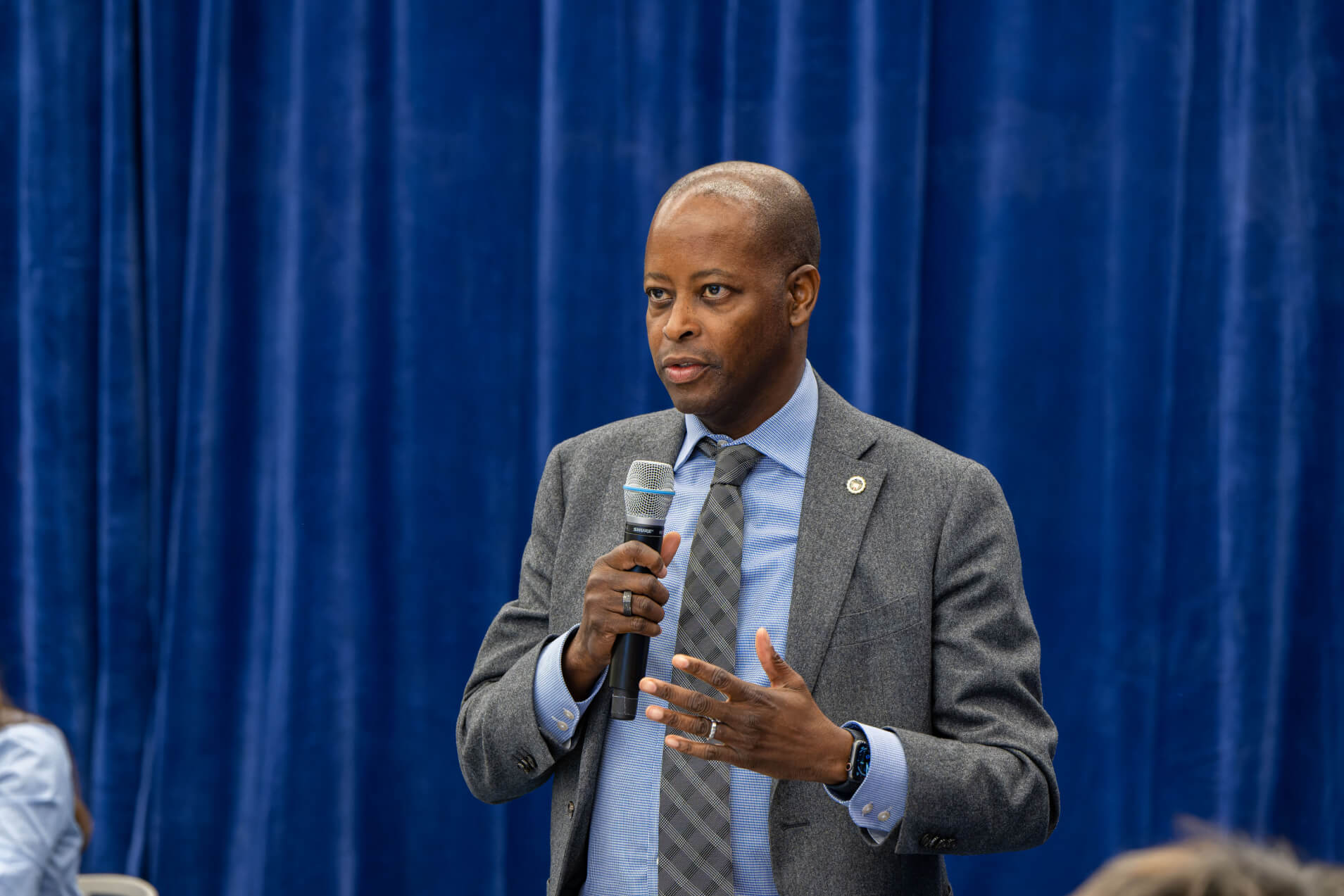
Q&A with Dr. Félix V. Matos Rodríguez, Chancellor of the City University of New York (CUNY)

CUNY Chancellor Matos Rodríguez is everywhere these days promoting and advocating for a system he calls “the Ellis Island of education.” CUNY has a storied history where separate public colleges, many with famous alumni from underserved communities, came together over time to form the nation’s largest urban public university, serving more than 226,000 degree-seeking students each year. 

Matos Rodríguez, known as “Felo,” is a vital part of that story.  A historian, professor, and author, Matos Rodríguez grew up in Puerto Rico, received a degree in Latin American studies from Yale University and received his PhD in history from Columbia University. He was president of two CUNY colleges before becoming the system’s first chancellor of color and first Latino to hold the office in 2019. Now, after four years and a pandemic, Matos Rodríguez acknowledges many challenges remain despite the progress he has made to build relationships with industry leaders, improve infrastructure at campuses, and create more workforce opportunities for CUNY students. 

In his interview with LW, the chancellor talks about the strategies he is using to improve the career connection for his students, as well as his efforts to strengthen the system. He also opines on broader issues, such as the value of public higher education and how going to college can be both a stressor and a haven for his students. 

CUNY Chancellor Félix V. Matos Rodríguez sitting at a table
Photo provided by CUNY

LW:  What are the priorities you are working on from a systems-wide level?  

FMR: CUNY is probably the best institution in the Unites States to boost social mobility. Nobody does a better job of moving people from the bottom quartiles of the socioeconomic ladder to the middle class and above than CUNY. We’ve done that by remaining an affordable institution—75% of our students graduate debt free and about 68% attend tuition-free, thanks to state and federal aid. We also have top-notch faculty and staff. Affordability and quality staff are two of CUNY’s strengths. 

What we have not done as well, particularly for a place where half the students are first-generation, is career preparedness and the whole connection to the world of work.  There has been vast underinvestment, historically, in career services, and not a lot done to integrate that world of work with curriculum and academic departments to really prepare students for careers. We’ve changed that with help from our partners in city and state leadership and the private sector.

LW: How do you tackle such a major issue at such a big place?

FMR: I break it into buckets.  The data we have on students participating, for example, in paid internships, tell us that those who participate in those programs graduate faster. When they go to get a job after graduation, they get it faster than their peers without that experience and their first-time pay is higher.  The other value here is the professional capital these opportunities create.  All college students come with assets and challenges, but the students with professional parents can often leverage their family’s networks once they graduate.  More than half of my students don’t have that. We need to be that connector to opportunities for them. Right from the start, I said, “I want to be known, at the end of my time, as the patron saint of paid internships for CUNY students.”

Nobody does a better job of moving people from the bottom quartiles of the socioeconomic ladder to the middle class and above than CUNY.

We have made a lot of progress in this area. A coalition of CEOs from some of the city’s largest employers was created three years ago to provide access to high-potential jobs for underrepresented New Yorkers. Another industry partnership, CUNY Futures in Finance, was formed by Centerbridge Partners, Bloomberg, and Goldman Sachs to connect financial services to CUNY talent.  We’ve also launched a number of public-private partnerships which, thanks to a strong backing from Governor Hochul and Mayor Adams, put millions of dollars to work on paid apprenticeships and internships for CUNY students.  

The point I really drive home to industry in New York is that our paid internships do all the things that paid internships do everywhere but because of our price point, it can really be an extra agent of advancement. Our tuition is approximately $7,000 a year for senior colleges and $5,000 a year for community colleges, for New York State residents. That paid internship that they have for a semester, if they were going to a community college, could pay for their semester. If they’re on financial aid, then that extra money can be used for food and housing, and all the other expenses we know make it challenging for them to stay in school. It’s like a scholarship. When I was president at Queens and a donor or alumni would come and say, “I’m going to give you $7,000, for a scholarship for a year,” I said, “No, give it to me in a paid internship.” At the end of the day, it will do the same thing financially for the student, but give that student a lot more in experience.  

CUNY is the ideal partner for New York industry.  I say to them, “We are a one-stop shop, come and deal with CUNY because we have 25 campuses, so if you’re an employer and you don’t want to have 25 conversations, we have a whole operation that can do that for you.”

LW: What other “buckets” are you working on in this area? 

FMR: We are integrating career preparedness into all that we do, including in the classroom and to get students to think about career options as early as possible and not in a narrow way. You want to make students think about career possibilities and begin to explore them and determine whether there’s a path, a liking, or not. And we don’t want them to wait until junior year or senior year and say, “Oh my God, I need to get a job. Now I need to think about all these things.” 

The second reason why students drop out of college—finances is the first one—is not knowing why they’re in college in the first place, and also not being able to make a connection with what they’re doing in college with what will happen in life later. So that entire career exploration is what I think we owe our students. And that’s why we want to get to career options early, to make students think about it. We’re actually trying to map for every major—and in fields within majors, not just the courses—some of the activities that you should be engaged in.  A lot of our students think career services are only for high-performing students with really good grades. My role is to get them introduced to careers, make them feel worthy of them, and then go out and compete and kick some butt.

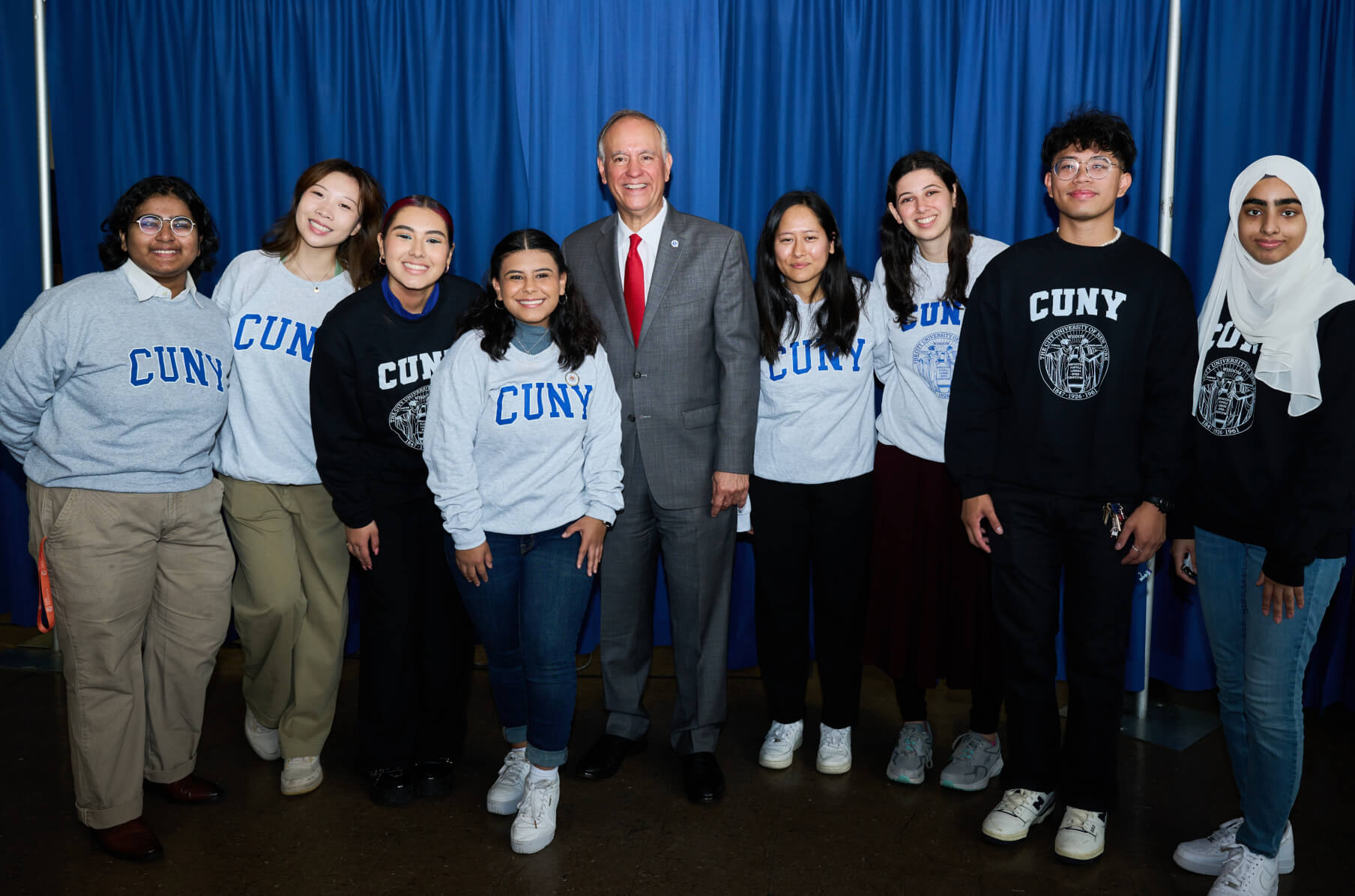
Chancellor Félix V. Matos Rodríguez with CUNY students and moscot
Photo provided by CUNY

LW: You mentioned incorporating this work into the classroom.  What does that entail? 

FMR: Curriculum revision is another bucket we’re working on. The New York Jobs CEO Council is a key partner in helping us think about updating curriculum. It is also a main focus of our new Office of Transformation, headed by an amazing senior faculty advisor Cathy N. Davidson, one of the best writers out there on education, to help us think differently about our pedagogy.  The key to that is to make sure that faculty value this work and have the tools to do it.  So many of them do this already but we are asking them to be more intentional about it so that their students understand that this exercise that you did here, or this test or this essay or this project, creates skills that they can go to an employer with.  But what I hope that our students do is that, as they’re building a portfolio, either personally or through career services, they think that what they have learned in a class is something they can then go tell someone, “I learned X, Y, and Z in this class, and here’s a concrete example. You need me to work in groups? Let me tell you about the project I did in my history or anthropology class.” 

Faculty have to be our partners in this. We need to help them think about that value, that engagement, because for students, even though they talk to advisors and other staff, faculty are still their key role models. 

Already, faculty have competencies in this area through NACE (National Association of Colleges and Employers), that are embedded into the curriculum, but they’re not necessarily thinking about it that way, so we decided that we need to have champions.  We’ve been working with the president of NACE and with a group of career fellows out of the Office of Transformation. We started with 20 faculty from across CUNY. The fellows have been thinking together about the best ways that CUNY faculty, in all fields, can support our students in their future lives and careers. This year, CUNY will scale the pilot to nearly 50 faculty, with the goal of promoting strong relationships between classroom learning and career success.  

LW: Has your experience as a community college president influenced some of the changes you are working on system-wide?

FMR: Absolutely.  Transfers have always been the key driver in the system. The transition from community college to four-year schools has to be improved, so that students aren’t set back in time and money by needless requirements.  This is a challenge for two and four-year schools everywhere, but at CUNY where we’re working within a system, we have no leg to stand on if we don’t get this right. 

The second reason why students drop out of college – finances is the first one – is not being able to make a connection with what they’re doing in college with what will happen in life later.

At the same time, when I came on board as chancellor, since I was president of a two-year school, I told all the presidents, “We have to improve the two-year experience.”  What often happens is if you come to CUNY and you are not college-ready, you need to start out in a community college. Part of the challenge has been that not every student starting at a community college really wants to be there. So, I told the community college presidents, “You need to create a rationale of why people want to come here. Not because we tell them to, but because either you have the student life or signature programs that they want to engage with.”  This is particularly important at this point in time when we’ve lost so many students to the pandemic.  We need to ask ourselves, outside of the personal circumstances, “Why is it that students don’t want to return or to start in the first place?” 

LW: Do you think one of the reason people stop out, or never enroll, has to do with public perception about the declining value of a college degree? 

FMR: I think that accounts for some percentage. Whatever I tell you will be a guesstimate. What I do think affects us is the perception that higher education is unattainable. Many of our students, particularly the ones who are low-income, assume it will not be affordable because the larger discourse is about debt and lack of affordability. They assume because we’re a part of higher ed that this place is going to be expensive without even thinking about applying for financial aid, or seeing what options are out there, so I think that we are being really affected by a mindset, which is the debt discourse. But that is not our story. Our average debt, for the 25% of the students that end up with debt, is, I think, between $12,000 and $14,000. But it’s hard to get that story out. There’s no validator in many families that can say, “This worked out,” and there might be a validator that somebody went and dropped out and said, “Yeah, look at what happened to cousin so and so.” We need to crack that. I tell people, “Listen, there’s probably no state more generous with financial aid than the state of New York.”

LW: Speaking of New York, what case do you make for why CUNY is worth investing in? 

FMR: The value and the importance of what we do is huge, and 80% of our students stay in New York so they are part of their communities. Graduates get higher paying jobs, which adds to our tax base, and they are less dependent on social service programs. There are also social and civic gains when you think about where all of our immigrants or sons and daughters of immigrants learn about democracy and what it means to be an American in New York City.  There’s another important category of work there of civic engagement, what I like to call civic mobility. That is also a key part of what we bring to the table. 

LW: We know so much about the stresses of college, particularly for students who have the added burden of poverty.  How do CUNY schools and others like them impact their students’ wellbeing? 

FMR: Obviously, there is some stress generated by going to school from a financial perspective.  “Can I pay? Can I stay?” And then there are the exams and the stress that comes from managing your life as a student. In that sense, we do add some stress. 

But we are also such havens for our students.  They’re commuter students and, in many places, the little campus corner where they can sit down and study quietly may be the only place they have some privacy. In my first presidency, every nook and cranny that we could put a desk, a chair, whatever, we used because some of those South Bronx students were in apartments with three or four siblings and they needed quiet space.

For parents of small children, there is often campus childcare. There are also mental health counselors and extracurricular activities that can provide some stress relief. It really is a balance in helping them to manage and overcome the stress of going to college. 

Q&A with Dr. Robert Waldinger, Co-Author of The Good Life

Bob Waldinger is a psychiatrist, a professor at Harvard Medical School, and the Director of the Harvard Study of Adult Development, the world’s longest scientific study of happiness.  His new book, The Good Life, with Dr. Marc Schulz, provides insights regarding what makes some people happier and more satisfied than others.  At a time when many of us, particularly young adults, are reporting symptoms antonymous to happiness, such as loneliness and disconnection, the insights he shares based on this research are particularly relevant. 

LW: Your new book, The Good Life, is based on the work you have done in the Harvard Study of Adult Development.  Can you describe the study?  

RW: I am the fourth director of the Harvard Study of Adult Development. As far as we know, it’s the longest study of adult life that’s ever been done in that it follows the same people from when they were teenagers all the way into old age. We’re in our 85th year and we have reached out to the children of our participants as well, the second generation. All in all, we’ve followed over 2,000 people over many decades. In essence, this is a study of human thriving and wellbeing. It started with two groups of males, one very privileged group of male undergraduate students from Harvard College and one very underprivileged group of boys from Boston’s poorest neighborhoods and most troubled families. It started with these two contrasting groups of people and then, over time, we brought in their wives and their children. Currently, more than half of those in our study are women.

Headshot of Dr. Robert Waldinger
Dr. Robert Waldinger

Now, we have this wonderful treasure trove of information on 724 families across 85 years. The study has discovered so many things. There have been hundreds of papers and scores of books, but there are two big takeaways I think are most salient, and very relevant today. One is, no surprise at all, taking care of your health really matters in terms of how long you live and how you feel during your life. Preventative healthcare, exercise, diet, not abusing alcohol or drugs, not smoking—all of that really matters. The finding that we didn’t expect, and, at first, we didn’t believe, was that the people who stayed the healthiest and lived the longest were the people who had the best connections with other people; that our relational lives make a huge difference in not just how happy we are, but how healthy we are and how long we live. And it’s not just our study that has found this, but now many other studies, so there’s now a fairly well-established finding that there is a powerful connection between relationships and health. 

The finding that we didn’t expect, and, at first, we didn’t believe, was that the people who stayed the healthiest and lived the longest were the people who had the best connections with other people.

LW: I think it’s interesting that you started with college students.  We know from the data how prominent mental health struggles are for this population.  What does your work tell us about this age group?

RW: What we know, not just from our study, but from a lot of studies, is that people ages 16-to-24 are the loneliest group of people, at least in the United States, and perhaps around the world—these young adults—adolescents moving into young adulthood—are the most isolated, disconnected population group. And that’s been a surprise to older people who look at young people and think of them as active and involved and so connected with one other. And, of course, many young people are, but there’s a huge subset of young people who are not, who are feeling really disconnected. And this is not just a function of the COVID pandemic, it was in the works before then, COVID just accelerated the upsurge in issues like depression, anxiety, and a sense of isolation. 

LW: If you’re providing some advice based on your data, what might you tell that 19-year-old or 20-year-old who is in college now about the importance of relationships? 

RW: We know that we get all kinds of value from relationships, and we don’t get the same things [from each one]; relationships are all slightly different.  Some relationships are fun, and some relationships are with people we confide in, and some relationships are simply with people who might help us move furniture or drive us to an appointment. Many relationships can serve more than one function, but almost no relationship is going to provide everything. And what that means is, we need to look to different people to meet all kinds of different needs. The best relationships, of course, are relationships that are reciprocal. And one of the things that feels bad about relationships is when they’re not reciprocal, when it feels like I’m always the one who calls my friend or I’m always the one helping out, and I don’t get that in return. 

Mutuality is really important. And one of the things I would ask young people to think about is: How mutual are your relationships? And if they’re not, can you work on that or can you find some people with whom it’s more mutual? Similarly, what we learn is that conflict is inevitable in relationships. That does not mean you want to get rid of that relationship in your life. In fact, if we have enough invested in good relationships then it’s worth trying to work out conflicts.  The work is not to find a conflict-free friend, but to find a friend with whom you can talk to about disagreements. And both people come out feeling okay, like nobody won and nobody lost and that, if anything, you are stronger together because you’ve worked out differences. 

LW:  This is for friendships and romantic relationships, correct? 

RW: Romantic relationships for sure. There is no real romantic relationship without conflict. When I look at people who are about to get married, sometimes I will evaluate couples who come for therapy, and the real question is not, “Are they each other’s soulmate?” but “How do they work out conflicts?” And if they can work out conflicts, they have a good future together. If they can’t find any way to talk about disagreements and come out the other side feeling okay, then they’re in trouble. They either have to develop skills to resolve conflict, or they should find another person with whom it’s not so difficult.

LW: You have some interesting data about perspective and lifespan. What’s that all about?  

RW: Even now, at my age I think, “Why doesn’t everybody think just like me?” And I have to remember from my own research and from looking around me that people think very differently at different ages. People of college-age are going to have a certain view of the world, a certain view of culture, of politics, of the future that older people don’t have, that younger people don’t have. And that’s actually a good thing, because we wouldn’t want a world that was filled with everybody who had the same perspective on life or even one generation dominating everything. Actually, the baby boomers probably dominated a lot of culture for a lot of years and didn’t always turn out so well. 

What we know, not just from our study, but from a lot of studies, is that people ages 16-to-24 are the loneliest group of people, at least in the United States, and perhaps around the world.

I think that the thing we learn from following people over time is that things change in their importance. Let’s say you’re 20 years old now, think about when you were half that age when you were 10 years old, what was important to you then? Well, it’s probably not at all the same stuff that’s important to you now. And when you’re 30, it’s going to shift again. And when you’re 40…and that’s okay, that’s normal. It’s to be expected. But it means that to some extent, we all have to hold our own perspectives a little more lightly and realize that it’s not the only way to look at life. 

LW: What implications does your research have on finding direction in life? 

RW: My sense is that we know that the college years are where we do a lot of figuring out of who we are. “What kind of person am I? Who do I want to align with? What do I value the most? And therefore, how do I want to spend my time on this earth? [Time] is pretty limited, even though it may not seem that way when you’re in college. We can teach ourselves to think about, “What do I value the most?” And if that’s what I value the most, am I actually spending my time promoting those values, doing things that align with those values? Or am I doing things that don’t align with those values at all? In my own life, I’ve ended up taking jobs that I don’t really care about and don’t really like, and that actually promote things I don’t believe in. 

It’s been really important for me to turn back to my own values and say, “Okay, as soon as I can, I’m going to make a change because this is not energizing for me. It’s not making me feel like my time is being well-spent.” And I think that’s the thing that can start when we go to college or university. It’s the thing you can do from day one, and it can help you with course choices. It can help you choose a major. It can help you think about summer internships. It can help you think about where you want to go after college. Then you can settle on some core things that you care deeply about that can become your North Star toward which you can point your decision. 

LW: I know in your workshops you ask people about their core values. Should we be doing this more with young people, with college students?  

RW: Yes. We all have values, but we don’t quite know what they are until someone asks us to clarify them. I’ll give you an example. We’ve started bringing my two sons, who are in their thirties, into our process of deciding about our philanthropy each year. There are a host of good causes, but we had to decide as a family what we were going to give to. And it turned out that my sons value some things differently than I value. I wanted to help with poverty and disease. They wanted to work on climate change. All of them are really important issues. And that’s just a way of saying that even clarifying values is something we don’t always do until someone asks us, and that’s a really good thing.

LW: What are your thoughts on socio-emotional learning?

RW: My friends who work in socio-emotional learning say that when teachers are given curricula to teach the children in their classrooms about feelings or having an argument with a friend, the teachers come back and say, “We need this for us.” What we know is that everybody needs this. You need it at a different level if you’re in college or if you’re a teacher in the middle of your career, but you need it. All of us need it. I practice Zen and a lot of Zen meditation is learning those emotional skills. It’s watching all the feelings and thoughts that come up and drive you crazy and then learning how to work with them. 

LW:  What would be your number one piece of advice for young people out there based on all you have learned? 

RW: Invest in connections with other people. It has the biggest payoff, both in terms of making us happier because it’s more fun to be connected, and in helping us get through the hard times, and the hard times are always coming along when we least expect them. It’s a really good investment of time and energy. Don’t neglect it. Don’t assume that your relationships will just take care of themselves. Keep your friendships going. Keep reaching out. 

Q&A with Dr. Wayne A.I. Frederick, President of Howard University

After a decade as president, Dr. Wayne A.I. Frederick will leave Howard University a very different place than he entered it.  He came to Howard as a 16–year-old undergraduate from Trinidad and Tobago who went on to graduate from both its medical and business schools.  His unusual profile as a surgeon and an academic have served him well as he steered the prestigious HBCU through a remarkable time for Black Americans – starting with the Obama presidency, the Black Lives Matter movement, the COVID-19 pandemic, and the insurrection of January 6th, 2021, which occurred just a few miles from his campus. 

He describes the school’s transformation over the past several years almost as if it were the personal growth of an individual, not an institution. As he prepares to leave the place to which he has long belonged, Dr. Frederick provides a perspective on the country, on young people, and on higher education that is honest and well worth hearing. Here is an excerpt of our interview. 

LW: How has Howard changed under your leadership? 

WF: Howard has always had big potential and a big legacy, and I think today Howard is fulfilling its potential and living its legacy. I think that’s the biggest difference: while we’ve existed on what has happened before, I think we now have a contemporary experience of excellence, and a contemporary expectation of being excellent. And I think that that’s very different.  This is true across categories. We are poised to be an R1 research institution. Financially, we’ve come out well from a very unstable financial existence which, to be quite honest, has been something that has plagued us throughout our history until now.  Our enrollment is the largest it’s ever been, so we’re serving more students than ever before, and also graduating them at a higher rate than ever before, so we are really fulfilling our academic mission.  I would say the third thing is we’re taking care of each other in a way that we haven’t done before. We are a community that’s inclusive, that recognizes the importance of holistic health including mental health. 

LW: What did it take to make these significant changes?  What were the obstacles?  

WF: As I look in the rear-view mirror, bringing my tenure to an end, I would say the biggest obstacle was making sure that we had self-belief.  I think that we believed to a certain extent in our past, but I’m not sure that we always believed that we could be what we are today. And I think that self-belief was something that we had to build.  Our graduates are such an accomplished group of people who become national and international figures, that that legacy of who we are took on a life of its own. But the actual numbers, the actual data, did not necessarily bear that out.  We started really looking at ourselves, doing the introspection but at the same time, setting out a plan to become that. The graduation rate has increased by over 25% during my tenure, as an example. We’re starting to really live out our legacy.

We started to be bold about stepping into spaces and places that we weren’t always welcomed.

The second obstacle was overcoming long-standing issues around how we fund our institution, looking at the business model, looking at what we did with respect to fundraising. And I think we really looked at those things very differently as we moved forward.  We started to be bold about stepping into spaces and places that we weren’t always welcomed. And once we were able to get in there and tell our story, people were very impressed and willing to invest in us.

LW: Your enrollment and graduation rate increases—I’m guessing they had something to do with the work that you’ve been doing on affordability?

WF: Yes. The number one reason that Howard students did not graduate was because of finances.  That financial barrier then led to other things—people working extra jobs, not getting enough sleep, not being able to focus enough on their schoolwork, that type of thing. Coming in, that was an issue that we looked at.  We were not raising enough endowed funds to help offset students’ bills, so we started doing things differently. We started what’s called a Grace Grant, which is a grant that we give to students who have an expected family contribution of zero. They get the maximum Pell [Grant]. We fill the rest of their gap on their tuition in order to help them matriculate.  We immediately started seeing a big difference in the graduation rate. Those students who did not get the full support graduated somewhere in the low 60s percentage-wise. The graduation rate of those who got it was 90-something percent.

We went to investors and donors and said to them, “Look at this data.”  And people started giving money, and we’ve now raised in excess of $45 million in that one area, with a goal of getting all the way to $100 million.  That’s an example where we did something different. We used the data…and convinced our investors that they should invest in us.

LW: Student activism is something that Howard is known for, but it has also been a challenge for you.  How do you reflect on those experiences now?   

WF: When I look at students who come to Howard, they’re very concerned about their place in society and what society has done and not done for them. That’s important and not lost on me.  However, there is some romanticism among students that activism is really all about protesting, none of which I have a problem with. But what I do want to make sure we have is the right balance, that we take our activism and advocacy, and we test it. We use all of the tools of negotiation, of interrogation, of debate, so that we do get the outcome we want. I think we’ve often had this in the wrong order.  Particularly later on in my tenure, I’ve been trying to put the students’ activism to work in a proactive fashion and not wait for there to be an issue to get somebody engaged in a conversation.

LW: What would you say about the politicization of higher education today, the roll back efforts around DEI, the sense that it is too biased, less valuable? 

WF: Let me start by saying that I think the issue in this country right now with extreme partisanship is real and it is causing our young people to question so many things about our society, including the things that we, over time, have come to love and hold up almost as a moral compass.  

We live in a country where we tout our democracy. We tout the ability for free elections. We tout our ability for the transfer of power, unencumbered.  And these young people have now lived in an era where every single one of those things has been questioned.  We’ve portrayed ourselves to the rest of the world as an arbiter of democracy and now we question everything about our elections. We question who should vote, how it should be managed. Young people see that, and they say, “There’s a hypocrisy taking place here. While you guys are casting aspersions afar, we have a problem right here. And you’re not solving it.”

As a result, they have started to turn away from a belief in that system. And I think that has hurt us. And as it seeps into this debate about liberalism in our education system, and turning back the tides on DEI, I think what people have started to say is, “I’m not sure that I believe in any of these things anymore. I feel that you guys are not honest about what it is you’re doing.”  

Young people are questioning even more. They’re questioning the very existence of why we are doing this and how we get here. How are we going to turn this off?  So, in my humble opinion, I think that our young people have to be redirected. How do we solve for this going forward as people question whether higher education is important anymore, in terms of being able to live a better life as a result?  I think what we have to do in higher education is to continue to tout and sell what higher education has been to this country. We have to lift those things up. 

And we do have to question and interrogate how we are providing information.  Is it allowing students to practice critical thinking? I would say that right now, it is not. On the average campus, it’s leaning left or leaning right, and when we bring people from the opposite side to speak on campuses, we’re shutting them down. We’re not having rich debate. And if it is not happening on our campuses, you have to believe it’s not happening in our barber shops, or in our grocery stores. And if we are a country that is not going to speak to each other because we have different views, we’re not going to be as strong as we could be. It’s a very critical time for higher education. I think we have to recognize how disappointed our young people are in our larger societal constructs, and we have to provide a solution for that in our higher ed institutions.

We need to remind our young people that we all belong to this construct, and we all have to figure out a way to make it work. It’s our responsibility, and in doing that, we don’t leave anybody behind.  Right now, we almost have a sanitary view about all this and we just avoid each other.  There are certain things we just don’t go to or participate in. And I think we need to change that, and say, “You know what? That’s not the right thing to do. Let’s go out with the goal of amplifying each other’s humanity.”  

We have to question and interrogate how we are providing information. Is it allowing students to practice critical thinking? I would say that right now, it is not.

And if we make that our goal, then we have a responsibility when we see an issue to jump in; whether we have an expertise or not, we need to learn about it and to understand it.  I don’t live in rural America, but there are challenges for people living in rural America. So the question is, “Do I have a responsibility to learn what those challenges may be?  And, when I do, is there something I could do about it?” Instead, what we say is, “if somebody lives in rural America, that’s not my problem.” And I think we have to get away from that because our goal, our responsibility, as a higher ed institution, is to amplify other people’s humanity.

LW: How can higher education help address these issues? 

WF: I think we have a real gap in civics education in our country. Most students who come to college aren’t aware of who their state reps or senators are, or even how bills get passed, or how laws are made. I think that’s another thing that we have to try to do a better job of—to explain how the country works so that when a Supreme Court decision comes down, students understand that that’s the tail end of a process that started in somebody’s court, in somebody’s jurisdiction. And I don’t think most students recognize that at all.  

Take students’ frustration with, for instance, the overturning of Roe v. Wade. They don’t recognize that the case that led to that started way back, and because nobody was paying attention, it didn’t get the type of activity around it when it should have. And for higher ed students in particular, they should be the most active among us, and they have the most resources to do that. And so, we should be supporting them better in this area.

LW: The January 6th, 2021 attack on the U.S. Capital: How did that impact the Howard community? And the reaction to that in America—what does that say about the separateness you are concerned about?  

WF: Several things about that day I think just encapsulate so much of our reality today. One was that I came out of my office and noticed a significant number of individuals associated with the Proud Boys movement parking their cars in parking lots around Howard. And I realized, subsequent to that, that it was because there was a train station there. But initially, we had no idea why it was happening. Was it because the vice president had gone to school here? So my security chief started setting up cars to kind of block access to the street. And then you go from that, down to the Capitol and all that was going on that day.  I got home and my kids were looking at the television. And I said to both to them, “Listen, you guys have been in front of CNN for the past two-to-three hours.” They were very distressed obviously and I said, “Let’s change the channel. Let’s go on Fox News for a little bit.” And so they did.  

The goal was to stay there for 30 minutes. I think they lasted 10 or 11 minutes and said they couldn’t watch it anymore.  And I said to them, “There are some kids who just did what you guys did. For three hours, they watched Fox News and their version of what is happening is very different from yours. That doesn’t make them bad. That doesn’t make them love this country any less. But it means that they have a different perspective. And part of your responsibility is to see how you can bridge that gap—not to become who they are, but to understand who they are. And to recognize that they have every right to their position as you do. And the more you’re empathetic about their perspective and understand it, even if you disagree with it, the more harmony there could be.”

Unfortunately, we are not giving our young people good examples. There’s a senator who called me to ask about coming to speak to my grad students after the 2016 election.  And I said to the person, “I would love to have you, but I want you to do me a favor. I want you to come with another senator from across the aisle, with whom you’ve worked on something difficult, so my students can see that that’s how you guys work.”  And the person just calmly looked at me and said, “Nah. At least, not this time.” And I thought to myself, “These are the people making laws in our country. If they don’t want to speak to each other, then we can’t expect our young people to take anything else away from it.”

For me, what is worse than the yelling is the silence.  There is a distressing silence in this country and that is the sound of people not speaking to each other. That is even more dangerous. And that’s why I started with why I think young people are so jaded today. They have the attitude of, “Why are you trying to tell me what to do when you guys can’t get it together yourselves?”  And the thing is, our young people actually are much more flexible and much more empathetic about people who are not in their circumstances, so we have an opportunity in the country. Young people are much more altruistic. They’re much more willing to understand a person’s sexual orientation or a person’s financial or social circumstances than older generations are. So, I think that we have to jump on that opportunity, because they have that openness. 

LW: As president of Howard, you are very active in the HBCU community. What are some of the biggest issues facing the sector right now? 

WF: I would say funding of infrastructure is really the challenge. After George Floyd’s murder, giving to social justice issues really spiked and HBCUs got a lot of attention.  But it wasn’t the entire sector. It probably was 20-to-25 institutions out of a hundred that really got attention and got money. That money has since gone away in many ways. Howard’s infrastructure around fundraising was there so we will continue to do well, but I’m really, really concerned that if those institutions are not able to have sustainable growth and sustainable funding, we could get into trouble as an entire sector.  

The question we need to answer is why is it even important to have strong HBCUs? Well, the data show that we produce and diversify so many fields—way above what our collective capacity is—and that we have to exist in order to diversify other, different fields.  Howard still sends more African Americans to medical school than any school in the country, as an example.   

But I do worry that this attention that has occurred over the past two or three years to some segment of the sector, which has already started to go away, will ultimately hurt the sector, because of longer-term neglect.  People now are going to say, “Well, listen. We jumped in and gave you guys some support and funding. And now we don’t have to do that.”

The second thing that I think is important for us to be thinking about is that we have to be competitive on an even playing field. The product that we supply has to be one of excellence. And I know that I speak for Howard in particular, but that has been our focus. We’ve been very focused on having the best programs, the best exposure that our students could get. And I’m very proud of what we’ve built around that.  Students who come here have very strong track records in terms of where they end up in their jobs and in life. That’s something that we’ve invested in, and that we’re committed to long-term.

LW: Speaking of improvements, you have made headlines with some of your hires.  How does that fit into the story? 

WF: It’s a good question because again, I think this is a demonstration of what I’ve been talking about. These are people that make a big splash. There’s no doubt about it because of their celebrity. But my attraction to them was really because of their excellence and their commitment to that excellence.  I developed a relationship with Ta-Nehisi Coates that was very personal and that started off with me convincing him to finish his degree. A little-known fact is that this famous author who is on my campus as a faculty member and teaching and holding a chair, is also matriculating to finish his degree. And that shows his commitment to excellence. I think when people see what Ta-Nehisi is producing, they’ll know this is far more than having a big name join you.  He had a writing workshop for students in the summer that he began before he started teaching. I will predict that several of those students are going to go on to become great authors like [him].  And that, ultimately, is going to be his legacy as well.  But that’s the type of excellence that he’s bringing. 

With Nikole Hannah-Jones, that was obviously a bit more opportunistic but, again, she had lots of other schools trying to step into this and I think the conversation that she had with me was quite different. I was not promising the bells and whistles. But what I was promising is that we would fulfill her mission to make sure that the role that journalism plays in our democracy would be alive and well. And I think that that intersection of our principles and mission is what attracted her to Howard. 

There is a distressing silence in this country and that is people not speaking to each other.

With Phylicia Rashad, I have to admit, I got a great assist from Chadwick Boseman, having him help me convince her to become the dean [of the College of Fine Arts].  Because [Rashad] could see so much in [Boseman], that she would then see in our young people, I knew what her commitment was. 

By the time this is published, I will have made another important hire.  All of these people, in my opinion, whether it’s Stacey Abrams or [a future hire], they have been excellent in their own right.  In my recruitment of them, we’ve been having conversations about what that excellence looks like, and how that fits in with what we are trying to do at Howard.

Unfortunately, sometimes that celebrity has overshadowed the other incredible faculty we’ve hired – nobody is going to put them on the front of the New York Times but, the reality is, I think in terms of academia, they are stars. That’s the other thing that I think hasn’t been well-told about our story – we’ve certainly been consistent.  It just so happens that the public personalities have gotten a lot of attention. 

LW: You have less than a year left as president, will you give us a hint as to what you are going to do next?  

WF: My intent is to retire, to really just take some time. I have committed to the board that when my successor gets here (Ben Vinson III, current provost of Case Western Reserve University), I will actively help him with the transition.  We’re already meeting once a week right now. Subsequent to that, I have a son who plays soccer in college and a daughter who plays volleyball—she’s a rising senior in high school—and I’m going to try to make it to every one of their games. I’m going to continue to travel with my wife. I want to travel to places where I could do some medical missions as well. I want to try to do about four medical missions a year. The other thing I’m committed to doing is going to Trinidad once a month to help mentor kids and that includes helping them to apply to higher ed in the U.S.

LW: That’s wonderful. Your wife, is she also a physician?

WF: No, she is the smart one in the family. She has a degree in computer science.