A Year of Stories

Dear Readers and Listeners:

As we move into 2026, I have been reflecting on the year’s worth of stories we have been honored to share in LearningWell. So much of LearningWell’s coverage mirrors what influences your work supporting student flourishing. Here’s a reference to some of the top stories that captured those struggles and gains.   

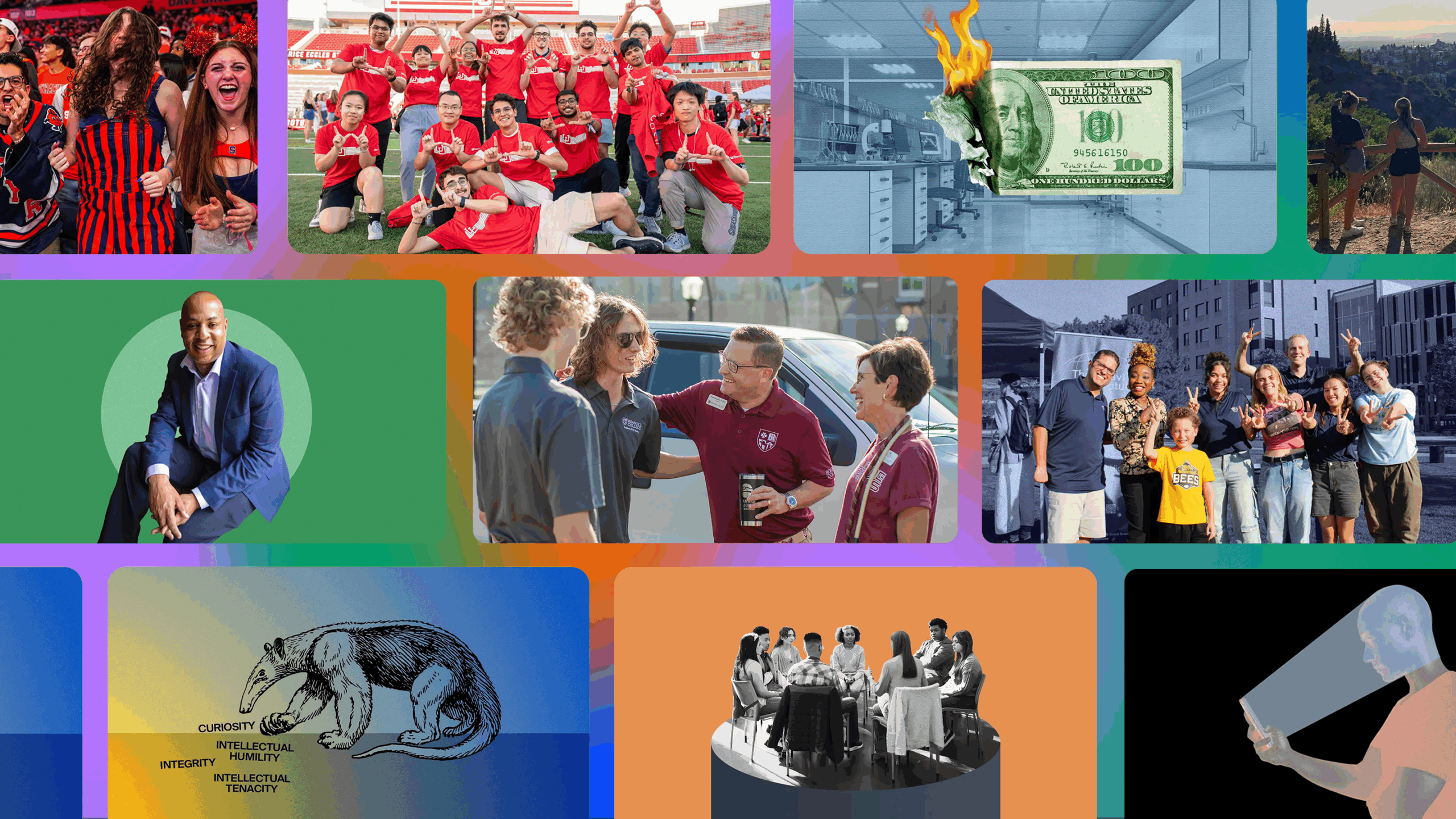
2025 may be remembered as one of the most disruptive years in higher education, set apart by numerous drivers of uncertainty and anxiety, all of which influenced campus wellbeing. “Without a Net,” “A Voice for High-Needs Students,”and “Uncertainty Weighs on Mental Health Researchers” were some of our stories that captured those dynamics, including the impact of federal upheaval on financial distress, equity initiatives, and research.

Student mental health issues remained at the forefront of higher education concerns and policies. At LearningWell, we tracked the latest national data in student wellbeing, while delving into the key factors at play: We heard about the influence of social media from psychologist Jean Twenge and of A.I. from reporter Beth McMurtry. Reflections from students and recent graduates offered first-hand insight into the mounting pressures they’re feeling. And we acknowledged the continued rise of mental health and wellbeing among institutional priorities, covering the Princeton Review’s Campus Mental Health Survey and The Wall Street Journal’s use of the Human Flourishing Project’sflourishing scale to rank the best colleges. 

But amidst these challenges, resilience, perseverance and innovation abounded. Practitioners and administrators across the country began thinking more holistically about student mental health, focusing on population outcomes, preventative strategies, and curricular and co-curricular partnerships, as reflected in these articles: “Leading the Next Chapter of College Mental Health,” “New Thinking in College Student Mental Health,” “Be REAL,” and “Experience U.”

Perhaps the best way of chronicling this progress in student-centered education is by telling the stories of the people doing this work and the places where it is unfolding. The institutions within the LearningWell Coalition continue to forge new programs and pedagogies aimed at preparing students to flourish in life and work — schools like Lehigh University, Roanoke College, Boston College and the University of Utah, among others. 

Character education has emerged as a constructive pathway toward human development goals, like curiosity, empathy, and intellectual integrity. LearningWell has featured a number of these programs set in unusual contexts, such as sports fandomscultural reconciliationglobal peacebuilding, and intellectual virtues.   

As we look forward to another year of telling your stories, a sincere thank you for supporting ours at LearningWell magazine. 

All the best for a great new year! 

Marjorie Malpiede, Editor-in-Chief

You can reach LearningWell Editor-in-Chief Marjorie Malpiede at mmalpiede@learningwellmag.org with comments, ideas, or tips.

The Stories They Tell Themselves

On an overcast afternoon last fall, Khaleigh Reed stood with crowds at the University of Colorado Boulder football stadium. She had transferred to the school the year before and had been feeling “kind of alien.” The game ended, and she stood talking to people she’d only recently met. As the skies opened into rain, the crowd spilled out of the stands and onto the grass, and she and her new friends joined them, laughing together and running with the large gathering of students. 

For Reed, a senior journalism major who had transferred from a community college at the start of her junior year, the moment felt cinematic.

“I’d hit it off with these two people at the game, and we were all, like, excited and happy,” she recalled. “I had this sense of relief, and with the rain and friends and community all running onto the field, it was like the feel-good end of a movie. After everything I’d been through, I was able to find some happiness.”

Months later, that memory would become an actual scene, the emotional center of a three-minute digital story Reed created as part of a pilot project housed at C.U. Boulder’s Renée Crown Wellness Institute. The project invited more than a half-dozen undergraduate students to craft multimedia narratives about their own experiences of “flourishing” — a positive term the institute uses without rigid definition.

Reed’s experience became part of a prototype for a new digital storytelling initiative being designed by the Crown Institute to be shared with educators the Flourishing Academic Network, or FAN, a consortium of universities committed to advancing wellbeing in higher education. At one level, the project was intimate: nine undergraduates meeting over six sessions, workshopping drafts and learning how to shape a story that could be shared aloud. At another level, the project was taking shape as the infrastructure of something larger. What unfolded in those rooms would eventually be distilled into a physical toolkit — a carefully designed, printable and digital guide intended to help other campuses create similar spaces for student storytelling.  

“One of our aims is to elevate youth voice,” said Michelle Shedro, a researcher at the Crown Institute who helped lead the project and design the toolkit. “Not just as an outcome, but as a way of doing the work. Tapping into youth voice is both a tool and a goal of ours.”

A Container for Voice

The digital storytelling pilot grew out of a broader question the Crown Institute has been asking for years: How do students themselves understand wellbeing?

Founded in 2018, the Crown Institute conducts interdisciplinary, participant-based research on youth and adult wellness. Its work spans maternal mental health, K-12 education, and campus-based initiatives such as Mindful Campus, a long-running program that offers courses and programming for students, faculty, and staff. But the digital storytelling project marked a distinct turn — one that placed student voice not only at the center of the findings but at the center of the method.

Rather than asking students to respond to surveys or predefined frameworks, the institute invited them to tell stories — in their own voices, with their own images, shaped through a guided but flexible process of storytelling in multimedia form.

“Digital storytelling is very adaptable to various disciplines and topics. People have many different ways of telling their stories, and it’s really dynamic and fun,” Shedro said. “So we wanted to give young people the tools to do this, and we also wanted to be able to learn from what they create around the question: What does flourishing mean to you?”

In this way, the project is both research and invitation, said Jenna Bensko, the outreach and education project manager at the Crown Institute. “When we create the container — the opportunity — and when students feel a sense of belonging, the flourishing happens.”

To facilitate the pilot, the Crown Institute partnered with faculty from the University of Colorado Denver, including Marty Otañez, an associate professor of anthropology and a longtime practitioner of community-based digital storytelling. Otañez described the work less as teaching students how to edit video and more as helping them learn how to land a story. Over six sessions totaling 24 hours, students moved through a carefully sequenced process: journaling and free-writing, story circles, writers’ workshops, and storyboarding before ever opening editing software. 

The early sessions focused almost entirely on building trust — learning one another’s names, sharing fragments of ideas, listening without rushing to respond. “The soul of the process is community,” Otañez says. “You can’t shortcut that.”

Only later did the technical work begin: recording voiceovers, selecting images, and learning DaVinci Resolve, the editing platform used during the pilot. Even then, Otañez emphasized restraint. Images were meant to deepen meaning, not illustrate every noun. Metaphor mattered more than polish. But at the core of it all was each person’s choice of a story, which for Otanez is part of the rich process of discovery and reminder to always expect the unexpected. 

“Some of the things surprised me, and this is always the case. Some students are really quiet and maybe a little reserved, and so we never know what we’re going to get,” he said. “And then sometimes their stories are just so rich because with their introversion, they’re thinking so much and so deeply, and they come up with these beautiful pieces.” 

The Crown Institute’s framing of flourishing provided a lens, not a script. Students were encouraged to ask where flourishing appeared in their stories but not required to prove that it did.

The nine students who participated came from across campus — political science, finance, health sciences, journalism. Few had prior experience with digital storytelling. Some arrived with clear ideas, and others discovered their stories only after listening to their peers.

Reed remembered one classmate who shared a story about a serious health crisis — hospitalization, uncertainty, learning to live with a chronic condition. “You would never have known just by looking at them,” she said. “That really stayed with me.”

The story circle, where students read drafts aloud and receive guided feedback, became one of the most powerful sessions of the pilot. “It was like journaling,” Reed said, “but with a community.”

Students learned not only how to receive feedback, but how to give it — asking questions that clarified rather than corrected and noticing what lingered emotionally rather than what could be fixed mechanically.

One thing that interested both the facilitators and the Crown Institute organizers was the nuanced way the students seemed to accept that flourishing was a work in progress, found as much in small moments as in large ones. 

One student used hair-braiding as a metaphor for independence and belonging. Another traced academic growth through mountain climbing. Others spoke about illness, procrastination, loneliness, or the quiet relief of finding a place to stand. The stories that emerged resisted tidy conclusions.

What unified the stories was their honesty, and the facilitators had to respond without an agenda. “We were very careful not to force the message into the stories,” Otañez says. “Otherwise you lose the essence.” 

That tension — between institutional goals and individual truth — shaped the project throughout. The Crown Institute’s framing of flourishing provided a lens, not a script. Students were encouraged to ask where flourishing appeared in their stories but not required to prove that it did.

“In a lot of higher ed discourse, we focus on how hard things are,” Shedro said. “That’s real. But we also wanted to create space for hope, without denying complexity.”

At the end of the pilot, the group gathered for a small screening event. Friends, faculty, and family members attended. Each film played, and each student spoke briefly about the process. Audience members noticed things the facilitators had missed — small gestures, lines that echoed, moments that felt larger than intended. The narratives developed lives of their own in the eyes, ears, and minds of the audience. 

“That’s always what amazes me about storytelling,” Otañez said. “Once the story leaves you, it becomes something else.”

Beyond the Pilot

The digital storytelling pilot at C.U. Boulder was never intended to remain a one-off experience, contained within a single semester or a single group of students. From the outset, the Crown Institute team understood the pilot as a way of learning how to design a methodology that others might eventually adapt. Out of that work, a digital storytelling toolkit is emerging, one intended to be freely available as a PDF for use across the FAN consortium. The toolkit is not a script or a curriculum to be followed verbatim. Instead, it offers a flexible framework shaped by what unfolded during the pilot itself.

“We observed everything,” said Shedro, who led the writing and design of the toolkit. “What worked, what stalled, where students needed more time, where they needed less.”

The resulting document is organized into three broad units: an introduction to flourishing and digital storytelling; guided opportunities for writing, story circles, and reflection; and hands-on production work, including storyboarding and media assembly. Throughout, the emphasis is less on technical mastery than on process — listening, revising, choosing what to include and what to leave out.

There are recommended minimum hours, suggested facilitator ratios, and sample prompts, but little insistence on uniform outcomes. That was intentional by design.

“We wanted something that could live in a lot of different contexts,” Bensko said. “A semester-long course. A co-curricular program. A student organization. It needed to be adaptable.”

That adaptability reflects a central insight of the pilot: the definition of flourishing can’t be standardized any more than the stories that attempt to capture it. Some students told tightly framed narratives about specific moments. Others traced longer arcs — from illness, from isolation, from uncertainty toward something steadier but unresolved. The toolkit preserves that openness, encouraging facilitators to resist steering stories toward predetermined conclusions.

But equally important, Shedro noted, was laying the groundwork for collaboration — the time spent building trust and guiding students in the most effective ways to be active listeners and give constructive feedback.

In FAN meetings, interest in the toolkit has already begun to circulate, though the Crown Institute team has been careful not to rush its release. For the students who participated in the pilot, the toolkit is beside the point — a downstream product. What stays with them instead are the stories themselves and the experience of being trusted to tell and hear them.

For Khaleigh Reed, soon to enter the field of journalism, the potent experience with multimedia storytelling became further evidence of all you don’t know about a person unless you ask questions and listen well.  

“You never know what someone’s going through,” she said. “This project gave us a way to see that.”
10 Years of Building a Community of Action for Youth Mental Health

When The Steve Fund began in 2014, youth mental health was just beginning to break into the national conversation. But the nuanced needs of young people from underserved and under-resourced communities and first-generation college students were largely invisible in both research and practice.

The numbers tell part of the story: over one million students impacted through our programs, five million people reached through our Family Corner digital platform, and 66 colleges engaged in our Excellence in Mental Health on Campus Initiative. But behind every statistic is a young person who found support, a family that learned to recognize warning signs, a campus that transformed its approach to student wellbeing.

Our signature initiatives have reshaped how institutions think about mental health support. Perhaps most importantly, we’ve always kept youth voices at the center. The Steve Fund’s Excellence in Mental Health Initiative provides evidence-based strategies for creating inclusive campus environments. Our Young, Gifted & Resilient conferences bring multi-disciplinary, cross-cultural, and cross-sectoral stakeholders together at universities across the nation, each event co-created with the host institution to address its unique challenges. My Digital Sanctuary, our newest digital platform, takes a fresh approach by speaking to concepts like love, hope, and creativity — shifting away from traditional medical models to more inclusive, spiritual, cultural, and artistic approaches that resonate with young people.

But we face a critical moment. Schools, families, nonprofits, and communities are facing significant reductions in resources at a time of sustained high need. Important systems that young people have long counted on are being dismantled. Intense pressures are being placed upon our nation’s most resource-limited youth and families that may have to suffer in silence due to unmet need and lack of access to mental health care and resources.

“There’s a real risk that young people may feel hopeless, uncertain, and fearful about the direction in which the country is going — anxious about violence, climate change, and civil rights rollbacks.”

There’s a real risk that young people may feel hopeless, uncertain, and fearful about the direction in which the country is going — anxious about violence, climate change, and civil rights rollbacks. That’s precisely why our work on risk and protective factors matters so much right now. We’re equipping youth and communities with resilience strategies and helping them learn to cope with stress, build supportive relationships, identify mental health services, and access restorative resources like nature, creativity, and rest.

The Steve Fund operates in a space where research meets practice, leading to direct impact and measurable outcomes. Our groundbreaking partnerships with the United Negro College Fund to assess mental health at H.B.C.U.s, our work with the Child Mind Institute on family mental health barriers, and our national student surveys inform every program we design. We ensure that our interventions are both culturally responsive and truly effective.

As we look toward the next decade, we’re scaling bold solutions that are youth-guided, family-centered, and grounded in rigorous research. We’re leveraging technology and embracing A.I., not as a replacement for human connection but as a tool to expand access and personalization for communities often overlooked in mental health practice.

The work of The Steve Fund matters now more than ever. When we support young people’s mental health and emotional wellbeing, we’re building the kind of future we want to live in.

What began in a dining room as a family’s response to loss has grown into a national movement and a community of action. The Steve Fund’s first decade laid a compelling foundation built on research, collaboration, and a belief in the promise of every student. As we enter our second decade, we remain steadfast in our mission: to ensure that all young people have the support they need to thrive.

Because no young person should face their struggles alone. And every family deserves to know that help is available.

Dr. Annelle Primm is senior medical director of The Steve Fund, a leading nonprofit dedicated to promoting the mental health and emotional wellbeing of young people from underserved and under-resourced communities.

Warning: Your Attention is Being Fracked

Listen Here:

D. Graham Burnett is a professor at Princeton University. He is also a revolutionary in a movement aimed at protecting one of humanity’s most precious freedoms: our attention. For several years, he and his colleagues in the “Attention Liberation Movement” have been studying, teaching, and warning of the commoditization of human attention by tech companies who make trillions off their ability to capture and keep our eyes on a screen. What is at stake, according to the advocates, is human flourishing. 

The new book by Burnett and his co-authors — they call themselves the “Friends of Attention” — is called “Attensity!” It is a manifesto for attention activists (no training needed) to organize around what Burnett calls “the fight of our lives.” The book is both highly informative and surprisingly funny about a serious subject that appears to be hiding in plain sight. Everyone feels it, yet no one really calls it out, for reasons the book aptly explains. The prelude to each chapter affirms: “You are correct: something is seriously wrong.”  

In this interview with LearningWell, Burnett talks about how this movement came to form, how it is similar to social change movements of the past, what attention really means, and how we can band together to reclaim it. All proceeds from “Attensity!” go to the non-profit, the Institute for Sustained Attention, and its flagship project, the Strother School of Radical Attention. The book is available for preorder now.

Here is a preview of our conversation. To listen to the full interview, tune into LearningWell Radio on January 6.  

LW: This is a really important book, and it’s also really witty. I was literally laughing out loud. As a writer, I cannot help but ask: Was there a reason that you and your colleagues chose to write in this fun style on such a serious subject? 

DGB: Oh, thank you for that question. This book was literally written by a bunch of friends carving time out in the summers over a couple of years to take residency retreats and think and talk and periodically play wiffle ball, and then argue and talk and think more, and then draft, and then hammer it together. Some of what I think you’re referring to is the lively, uninhibited energy of the book, and I think we succeeded in capturing some of that rollicking vibe. 

LW: “Attensity!” is a call to arms. What is it that we are fighting against, and what is it we are fighting for? That’s a big question, I know. 

DGB: It’s big, but it’s also simple. I believe, and my colleagues and friends believe, we are in the fight of our lives. This is not a test. In the last 10 years, new technologies have made possible a new kind of human exploitation. It was not previously possible to turn the most intimate movements of the human spirit directly into cash. You could not monetize care, interest, or curiosity directly, but now you can with these extraordinarily powerful devices which we call phones, even though obviously they’re not really phones. They’re like little, mini supercomputers, highly networked in our pockets at all times. They’re cognitive prosthetics that have transformed the experience of personhood. 

“It was not previously possible to turn the most intimate movements of the human spirit directly into cash.”

These devices and the market gains they have made possible have enabled a multi-trillion dollar new industry that is quite literally commodifying the essential characteristics of human personhood. You know those books about how we have to learn to put our phones down? This is not that book. We all know that the devices are a problem, tied in complex ways to a global pandemic and when it comes to youth and mental health issues. They are seriously compromising features of what we thought of as our educational systems and our lives as individuals and in community. We know all that. 

Our book wants to point to the underlying cause of all this, which brings us to the idea of human fracking. The problem is not the phones. The problem is not social media. Because if the phones had been designed by your mom, you would use it to call your mom; and if social media had been designed by two artists and a Buddhist monk, social media would be like a groovy place for us to express ourselves. The problem is the underlying business model, which has essentially permitted a small number of heedless and greedy rational actors to maximize their return on investment. 

Their goal is to create systems that maximize our time-on-device selectively to stimulate components of our cognitive processes in highly Machiavellian ways to enhance our engagement experience at whatever cost to our emotional state. It is a project that is profoundly harming us. It is quite literally at odds with human flourishing in the most basic ways, and we need increasingly and clearly to call that out. 

Here’s where the book really makes its big move. We need to have a positive vision for an alternative, and this book swings in hard with a simple assertion: What we need is a movement. We don’t need screen time apps to assist us in protecting seven additional minutes of time with our device. We don’t need pharmaceuticals to assuage our cognitive capacities in their increasingly intricate anguish, although we are certainly happy that pharmaceutical products are available to help those of us who are suffering. But Big Pharma’s not going to save us. 

Big Tech’s not going to protect us from itself. And frankly, it’s not as if a bunch of regulators are suddenly going to appear and reign in the deepest pocketed, most technologically sophisticated corporations on the planet. That’s just not going to happen. What we need is collective action. We need to join together — recognize that the goodness of what we like to do with our mind and time and senses and with each other needs to be protected and enacted by us. We need to push back. 

You can reach LearningWell Editor Marjorie Malpiede at mmalpiede@learningwellmag.org with comments, ideas, or tips.

Love and Flourishing with Matthew Lee

On this month’s episode of LearningWell Radio, Matthew Lee, a professor at Baylor University’s Institute for Studies of Religion and the director of the Flourishing Network at Harvard University’s Human Flourishing Program, discusses the latest paper he co-authored with H.F.P. director Tyler VanderWeele.

Listen now on Spotify or Apple Podcasts.

You can reach LearningWell Editor Marjorie Malpiede at mmalpiede@learningwellmag.org with comments, ideas, or tips.

The Information Gap in College Affordability

Listen Here:

California-based Jennifer Klein is a single mom and freelance sign language interpreter whose income varies from one month to the next. When her daughter began applying to four-year colleges last year, the cost to attend was always going to be front and center. But Klein is also remarried, which changes the math in the eyes of FAFSA (the Free Application for Federal Student Aid). Figuring out what school her daughter could afford to attend was a confusing landscape.

Given a lack of easily accessible information on college affordability, Klein and her daughter did what many families do: applied to schools of interest and hoped for the best when it came to scholarships and aid. “I told her to apply wherever she wanted and we’d see what happens,” Klein said. “I just jumped in and filled out FAFSA, having no idea if that was helping or hurting.”

Klein’s daughter is a high-performing student, so they had that in their corner. After whittling down her list and sending out applications to colleges in the West Coast region, Klein’s daughter received good news: The University of California, Davis offered her the prestigious Regents Scholarship, worth $7,500 per year. The state of California also chipped in $7,400 through its Middle Class Scholarship, bringing the $46,000 sticker price down to approximately $30,000. Additionally, Klein took out a Parent PLUS loan to help round out the remaining costs not covered by savings and income.

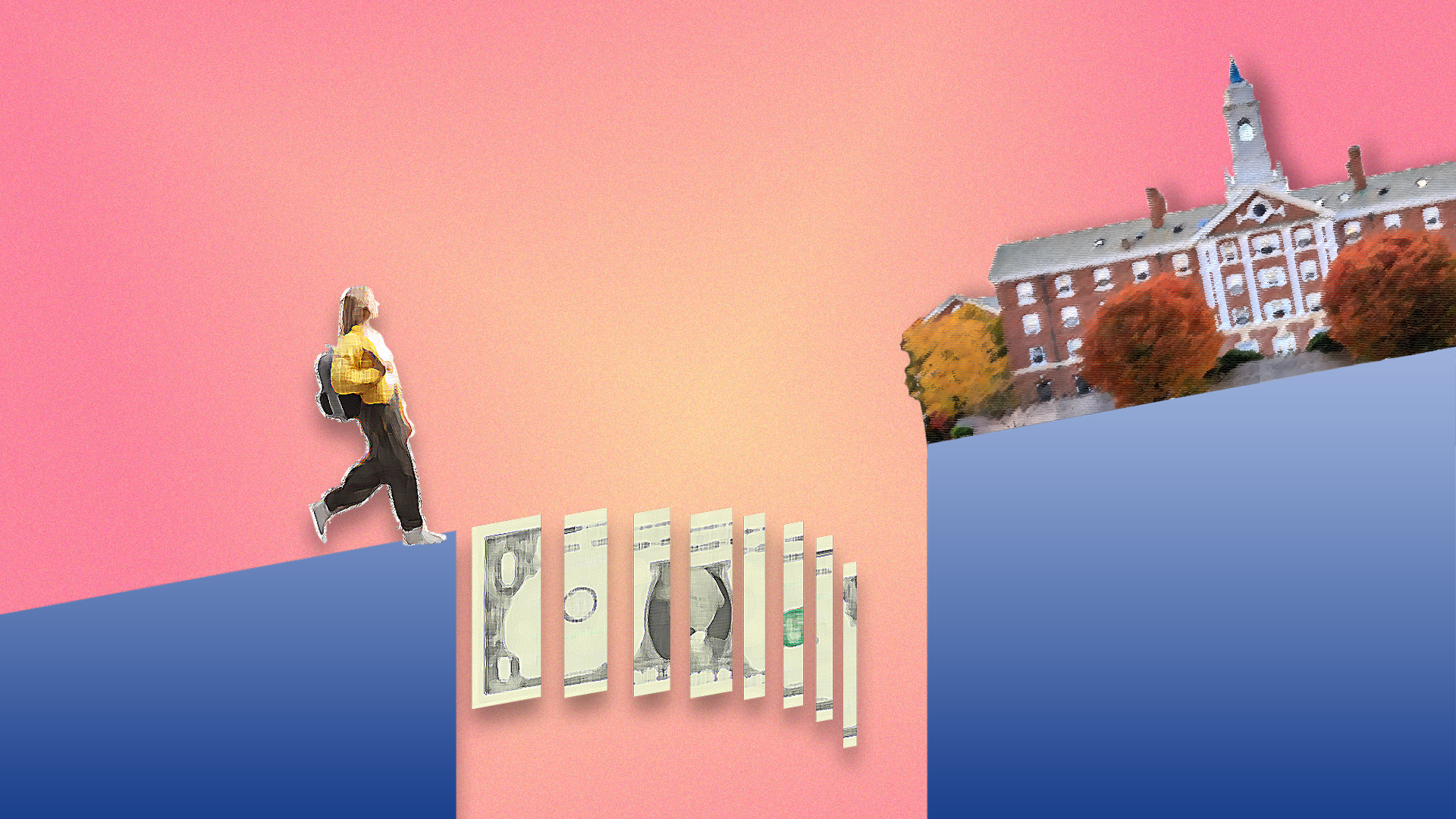
In the grand scheme of things, the Kleins had an easy ride. But for lower-income and first-generation students who have had little to no exposure to the complex college affordability equation, there’s often a sense of helplessness. High schools may not have the resources to adequately inform these students about monies available to them. Left with not much more than the sticker price they read on a college website, many students give up and fall through the cracks, never knowing what funding might be available. 

According to the National College Attainment Network, these students left $4.4 billion in unclaimed Pell Grants in 2024, which represents an increase of $400 million from the class of 2023. “So much comes down to students and families knowing what to expect from college costs so that they can prepare for the future,” said Brendan Williams, vice president of knowledge at uAspire, a non-profit organization whose mission is to improve the economic mobility of underrepresented students by creating financial solutions to diverse postsecondary pathways. “When they miss out on understanding the funding available to them, these students and families think college isn’t affordable.” 

Even when introduced to some of the funding avenues, students and their parents can find the FAFSA, financial aid, and scholarship applications processes confusing. Most people, according to an NCAN survey, significantly overestimate the cost of both public two- and four-year institutions. 

“Most first-gen students assume they can’t afford college or that they’ll have to go into massive debt to afford it,” said Shellee Howard, C.E.O. and professional certified college consultant at College Ready. “There’s also a lot of negativity surrounding college affordability on social media, which discourages students before they even have a chance to succeed.”

There’s also the issue of language barriers in some cases, which adds an extra hurdle for some first-gen students and their families. The result is that too many students are missing out on opportunities. At a time when recent research points to the fact that by 2031, 72 percent of jobs  will require post-secondary education and/or training, that’s a giant loss for students — and the economy as a whole. 

A Landscape of Confusion 

In an ideal world, all high school students and their families would receive detailed information and assistance about the costs of college and ways to make it affordable. The government’s Federal Student Aid website would be easy to navigate and FAFSA/the student aid index easily understandable. But that’s not the world in which students live. 

“The system is broken,” Howard said. “It’s a huge problem and has existed for years.”

Howard was a first-gen student herself and today is the parent of four children who have all navigated the college application process, graduating debt free with her help. “If a family has an education and the finances, they hire a consultant to help them,” she said. “But if they are first generation, they have a long runway to start the process and don’t know what resources exist.” 

For lower-income and first-generation students who have had little to no exposure to the complex college affordability equation, there’s often a sense of helplessness.

One federal resource, housed under the Department of Defense Education Activity and designed to help students with college readiness, is the AVID (Advancement Via Individual Determination) program. Its stated goal is to support students in the “academic middle” —those who have the potential to succeed at increasingly higher levels but may need additional support to fully realize their potential. The program’s centerpiece is a toolkit to support future-ready skills like time management, organization, and critical thinking. It also touches on financial literacy, with 85 percent of students who participate submitting FAFSA, compared to an average of 61 percent in the 2023-2024 academic year. 

At its best, AVID is a nationwide program facilitated by high school guidance counselors that students can take as a subject or in a study hall. According to Howard, however, not all AVID programs are created equal, and many are not integrated into curriculum. “At some schools, you may have a very motivated teacher who ensures AVID is easily available, and those students have a big advantage,” she said. “At others, students have to seek out the program and assistance.”

The affordability problem — or lack of financial literacy surrounding it — extends beyond first-gen and low-income students, however. Evelyn Jerome-Alexander, a college counselor with Magellan College Counseling, frequently works with middle-class families. “The families who hire me and my team generally appear on paper to be able to afford the somewhat obnoxious sticker prices of the most well-known colleges,” she said. “Many just grit their teeth and ‘find a way’ to pay for college. My focus is helping them realize there are so many opportunities for their kids to get a great education without taking money from their retirement accounts.” 

Jerome-Alexander finds that most high school counselors don’t have the bandwidth to help students go beneath the surface with college affordability because much of the equation is highly individualized. One issue is the federal student aid index (S.A.I.), she said. “The S.A.I. sees an income level but doesn’t understand your expenses and what you have to spare for education.” 

One family Jerome-Alexander worked with, for instance, had a nice six-figure income. After going through the S.A.I. via FAFSA, they received no financial aid. On the surface, this would appear logical and realistic for such a high income. “But they also had a special needs child that requires very big expenses and will well into the future,” she said. “FAFSA doesn’t care about that or about how much you spend on education.”

This was a case where Jerome-Alexander’s guidance to complete the College Scholarship Service Profile application — which colleges and universities use to award non-federal institutional aid — made a big difference for the family. 

But families who can access counseling services like Jerome-Alexander’s and Howard’s are the lucky ones. Lower-income and first-gen students depend on their schools, web searches, books, and more resources they may not realize are available.

Programs to Help 

Like uAspire, MyinTuition is a non-profit with a mission to help mid- and low-income students understand the cost of college and find their most affordable option. Created by Phillip Levine, a professor and economist at Wellesley College, the organization runs on the theory that there’s an information problem when it comes to college costs. “To make a good decision about college, you need to know how much it will cost,” he said. “We haven’t made that easy in America.” 

While the federal government requires that all public higher ed institutions post the cost of college on their websites, the truth is that very few students actually pay full price, Levine said. “If you have a very high income, you’ll pay that number,” he said. “But most people are not in that category.”

Most people, however, don’t understand that fact. Net price calculators can be difficult to find and use; there’s a good deal of confusing jargon in college-cost speak; and even FAFSA can deter people nervous about sharing their tax information. This is where community-based non-profits hope to fill in the gaps. 

MyinTuition has created its own fiscal tools to help aspiring college students understand their real costs. Right now, the organization is partnered with about 70 colleges and universities. “It’s not perfect, but it provides a ballpark estimate and range, which is a huge advantage,” Levine said. 

Getting tools and information dispensed to students and their families will continue to be one of the biggest barriers, and Williams from uAspire sees lost opportunities here. “I can’t reiterate how important it is that college costs are family conversations,” he said. “High school is a time when you have a captive audience, but often, even when there are informational meetings, they take place when many low-income parents might be working.”

Today, uAspire operates in Boston, New York, and the San Francisco Bay Area, working alongside high school counselors. Where they don’t have a physical presence, Williams and his team are deploying to high schools in a “train the trainer” format. Williams hopes to keep building out his model, continuously working to close the financial literacy gap.

An Uncertain Future 

The wild card in all things related to college affordability is change at the federal government level. Step by step, the Department of Education is shutting down. The department, which has long administered the federal student aid program, is transferring the TRIO programs, for instance, which provide post-secondary education services for people from disadvantaged backgrounds. The D.O.E. is also offloading the Title III Part B program, which provides grants to Historically Black Colleges and Universities, as well as the Gaining Awareness and Readiness for Undergraduate Programs.

The $1.5 trillion federal student aid program will likely land with the Small Business Administration, which has no experience managing the program and has experienced its own 40 percent staffing cuts this year. 

And then there is the Big Beautiful Bill. “The bill is vague and there are many misconceptions surrounding it,” Howard said. “It has both advantages and disadvantages.”

In the plus column, Howard believes, is the fact that the bill allows more flexibility for 529 plans. Families will now be able to use 529 plans for credentialing programs and trade certifications. They will also be able to apply funds to tutoring, testing fees, and continuing education programs required to obtain or maintain professional credentials. 

Yet as it stands, the bill is also gutting $300 billion from higher education, eliminating the most affordable repayment options on student loans. By some measures, the bill will mean that a typical college graduate will pay nearly $3,000 more per year in student loan payments. 

Other changes from the bill include the elimination of Grad PLUS loans, which cover expenses for graduate-level programs, and new caps on Parent PLUS loans beginning in 2026. Klein, who is using a Parent PLUS loan, remains unaffected, as the program grandfathers in borrowers prior to July 1, 2026. 

While the future remains uncertain, Levine said there is some bi-partisan agreement that understanding college costs is too complicated and creating a significant barrier to entry for too many eligible students. Whether this results in any sort of reform in today’s environment is anyone’s guess. For now, however, Levine has this thought: “At the end of the day, we want students applying to schools that are the best fit for them academically and geographically. If their decision is based on affordability, that’s a constraint. If they can afford it and don’t realize it, however, that’s a failure in the system.” 

The Art and Science of Formative Education 

Listen Here:

Since its founding in 1863, Boston College, like many Jesuit institutions, has practiced “whole person” teaching, powered by the belief that one learns in multi-dimensional ways well beyond subject matter knowledge and vocational training. Over the last 20 years, B.C. has devoted particular time and resources to developing its approach and becoming a leader in the larger field, known as “formative education.”  

The university in Chestnut Hill, Mass. now has a formative education department within the Lynch School of Education and Human Development and has recently launched a campus-wide Transformative Education Lab (TLab), an interdisciplinary research and innovation hub dedicated to advancing the theory and practice of formative education.  

“We’ve been building up a particular vision of what education for undergraduate students should be about,” said Stanton Wortham, dean of the Lynch School. “Formative education is this notion of integrated or holistic approaches that are not just intellectual and not just vocational but include an interconnected set of social, emotional, ethical, and spiritual questions and developments.”

Wortham said the lab is designed to clarify and promote formative education so that it may benefit other institutions, both K-12 and higher education. Its first mission is to share best practices, through the literature and by convening people who are doing this work. Secondly, the lab will focus on the research on the method itself, with an intention to distinguish it from other practices such as social and emotional learning or character education.  

“All of those things are good but what we are doing here is different and has something special to offer,” Wortham said. “The purpose of the lab is to articulate that and present it to people more broadly.” 

“What we often do with children is just teach academic material, mostly through memorization, when what we need to do is ask them what kind of person they want to be.”

According to Wortham, formative education has four distinctions: It focuses on intrinsic ends, developing dispositions that stay with us for life; it centers both individual and community development so that young people are disposed to contribute to the common good; it is holistic, acknowledging the multiple dimensions within which young people develop — emotionally, relationally, civically, ethically, and spiritually; and it includes an emphasis on purpose, on discerning what we are called to do.

Deoksoon Kim is a Lynch School professor in the Teaching, Curriculum, and Society department and a strong believer in how the right kind of education can change people’s lives. As the inaugural director of the TLab, she seeks to seed within other institutions a method she believes can lead to personal growth in a way that other pedagogies cannot quite match.    

“What we often do with children is just teach academic material, mostly through memorization, when what we need to do is ask them what kind of person they want to be,” Kim said. “As an educator, I really wanted to make differences in people’s lives and in the world. This work really gave me a deeper sense of who I am and what I want to be doing.”

Kim has an ambitious blueprint for the TLab that includes three major strategies announced at the launch. In an effort to jump start and share new ideas, the TLab will hold a K-12 Formative Education Grant Competition which identifies and supports promising practices in schools, after-school programs, and community-based learning environments.  

In summer 2026, the TLab will host an intensive professional development institute designed to prepare K-12 educators and leaders to implement formative education practices in their teaching and leadership. And in October 2026, the TLab will hold its inaugural conference on formative education, bringing together scholars and practitioners from around the country and the world in both K-12 and higher education.  

Kim said developing the TLab to help expand the formative education pedagogy within higher education is a major goal. It is part of what she hopes will address a narrow focus on academic standards that she and others believe has “gone too far.”

“This is a great kind of a movement we are in — one that broadens education to be about meaning, character and purpose,” Kim said. “This is what we need to do to transform higher education.”  

You can reach LearningWell Editor Marjorie Malpiede at mmalpiede@learningwellmag.org with comments, ideas, or tips.