A Creative Conversation

David Kelley is the Donald W. Whittier Professor of Mechanical Engineering at Stanford University, but most know him as the creator of the Hasso Plattner Institute of Design, or simply the d.school. Kelley, who celebrates 50 years at Stanford this year (as both student and professor), presents more like an eloquent historian than an engineering genius. But it should be no surprise that the founder of an institute that invented “outside the box” thinking would be such fun to talk with.  

The founder of design firm IDEO and recipient of numerous honors and awards, Kelley describes his work as“helping people gain confidence in their creative abilities.” He and his brother are the authors of “Creative Confidence: Unleashing the Creative Potential Within Us All.” In it, they argue that labeling people, particularly children, as creative or non-creative is as limiting as it is incorrect. In this interview with LearningWell, Kelley talks about the connection between creativity and discovery, how human-centered design is changing the world, and how the d.school got its name.   

LW: I’m very curious about one of the main focuses of your book, which is creative confidence — unleashing the creative potential within us all. What do you think the implications of that idea are in the context of higher education?

DK: Most of my work could be categorized as helping people gain confidence in their creative ability. That would be what I care about the most. And I think we start out by people thinking of themselves as not creative, and I’ve tried to convince people — and prove — that everybody’s wildly creative. They just have blocks in the way of it. So you need to change the mindset from teaching people to be creative to giving them credit that they’re already a creative organism and remove the blocks keeping them from doing that. The psychologists call it self-efficacy — that you believe that you can accomplish what you set out to do. I mean, that’s just it. Wouldn’t you like to give every one of your students the notion that they can accomplish what they set out to do and have that confidence? I really think that’s the goal here.

So how do you go about that? The way you go about it, especially with students, is to help them have some success. You set it up so that it’s a problem that’s easily solved, and you hold people’s hands, and you lead them through it, and they’re successful at some small thing. Then you do another one, and then you do another one. Pretty soon, people are saying, “Oh my god, I am creative.” So I guess I’ll summarize: The main thing about creative confidence is how you help people remove those blocks. And the main reason that they have that block is that they are worried about the judgment of others.

LW: And that has something to do, I imagine, with what they’ve been told they are, right?

DK: Yes. You do something that’s not conventionally creative, or just doesn’t seem like it has a direction that’s creative, and then pretty soon you’re “not creative.” And people hear that when they’re nine years old. They hear, “You’re not creative,” and then they never address it again. It’s like, you try to play the piano, and you’re not good when you sit down for the first three seconds. You are not good at playing the piano, so you don’t continue. It’s hard. Doing things that matter is hard.

“The main thing about creative confidence is how you help people remove those blocks. And the main reason that they have that block is that they are worried about the judgment of others.”

LW: So you’re encouraging people to have a wider view of creativity and what that can mean?

DK: Yes, for sure. Sometimes, early on — I’m talking about child development — creativity is defined as drawing, believe it or not. If you can’t draw well without any practice and you just don’t naturally draw well, you’re identified as not being creative. Well, maybe this person’s musically wildly creative, or maybe they’re creative in a different way. So the problem is that, whatever the conventional way of doing something, if you are off that, you’re not creative. You’re also not conventional. It’s a funny dichotomy. But the main thing, yes, is that people are branded as not creative for a bunch of reasons, and we need to see that as wrong. 

LW: It sounds like there’s an urgency around this. Because if people are limited in thinking about themselves as being creative, then we have arguably less creative people. Why is it important to have more creative people?

DK: It’s only if you care about the future that you think creativity is important. That’s how you cure disease and how you make advancements in technology — is people being confident in their career ability and doing new things that change the world for the better. Our phrase that we like to use is: It’s your job to paint a picture of the future with your ideas in it. The funny thing is once you can use your creativity and paint a different picture of the future, then everybody else can have an opinion. They can help you. They build on the ideas of other people when they can visualize it — when they can see it. So that ability to visualize the future is inherently a creative task.

LW: Let me ask you a little bit about the founding of the design school.  Can you just give me a quick overview of that?

DK: Back to the notion of creativity — when you have a diverse group of people, you come up with better ideas. You can define diversity in any way you want: age diversity, racial diversity, or geographic diversity. But having those people — the mashup of those different people that come from different viewpoints — greatly increases the probability of you coming up with something new to the world. So that’s something I wanted to codify at the university. 

And so basically the notion of the d.school was to have a place that everybody wants to come to. A lot of the classes students take in college are required classes, and so the teacher doesn’t really want to teach them, and the students really don’t want to be there. I wanted a place where everybody wanted to be there all the time — that they opted into this place because it was so enjoyable, so fulfilling, rewarding, informative. So the d.school is really based on that notion of making a crossroads, where professors and students from all over the university would come together. And I’m so gratified. It turned out so great. And the reason — they all say the same thing, particularly the professors: “When I cross the threshold, I know I’m allowed to act differently here.” And that’s just like music to my heart. 

LW: Was it a difficult concept to communicate within the school?

DK: It started out with a bunch of us in a room talking. It wasn’t going anywhere particularly, but it got started. And then, fortunately, as we went further along, we had a perfect storm of administration. So we had a department chair and a dean and a provost and a president that all resonated with the idea. It took giving us the donation. I don’t know that I ever would’ve gotten it started if it hadn’t been for the generous donation from Hasso Plattner. But the president,  John Hennessy, came to me and said, “What would it take for all Stanford students to be more creative — to be more confident in their creative ability?”

It really helped to have that. I mean, faculty are very siloed and more concerned about their little empire than somebody else’s. So getting everybody’s attention was difficult. It took a long time to get the place up and running to the point that people were drawn there naturally. But it did snowball. It accelerated beyond my wildest dreams because it turned out to be true — that it was super interesting for these geniuses from different departments to get together and duke it out on different topics. They really liked being there. They liked teaching together. And the way we used to do it before was I’d go in and lecture in somebody else’s class, or they’d come in my class and give a lecture. But that’s not a collaboration. Once people started to team-teach classes  — somebody from political science teaching with somebody from the ed school or the business school or the law school — when they were actually standing in front of the class together for the whole class, then we knew we had it. That’s what we were after.

On a side note, one of the most interesting things that happened was how much the students loved watching the faculty fight. Somehow it was really cathartic for the students. They were used to the sage-on-stage, saying their point of view unchecked by anybody else in the room. So as soon as you get a couple of strong-willed experts in the room talking about a subject and they disagree, it’s really interesting. I think, for the students, the faculty became more human to them, and maybe there’s not a direct, correct answer to every question. 

LW: I hear there is an interesting story about the naming of the school?

DK: Actually, it is not a school at all. It’s completely separate from the academic hierarchy.  I remember sitting around a room — a couple of my graduate students and friends — and we were figuring out how to make this happen. And it wasn’t clear. We are a small organization and felt we weren’t very well understood. So there was the business school — the “B-school” — that was a really big deal on campus, and to feed off their importance, we decided to call ourselves the d.school.   

LW: That’s fantastic! Can you define for our readers what you would call design thinking?

DK: Yeah. Design thinking is just a description of the methodology and process that we use to routinely innovate. The way I talk about it is mostly around human-centered design. So there’s plenty of people who have methodologies that are business-based or technology-based, and those are all good, and we employ those. But we seemed to lack a human-centered approach. What’s feasible and viable is nice, but what’s desirable? How do you make it more useful or convenient for people? How does it fit better into people’s lives? To me, that’s what design thinking is. It’s a human-centered approach. And all the discussion about design thinking is the steps — the methodology — that you use to do that, but it’s all centered on: How do you make it better for people?

LW: What has been the reaction to this method at the d.school from the students? 

DK: Well, at first, all of our classes were electives. So the students were choosing something that they were particularly interested in. And by having different faculty, there were two wildly different points of view in the same room. So the students were excited about that. I’m going to go back to the same thing about human-centered design: Everybody can buy into this because it’s so human. I mean, we’re all humans, and the driving force is: How is this going to be better for the students? Or how is this going to be better for the people we’re trying to design something for? That humanness is just really enjoyable.

And today, one of the consequences is that I used to be able to tell the students to design a clock radio or something like that. I’d be shot if I said something like that now. They want to do something that has social value. They want all their projects to be something that’s good for the world. And I think that’s a consequence of the human-centered approach. What they want to do is improve the lives of people who live in a village somewhere and don’t have the internet. As a steady diet, that’s what they really want to do, which is encouraging for that whole generation if you ask me.

LW: You’ve been at this a long time. Any other observations about how your field has changed?

DK: Design was just not a big deal in the world as a discipline. I always say I felt like I was at the kids’ table, and then through mine and a lot of other people’s efforts, we’re now at the adult table. And I think that has to do with our way of thinking — that finding the right problem to work on is as important as the problem we are solving. Before our language, everything was problem solving, problem solving, problem solving. And after design started to take off, it was all: What’s a project worth working on? Need-finding, more than just problem solving. So that put it front and center: the messiness of trying to understand what people really want, what would make their lives better.

Part of everybody’s process now is this human-centered approach where you go out and try to understand — we call it the need-finding —what’s valuable to people. It’s a messy phase. At most companies, people want to sit there and look at their laptops in a conference room. They don’t want to go out into the field and experience what’s really going on with people. And I don’t understand why that is, but we’re getting better and better in that more and more organizations start out by trying to understand what’s a good problem to work on by understanding what people really want. And I think that’s a consequence of design having more agency in the world.

And I can tell you a million stories. One of the ones that comes to mind with my students is this class called “Liberation Technologies.” They were asked to look at fire prevention in these villages in Africa, and I thought they would end up doing a low cost fire extinguisher. But when they got down there and used our process and talked to the people, they started to realize that, yes, they were afraid of fires, but they’re really afraid of losing their documents in the fire — their immigration documents that prove they were allowed to be in this building. And so students changed the problem from fire prevention to document preservation.

Their solution was a pickup truck with a scanner in it. And they went from village to village and scanned everybody’s documents and put them up in the cloud. When you have a mindset of understanding what’s the real problem by talking to people, then you solve the problem in a completely different way or you even solve a different problem. But for your question, I think that’s the contribution of design being in the world and our methodology having some impact.

LW: Do you worry about people making things that aren’t good for the world?

DK: We used to teach an ethics class and now there’s ethics in every class — to try to understand the consequences of what you’re going to do. We have a culture of prototyping, where we take a first pass at what we’re going to make, and then you take it out and actually get it into the situation where it’s going to be used. So before you’ve committed to what it’s going to be and get it out there, you’ve seen the consequences of it. Before you commit to doing something bad or something good, you want to know the non-obvious things that are going to happen when that invention enters the world.

You can reach LearningWell Editor Marjorie Malpiede at mmalpiede@learningwellmag.org with comments, ideas, or tips.

A Voice for High-Needs Students

Not many academics find mainstream success with the publication of their first book. Anthony “Tony” Jack, Ph.D. did.

In his award-winning debut, “The Privileged Poor: How Elite Colleges Are Failing Disadvantaged” (2019), Jack explores how elite colleges and universities tout mounting diversity but tend to recruit students of color from private and preparatory high schools rather than local, more distressed ones. His second book, “Class Dismissed: When Colleges Ignore Inequality and Students Pay the Price” (2024), tracks the fallout of the pandemic for students with little to no support at home, and how institutions failed to anticipate and respond to their needs.

From assistant professor of education at the Harvard Graduate School of Education, Jack joined the faculty at Boston University in 2023 as an associate professor of higher education leadership. At B.U., he is the inaugural faculty director of the Newbury Center, a resource office for first-generation students across undergraduate and graduate programs. From his perch as researcher, educator, and student affairs insider, he offers a unique understanding of the challenges facing high-needs students, as well as those supporting them. He’s also committed to being part of the solution — one that hinges on scholarship and student services working together. 

LW: To start, could you give a bit of background on your research and areas of expertise up to now?

TJ: In my first book, “The Privileged Poor,” I discussed an overlooked diversity in higher education. Universities were doubling their efforts to recruit lower-income and first-generation college students, and many universities had actually almost doubled the number of Pell-eligible students who they were admitting. But my question was always: Where are they getting those students from? And what I show in my first book is that they were actually going to get their new diversity from old sources: boarding, day, and preparatory high schools. And I called those students the “privileged poor,” lower-income students from boarding, day, and preparatory high schools. And I called their peers who went to low-income — typically distressed — public schools the “doubly disadvantaged” and showed how students’ trajectories to college shaped their trajectories through. 

One thing in that book that I wish I was able to engage with more was how the inequality at home so often comes to campus. “Class Dismissed” was born out of a pebble-in-a shoe-type moment, where all the presidents of universities were like, “I didn’t know our students didn’t have internet at home. I didn’t really know what kind of communities they were coming from.” And I’m just like, but you do. Your admissions officers know. From their personal statements — because you make them pimp out their poverty — you know where they come from. You know what they’re returning to. “Class Dismissed” was a response to that. What was important for me to bring to “Class Dismissed” is to say that COVID exacerbated the very inequalities that students were suffering with in silence. 

LW: And you are now involved in translating some of those lessons into practical supports, right? At the Newbury Center at B.U.? Could you say a bit about what goes on there and what it means to be the “inaugural” faculty director? 

TJ: The Newbury Center is this amazing opportunity to put my research into action because the Newbury Center is a resource center for first-gen undergraduate, graduate, and professional students. There usually isn’t this coordinated, university-wide effort to support students who are first in their families to go to college. And so the Newbury Center is unique in that sense. And it’s a really amazing opportunity, as well as a monumental task. Because we have people who are coming in at 17 and 18, and we also have people who are coming in at 30 and 40.

My inclusion is to put research more central to the endeavor: How do we support our undergraduates to go to study abroad? How do we make sure that we understand the best practices to help them get internships — to get opportunities to extend learning beyond the classroom? Those are the kind of things that I’m able to do and support with research. During the summer, we actually help students who take on unpaid or low-pay internships with stipends. It is so stressful to be able to have this amazing opportunity to work in a field that you love, but you can’t afford to live where the internship is. We can help fill that gap for lower-income students. Not as much as I would hope, but that’s also why I’m helping to expand the center so that we can help more people. 

LW: So had you heard of the Newbury Center when you were at Harvard, and it became sort of a driving force for you to move over and get more involved? 

TJ: The Newbury Center is still a very young center. Five years. The ability to craft its trajectory from early on was an attractive piece to get me to think about going from just being a producer of research to now also being tasked to create policy and advocate on behalf of students across the country. 

My work on food insecurity is a huge piece, where I can actually engage with deans. I was doing that in addition to my work at Harvard, but now it is part and parcel of my advocacy work at B.U. My work on mental health has shifted from being a finding that I have about how students do or do not seek help to now being able to invite directors of mental health services to campus as part of an annual conversation. 

LW: It’s interesting that you say that. I was thinking about that dual role you’re playing as a professor and then in more of a student services role at the Newbury Center. Did that feel like kind of a natural balance for you to strike? Was there ever any kind of hesitation or feeling like you needed to stay in one lane? 

TJ: No, for me, from the very beginning, my philosophy was: Why just write about it when you can do something about it? 

In “Class Dismissed,” I have this line: “Now that we know what we know, what are we going to do about it?” Don’t just relegate a very, very important possible policy change — one that could fundamentally change the everyday existence for tens of thousands of students across the country — to a paragraph at the end of the paper. Why not give more life to it? It’s ethical research. It’s theoretically informed. It’s empirically rich. Why not add that fourth element? And then also to write in an accessible way so that a president, a professor, a dean, a parent, can learn about what the children in their life are going through. 

“In ‘Class Dismissed,’ I have this line: ‘Now that we know what we know, what are we going to do about it?'”

LW: Right. On that note, what are young people going through right now? This is a broad question, but what are your major concerns at the moment for students, especially first-gen or low-income ones?

TJ: The thing that’s top of mind right now? I mean, where do we go? We can talk about affirmative action, withholding of funds. It’s just a lot, to be honest. But one thing that I think people need to realize is happening on campuses in this McCarthy-era-style politics that we find ourselves in — what we are seeing — is labeling what were once good student affairs practices as “benefits.” And any limiting of that newly labeled benefit to a particular group is seen as unconstitutional. That is a very different way of doing student affairs. Student affairs was saying, “Hey, we are here for everyone, but we also know that we have to take particular steps to welcome different groups. And we do that by allowing — supporting — affinity groups and hosting these different offices because we know that our campuses were literally not made for people here, who are here now.” 

Now that work is said to be giving an undue benefit to someone else and discriminating against, essentially, a white man, which is now the reference point for any kind of support service that you have. And that list is going to get longer and longer. It’s going to go just from being a white student to a white male student to a white Christian male student to a white rich male student. And it’s just going to keep getting longer and longer until that reference is a very narrow person, who is not the modal group on campus, and yet all policy and all practices are going to be seen as: Are you not allowing this person to feel comfortable here? 

LW: Have you been experiencing that firsthand through the Newbury Center or otherwise — restrictions to your work or your ability to support people?

TJ: To be honest with you, it’s a day to day thing. We don’t know when we’re going to get another “dear colleague” letter. We don’t know when another executive order is going to come out. We don’t know if any university is going to keep fighting it through the justice system, knowing that the Supreme Court is what it is. And so we’re waiting day-by-day to figure out: Can we continue to do the work that we do across the country?

LW: But so far, do you feel like — notwithstanding daily challenges or pivots — you’ve sort of been able to maintain the level of support that you had in years past?

TJ: So far. 

LW: And in terms of your student interactions, what are you hearing from them about the things that they’re most nervous about? How do you guide them through that, if that’s part of your role? 

TJ: It’s generalized anxiety about what is next — what’s going to be possible. And so what we are trying to do is still encourage students to put themselves out there — go for every internship, go to study abroad, pick out your favorite spot in the library that you are going to be known for at your 20-year reunion: “I would always see you in the library right at your favorite window.” They can still make memories and take advantage of all the things that college provides. That is incredibly important. That’s just huge. 

LW: What else are you thinking about going forward with this school year? What are you anticipating will be the biggest challenges both for your own work and also for the students that you support? 

TJ: If it’s two things that rob people of so much, it is scarcity and precarity. Right now, everything that we are trying to do is to make ends meet with less and in less time. And to be honest with you, this is the year that I want to be fully present for students and hear from them — learn from them — so that, as I craft out my next project, it is one that is going to not only expose what they went through but think critically about the policy and practice changes that can help support them going forward. 

LW: Is that something that you feel hopeful about? The idea that the policy change could really happen and make a difference? 

TJ: First-gen-as-pawn is something I’m really grappling with right now because a lot of people are flocking to first-gen — to recruit first-gen. But they’re not ready. They’re still not ready.

LW: Not ready to support students once they actually come to campus? 

TJ: Yeah, yeah. Those are some things I want to just grapple with. 

LW: In terms of a future research opportunity or just in general? 

TJ: Well, for me, everything is going to be tied to investigating it. Students’ voices inform the policy suggestions that I present to colleges because I believe that in students’ voices are the keys to success and a more equitable future. 

LW: Is it encouraging to see other actors or organizations with a similar outlook and doing similar work?

TJ: It’s absolutely encouraging. Because that means that people are intentionally invested in making campuses not only more accessible but equitable. They would probably never be equal. But to have a more equitable space — people who are being intentional about removing some of the hurdles that disproportionately hurt, humble, and quite frankly, sometimes just destroy those who believe in education the most. Not as, “Oh, I have to go because my family has always gone.” But literally the people who believe in it because they believe in the power that they can completely transform their life. 

LW: So still feeling like that’s possible? 

TJ: I’m a first-generation college student myself, so this work is inherently personal, as well as it is professional. I do believe in the power of research to change things. I do still believe in the power of education to be transformative. I believe in the power of research to make that transformative experience more accessible to more people. 

One thing I would love is a push for more researchers to write in an accessible way and not ignore general audiences. Because it’s important — especially now in this age of misinformation — for more people to actually understand what goes into research and how our findings are not manipulated. We need to stop talking at people and have conversations with people. And so I don’t think that work is any less theoretical just because people can understand it. 

You can reach LearningWell Reporter Mollie Ames at mames@learningwellmag.org with comments, ideas, or tips.
Posted in Q&A

Disrupting, Politely

The New Model Institute for Technology and Engineering (NMITE) in western England offers an unorthodox approach to university life and learning by any standard. In the United Kingdom, where tradition reigns in higher education and has for several hundred years, NMITE President and Chief Executive James Newby says the fresh concept behind his college is especially radical.

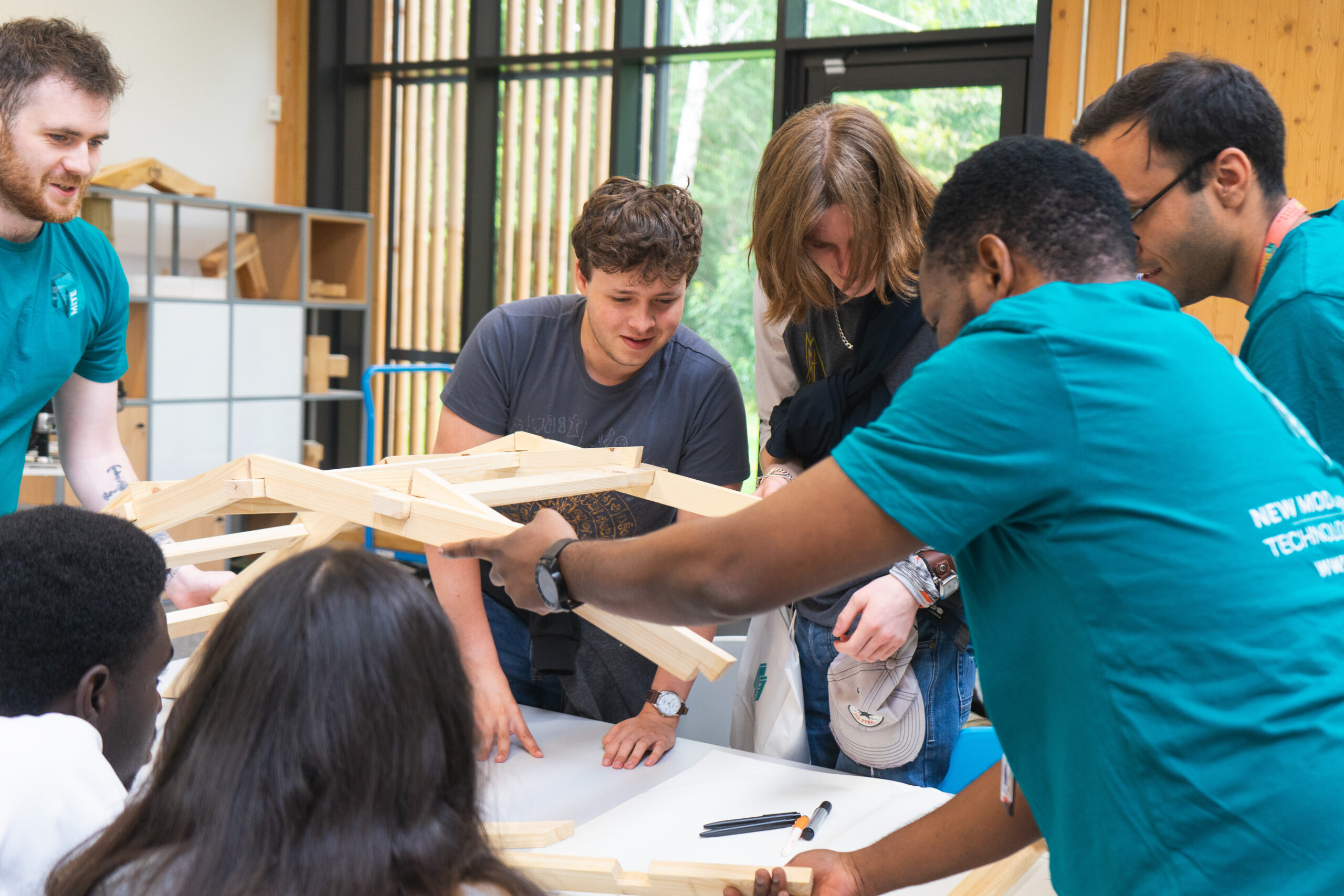
Around 2021, when NMITE welcomed its first class of students, Newby joined the team of what he calls “closet revolutionaries,” dedicated to forming a new generation of engineers uniquely prepared for career. The approach centers highly practical, collaborative assignments that mimic dynamics in the workplace. The intimate, immersive, and accelerated pathway attracts a wide range of students, all hungry to get the most out of their education — and their money.

With LearningWell, Newby discusses the big idea behind NMITE and the many small deviations from the standard that bring it to life. He’s leading with the “politeness” to navigate British education from the inside and the boldness to envision how one institution could launch a movement.

LW: Tell us a bit about the concept behind your work and its history. Why is this new approach important right now?

JN: NMITE is a very rare thing in the U.K. higher education system — a new university starting entirely from scratch. It’s very unusual in the U.K. for new universities to happen at all, but to happen without evolving from some precursor institution is incredibly rare. 

There are really two key strands to our mission. The first is that the U.K. engineering employers have, for about 20 or 30 years, been complaining that the graduates they get from the traditional higher education sector just aren’t what they need — don’t have the right skills. They’re not ready to work. It takes too much time, too much money, and too much effort to convert them into really good, valuable employees. So we wanted to create a university that would just prepare a different type of engineering graduate, and our key focus was to make those graduates work-ready. It’s not just about producing brains on a stick or graduates who are good at winning pub quizzes. They need to be able to work and interact and understand what they’re doing. 

The second key strand of the mission was to put a university in a part of the country in the U.K. where there hasn’t been one before and, therefore, where very few young people went to university. When I explain this to Americans, they’re always very surprised because we always look like such a small country from the American vantage point. But there’s such significant regional variation in the U.K. that we feel like a number of very different countries all crammed onto this very small island. So the part of the U.K. that we’re in near Wales is very sparsely populated, and, actually, very few young people who grow up in this part of the U.K. will ever go to university and enjoy all the life benefits that come from having that level of education. There’s just a lack of ambition regionally. There’s a lack of pathways that are really clear and easy to access for young people here. So we wanted to create a new type of engineer and really warm up this higher education cold spot in the U.K.

Those are the two things we were set up to do. It’s fair to say it took a long, long time to get us off the ground. We knew we didn’t want to create something that would just add more capacity to an already quite crowded higher education sector. It had to be different. We had to be quite disruptive — in as positive a way as we can — to a sector in the U.K. that had really not undergone any kind of major reform, any structural reform for generations. Most young people in the U.K. who go off to university to do a degree do it in the same institutions in the same kind of way that they’ve always done it. Every other sector of our economy has been completely reformed in the last 30 or 40 years through market disruption or political prioritization. But higher education has largely grumbled on in the same way. 

LW: Was the prospect of leading that sort of rare change in U.K. higher education what personally compelled you to get involved with NMITE? What stage in your career were you at when you joined the team?

JN: I had been working in a big, traditional university — the sort I’ve been describing in disparaging terms. So I was probably part of the problem. But I was approached and asked whether I might be interested in this really mad idea of building a new university. It was one of those questions where you think, If I say no now and then just go and do another job similar to what I’ve been doing for the last few years and just plop on through to retirement in that way, then I’ll just regret for the rest of my time that I never did this. So I took the plunge and did it. I’ve never regretted it.

We tend to attract staff who are sort of “closet revolutionaries.” They’re really frustrated by the system they feel stuck in, and they really want to do something exciting and different. Even if it might fail, you just want to do it. Or we recruit people who just don’t come from the same traditional background. A lot of our team are early career academics, so they’re in their late twenties, perhaps postdoctoral students. They’re not embedded in academic traditions. They’re good at innovation. 

I lived near London when I joined. I was in the part of the U.K. where all the economic activity and the main jobs are, and all the innovation is. So I did have to grapple with moving my family to this rural corner of the country to do this. That was not an easy decision, frankly. I remember it because it’s the decision we ask a lot of our students to take when they come from London or Birmingham or Manchester. It gives you empathy, if you just remember how you felt. So I did it, and I can tell them it is the best thing I ever did, and they should give it a try. And when you’re 18, you should do things like that. You should take a few risks.

LW: So despite being positioned to bring in a new type of student in its rural area, NMITE also serves students from far and wide? 

JN: It’s both. The U.K. system actually isn’t as regionally rooted as the American system. Most of our institutions have a national outlook and a national focus, whatever the location of their campus. Some of the smaller ones, just by virtue of their geography, do tend to recruit more local students. And there’s a trend towards attending your local university slightly more than there used to be, but that’s because it’s so much less expensive to do that than to have to pay for accommodation at some distant institution. And that’s another reason why well-off kids can make all the choices that they want to make and less well-off kids simply don’t have the same choices. That’s something else we’ve always been conscious of. We want to drive social mobility and give opportunities — the same kind of opportunities for the same kind of quality — to kids who generally can’t move around the country just because of economic constraints. Our split between local students and those recruited nationally is about 40-60 in favor of national students, but 40 percent is a significant minority in the U.K.

LW: Got it. Can you elaborate on some of the other specific ways you’re flipping the script on educational tradition in the U.K.?

JN: Well, the model is distinctive in the following ways: We adopt block learning. Our students learn one topic at a time in the form of an immersive learning experience in a single module. That’s unusual in the U.K. Generally, degrees are built from various modules of building blocks, but you’ll learn them in a timetable that moves you around the campus from one topic to another in any given week. It’s a very inefficient way of learning. I often draw the comparison to learning to play the piano. You learn much quicker if you spend three weeks doing it in a completely immersive way with a full-time tutor teaching you the whole time than if you’ve split the same number of learning hours across a year and do it once a week for one hour along with everything else. That immersive form of learning significantly accelerates learning gain for students. They learn and become technically proficient much more quickly. 

The other thing that’s distinctive is we accelerate the program, so we compress the learning into a shorter time period. Whereas it takes three years to do an undergraduate degree in a normal U.K. university, it only takes two years at NMITE. The reason for that is we make our students work nine to five Monday to Friday in this immersive way. That’s a much more efficient use of time. It reflects much more accurately the rhythms and patterns of a job — the workplace. It’s really good for developing a work ethic. We work very hard to make sure our students are on task for much more of the time. That means they’re working on something purposeful.

When we say that, it sounds very earnest. But we try to inject quite a lot of fun. We definitely don’t disapprove of fun. But what we really want them to be doing is meaningful, on-task work. That’s because our observation of traditional universities is students just spend an awful lot of time rattling around between lectures, not engaged in anything purposeful. And when you are paying by the year, that’s just not getting you the payback for the money you are spending. It’s just not good value for the student or the taxpayer or the university. 

Our students are always working on challenge-based learning. Instead of putting them in lecture theaters and transmitting theory to them via PowerPoint presentation or a lecture, they’re working in a hands-on way. There may be a series of quite short, sharp seminars to transmit technical information, but most of the time, they’re working on something that delivers an output that reflects what happens in a workplace. They might be building a prototype or a series of codes or a circuit board. We don’t test them by traditional exams. 

We’ve developed a whole pedagogical approach whereby students only succeed if the team succeeds, and they have to work in teams. We’ve designed it so you can’t possibly do the course — it’s too much — to do on your own. You could only succeed if you work as a team — divide the work up. And it’s just the social skills that develop, the extra support that inevitably provides — the nurturing that gives to people who are more neurodiverse and who struggle with self-directed learning common in traditional universities. That scaffolding is just provided in a much more real-world kind of setting. We find that’s hugely effective. 

So those are the main elements of the model that are different from a traditional degree. One of the things we’re quite obsessive about is the accusation we might not be academically rigorous — that this is just too vocational in its style. We obsess about academic quality. We are absolutely determined that the students we produce will have the same level of technical knowledge and proficiency as a student from a top university. But what will be different is they’ll have much more practical capability and much more emotional intelligence. 

LW: And when you heard from employers unsatisfied with newest engineers, were those the main things — work ethic, work experience — companies said young people were lacking? Are there other areas this model is directly responding to?

JN: We wanted our students to be really ethically conscious. We do that by teaching them quite a lot of liberal studies. They have to know how to do some engineering, but they have to know why they should do it — or why they should not do it.

Just being able to do something doesn’t mean it’s the right thing for you to do. We want them to understand the sociological impacts, the climate impacts — the ethical things you have to grapple with. We do a lot of work with the defense and security industry in the U.K., and that creates lots of really fascinating engineering challenges, but it creates quite a few ethical things to think about, as well. If you are building a drone, you might be building it for humanitarian purposes to deliver aid to disaster areas, but it could quite easily be repurposed to deliver munitions in a war zone. We can’t make the world simpler than it is, and we can’t make those problems go away, but we can equip students with the emotional intelligence to cope with the debate that happens around them, so they can choose where they want to apply their skills and who they want to work for.

LW: And I imagine that ethical training serves the more academic focus you were talking about, in contrast to those detractors who may say this school is totally devoted to professional development.

JN: Yeah, I’m not entirely sure how it is in the American system, but in the U.K., we have this rather tedious binary debate about vocational versus academic training. I mean, it sort of goes without saying you need both to really survive in this world and to thrive in this world. You have to be good at the practical teamworking elements, but you have to have good theoretical knowledge, as well. We want to create students who can think and do — not one or the other. We try not to overcompensate on the risk that we are viewed as too vocational and not academic enough. But on the other hand, we try not to say we’re one or the other or that one is more important than the other. The whole point is you can only succeed if you’ve led them both and produce people with genuine intellectual intelligence but practical and emotional intelligence, too.

LW: How does NMITE differ from other schools in terms of its criteria related to math and science?

JN: That was a really important thing when we started. So to do an undergraduate engineering degree in the U.K., it’s nearly always a prerequisite that you have a maths or physics A-level. An A-level is an advanced level of pre-university study, and to get a maths A-level is quite hard. It’s one of the hardest pre-university subjects you could do. Physics is hard, as well. And because they’re difficult, fewer kids do them than really should. But what we found when we were developing the NMITE courses was that most of what you need for that maths A-level doesn’t actually present until much later on — year two or year three. So we asked ourselves the question: Why do we exclude people from engineering because they don’t have that maths A-level, when they actually don’t need the content in the maths A-level until at least a year into the course? That would give us plenty of time to get them up to speed — recover their maths learning — and it would stop us having to exclude them from becoming an engineer. But if we did that, we would open up the profession of engineering to this fantastically new pool of people who are currently excluded. 

Would you believe that includes an awful lot of women because women don’t do engineering in the U.K. in anything like the numbers they do in other countries? About 15 percent of engineers in the U.K. are female. So there’s a massive diversity problem. Most engineers look and sound like me — not enough females, not enough from different backgrounds, and not enough ethnicity in the profession. We wanted to focus on was the gender problem: Can we set a target to have 50 percent of our cohort as female, so that when we recruit a girl onto our courses, we don’t put her in a class with 28 other boys, so she just feels like a minority the minute she walks in the door? What we found was bright girls in the U.K. who do maths A-level almost never go into engineering. They go into medicine and other disciplines. But actually, girls who don’t do the maths A-level quite like going into engineering. We’ve got quite a lot, and they’ve really thrived. 

We tracked the attainment – their mathematical and their other attainment – and we found that students with the maths A-level perform at a higher level than those without in the first year of the program, as you might expect. They’ve had better academic preparation. But by the middle of the second year, they perform at exactly the same level. The playing field is leveled, and that’s because their attainment is being tested on engineering progress, not mathematics progress. You don’t need the maths A-level. You do need maths, but you need it in a way we’re teaching it. There is no reason for universities to exclude people because of the certificates they hold.

LW: Moving to the student life side of things, you said you’re not an “anti-fun.” I imagine that’s in the classroom and outside the classroom, but what does student life look like holistically at NMITE?

JN: NMITE is right for a certain type of student. We are not right for everybody. That’s the first thing. We don’t claim to have all the answers or to be the model that will replace all other models. We are right for students who value working in a smaller institution, where everybody knows each other’s name. We want our students to know that they matter and to feel like they matter. They’re not a statistic or a number in a big cohort. Most of them will say they really like just the personal nurturing atmosphere that the small teams and the smallness of the institution brings. 

Most of them like the fact that they’re kept busy and on-task, especially if you are slightly socially awkward or shy. And for a lot of neurodiverse kids, it often presents as a kind of social awkwardness or a difficulty in forming connections and relationships. They do well here because they can work in a small team that isn’t scary or intimidating. It feels quite nurturing and after a period of time, they gain quite a lot of social confidence from being able to practice in the safe place that a small team provides. So we are often struck by the fact that some of our kids join us without being able to even look you in the eye or talk to you properly. And then by the end of the course, they’re like George Clooney. They’ve got all this charisma and this confidence. That’s the transformational change that we really see.

The students that this isn’t right for are the ones like, frankly, my two sons, who want to go to a big city, where there’s loads of social things to do and sports facilities and bars and restaurants and thousands of other students and loads of clubs you can join. We are not the right institution for students who want to do that. 

LW: Right. Is it a challenge to attract students who maybe didn’t see college on their path, even if the school is in their backyard — to get them to see this as an option and to come?

JN: It was a real challenge to start with. It’s becoming a smaller challenge as we go, the more we deliver good results. We’ve now got a graduated cohort of students out in the workplace. Our first-ever intake has gone all the way through and has now left – finished, graduated – and they’re in the workplace. That’s enormously helpful to telling people, “This could be you.” That’s reflected by our application rates, which are very strongly up. But to start with, that was really difficult. Our opening pitch was, “Come to a university you’ve never heard of in a part of the country you’ve never heard of to do a degree that’s really hard and no one wants to do. How ‘bout it?”

LW: On that note, what is the buzz like in the engineering community around this program? Are you seeing a lot of students who were once planning on a traditional path but then looked at this model and said, “Wow, this is a lot more interesting”? 

JN: We get a lot of those. A lot of our students could have chosen any university in the country. They have the means and the academic preparation to do that. A lot wouldn’t have been given a second glance by the traditional system, but a lot could have. And the buzz from the employers is just fantastic. It’s very important we work closely with employers in our challenge-based learning in our studios. That’s an important part of our model. Employers are embedded in our curriculum in a way they’re not anywhere else, and there’s a bit of altruism involved. A lot of employers just wanted to get involved with this really interesting experiment in higher education. But now we’ve got employers who want to join because they know the graduates are so work-ready — so capable — by the end of their course that they want to get in early so they can pick them off before they get picked off by some other employer. So most — in fact all — of our first cohort of graduates got jobs before they graduated, and most of them got those jobs from partners they’d worked with during the course. They just formed those relationships. That’s a key part of the model. It smooths the transition from university to work. It’s not a completely continuous transition, but it’s very close to it.

LW: And what might you be looking forward to from here on?

JN: Because we’re small by design, our aim is not to grow bigger and bigger and bigger and then dilute the model, as we start reverting to the sameness of the sector. But we do think there’s an opportunity, at least in this country, to replicate the model. It can become a kind of surgical intervention in areas that are economically disadvantaged because we’re a small, quite agile university. So instead of the normal hundreds of millions of dollars or pounds it would take to build an academic infrastructure that universities normally involve, we see ourselves as a small, modular, nuclear reactor that could be put into an area, and then it can just warm it up. It creates new jobs — creates more knowledge-based jobs — which is hugely important, and it creates more really good opportunities for a professional, rewarding, economically secure life for kids who would otherwise never have the opportunity to do that. 

You can reach LearningWell Reporter Mollie Ames at mames@learningwellmag.org with comments, ideas, or tips.
What is “Academic Flourishing”?

Tyler VanderWeele, Ph.D., has in interesting C.V. He is a social scientist, an epidemiologist, and a theologian. And in the world of flourishing research, he is somewhat of a celebrity. VanderWeele is the director of the Human Flourishing Program at Harvard’s Institute for Quantitative Social Science. The initiative aims to study and promote human flourishing and to catalyze knowledge across disciplines that intersect with key components, including family, friendship, virtue, community, work, beauty, forgiveness, religion, purpose, and meaning. 

The program’s most recent research, the Global Flourishing Study, made headlines around the world for its eye-opening preliminary findings. Among them was the collapse of the U-shaped pattern of flourishing, which traditionally indicates greater levels of wellbeing among young people and older adults. According to the report, it was the poor mental health and wellbeing of the Gen Z cohort that caused the disruption. 

This month, VanderWeele and his team launched a separate initiative examining flourishing among young people — this time college students and their role in what VanderWeele calls “academic flourishing.” He describes the concept as “the relative attainment of a state in which all aspects of an academic community’s life are good,” including the degree to which institutions help students grow as human beings. 

The Academic Flourishing Initiative invites colleges and universities throughout the country to join in data collection and reflection in three areas: the individual flourishing of students, the flourishing of the campus community, and students’ perceptions as to how university life has contributed to their own formation. The last area excites VanderWeele, as he sees the understanding of how colleges contribute to attributes such as citizenship, character, purpose, and meaning as both innovative and, in some cases, controversial. 

In his office in Cambridge, VanderWeele offers coffee and conversation about the issues he has made the center of his scholarship and curiosity. 

LW: How did the Academic Flourishing Initiative come about? 

TV: Our working definition of flourishing is “the relative attainment of a state in which all aspects of a person’s life are good, including the contexts, the communities, the environments in which they live.” And while we’ve been looking at this at a global scale across numerous countries with our Global Flourishing Study, we do also firmly believe that a lot of the actual work of promoting flourishing happens in more local institutions. And from our prior reviews, we suggest four major institutional pathways to flourishing: family, work, education, and religious community.

As we’ve continued to reflect on how to promote flourishing in practice, we’ve thought that what we need to do is focus on each of these institutional pathways — on the dynamics that are specific to each of them and on how we can further strengthen opportunities to flourish. That led to work with schools and thinking about colleges and universities as well. On the school front, we partnered with the O.E.C.D. to develop a framework for metrics for education, for flourishing, which we’re also now working on operationalizing. But being embedded ourselves in an academic context, we thought we should take these notions seriously for our own university community.  What does it mean for an academic community to flourish?  It certainly involves the individual flourishing of the students, the staff, and the faculty which involves our established flourishing assessments — happiness and health and meaning and relationships and character and financial security.

But the flourishing of the community is more than that. It is also about good relationships within the community, proficient leadership, healthy structures and practices in place to help sustain the community with a sense of belonging and a common mission. To that end, we’ve taken our community wellbeing measure and adapted it for university context. But then we also thought, let’s turn to the mission and vision statements of colleges and universities and see how they reflect on their own understanding of themselves.

“Let’s turn to the mission and vision statements of colleges and universities and see how they reflect on their own understanding of themselves.”

You see pretty consistent themes, especially in research universities, related to the generation, preservation, and transmission of knowledge. But you also see, very regularly, notions of student formation — that institutions are here to help shape citizen leaders of the future, to help develop students who can contribute in important ways to society, to develop leaders who have creative capacities to address, in an ethical manner, some of society’s most challenging problems.

And we started thinking, Well, if we’re going to take the mission of these institutions seriously, we should start by assessing whether these beautiful, grand, important aspirations are, in fact, being achieved. Perhaps we can begin by asking students whether they think they’ve been shaped in these ways as part of their university or college experience. Has the university helped them to grow in wisdom and justice and leadership and capacities to work across difference — in addition to, of course, developing knowledge and capacities for critical thinking? It was those sorts of considerations that really led to this work and what we’re calling “academic flourishing.”

LW:  What is your pitch to institutions on why they should participate?   

TV: Essentially, we’re saying that the data collection that is typically taking place — often on retention rates and academic performance, job placement and salaries, mental health, experiences of bias and discrimination — is generally good. This is important work that should be done. But students who come to universities, and parents who send their children to universities — indeed, the universities themselves — often aspire to more. And if that’s the case, why aren’t we doing assessments on these other matters: whether there has been a growth in wisdom; whether they have greater capacity to think critically; whether they have been prepared for leadership; whether this has helped them to clarify their life purpose and define meaning? Students want this. If parents want this, and if universities and colleges aspire to this, let’s collect the data.

This is not being presented as an alternative to what colleges and universities are already doing, but rather as a supplement. And if colleges and universities don’t want to do that, then so be it. But what we’ve seen is that a number of them do, and so this is just an invitation to do so.

LW: In terms of the invitation to the colleges and universities, what exactly are you inviting them to do? How do you engage with them?

TV: We’re inviting them to participate both in assessment and data collection campus-wide, and then also to join a community of practice with other colleges and universities that are doing similar data collection. The idea is to reflect on the data, to try to understand it, and to try to work out together what the best ways forward are. How do you address the weaknesses as well as the strengths within a particular institution?

The heart of this academic flourishing survey is focused on — again — first, the individual flourishing of the students; second, the student’s assessments of whether the university or college is flourishing as a community; and third — and this is the real innovation — the students’ perceptions of the contribution of university life to their own development: to their growth and knowledge and critical thinking, yes, but also to their moral formation and character development and their capacities for leadership and citizenship, and their ability to find meaning and growth in the process of their college experience.

And so we’ve included 24 of these student formation questions, in addition to the individual flourishing and the community wellbeing questions. Universities are being invited to collect this data, and we have an automated Qualtrics survey to do this in a very straightforward manner. And we’ve now set up infrastructure to immediately convert that survey into a report for the individual school. And then that data will be used in a much larger database to try to understand dynamics across schools and universities. In addition, we’ll be hosting meetings and events to discuss the similarities and differences across institutions. If one university has a particular strength, we’ll talk about how this came about. How can the other universities strengthen in this regard?

LW: Do you get push back from people saying that flourishing and this student formation work is outside of the scope of higher education?

TV: In our academic paper, we include a principle with regard to the appropriate scope of efforts for flourishing in education. And we would agree that it’s not the school’s or the university’s responsibility to sustain all aspects of a student’s flourishing. This requires families. This requires neighborhoods. This requires workplaces. This requires religious communities. You can’t make the school responsible for everything, and they’re not equipped to do so.

On the other hand, just to say education is only about vocational career preparation seems too narrow because you have these extraordinary narratives — anecdotes — about transformative experiences. There’s real potential there, and we don’t want to restrict that potential. We’ve said what we’ve proposed is that the proper scope of educational efforts oriented towards flourishing concerns those aspects of flourishing around which societal consensus can be attained and for which educational leaders and staff and faculty are prepared to address.

LW: What has been the reaction to the student formation work?

TV: Different institutions each have a very different focus, and that needs to be acknowledged. We have divided the student formation questions into these four domains: knowledge and critical thinking, character formation, citizenship and leadership, and then meaning and growth. Not all of these aspects of student formation will necessarily be of interest to all institutions.

We think pretty much any college would be interested in increasing cognitive capacities and knowledge, so those we feel are always core. What we’ve also argued is, even for institutions that don’t embrace character formation as part of their mission, some of this is necessary to accomplish the cognitive and epistemic goals of their institutions. You need a certain level of perseverance to work through difficulties and to push one’s mind. You need a certain level of courage to work through controversial or challenging questions. And you need honesty in test-taking and research practices. We need justice and patience to be able to hear different perspectives we might not like.

I think everyone would agree on a lot of this. Take courage. Do we want our students to be cowardly? Let’s get a show of hands amongst the trustees and the faculty — who wants our students to be cowardly? What about honesty? Who wants our students to be dishonest? What about your practical wisdom? Who wants our students to be foolish? You’re just not going to get many takers. There’s a lot of individual character strengths that I think we can agree are important.

A number of colleges and universities have real visions of flourishing for their students, and that includes meaning and growth. Different institutions may place different weights on these various aspects of student formation, and we are not trying to be prescriptive. What we’re saying is, collect the data and hopefully your strengths align with where your primary areas of focus are. And if not, then it’s time to work on it.

LW: Do you find that schools are interested in flourishing because of the mental health association?

TV: Yes, I think there may be interest in flourishing because of mental health concerns, but we are trying to broaden beyond this. I think there may be roughly equal interest in the flourishing of the students and in these student formation questions. We’ve been leading with student formation as the real innovation here because there are other universities collecting wellbeing data. But all these aspects are related. I do think the mental health and wellbeing crisis amongst youth has gotten much of society to take these matters more seriously and to reflect upon them. What are the sources of that decline? I do think one of the sources is a lack of meaning, a lack of purpose. This is evident in surveys as well, when asking younger adults and students: What do they long for? What are they seeking? I think meaning is increasingly a common theme there.

LW: Four of your student formation questions are included in the Wall Street Journal college rankings. What does that indicate?

TV: We are certainly pleased that they would take these matters seriously, but we’ll let the college and university rankings folks continue their work. We are, however, going to try to use this data collection with the Wall Street Journal to launch the movement, but our goal after this is not to directly participate in any sort of ranking endeavors. We are focusing on the relative strengths and weaknesses of each institution, rather than comparing them. What can you be proud of and perhaps use in your marketing materials? Where are areas for growth, which you may not put in your marketing materials but want to work on internally? And then what do you learn from other institutions that may have different strengths and weaknesses than you?

LW: What’s next for the Academic Flourishing Initiative?

TV: We’re just starting out, and we’re focused on students. But as discussed in the academic piece, ultimately, if we’re talking about the flourishing of a community, that includes faculty and staff as well. So that’s another direction we would like to eventually go. We’d also like to look at alumni and parents. I think employers would be another interesting aspect of this. But we needed to begin somewhere, and students seem to be the right place to being.

When Questions Are the Answer 

At Roanoke College, purpose is part of the brand. With the motto, “Our purpose is to help you find yours,” the school prides itself on guiding young people towards full and rich lives focused on doing good in the world.  

The champion of this bold expression of formative education is Roanoke’s President Frank Shushok. With degrees in education and 30 years of experience in the field, Shushok is passionate about the role higher education can play in young people’s personal and professional growth and has compelling reasons for why they should be intertwined. In this interview with LearningWell, Shushok talks about creating counter-cultures on campus in which students are frequently asked meaningful questions without binary answers.  

LW: How has your background influenced your role as a college president?  

FS: First of all, I am a person of faith, and what I mean by that is my whole life has been shaped by a sense that life is for a purpose. Believing that my own life can push forward goodness in the world is something that both centers me and compels me. I’ve also been focused on interfaith curiosity and collaboration, and along the way, that has drawn me into many conversations about how people find meaning and purpose in their lives. 

Almost all people yearn to understand why they’re here, and I find very few people who, at the end of that question, don’t believe their life should be for something good. Whether I’m sitting at a table with Muslims, Buddhists, agnostics, Christians, or atheists, I have found that when we begin a conversation about how we find meaning and purpose in life, designing a life toward virtue is a really powerful connector. 

That framing says a lot about how I view higher education. I absolutely believe every student should be able to graduate and find work that can support them economically and support their families. But I also want them to find purpose in that work and to find an alignment between their gifts and talents and a need that the world has. When that happens, energy and hope abound, and who doesn’t want more of that?

I’m such a fan of the good work that’s being done on the science of hope and the idea that hope has three actionable components: goals, pathways, and agency. In short, to have hope, you need a goal you’re shooting for and practical ways to go after it. You also need pathways and a consistent belief that you can get there — agency. What I love about the agency part is some people have plenty of agency and some people are growing in their agency, and that’s the golden time when they need someone to walk alongside them until they have the confidence to make progress toward their goals. That’s our job. Fundamentally, I believe that higher education is there to inspire in students a sense of purpose, shaped by character, and that makes life so much richer for them and for everyone in their orbit — their families, communities, workplaces, etc.  

But for whatever reason, I find a lot of college students haven’t thought about how their education can be about connecting to much more than a job-slash-career. Often, it’s not a question or a conversation they’ve been having at home. And it’s not a conversation that they’ve been having in the educational environment they were in prior to college. Sometimes, they make it all the way through college and never have this dialogue with anyone, even within themselves. In fact, they mostly have had one conversation, which is about the return on investment question: “If I go to college, what should I study so I can get a certain job, so I can have a particular level of economic security?” 

Those are also good questions, but they’re much more powerful if they’re coupled with other questions like the imperatives we have in our strategic plan, which champions the exploration of purpose, the pursuit of character, and the graduation of leaders. This is a distinction of the Roanoke experience. We’ve created this entity called PLACE (Purpose, Life And Career Exploration) drawn from our old career center model, and what we’re saying here is this process is about so much more than getting a job.  

LW: Do you think these imperatives are particularly important at this moment in time?  

FS: Absolutely. I found a report released by the Harvard Graduate School of Education sobering. Thirty-six percent of young adults aged 18 to 25 are struggling with anxiety, and 29 percent are dealing with depression. The study reveals some likely suspects, including worrying about finances, feeling pressure to achieve, being concerned with the world unraveling, and feeling like they don’t matter to others. But the number one driver of poor mental health for young adults was a lack of meaning, purpose, and direction in their lives, with 58 percent reporting. We can’t ignore that deep yearning to understand what makes life matter.

LW: How do you go about “meaning making” with students?  

FS: There are many practices to engage, but we need practices that shape culture so that culture shapes practices. What I mean by that is we first ask good questions, which will help us get good at being thoughtful and spur us to think more deeply about better questions worthy of our time. In a way, it’s countercultural. The power of a question is a crucial thing to acknowledge. Occasionally, I experiment to see how long it takes for someone to ask me a meaningful question — a question that asks me to reveal something about who I am, what I believe, where I’m going, what’s motivating me, and why I care.

If you pay attention, you can go a whole day without anyone asking you that kind of question. I think what we can do in a place like Roanoke College or any institution of higher education is to create a culture where we teach ourselves to be countercultural and to ask questions of meaning and purpose, questions that engage all of our not-so-disparate parts: our intellectual selves, our emotional selves, our moral selves. But we have to acknowledge we live in a world where people are moving at warp speed. Technology overwhelms people, and no one’s asking them meaningful questions. In turn, they’re not developing the habit of asking other people meaningful questions. Without meaningful questions, there is little need for astute listeners. And when we don’t develop astute listeners, we’re often not encouraging thoughtful learners.

“Without meaningful questions, there is little need for astute listeners. And when we don’t develop astute listeners, we’re often not encouraging thoughtful learners.”

I have two questions that I keep at the forefront of my mind every day as I approach my work: First, what am I trying to increase the probability of occurring through my daily activities, conversations, and experiences? And second, what am I doing when I’m doing what I’m doing? See, every one of us is engaged in seemingly unidimensional transactions, but underneath them is a greater purpose. Whether you’re serving food in the dining center or you’re advising or you’re standing in front of a classroom, the kinds of questions you ask and the kinds of listening you do and the way that you view your purpose — what you’re doing when you’re doing what you’re doing — it shapes everything. So many people on a college campus don’t understand the incredibly transformational and powerful role they play as educators when they enact the important and powerful pedagogical practice of asking meaningful questions, followed by deep and curious listening.

LW: How do you get a whole campus to embrace this approach?  

FS: It’s slow and iterative, like all transformations. In many ways, the headwinds pull you away from doing these things, so you must drive into the wind. You must be committed and undeterred when the car’s shaky. Sometimes, you have to slow down a little, meaning it will take a little extra time, but it will be worth it. But if you believe that the whole world can shift by doing this, you can stay the course.

There’s a book that I’m particularly fond of by Peter Block called “Community: The Structure of Belonging,” where he talks about the small group as being the unit of transformation. You think of these movements as top-down, and they are to some degree because one of the first things you must do is declare a shift. In our case, we determined and stated that we would make the exploration of purpose, the pursuit of character, and the graduation of leaders a distinction of Roanoke College. 

But a stated plan becomes a cultural transformation at the small group level. It’s the small conversations. What new conversations do we want to have, where will we conduct them, and who at every level will start? These things happen at the micro level, and then they become exponentially more likely to occur naturally on a campus. Over time, you’ll be surprised that everything has been transformed.

My assumption about how we build people of character and shape virtue and moral fiber is that none of it happens outside the context of community, and you can’t desire community until you’ve experienced it. One of the immediate structural challenges when people enter a new environment is to help them experience community. There are a lot of young people who come to a college campus who haven’t experienced it, and they don’t know that they need it. They’re not going to look for it. We have many, many lonely young people. It’s up to us to play a structural role in creating an environment that increases the likelihood that community happens. 

LW: Would you connect this work to what employers say we need more of: people who understand people? 

FS: Yes. When you think about the technical skills that are required to build a 21st century aircraft, it requires incredible knowledge of physics, engineering, aerodynamics. But we also need people that can convene other people from different vantage points and communicate in adaptive ways that allow for understanding based on different acculturation. And look what happens from a character or virtue standpoint. If there is pressure to produce something in a particular timeframe that may not be safe, that’s not a technical question. That’s a moral question.

You really need expertise and character. You need a competent “what” and a firm “why.” You need to know what you’re doing when you’re doing what you’re doing. Are you taking care of humanity? Are you loving people? Are you looking for opportunities to lift others up? Are you viewing yourself as part of a greater community? Those are the kinds of questions, the kinds of values, that when coupled with the job that you have, make such a powerful combination.

LW: Does higher education have a role to play in addressing the polarization we are experiencing on so many levels? 

FS: Yes. I think this is why I’m attracted to this conversation of character. Most of the skills that are important in character formation are learning to listen and asking good questions, which may be as simple as forming a meaningful question, versus a question with a binary answer. You get better at these things when you’re equipped, and then you get to practice in an environment where there are people with diverse viewpoints and different backgrounds. And I think a legitimate critique of higher education is that we have preferred echo chambers and haven’t been interested in listening to and learning from some voices, and there are some good reasons why that’s been the case. But if we view leadership as growing the skill and capacity to bring people together to achieve a common goal that is good for all, then yes, we can widen the circle. And I think those who can do that most effectively must be well-informed people of character. Because that is what will keep you in a place of productivity when times are tough and conversations are hard.  

You can reach LearningWell editor Marjorie Malpiede at mmalpiede@learningwellmag.org with comments, ideas, or tips.
Not by the Book

Here at LearningWell, we are always interested in new approaches university leaders take to foster community on campus—with students, among students, and within the faculty and administration. So our ears pricked up when, at a recent gathering of educators, we heard Connie Book, the president of Elon University, speak about her practice of ambushing parents with good news phone calls. 

We asked her to expand on this and other things she does to help cultivate connection. Her experience and insights tap into her years as the first female provost and dean at The Citadel, a military college in Charleston, S.C., and far earlier to her own upbringing in a large family as the sixth of nine children.

LW: I heard you speak recently about your Friday phone calls to parents of students who’d done something noteworthy. I love this idea of catching students in the act of doing something good. Can you tell us more about it? 

CB: Sometimes it’s when they’ve done something like won an academic award, but other times it’s when they’ve taken on some role on campus, like they’re on a committee or helping us with something new that we’re trying to accomplish. Or sometimes it’s just students that I think, Oh, he’s really interesting. He just makes the student body more present. It’s such an easy thing to do. The parents are always grateful, and the kids are, too.

I do it on Friday afternoons because at the end of a long week, Fridays can be a day that some unpleasant things get dumped before the weekend. When I worked at The Citadel, the military guys would never take appointments on Friday afternoons because they said that’s when the second lieutenants came in and wanted to dump the problems on them, and they didn’t want to let this ruin their weekend. So it’s my realization that my Fridays could, depending on what was going on campus, really stage either a terrible weekend or a relaxing weekend. So I started being a lot more intentional about Friday afternoons. 

LW: As a mother of college kids myself, I imagine it could be really moving for a parent to get that call. Can you give us an example?

CB: The first call I made was in my second year here at Elon when one of our first-generation college students won a Goldwater Award. If you’re in higher ed, you understand what that means. But I thought, I think her parents don’t even realize what a significant achievement that was. So I just decided on Friday afternoon, I had the staff pull her record, and I called her father. They see the out-of-state area code for the university come up on their phone, so the first thing I say is, “Your child is healthy and fine and not in trouble.” Just to get all that off the table. I did have such a powerful conversation with him that day. It felt so good to share with him what a remarkable daughter he had and that she was doing such good things, and then explain what the Goldwater was and how much our community here enjoyed having her. And then he shared about all the hard work she had done to get to college from the time she was very young. It was a conversation about the hard work that young people do to make sure they have a good opportunity, the process, and the appreciation when scholarships come through and they can afford college. Just leaving home from Arizona to come to Elon was a risk. After I hung up, I thought, Wow, I should do this more often because it was driving my sense of mission and purpose about the work. You can get so wrapped up in politics or budgeting or some other challenge that it can be a barrier to really feeling the mission, and on those calls, I feel the mission and the impact it’s having. 

LW: What are some other ways you make yourself more present for the student body? Do I recall hearing you mention something about Ping-Pong?

CB: Yes. Friday is my day to connect with students. So I play table tennis at one o’clock for an hour. They sign up on a whiteboard. There’s always a line there to play. Students will say, “This was on my bucket list, to come play with you before I graduated.” I have parents show up, because they’ve heard I do it, and they’re good at it. So they’re like, “Oh, the next time I’m on campus, I want to play the president.”

LW: And how did this activity occur to you? 

CB: When my son was in middle school, he really started answering every question with one word answers. “Yes. No.” I could not get him to talk about anything. So I told him that winter, let’s bring the Ping-Pong table inside. We had played occasionally, but we started playing every day. And then I noticed that because you talk when you play, he would start talking more after a couple of sets. 

That’s true with the students here, too. I’ll always say, “Well, what’s your major? Where are you from?” And we get talking. My son now is an Olympic-rated table tennis player, so I know how to play, and I like to win. If they have a good hit and beat me, I’m always like, “Aaand … What’s your name again?”

LW: So this game isn’t just a walk in the park! But that is true about communication with teens, having that shared activity to get you talking. 

CB: I actually do walks with students, too, a couple of times a semester. I’ll invite student groups, post where I’m going, and anybody can show up and join us. What’s really funny about that is that students, when they see where I’m going to be, sometimes they do come to lobby me for different things. I had some theater students ask for a budget increase. It’s almost like I had a little tracker on me. “Yeah, we know where she is.”

LW: Ha! Future politicians. What about community building with faculty, staff, administration? Do you have strategies for outreach with them as well?

CB: I would say our culture is pretty open already. Like last week, I had two faculty conversations that I announced literally on Monday and had them on Friday. And I always have audience microphones. I have three suggestion boxes on campus and an online one where anybody can tell me anything.

LW: Are they used? 

CB: Yes. And they do tell me anything. Some are like, “The doorknobs are broken here.” But they are usually about things that make the workplace or the learning environment better. “Have you considered doing this?” 

I am a believer in letting people know you are open, saying to them essentially, “Hey, if you see something, let me know because I can’t see what you can see.” It may not create the solution they have in mind. Bring me the problem, but don’t get too wedded to the solution. They have to be open to us problem-solving together. 

LW: Do you have an example of some kind of problem brought to you that way?

CB: We have an ombuds program here for the faculty. It’s very official. You have to do the training. We pay a stipend. But one of the staff people that serves as the ombuds also happens to be an employee in Human Resources. And people said, “I’m not comfortable going to HR to talk to the ombuds person because it’s supposed to be a confidential unit.” I had never thought of that because we have been doing this through HR for a long time, and it never occurred to me that people saw that as a disciplinary unit so that there was hesitancy. We did add another ombuds person to the mix. And we worked together on the job description to give people more choice. 

LW: What kinds of things did you learn from the requests coming into the ombuds person? 

CB: What was really powerful about that is that I was always thinking it was workplace disagreements, but I learned a lot that people need somebody to talk to about personal challenges. They were coming to her for things like food insecurity, car repairs. And I was like, Wow, it’s almost like pastoral care. We have on-site counseling services for students but not employees. So it was a good learning moment for me as well. 

LW: Is that going to spark any kind of a change in the way you offer counseling services or pastoral services for employees? 

CB: It could. We have a chaplain here, and the chaplain has an emergency fund. Part of it was letting the ombuds person know they have a resource in the chaplain, who can help. But for some people, religion might be a barrier, too. 

LW: Is there anything else you’d like to add about community building? We’re at a very difficult moment nationally—both socially and politically, as well as educationally. Is there anything you do at Elon to break down barriers? 

CB: Well, we have 7,000 students on campus at Elon, and there’s a longstanding community dead-period—a time where you don’t have any classes—on Tuesday and Thursday mornings around 10 o’clock. On Tuesdays, we have College Coffee—free coffee and donuts outside when the weather is good—and there’s always several hundred people that come. And then on Thursdays, we have a spiritual program with singing. We’re not religiously affiliated. We’re independent. But there’s certainly a really vibrant feeling with multiple faiths represented. 

Also, we have a street that runs down the middle of campus, and during really difficult times, we will put a chalkboard out there. The day after the election, for example, we put up boards inviting the hopes that students had about the future. Politically, we don’t overly lean one way or the other, so the responses were really down the middle. Like, “There’s happiness for all to find joy in every day.” Or, “Strength and unity. God is good. We can all love and accept each other, no questions asked.” And then we kept them up in the student union for several weeks. I decided to take some pictures of them because every now and then I like to remember that part of what we’re doing on college campuses is the critical work of a future that we won’t be alive to witness, but we are planting all these seeds for a really strong future for all of us all around the world. To me, that is purpose-driven work. And I like to pull it out and be reminded.

“I like to remember that part of what we’re doing on college campuses is the critical work of a future that we won’t be alive to witness.”

LW: You have a very insightful and empathic way of talking about students and the experience of leading a university, something people might not expect to evolve from working in a military environment. How did you come by this mindset? 

CB: That’s a really good question. Growing up in my own family, I’m number six of nine kids, and both of my parents were educators. I think about all the great lessons of sharing and compromise and negotiation that you learn in a family. I think one of the things as a president that I think a lot about is that I see and witness things. And then my job is often to tell the story of that to people who influence the resources and regulatory policy that shape the world we live in on campus. 

LW: Thank you for that plug for the benefits of a large family. I have five children, but it doesn’t always feel like the world sees that as a positive. 

CB: Oh yeah, the good lessons of humility, of being an equal and doing your part. My job was to do the laundry growing up, three loads a day. 

LW: The chore chart. And the role of fairness and truth-telling. And squabbling and learning to work it out. Those are powerful things.

CB: I have been really aware of the power of this witnessing piece. And so now I think I’m intentionally looking all the time, talking to parents, and wanting to be effective in sharing the power of the work that’s going on on college campuses. Especially at a time when the negative rhetoric is suggesting that it’s not needed and it’s not worth it. Yet we all know 99 percent of what we’re experiencing on a college campus is good and powerful. 

Influencers for Life 

Ellise LaMotte, Tufts University’s Associate Provost for Student Success, knows how difficult college can be, particularly if you feel you don’t belong. Where she now works to connect all kinds of students with the support they need to succeed, she once felt utterly alone as a Black woman in a predominantly White, male field.   

LaMotte says the early setbacks she experienced as a first-year engineering student only made her more determined to make it in technology, business, and academia. After graduating from Northeastern University with an engineering degree, she spent years in telecommunications, earning a master’s and then a Ph.D., after working at Babson College. That led to a position at Olin College of Engineering, where she came full circle, realizing she had arrived at a position to make a difference in the STEM space for students, especially underrepresented ones. 

In this interview for LearningWell, LaMotte discusses what motivated her to continually move forward in school and life, starting with her desire to make her parents proud. 

LW: Has education always been important to you?

LaMotte: Growing up in my household, I honestly thought there was a law on the books requiring everyone to attend college. That stemmed from my dad. He had a great work ethic and expected us to have the same. Our only responsibility was to work hard on our education. He was determined to ensure that my brother and I attended college and were going to be successful and self-sufficient.  

So, my first motivation for attending college and pursuing advanced degrees was simple: to make my parents proud and to make sure I took advantage of their hard work.

As I grew older, I excelled in math and science—and, more importantly, I liked the subjects. The first time we dissected a cow’s heart, I was all in, and math was like a game I wanted to win. Everyone around me told me I could become an engineer and could make a lot of money. That advice led me to attend Northeastern University in Boston.

LW: What was that experience like?

LaMotte: It was very different. I grew up in Jamaica, Queens, New York, in a predominantly Black and brown neighborhood, and suddenly, I found myself in spaces where I was in the minority all day long—usually the only woman and the only black person. That change of environment started playing out in my head, reinforcing the messages I always heard: You have to be twice as good. You have to work twice as hard.”

I was determined to succeed, but I didn’t know how. My freshman year was a disaster. I had never failed a class in my life, yet I failed physics. That alone was tough, but what made it worse was another physics professor, who was also my advisor, one day came over and asked me and the two other women in the class, “Why are you in my classroom?” Then, he flat-out told us, “You should go home to your moms and become nurses, or teachers.” Needless to say, I dropped the class.

LW: Wow. What got you through? 

LaMotte: First off, my self-determination was strong. Second, I joined a Black women’s engineering sorority, Sigma Beta Epsilon, Inc., and I saw that these women, who were not much older than me and who looked like me, were succeeding in engineering. This was another piece of my how-to-be-successful puzzle. I now had mentors who said to me, “You can do this.” Fast forward to today, and these women are my friends who have become family. Other puzzle pieces I discovered from the sorority members were how to study, how to use my time wisely, and how not to be afraid of faculty office hours. And with this encouragement, I got a lot braver. In every class, I sat in the “power” middle seat in the front row. I thought to myself, “If you are going to ignore me, then you are going to ignore me intentionally.” There was no doubt that my motivation in college and afterwards stemmed from the mantra, “I’m going to do this because you think I cannot.”

“I’m going to do this because you think I cannot.”

LW: What did you do after college?  

LaMotte: My first job out of college was with a telecommunications company, and compared to college, my experiences were similar. I was usually the only woman and only Black person in a management role. I supervised people who were older than me and who were mostly White men. One man said to me, “You are my granddaughter’s age. What can I learn from you?”  Another time, I was told to change my hairstyle from braids, which I did not, potentially costing me future advancement. Through it all, I learned a great deal during my years in telecommunication, and these lessons learned shaped me professionally. However, I ultimately found the corporate world unfulfilling. 

LW: How did you end up in academia? 

LaMotte: I moved out of the corporate world into the non-profit space, supporting women entrepreneurs as they grew their businesses. I enjoyed creating initiatives and programs that directly support the dreams of others. From there, I found my way into higher education. I was finishing my Ph.D. in Education when I got an opportunity to join Olin College of Engineering, working for the provost as the director of academic services. Olin is a very creative place, where I found community and found I could get involved in initiatives on campus supporting students. I thought this is what I was meant to do—to support students in STEM who are underrepresented so they can shine. Over time, I wanted to be more student-facing, and that was the impetus for my move to Tufts University. 

I would also like to add that I had many role models during my doctoral journey. My professors and in particular my dissertation chairperson Dr. Tara Parker were instrumental as I altered my motivation, from extrinsic to ones that were more intrinsic. I now set goals to satisfy my interests and passions, so I can focus on honing my skills to support students whether I am at work or in my community providing service.

So back to my Tufts University journey, my first role there as the Center for STEM Diversity director was a great experience and made me realize my goal was to provide support for a larger student population on campus. So that opportunity and others at Tufts grew into my current role as Associate Provost for Student Success, working directly with President Sunil Kamar, Vice President for Strategic Initiatives Marty Ray, and Vice Provost for Education Cigdem Talgar. In this role, I work collaboratively to develop initiatives and opportunities, so all Tufts students are succeeding and thriving, regardless of their backgrounds. We are always thinking and asking the question, “What programs or structures can we put in place to support students at varying levels so they can thrive?” 

LW: You’ve fulfilled so many of the goals that motivated you. I’m assuming you have made your family proud.

LaMotte: Oh yes. I mentioned my dad. He was my silent cheerleader, and my mother was my out-loud cheerleader. They were present for my college and graduate school graduations. My mom was present for my doctoral graduation. Even though my dad was not there physically, his spirit was, as he received a shout out from University of Massachusetts’ Chancellor Dr. J. Keith Motley during his welcome address. As for my own nuclear family, my daughter witnessed me working while attending school, and she has always been proud of me for my efforts. Thus, I believe I am a good role model for her. As for my husband, he supports me in whatever I want to accomplish, makes way for me to reach my goals, and says to me at every turn, “Just go for it.” So, I always do!

Leading with Wellbeing at NYU

Rooted in New York City and distinguished by a global network of campuses across 15 other cities, New York University is a composite of the world itself. Its president, Linda G. Mills, is charged with leading this cosmopolitan learning community at a time when many of the world’s problems are reverberating on campus. A therapist by training who is also a lawyer, filmmaker, social scientist, and restorative justice champion, Mills draws from her own diverse background to center wellbeing amidst unrelenting change and uncertainty.  

Before becoming the school’s first woman and first Jewish president, Mills spent many years at NYU, building a mental health infrastructure that has become a national model. In this interview for LearningWell, she is joined by VP of Student Health, Mental Health and Wellbeing, Zoe Ragouzeos, to talk about why that is only one aspect of a larger strategy to make individual and collective wellbeing a part of every student’s experience. In the current climate, that means helping those who come to NYU with mostly homogeneous past experiences thrive in a pluralist society.

LW: How is the uncertainty in the political world today, including on college campuses, affecting the wellbeing of your community?

Mills: When I think about the rapid changes happening at the federal level and their impact on our students, I’m constantly thinking about both the individuals and the community as a whole. What I’m seeing is an undercurrent of anxiety—students feeling deeply unsettled by the sheer velocity of change, regardless of their political perspective.

For those already vulnerable from a mental health standpoint, this uncertainty only amplifies their struggles. But even those who are generally resilient are feeling weighed down, less steady, and often simply confused. And that leads to deeper questions: “How do I process this? Is this something I should bring to therapy?” For some, becoming engaged in a community to advocate for change is an outlet. But if those actions don’t bring a sense of emotional relief, what then? How do they manage that lingering distress?

This moment in time creates a real tension between meeting personal emotional needs and navigating the external events unfolding around us. Finding balance between the two is a challenge we all must confront.

LW: What do you most worry about in terms of how this is affecting people?

Mills: I worry about all of it. In times of intense change, people often struggle to find their footing. That uncertainty can cause them to neglect their own wellbeing—whether it’s their mental health, their academic work, or even just basic daily routines. Reading and concentration become difficult. Decisions feel overwhelming. And stress can lead to choices that may have lasting consequences.

“In times of intense change, people often struggle to find their footing. That uncertainty can cause them to neglect their own wellbeing.”

What I worry about most is students making impulsive decisions—choices that could derail their long-term goals—simply because they feel like they’re being swept up in a tidal wave of external events. What they often need most in these moments is to pause, reflect, and take a step back before reacting. But in times of stress, that’s not always easy to do.

LW: Hearing you talk, I am reminded that, among all of your many distinctions, you are a licensed clinical social worker. How has this influenced how you approach your presidency?

Mills: I think it has been really central. I feel like I need to be aware of the therapeutic and resilience elements of our students’ lives. My background in clinical social work means I don’t just see the importance of seeking support, whether that’s through therapy, group counseling, or student organizations. I think deeply about students’ inner lives and what this particular moment in history means for them.

I also recognize that my position is unique. I don’t know many university presidents who are trained therapists. That experience gives me a different lens. I approach my role with an acute awareness of the mental health challenges our students, faculty, and staff are facing. It informs how I communicate, how I think, and how we develop programs that support not just the community as a whole but the individuals who need specific interventions.

So, in many ways, I am always thinking in two directions: What does our student body need collectively, and what does each student need individually? And that approach fundamentally shapes the way we build our mental health and wellbeing initiatives here.

LW: You recently hosted a national convening of university presidents on student mental health and wellbeing. What were some of the common concerns and challenges you and your peers discussed?

Mills: Zoe and I have been working on these issues for nearly 20 years. We started with a focus on direct services, ensuring that students who needed one-on-one counseling could access it quickly and effectively. That remains a core priority.

But over time, a larger challenge has come into focus: Not everyone will seek out traditional mental health services. Some students avoid therapy for religious, cultural, or familial reasons. Others struggle with the stigma attached to mental health care. So, our work has expanded beyond simply serving the most vulnerable students. It’s about creating a culture of wellbeing that reaches everyone.

The question we’re asking now is: How do we support mental health in a way that meets students where they are? How do we tailor programs that resonate with different backgrounds and lived experiences? That was the heart of our discussion at the convening—exploring innovative approaches that make mental health support accessible and relevant to all students, not just those who walk into a counseling center. And I was truly inspired by the creative solutions my peers are already testing.

LW: What are some of the challenges to that shift in focus?

Mills: One of the biggest challenges is that college is an incredibly demanding time with competing priorities pulling students in different directions. They have academic goals, study abroad opportunities, research projects, career aspirations—all of which require time and energy. So how do we integrate wellbeing into their daily lives in a way that doesn’t feel like yet another obligation?

That’s where I think Zoe has done this brilliantly, weaving mental health and resilience into every part of the student experience. If college is meant to prepare students for life, then wellbeing has to be a fundamental part of that preparation.

Some students arrive with strong wellbeing skills. They’ve been working on this for years. But others come to us with no foundation in self-care or emotional resilience—sometimes even with deeply ingrained stigma around mental health. For them, we’re starting from scratch, or even from a deficit.

So where should this integration happen? In student affairs? In study abroad programs? In the classroom? Faculty are often surprised when we suggest that mental health belongs in academic spaces, but the reality is it’s already showing up there. When a student asks for an extension on an assignment or when they can’t finish a course due to a personal issue, those are mental health concerns manifesting in academic life. Universities need to recognize this and build systems that support students holistically.

LW: Zoe, from your perspective, how do you see this shift in thinking taking shape?  

Ragouzeos: Linda often spoke about “the student in the back of the calculus class”—the person who never raises their hand, who may never step forward to seek help. She instilled in us the importance of not just serving those who come to our counseling services but actively reaching those who won’t. And that philosophy, in many ways, is the foundation of the public health model we embrace today.

So, the real question becomes: How do we reach that student?  Because this work isn’t just about clinical services, though those are critically important. It’s about every touchpoint a student has within our institution. Whether it’s an interaction with a faculty member, a peer, the physical environment, or student services, what messages are they receiving? What are we doing to strengthen their ability to cope?

At its core, resilience is the challenge we must address. While this model was initially built to support our most vulnerable students, we now recognize that every student benefits from stronger coping and resilience skills, regardless of where they start. In fact, we see it as our responsibility. By the time a student leaves here, they should not only have gained academic knowledge and the ability to think critically but also a greater capacity to navigate life’s challenges. That’s part of our mission.

With that in mind, how do we, as an institution, ensure that every student—not just those who seek support—leaves us more resilient than when they arrived?

LW: What’s the most effective thing a university president can do to address mental health on campus?

Mills: Modeling and reinforcing.

I often say that to be an effective therapist, you have to have gone to therapy yourself. The same is true for leadership around mental health. We need to model the idea that seeking support isn’t a weakness. It’s a fundamental part of a productive, healthy life.

That means speaking about it openly, normalizing conversations around mental health, and ensuring that our institutional policies reflect those values. We have to create a culture where prioritizing wellbeing is not just accepted but expected.

LW: What are your thoughts on the current state of higher education? What kind of change do you think is needed, especially in light of public skepticism?

Mills: Despite definite concerns about higher education, people still deeply believe in its value. The sheer volume of applications to NYU—over 120,000 this year—tells us that. Higher education remains the single most important factor in setting individuals and families up for success.

But beyond academic and professional preparation, universities also have a broader responsibility. We need to cultivate critical thinking, civic engagement, and the ability to navigate diverse perspectives.

One of the most urgent gaps I see is in bridge-building. Many students arrive on campus from homogenous communities, whether in the U.S. or abroad, and are suddenly immersed in one of the most diverse environments they’ve ever encountered. That transition can be jarring, especially in today’s polarized world.

Social media and cancel culture have made it even harder to engage across differences. We need to teach students the skills to have difficult conversations, to coexist with people who think differently, and to build meaningful connections across divides.

Interestingly, our research shows that students who study abroad improve their ability to navigate cultural differences. So how do we bring that kind of growth into all aspects of university life? Just as we integrate mental health and resilience from day one, we need to be just as intentional about fostering cross-cultural understanding and communication.

LW: Zoe, do you have any thoughts on that?

Ragouzeos: Resilience isn’t just about personal coping. It’s also about how we engage with the world around us. When we truly listen to one another and appreciate differences, we become more adaptable, more open, and, ultimately, more resilient. The ability to navigate life’s challenges is deeply connected to our capacity for understanding perspectives beyond our own.

“Resilience isn’t just about personal coping. It’s also about how we engage with the world around us.”

This is one of the reasons why study abroad experiences can be so transformative. When students immerse themselves in a different culture, they naturally give themselves permission to accept differences in a way they might not at home. As visitors, they recognize that they are stepping into a world with different customs, perspectives, and ways of life, so they adjust. They observe, and they grow.

Yet, back home, that openness often fades. In familiar environments, people tend to default to expecting things to function as they always have within the norms of their own communities. This can create resistance to difference, rather than a willingness to embrace it.

So the question becomes: How do we cultivate that same openness and adaptability within our own communities? How do we encourage students to bring that study abroad mindset—one of curiosity, acceptance, and resilience—into their daily lives, even in places that feel familiar?

LW: Do you ever get asked about your own mental health? This is a tough time to be a college president, but I’m guessing there’s no support group for that.  

Mills: As a therapist by training, I think about my own mental health constantly. I believe that if I didn’t, I’d be failing my community. We all have to prioritize our wellbeing, especially in leadership roles where the pressures are relentless.

These are incredibly challenging times, and I have to be at my best to lead effectively. Some days are tougher than others, especially when events hit close to home, like my personal experiences with antisemitism. But those moments also deepen my understanding of resilience, making me a better advocate for our students. At the end of the day, I’m not just leading this community. I’m living these challenges alongside them.

Sometimes There’s a Wolf

In his 2023 book, “Whatever it is, I’m against it,” Brian Rosenberg sums up higher education’s aversion to change. In making his case, the Macalester College president emeritus identifies institutional barriers, such as shared governance and insular cultures, that keep higher education from addressing uncomfortable truths, like a flawed economic model and plummeting public support. He warns that this head-in-the-sand strategy will leave higher education vulnerable to a political take-down, like the one it is currently experiencing. 

Now that external forces of change, led by the Trump administration, are threatening to upend higher education as we know it, Rosenberg is far from gloating. A visiting professor at the Harvard Graduate School of Education, Rosenberg continues to advocate for strategies that will strengthen higher ed—those that will bend the cost curve, improve the student experience, and open up access for people who want to go to college but can’t afford it. He distinguishes this type of change from the unhelpful assaults on higher education he believes will have disastrous effects on the sector he both admires and admonishes. 

In this candid interview, Rosenberg explains how higher education got to where it is now and why this is not the time to stay neutral.  

LW: You have long advocated for change in higher education which, as you say, is very difficult to achieve. Do you think this point in time feels different?

Rosenberg: Higher education has been the most stable industry in the world for centuries. It hasn’t really needed to change in more than incremental ways, and there have been some good things about that. But when you go years and years without change because you don’t have to, you also fall into some really suboptimal practices, and sooner or later those are going to catch up with you. I think right now the pressures on higher education are so strong that incremental change just won’t do it anymore. People have been saying this for a long time, and it’s easy to think of someone like me as a boy crying wolf. But what I say to people all the time is, every once in a while, there’s a wolf. And I think we’re at that moment. 

LW: What would you say is driving the necessity for change?

Rosenberg: First, the economic model is unsustainable. The demographic trends are not on our side. And if it wasn’t clear to people a year ago, it certainly should be clear right now: people don’t like us. If there’s anything that the far left and the far right agree upon right now, it’s that they’re not particularly fans of higher education. They have different reasons, but what we’re seeing is that public discontent translates into public policy and that public policy has the potential to be extremely damaging to higher education, whether it’s an endowment tax or cuts to funding from the N.I.H. (National Institutes of Health) or limitations on what people can teach or services they can provide. 

If people liked us, it would be harder to implement those changes. But because the public regard for higher education has declined so much, we become a politically convenient punching bag, and that’s going to have real impact. If you combine economics, demographics, and public sentiment—you can throw in technology and artificial intelligence—I really do think we are at an inflection point now where same old, same old is just not going to cut it for the next five, 10, 20, 25 years.

LW: Let’s start with the economics of higher education. What needs to change there?

Rosenberg: When people say, change isn’t really necessary, the number that comes to mind for me is 56%—that is the average discount rate now at private colleges across the United States. Higher education in these places is  on sale for more than half off. If you walked into a store and you saw a sign that said everything is 60% off, you would assume it was a closeout sale.

That is the definition of an unsustainable model—when that discount is going up every year and every year you are marking down your product more and more. And sooner or later you’re going to get to 100% and be giving it away for free. So the need to bend the cost curve seems to me inarguable. We cannot continue on this economic trajectory. More people are deciding not to go to college because it’s too expensive, and more people who can afford it are still deciding not to pay it because it’s too expensive. In Boston for instance, the percentage of students in public schools who choose to go directly to college has dropped over the last decade from almost 70% to a little over 50%. In a high education state like Massachusetts, that’s staggering. 

LW: People tend to think of high tuition as the result of overspending or inefficiency. Is there truth to that? 

Rosenberg: The economic problem in higher education is not caused by climbing walls and lazy rivers, and it’s not caused by extravagant residence halls. Sure, at some institutions those are wasteful expenditures, but that’s not what is driving the increase in cost. What is driving the increase in cost overwhelmingly is personnel, which is about two-thirds of the budget. The majority of every college and university budget in the country goes toward paying people’s salaries and benefits because it has always been a very people-intensive industry. And the problem that higher education has faced is that the cost of hiring those people has gone up, but productivity hasn’t changed. It’s a fundamental economic problem called “cost disease,” where your costs of hiring people go up but you see no increased productivity.  Industries that have bent their cost curves have generally done it by increasing productivity. It’s easier to do in manufacturing than in service. If you look at things like the cost of producing an automobile adjusted for inflation, that’s actually gone down because you have so many fewer people. It’s so automated. But in higher ed, that’s not the case. 

The second largest cost driver is the physical plant. Institutions tend to have big, old physical plants that cost a fortune to maintain. They almost all have gigantic deferred maintenance budgets that they’re not really addressing. The only way to make it cheaper—and people don’t like to hear this, but it’s true—the only way to make it cheaper is to do it with fewer people and fewer buildings. And that’s very, very hard to accomplish in higher education because it’s not wastefulness as much as it is things that we prize. Things like student faculty contact are exactly the things that drive our costs. We haven’t found the right balance between doing things that we think are effective and doing things that we think are economically affordable. And so that’s the situation that the vast majority of colleges that are not places like Harvard find themselves in right now.

LW: What is at stake here if higher education does not change?

Rosenberg: I think what’s at stake is that you’re likely to see high quality higher education become a luxury good reserved for the few and much lower quality, less expensive higher education become something that most people experience. At one extreme, you have places like Harvard and Williams and they’re not going to go anywhere, but I think we run the risk of seeing a lot of very good, much less wealthy institutions go away and be replaced by institutions that are far less effective and consumer-focused. 

I’m someone who believes that essential public services are not best served when they are provided by for-profit entities because the profit motive and the motive of social good can come into conflict.  Worst case scenario is that higher education becomes taken over by for-profits and it stops being a public good and starts being a revenue source and a way to return money to shareholders. And I think that would be a disaster.

LW: The title of your book suggests you know something about resistance to change in higher education. You’ve lived it and studied it. What is your theory?

Rosenberg: If I had to boil it down to the simplest formulation, I’dborrow a phrase from Larry Bacow, who was the president at Tufts and then the president at Harvard for five years. He has said, “Virtually none of the internal actors within higher education have incentive to change it.” There’s certainly a lot of incentive for people outside of higher education—families who want to pay for college, students who want to attend college, states that want to educate more people. But inside higher education, if you think about the key actors, you have college presidents, and any college president who wants to keep their job knows that if you push for dramatic change, you’re likely looking at no-confidence votes and a short presidency.  If you want to keep your job as a college president, the easiest thing to do is not rock too many boats. Steer the boat, but don’t sharply change direction because you’re probably not going to survive. 

Boards of trustees certainly at private colleges are made up of alumni whose vision of the college is from the past more than it is the future. And so they hold on very tightly. And this is true of alumni in general. They hold on to the past version of the college that they experienced. Any college president you ask will tell you that any kind of change beyond what is very small is going to get pushback from alumni. If you’re a tenured faculty member and you have a job for life and your institution isn’t about to go under, why in the world would you change anything? You have a privilege that no other worker in the American workforce has, with the exception of federal judges. 

People often point to students, but when students push for change, it tends to be around things like political issues or better food in the dining hall. Most students don’t want the college that they enrolled in to go through disruptive change while they’re there. That’s not comfortable. The only people within the system who I think are incentivized to change it are the people who have no power to change it. I would say that’s staff, non-tenure track faculty and graduate students. They all know the system’s broken, but they have no power in the governance instruction. And so you have power located with people with no incentive to change, and you have incentive to change located with people who have no power. And that is a recipe for stasis. And of course then there are all these structural impediments like shared governance.

Anyone who studies change will tell you that two of the conditions that are necessary to change an organization are the right incentives and alignment, and you don’t have either in higher education. The desires and the priorities of a history department and the priorities of a college president are not necessarily going to be in any way aligned. And colleges, if you think of a metaphor, aren’t like highways. They’re like those bumper car rides that you used to go to at amusement parks, where everybody’s driving into each other and nobody goes anywhere because everybody’s driving in their own direction. That’s kind of the way decision-making at a college happens. We prioritize participation over outcomes. And that has a history that goes back more than half a century now, and it’s very hard to change when consensus and innovation don’t sit easily together because innovation by its very nature is disruptive and consensus by its very nature is not.

LW: What other things about higher ed do you think need to change that may or may not be related to the economic model but may be contributing to the decline in public sentiment or the questioning of its value?

Rosenberg: Higher education has tended to be extraordinarily insular. Just think about the typical college campus: it has sometimes literal walls between itself and the rest of the community, and it certainly has figurative walls. One of the things that needs to change is that higher education needs to start looking outward more and stop looking inward, asking itself, “What does society need?” People who teach at liberal arts colleges or research universities don’t like to hear this, but we need to be asking, “How can students get jobs?” This is for most people the largest investment they’re going to make other than maybe buying their house. Especially for first generation students, getting a job is not a luxury. It’s kind of a requirement.

I’m not saying that it all needs to be vocational, but are we teaching the right skills? Are we teaching the right competencies so that the people we are sending into the workforce are the people that employers want? Right now, the message back from employers is you’re not doing a very good job, that there’s not a great alignment between what we’re seeing in your graduates and what we want in our employees—things like creativity, being able to work in teams, resilience, adaptability. There are certain hard skills like being able to communicate well, work with numbers, work with data sets. I would describe it as a set of hard and soft skills that higher education has neglected in its focus on disciplinary expertise and on research. I mean, most college and university majors are still designed as if their graduates are going to become college professors, and that’s not what they’re doing. 

I also think about the method of instruction. There have been, at this point, countless studies that have shown that passive learning is not very effective. And yet higher education still relies very heavily on things like large lectures, when we know that students learn very little in that setting. You get a grade, you move out of the class, and then within a year, you don’t remember anything that you learned, whereas learning through doing—experiential learning—teaches you a lot more. And higher education has been incredibly slow to embrace the importance of learning-through-doing rather than learning-through-listening ,so I think the pedagogy could be improved as well. And that means that faculty members like me who were trained in a certain way have to rethink how they teach. And it’s hard to get people to do that. 

LW: Without those incentives, other than being a good person who cares about the post-graduate lives of your students, what is the motivation for professors to change their teaching? 

Rosenberg: I think the incentive is going to come from the bottom-up and not from the top-down. All of these schools now are facing incredible constraints and challenges, and you have a choice when you’re in that situation. For most schools, the incentive is survival. If you’re going to survive, then you’re going to have to offer something different than what you’re offering now. I have to believe that there are going to be some schools that take a look at a failing model and say, “All right, we have nothing to lose. We’re going to try something different.” My old AP biology teacher used to say that the nature of change is adapt, migrate or die, and migration is not a real option for colleges. But adapt or die is going to be, I think, the thing that sparks change In higher education. 

LW: You mentioned experiential learning, working in teams, some of the other high-impact practices that have proven to lead to things like wellbeing, fulfillment, and flourishing. These outcomes are also important to employers. Do you think embracing these kinds of experiences would help improve how people view higher ed?

Rosenberg: I think they would. And again, even if you look within very well-resourced institutions, there are departments that are struggling. Everybody points to the humanities. And so if you’re in a department where you’re just bleeding students, it seems to me you should be incentivized to look at what you’re doing and say, “All right, what can we do to make what we’re doing, what we’re teaching, more attractive to students?” And that would mean adopting some of those high-impact practices that we know work very well. 

We’re not talking about the French Revolution here. I think that there are things that could be done without completely blowing up the system that would begin to incorporate some of these high impact practices and conceivably could help bend the cost curve a little bit. For example, if you have more students doing group work, then maybe you don’t need quite as many TAs, or maybe you don’t need quite as many instructors because students are working in groups. So certainly, it could improve the quality, and it might actually even help with the cost.

LW: As you say, the wolf is at the door. Is there anything positive about what we are witnessing from the Trump administration in regards to changes in higher ed?  

Rosenberg: Is there anything positive here?  Sometimes it takes a major jolt to the system to change something for the better. If you’re in the habit of driving while intoxicated, and you get into an accident, and you narrowly escape with your life, maybe you say, “I’m not going to do that anymore.” And I would say higher education needs to start looking outward more and stop looking inward, asking itself, “What does society need?”

I don’t know what’s going to happen with this cut in indirect cost from the NIH, but if it stands, no university, even places like Harvard and MIT, is going to be immune. It’s certainly a message that if you don’t pay attention to the world outside the campus, sooner or later, that’s going to come back and bite you. And so if we get through this without complete disaster, maybe colleges and universities will rethink how they engage with the world beyond their campuses, do a better job of making the case for their value, and actually provide more value.  I think it’s waking people up to the fact that whether we like it or not, it’s not going to look the same in 10 years as it looks now. The question is: to what extent do we want that forced upon us? And to what extent do we want to try to have some control over that?

“The question is: to what extent do we want [change] forced upon us? And to what extent do we want to try to have some control over that?”

LW: What would you offer as suggestions to people like Vice President JD Vance who have called higher education the enemy?

Rosenberg: If in some alternative universe, someone like JD Vance were reasonable enough to actually listen to how to improve higher education, my response would be pretty simple and that is to double the Pell Grant—double the size. That is one tool that could make a major difference tomorrow. The Pell Grant has been stuck in the $6,000 to $7,000 range for decades. When it was first designed, it mostly covered the cost of college. Now, it doesn’t even come close, unless you’re talking about a community college. If you dramatically increased the Pell Grant, a) the money would be going to people who need it—lower income students and families—and b) it would make college much more accessible. I don’t believe everybody should go to college. What I believe is anyone who wants to go to college should be able to, shouldn’t be prevented by economics from not being able to. As with our infrastructure, we’ve neglected these kinds of investments because we’re so fixated in this country on low taxes.

I would also acknowledge that one major weakness is that higher education has become too ideologically uniform and that that’s not helping students. We need to figure out a way to make sure that people with all reasonable views can express them on college campuses without fear of reprisal or being shouted down. And that’s on colleges and universities. We haven’t done as good a job as we might have. That said, the answer to one form of censorship is not another form of censorship. And what we’re seeing now, in response to the soft power of students shouting down a speaker, is the hard power of the government telling you what you can and cannot teach and what you can and cannot do. That’s exactly the wrong thing. People like JD Vance and Musk talk about all the woke things that they’re rooting out. What we’re seeing now is that if you’re not on board with that particular ideology, then the law’s going to come after you. And that’s a lot scarier. 

You can say all you want about student protestors or about student demonstrators, but their power compared to the power of the state is minuscule. And right now, we’re seeing the enormous power of the state being brought to bear to shut down the open exchange of ideas on college campuses. And that is infinitely more dangerous than anything that’s come from within colleges. So I would acknowledge the failures, but I would also say that this prescription for correcting it is worse than the disease.

LW: I am guessing this is not the kind of change you talked about in your book.

Rosenberg: That Dear Colleague letter from the DOE, I’ve never seen anything like that come from any agency of any government in my entire life — state, local, federal. It read like an editorial in the New York Post. I mean, it was crazy—not just in terms of  its language, but its interpretation of the law was also just completely wacky. In some ways, it was directly inconsistent with the Supreme Court ruling on affirmative action, where Justice Roberts said, for example, that schools could use the students’ essays to make judgments about their life experiences. It went way beyond what was a fairly narrow ruling about affirmative action and admissions. I have yet to see a legal expert, right or left wing, that says this is actually supported by the law. There’s nothing about it that’s helpful. It’s just a standard playbook: overreach and scare people. And it’s a standard authoritarian playbook. What you get is a lot of what historians have called anticipatory obedience. People obey without you having to force them to do it because they’re scared. We’re seeing a lot of that right now. It’s a very effective way of exerting control when you can’t actually do what you’re threatening to do, but just the threat causes people to cower and to change what they’re doing. 

LW: Are you disappointed in the way that higher ed leadership has responded?

Rosenberg: The short answer is yes, I’m disappointed. But I do understand. I’m sympathetic to the notion that we should become more neutral. It’s probably true that higher education over the last decade has gotten too embroiled in political issues. I don’t think that’s entirely unreasonable because I think it coincided with the rise of Trump and so many actual or proposed policies that go against everything that higher education is supposed to stand for. That led higher education to get much more politically active and opened it up to a lot of these attacks.

“I believe that more leaders have an obligation to speak about what parts of the university we will not compromise on.”

I’m also sympathetic to the fear of reprisal. If you’re a college president and you’re dependent upon the legislature for funding, you don’t want to do harm to your institution. But having said all that, we need to have a different response. This goes back to something called the Kalven Report from the University of Chicago in 1967, which talks about institutional neutrality. It says the exception to that is when society or some segments of society propose or do things that threaten the mission of the university. In these instances, you have an obligation to speak—not an option, an obligation. And I really believe that we’re at that point now. I believe that more leaders have an obligation to speak about what parts of the university we will not compromise on and we will fight for and what things being done to our students in particular are unjust.  

I am sympathetic to the caution, but I’m also somewhat disappointed in it. I think that one of the things you learn when you’re in a schoolyard is if you keep getting punched in the nose by a bully, they’re going to keep punching you until you punch back. If you think that someone like Donald Trump or Elon Musk is going to stop punching you because you hide behind neutrality, you haven’t been paying attention. 

Posted in Q&A

Innovation and Financial Well-Being at CUNY

The spring semester at the City University of New York (CUNY) brings a fresh approach to a perennial problem. CUNY’s new Transfer Initiative enables students currently transferring for Fall 2025 to move anywhere within the system without sacrificing credits towards their major. The key is an automated process that shows them how their existing credits transfer immediately upon acceptance. 

The new initiative helps students avoid losing credit, time, and money when moving from associate’s to bachelor’s degree programs within the 25-college system. It is a culmination of a number of strategies at CUNY aimed directly at benefiting students, the majority of whom are low-income and/or first-generation. The person driving much of this innovation is Alicia M. Alvero, CUNY’s Interim Executive Vice Chancellor and University Provost. A first-generation American trained in Organizational Behavior Management, Alvero has the heart and the head to make systemic change at the country’s largest urban university. 

From streamlining advising to harnessing generative AI, Alvero is helping the colleges strengthen how they support students, particularly with factors such as time-to-degree and career alignment, which affect their financial well-being. In this interview with LearningWell, she discusses her own trajectory in higher ed, how those experiences helped guide her work in CUNY’s central office, and how organizational change can benefit the people who need it the most.  

LW: You wear a number of hats at CUNY. Tell me a little bit about your trajectory there and, in your own words, what the job entails.

Alvero: So I started in CUNY at Queens College as a faculty member of Organizational Behavior Management in 2003. And during that time, I was doing a lot of consulting work for organizations on both leadership training and improving workflow and efficiencies within businesses. And as with all faculty, once you get tenured, you get administrative responsibilities. And so sure enough, I ended up with administrative responsibilities and started to realize that all of these skills I was teaching to outside organizations, I could apply in-house to the psychology department, which at the time was the largest department. 

We would have a lot of students who would get denied graduation because they took a wrong course. And I thought, that’s a crazy time to find that out, when you’re applying for graduation. And so I started to think, how do we improve our advisement system within the department to eliminate that? That is, how do we get that information to students right away? How do we create work or course schedules that really meet the needs of our students? 

We’d get complaints from students saying, “I took this course, but it’s only offered Tuesday/Thursday, and it conflicts with another course that I need to graduate.” So I started really looking at how we were doing the work and then meeting the needs of the students. How do I ensure the right faculty, especially the part-time faculty, get assigned to courses for which they’re experts? We’d create a schedule and then try to fill all the adjuncts, but sometimes at the day and time of the course that aligned with their expertise, they were unavailable. And I thought that was a silly reason to lose this wonderful person.

And so I started making some changes in the department. I guess it started getting recognized by the college and the president and the provost. And they started saying, “Can you do this for the entire college?” And that was really my introduction to what it could be like to be an administrator for college. Then I became the Associate Provost for Academic and Faculty Affairs. Then our provost was retiring, and so it was announced that I’d be the interim. But before stepping into the role, our now former Executive Vice Chancellor University Provost, Wendy Hensel, was coming from Georgia State, and she reached out to me and said, “I really need somebody on my team who understands CUNY faculty, understands the system, because I’m an outsider.” And that’s how I came to the central office. I said I couldn’t pass up an opportunity to do what I love at a much larger scale. So I became a Vice Chancellor of Academic and Faculty Affairs for two-and-a-half years, and now I’m the Interim University Provost and Executive Vice Chancellor. 

LW: If you could identify one main priority of your work, is that to better facilitate a supportive, or student-friendly, way for students to get from entrance to success throughout their degrees?

Alvero: Yes, but it’s also about taking a holistic approach. It’s not just about making the process student-friendly. It’s about ensuring that our technologies, platforms, and policies are truly designed to support student success. Are our systems integrated in a way that makes life easier for students? For example, when a student transfers, does their information seamlessly transfer with them, or are they required to fill out unnecessary paperwork, even within CUNY?

We examine every step of the student experience—from entry to graduation—including the technologies we use, the policies in place, and the human factors like academic advisement. Gaps in policy can hinder student success, and some existing policies may not be functioning as intended. Additionally, students often receive contradictory information when moving between institutions, and we need to eliminate that confusion.

Our goal is to streamline information—through technology, well-designed policies, and well-trained advisors—so that students can make informed academic decisions and receive the right support at the right time. We shouldn’t wait until a student drops out to intervene. Instead, we should leverage predictive analytics and artificial intelligence to identify and support struggling students early on. It’s about a comprehensive, proactive approach, rather than a single initiative.

LW: And why would you say this support is particularly important at CUNY, which primarily serves first-gen and low-income students?

Alvero: The majority of our students don’t have the benefit of an expert in their home to guide them through the college process. When someone in a family has gone to college, they often understand—at least to some degree—what it takes to be successful. Most of our students don’t have that resource. And while attending college doesn’t automatically make someone an expert, any level of insight or support from someone who has navigated the system can make a significant difference.

Without that guidance, many of our students are left to advocate for themselves. But how can they effectively do that if they don’t even know the steps? That’s why it’s so critical for us, as a system, to proactively remove obstacles and provide the support they need, rather than expecting them to figure it out on their own.

LW: Could you give me an example of what some of those specific measures or supports look like? 

Alvero: For example, when a student transfers from one school to another, they often have to make a decision about which school they should go to. And there’s this misconception that, “Well, all 60 credits from my associate’s degree will transfer.” That is true. All 60 credits will transfer, but it’s how they transfer that makes the difference. Even if you’re transferring from accounting to accounting, credits that you thought would count towards the accounting degree could end up transferring as electives. That’s not useful. And so I bring this up because as a student, if I apply and get accepted to two schools, I should be going where the majority of my major credits are going to apply towards that major. But students often have to make this decision completely in the dark. 

We just automated that entire process. So now, say a student applies to three schools and gets accepted to two of them. They log into their account and see how each school will accept every one of their credits. That’s very powerful information. And the moment they’re admitted, it’s triggered, before they even commit to a school. Oftentimes, students used to accept admission and still not know this information because there was a delay in somebody getting it to them. So this is one example of support through information that helps make a well-informed decision.

LW: I imagine many students, from a financial perspective, may not have the luxury of saying, “Oh, well that course won’t add to my degree from a credential perspective, but it was fun.” They have to be really focused, right?

Alvero: Absolutely. And for students on financial aid, they lose their aid because aid is based off of a certain number of credits. So if you’re spending time taking credits that aren’t going to count, you already used the aid for those courses. And so whether it’s wasted dollars out of pocket or wasted financial aid dollars, what happens when you run out of aid and you can’t afford to pay out-of-pocket and now you can’t complete your degree because you took too many courses that wouldn’t apply?

We estimated that we’ll be saving students $1,220 with the new transfer initiative because of the average number of wasted credits for our students, which is in line with the national average.

“What happens when you run out of aid and you can’t afford to pay out-of-pocket and now you can’t complete your degree because you took too many courses that wouldn’t apply?”

LW: How about teaching and learning innovations? What are you working on inside the classroom?

Alvero: I’ll give a very obvious answer, but it is a priority, and it’s artificial intelligence. There’s just so much potential and so much that we’re exploring, and faculty are really very excited about ways in which they can use artificial intelligence to help their teaching, help students learn, but also teach students how to use AI, a skillset they’re going to need in the workforce. 

We recently asked faculty to submit proposals for creative ways of embedding artificial intelligence within their general education courses. And we received well over, I think, 40 applicant requests. We received more requests than we could grant because we provide faculty with a stipend. We want them to report back after the semester about how it went. Did they see a change in student learning outcomes? We want to know if we should be working with faculty to embed these strategies throughout, whether it’s within our math courses or English courses, where we see students struggle. We’ve not recovered since the pandemic with the learning loss, and students are really struggling in those gateway courses. And so not surprisingly, a lot of faculty are trying creative solutions in the classroom to try to improve student learning outcomes.

LW: There is evidence that avoiding remedial classes and going straight into regular classwork tends to have better outcomes for students. Do you think AI could be a tool to help students get up to speed? 

Alvero: CUNY actually moved away from traditional remedial classes for the very reason you mentioned. Instead, we now use a co-requisite model, where students who need extra support are placed in regular classes but with additional hours of support built in. So for example, if a course is usually three hours a week, this one might be five or six hours. In those extra hours, there are opportunities to use generative AI. Let me give you an example: A professor might provide slides to the students, and since CUNY has a license with Microsoft, students can access a tool called Microsoft Co-Pilot, which is a secure AI chatbot that requires a CUNY login. A student could use the tool to say, “Take these slides and create a 10-question multiple-choice quiz for me.” The goal is to help students use these tools to master the material. Of course, we also need to teach students critical thinking skills so they can spot errors, including those that might come from AI. But by using Co-Pilot and other tools we have secure university licenses, we minimize issues like AI hallucinations because the information is based on the class slides, not something random from a public AI platform. That’s just one example of how AI can be used in the co-requisite model to help students learn.

LW:. How are you guys thinking about student well-being? Do you see people, particularly from your seat in the central office, focusing on or investing in these issues?

Alvero: Absolutely, it is definitely at the forefront of most all of our conversations. We work closely with the university student senate so that we have a direct line of communication and they can express student concerns, but it’s about creating a really supportive and safe environment for our students. And how that’s defined—what those needs are—will vary from student to student. For financial well-being, it’s not just about ensuring that they have their basic needs met. It’s also, how do we provide them with financial literacy? Because getting a degree is great, but if they don’t come out with that degree understanding finances and how to manage them to help break that cycle, that’s on us, in my opinion. So we think about it in every single aspect—ensuring basic needs are met, ensuring if anything should happen to a student where they don’t feel safe that they have resources when they need them.

Of course, mental health is really important, but so is academic support, financial assistance, and access to basic needs. We have a program called CUNY Cares, which is based in the Bronx. It’s a one-stop shop where students can go to see all the benefits they qualify for in New York City, instead of having to go from agency to agency. It’s been incredibly impactful for our students because they have someone there to help them navigate this complicated process. They get guidance on things like, “Do I qualify? How do I get all of these services I might be eligible for?” The truth is, many of our students are eligible for far more services than they actually receive.

LW: CUNY is a very pluralistic environment. How do you make people feel welcome wherever they come from, particularly in today’s political climate? 

Alvero: CUNY offers a number of resources to support students from all backgrounds. For example, we have an office specifically for undocumented immigrant students, where they can get help with finding relevant support, both within CUNY and externally. Every campus has a dedicated contact to guide them through the process.

We also have a college language immersion program that’s open to anyone in the community interested in learning English. It not only helps with language skills but also provides college readiness, acting as a pipeline for students to move forward. This approach is really woven into the fabric of who we are as an institution.

LW: How about your focus on helping students connect with careers? Are you thinking, in addition to salary and similar benefits, about the importance of students finding purpose and meaning in their profession?

Alvero: Oh, absolutely. And this is another example of the holistic view. The way I see this, it’s not just about connecting them to the right career. It’s helping them from the beginning figure out the right career choice for them. And so in my dream, which is something I am planning to bring to fruition, students could have one place to really explore CUNY from A to Z. For career exploration, they could figure out what appeals to them, what might they do, and then be connected to what programs exist within CUNY. Because if I enroll at one CUNY school, they’re not going to have every single major. Maybe I realize that for what I’m aspiring to, I’m in the wrong CUNY school. Maybe I should have started somewhere else. How can we help students navigate that? 

And as I’m navigating what programs exist within CUNY academically, what internships opportunities are there? How can we connect students directly to our career partner industries? We’re doing a lot of work with that and integrating career milestones into academic degree maps. Currently, most degree maps are just, “Take these courses in this order if you want to graduate in X amount of time.” But what are the career milestones at different points in time? So it’s this holistic view of exploring careers, academic programs, and career milestones all within one place.

LW: Clearly advising takes a number of different forms at CUNY. How important is that? 

Alvero: CUNY now officially has a Senior University Director of Academic Advisement Initiatives that can help. The colleges are craving this. They’re all trying to do their very best, but until now, we haven’t shared best practices. How can we connect all of the advisors? We have an Academic Advisement Council. Every college has their Director of Academic Advisement, so they are at the forefront of these discussions.

The schools all have their own culture, their own things that their academic advisors must learn and navigate, but there’s also a level of consistency, especially with really critical information: the general education curriculum, appeals processes, how transfer works. These are things that are universal to all the colleges. So rather than having them spend time designing training, how can we serve in that capacity to provide really robust training and provide resources that are universal to all of them, so everybody’s on the same page with some of the foundational, critical information? 

LW: You seem to me like a very humble person, but that sounds like something you made happen?

Alvero: I don’t want credit. It’s a team effort.