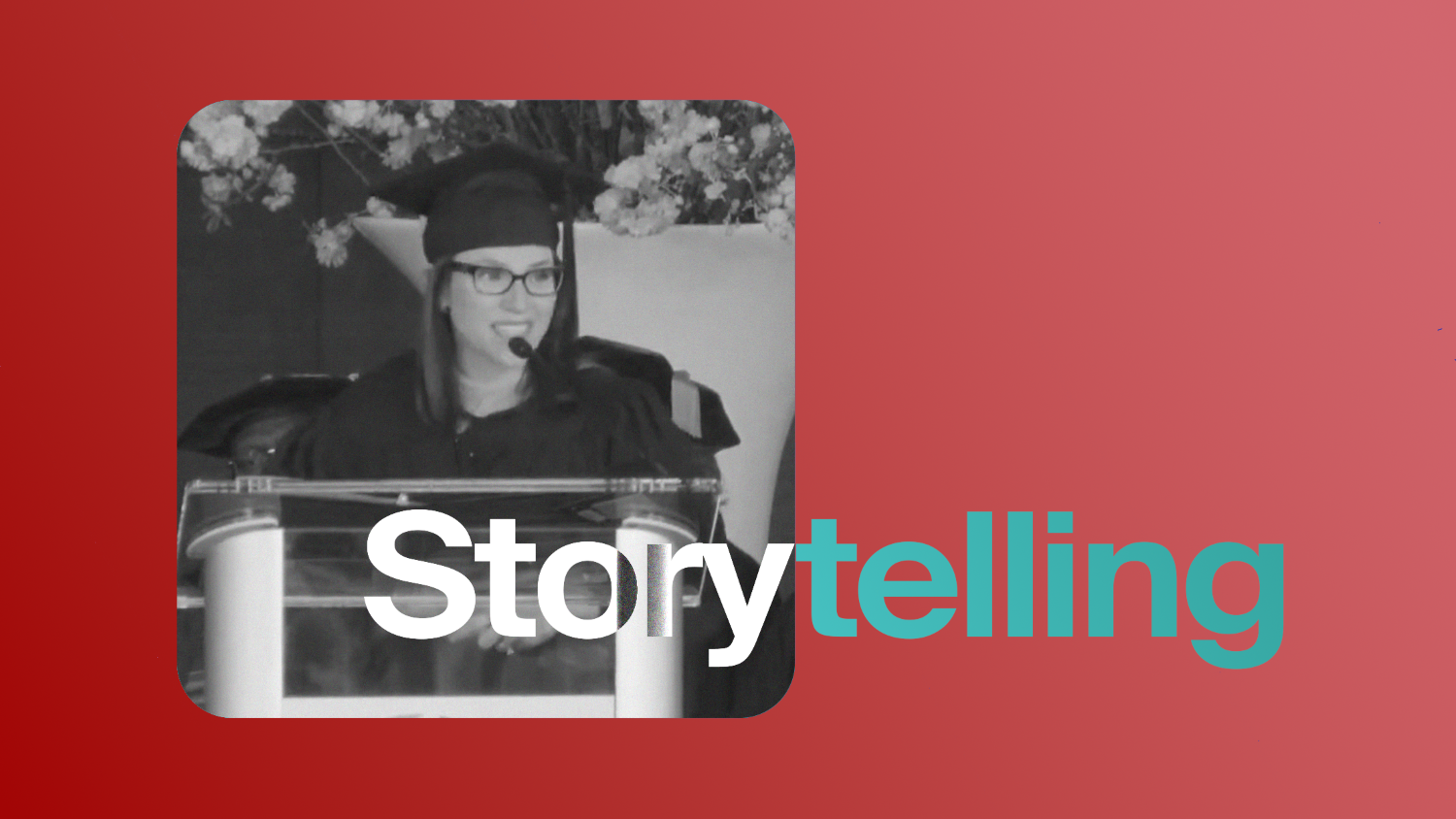
Storytelling | Emily Roper Doten

This story from Olin’s former dean of admissions and financial aid Emily Roper-Doten (now dean of admissions at Brandeis University) recounts a key moment in her own time as a first-generation college student when socioeconomic class differences became starkly evident to her — and the ways in which that moment has shaped her career-long commitment to equity.

To learn more about Storytelling, visit Olin College’s Story Lab website here.

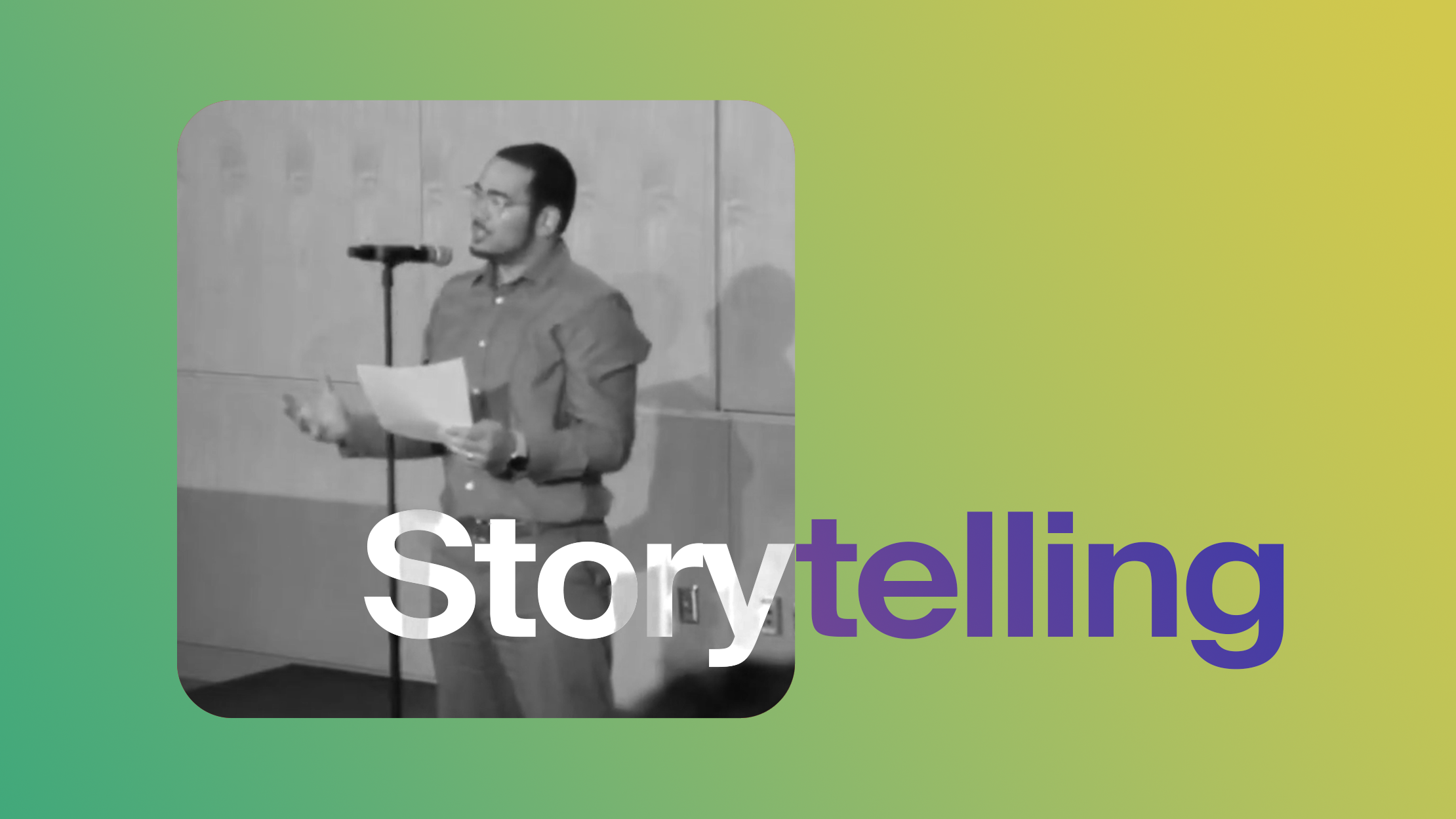
Storytelling | “Decoding the Rules,” Amon Millner

This story from Olin professor of computing and innovation Amon Millner recounts the origins of his investment in changing the computer systems that govern our world. He takes us from his divorced parents’ very different homes to a fateful moment at a carnival to his current work in computing, linking the personal and the cultural.

To learn more about Storytelling, visit Olin College’s Story Lab website here.

Building a More Caring University

Like many educators during the pandemic, Kevin R. McClure felt the burnout. Faculty members were juggling research and leadership responsibilities, teaching and helping students, while navigating their own personal issues and watching colleagues struggle. As chair of the Department of Educational Leadership at the University of North Carolina at Wilmington, he began writing and speaking about these challenges and the coinciding tide of resignations. Institutional leaders and journalists tuned in for insight into why so many employees were disengaging — and what colleges could do differently to retain their people.

Those conversations culminated in “The Caring University: Reimagining the Higher Education Workplace After the Great Resignation” (2025), a book that argues burnout is not an individual failure but a signal of deeper organizational problems. His research on college leadership, workplace culture, and organizational care helps campus leaders to build institutions where doing meaningful work isn’t to their own people’s detriment. 

LearningWell connected with McClure to discuss what it looks like when a university takes steps to prioritize its employees and the difference that effort makes in engagement. 

LW: Let’s start by looking at what it means for a university to be a caring institution. Why are we talking about this for higher education in a way that differs from, say, a grocery store chain?

KM: Higher education has not done a great job of prioritizing the wellbeing of staff and faculty. That’s not to say that it is worse than other industries per se, but we aren’t knocking it out of the park. Based on data that I collected through interviews with over 150 staff, faculty, and leaders across the country, what I heard over and over again was this question about whether or not this is a place that really cares about me. There was a feeling that they were expendable — that their health came second or third to other priorities that the institution had — and it was willing, in some cases, to sacrifice the health of some employees. This was particularly evident during the pandemic. We’d see a certain kind of comfort with the idea that we’re just going to lose people and either not replace them and absorb some of those cost savings or just repost the position expecting that people will line up to take it — a kind of churn and burn.

As I was doing these interviews, I heard a fair amount of pain from people on a regular basis. These are institutions that are dedicated to human growth and development, and we should be the world leader as employers. There was a time where we had the ability to point to indicators that we are leaders in certain regards, and that’s harder to claim today. And so it’s really an invitation for those of us that work in higher ed — those of us who are leaders in higher ed — to say we can do better than this. 

“There was a feeling that they were expendable — that their health came second or third to other priorities that the institution had.”

LW: What did the great resignation look like in higher ed, and what did it reveal about universities as a workplace?

KM: We certainly saw a number of people who left, and there was pretty heavy recruitment of people into ed tech as kind of an adjacent industry selling products and services to higher education. And we saw a number of people looking for places better aligned with their values or places where they might get slightly better pay or slightly more flexibility. And so similar to other parts of the great resignation, it wasn’t necessarily people leaving work all together so much as it was this kind of great shakeup of people moving jobs. 

The part that makes it somewhat unique is that higher education employees don’t always have a ton of mobility options. They may be in a particular field where there are only a handful of jobs open in a given year, and their ability to just move somewhere else is quite limited. A fraction of them have job security through a tenure system, which only actually works out to about a quarter of faculty. So in higher education, a great resignation looks a little different because of these other dynamics at play. The question becomes: What are we as an institution going to do differently to attract and keep really talented people? And very often, the answer was that there wasn’t much of anything happening in response to that. 

LW: Your book makes a strong case that employee wellbeing is foundational to student wellness and institutional success. What does that look like on campus? How do students and the whole school benefit when faculty are happier and doing well?

KM: When you look at some of the things that we know about student success, they include things like sense of belonging, a sense of mattering, doing work that is meaningful, feeling included, and getting engaged in the life of the institution. They’re all concepts that have a similar if not identical concept when it comes to retaining and attracting employees. And it’s because a lot of these things are just base-level, fundamental components of what humans need in order to be healthy and thrive. As we’ve had all these conversations about student success, I’ve been trying to point out the fact that these are all things that are good for employees as well. We don’t have to just think of them as things for students. What this book is trying to do is to push us to not necessarily think in terms of specific populations but to say we are a community of learners, and we ought to be thinking across the entire organization about some of these things. And if we do that, I think we are going to see downstream benefits and outcomes for students.  

You know, students are smart and perceptive, and they pick up on when an institution is thinly staffed and when faculty and staff seem really stressed. They’re able to pick up on P.R. spin and prestige games that institutions play. And they have an awareness, I think, of an institution where things are imbalanced, and they can feel it really acutely when somebody leaves — when they lose a mentor or someone on campus that has been important to them. And so if we think about foundational conditions for a community to do well and to be well, we need to say instead that this is something that’s good for everybody. 

LW: You’re clear that care isn’t a matter of band-aid solutions like extra wellness days. What does institutional care look like when it’s embedded in policies and structures beyond encouraging people to, say, make sure they get out and take a walk?

KM: Institutions have often relied on that more individualized type of response to challenging workplace conditions: Don’t overwork. Don’t say yes to too many things. As you put it, go take a walk. We’ve put a lot of onus on individuals to navigate through this themselves, and my argument is not necessarily that we should throw out self-care. Everybody should be thinking about the choices that they’re making.

But when you look at the root causes of some of these workplace problems, they are often structural and cultural — a reflection of choices that we make across the organization, our strategic planning, and the priorities that we set. When we set goals, we need to ask how they are going to affect our people and what additional capacity we are asking of them as a result. It means looking at some of our practices and policies and whether they’re really designed for the realities of living, breathing humans with caregiving responsibilities and health limitations. Oftentimes, our practices and policies are designed for people that are robots or don’t have any kind of demands of a body.

LW: In the book, you critique the idea of the “ideal worker” in higher education — the myth of the teacher constantly available to be a life-changing mentor for students. How does this myth of “The Giving Tree” professor affect not only employees but also the learning environments we create for students?

KM: There is a real need for us to be thinking about workload and establishing some real guardrails to prevent that sort of thing from happening. Yes, it’s up to people on their own to parse out how they should be handling these things. But often we’ve got reward and recognition systems that are based on the idea that the more productive and performative that you are, the more likely you are to be recognized, so there’s kind of an inbuilt incentive for people to go above and beyond. We don’t want to take away incentives for honoring work that is good and valuable to the institution. But we also don’t want to suggest that just because someone is setting some healthy boundaries on what they take on that they are considered someone who’s not pulling their weight.

“We don’t want to suggest that just because someone is setting some healthy boundaries on what they take on that they are considered someone who’s not pulling their weight.”

LW: It’s hard to determine what an appropriate level of engagement is — how much to put yourself out there and pull your weight — particularly when we’re talking about supporting students and colleagues. Is there a way the university could be better involved in modeling expectations?

KM: Of course there’s some nuance with this, and it gets a little bit complex, but I do think that there is a role to be played by leaders in modeling what this can look like. When there’s an opportunity for any of us in leadership roles to show what a healthy boundary looks like for newer people that are coming in, it makes it a little bit easier for them to make that choice — to not feel like they’re going against the grain — because this is the norm. If we as leaders have a situation where someone is clearly overwhelmed, we need to take some steps to help and say, “Hey, you’ve got too many students that you’re mentoring right now. Our norm is closer to eight, and we see that you’ve got 15. Let’s figure out a system so that we can better distribute this so it’s not entirely on your shoulders.”

LW: What makes it harder is that it’s personal. Employees aren’t building widgets. They’re investing time in helping colleagues or developing a young person in their field looking for guidance.

KM: All of it’s very personal. The reality is that most of us are people who got into this work because we really believe it’s important. It’s meaningful to us. So much of our scholarly work is collaborative, and we have commitments and obligations to other people. It feels very hard sometimes to pull back on that because it feels like you’re risking some of those relationships or failing to show up for people you care about. 

But again, there’s a real role in setting healthy expectations — expectations for people who are seeking promotion, for example, that aren’t over the moon, but reasonable. 

LW: Higher education tends to be good at measuring enrollment, retention, and revenue. How could institutions think differently about measuring wellbeing — for employees and students — and following through?

KM: A basic level is we probably should be collecting more data that better gets at the employee experience. Right now, we do very little of this beyond a periodic employee engagement survey. There might be some exit interviews that happen as someone leaves, but even that can be very sporadic. And so the bar right now is quite low in terms of what we do. Anything that we do above that is going to be a step in the right direction. Then, once we better understand who our employees are and what their experience is on the job, we can make sure we’ve got capacity to analyze that data and that it doesn’t just sit on a shelf.

“People have to start believing that this is a system worth investing in.”

We have at our disposal at colleges and universities people who are trained in social science research, and there’s no reason why we couldn’t be figuring out some better ways of designing studies to better understand the employee experience and improvements that we can make. Too often institutions collect data, but then they don’t act on it. And then people lose faith that this is a process that’s going to lead to change, and then they opt out of doing it in the future. People have to start believing that this is a system worth investing in.

LW: Do you have some examples of universities doing it well?

KM: Almost every positive example in the book begins with some type of data collection effort. They are starting from a position of: “Let’s get a better handle on what the problem is — specific to our institution, our culture — and then let’s design something that speaks specifically to us.” 

One of the issues that I flag in the book is about the lack of career advancement and career pathways. There’s a great example from Miami University in Ohio where a marketing communications department had lost a significant number of people. They began with an employee culture survey, and through that, they identified that the biggest issue was people felt like there wasn’t room to grow, particularly people that were not interested in being supervisors. From that, they designed a new career pathway model — one for people that wanted to supervise and one for folks that didn’t. There is another example at the University of Louisville that identified the need to pay better attention to the employee experience. They now have a dedicated staff that is working on better onboarding, better recognition systems, better employee training, and I think that has been a smashing success. 

LW: It’s such a time of change right now. Are there already new things you wish you could add or adjust in the book?

KM: I feel like I should write an epilogue! We’re in a moment that makes all of this more complicated. I mean, how do you show care for people that are coming to join your faculty from other countries, when it doesn’t feel like the door is quite as open or students that have come here to study are being detained? 

Politically speaking, we have institutions that have had sources of revenue disrupted or cut, so they have less to work with. It’s very difficult to try to pursue a model of organizational care at the same time that you’re laying people off. We have spaces where there’s real challenges with enrollment decline. 

A lot of this is not symbolic or hypothetical anymore, and we will see the consequences of that over time. That’s the world we live in right now, and those of us still in it are trying to do the very good work with students, and remain hopeful.

How Our Stories Shape Culture with Jonathan Adler and Gillian Epstein

This is the second episode of “Lives Well-Told,” a two-part series of LearningWell Radio.

On this episode of LearningWell Radio, Drs. Jonathan Adler and Gillian Epstein, the co-founders and directors of the Story Lab at Olin College of Engineering, rejoin Marjorie Malpiede to continue their discussion of storytelling in the college context. Following the last episode on how individuals can approach crafting their stories, this episode explores how the act of sharing those stories has the power to shape and change larger communities. 

Listen now on Spotify or Apple Podcasts.

You can reach LearningWell Editor Marjorie Malpiede at mmalpiede@learningwellmag.org with comments, ideas, or tips.

How to Tell Our Stories with Jonathan Adler and Gillian Epstein

This is the first episode of “Lives Well-Told,” a two-part series of LearningWell Radio.

On this episode of LearningWell Radio, Marjorie Malpiede hosts storytelling experts Drs. Jonathan Adler and Gillian Epstein, the co-founders and directors of the Story Lab at Olin College of Engineering. They discuss the intrapersonal integration that storytelling supports and the ways in which our stories do — and do not — support our wellbeing.

Listen now on Spotify or Apple Podcasts.

You can reach LearningWell Editor Marjorie Malpiede at mmalpiede@learningwellmag.org with comments, ideas, or tips.

Truth and Service

When Jaydn Decuir was looking at colleges, her father asked her an instructive question: “What is it you need to solve the problems you wish to solve?” She thought about her own community and how she hoped she could someday lessen the burden of gentrification on those who were displaced. She decided she would become a civil engineer. Her first choice was Howard University. 

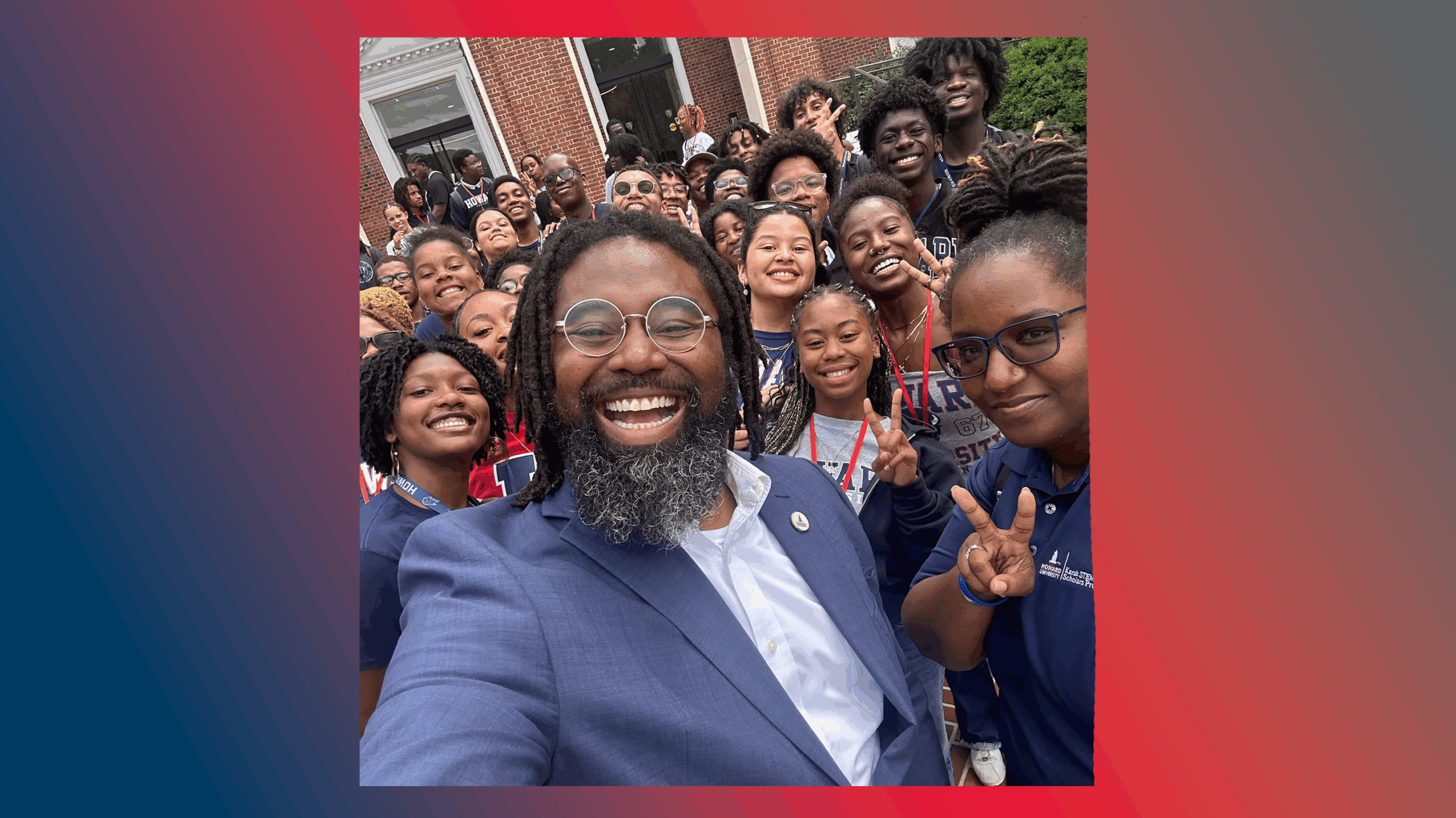
Students like Jaydn Decuir are the heart and soul of Howard. They are high-performing, civically engaged, and mindful of their positions as future Black professionals in careers where they’ve been historically underrepresented. The prestigious Research 1 university, which is also an H.B.C.U. (historically Black college and university), has graduated more African American Ph.D. recipients than any other university in the United States. Many of them serve in leadership positions focused on social justice. 

Howard University is now engaged in a campus-wide character education initiative that takes all of this into account, as it considers how to codify, promote, and integrate character work throughout the university. In 2025, the university received a substantial Institutional Impact Grant from the Educating Character Initiative (E.C.I.) at Wake Forest University. Funded by the Lilly Endowment, the program seeds and studies character education programs at colleges and universities of diverse profiles across the United States. 

“What we do here is create leaders, and you cannot have those conversations or that training without talking about character,” said Dr. Dawn Williams, the interim provost and chief academic officer at Howard. “What this initiative allows us to do is name it, and study it, and that leads to capacity building and replication.” 

The grant will help organize the formal and informal character education efforts already underway at Howard into a center. Research will inform an H.B.C.U.-based framework for character education that can be infused into the curriculum and shared with schools throughout the country. Perhaps most importantly, the work will help answer questions such as: What is different about character education at an H.B.C.U. with a rich legacy of social change? And what does character education look like for institutions that have both held it dear and been excluded from its record? 

What does character education look like for institutions that have both held it dear and been excluded from its record? 

“When you think about character, different things come to mind that may have been informed by books, experiences, or individuals,” said Dr. Jorge Burmicky, the principal investigator on the grant and faculty member at the Department of Educational Leadership and Policy Studies at Howard. “Now we get to add to that word — its meaning and traditions — from the perspective of our work here at Howard.” 

Studying the Scholars

As a higher education scholar focused on racial equity, social justice, and leadership, Burmicky said the opportunity to lead the exploration of character at the nation’s premier H.B.C.U. was “by far my wildest dream.” Through a previous capacity building grant from the E.C.I., Burmicky had participated in the Common Good Character Trust project, where he met with other scholars and thought leaders to reimagine character education through a contextually relevant lens.  

Burmicky said the first part of the project, which is housed within the provost’s office, aims to study and potentially transfer exemplars of character education that exist within the university. In seeking a baseline, he immediately consulted Ron Smith, the executive director of the Karsh STEM Scholars and the Humanities and Social Sciences Scholars programs at the university. Smith had been running these highly selective learning communities since 2016. 

The Karsh program is modeled after the Meyerhoff Scholars program at the University of Maryland, Baltimore County, with the expressed intention of addressing the underrepresentation of African Americans in STEM professions. Its unique capacity to nurture leaders of good character made it the ideal subject by which to assess and organize character education at Howard.  

“Our programs are anchored by a set of values that can easily be discussed as building character within students,” Smith said. “We have expectations for our students on how to build community and to connect ourselves to what has always been central at Howard: our motto — Truth and Service — which runs deep through our veins.” 

The signature component of these initiatives is the Summer Bridge Program (S.B.P.), a six-week curricular and co-curricular living-learning community for emerging leaders that is capped by a two-week study abroad component. While sharpening skills within their disciplines, the S.B.P. challenges student to think more critically about virtues such as justice, courage, empathy, self-awareness, and humility. It upholds eleven core values, including “be honest and earn the trust of others” and “be open to new ideas and different perspectives.” 

As a Karsh Scholar, Jaydn Decuir became part of that community. She met her roommate and best friend on the first day of the S.B.P. and said her experience that summer will stay with her the rest of her life. 

“I imagined the Summer Bridge Program to be technically-heavy, but it was so much more than that,” Decuir said. “We had so many discussions about what was happening around us, around the world, and what our viewpoints were on different issues. I am forever grateful for it.” 

This holistic preparation is meant to equip students with skills beyond their disciplines, as they navigate graduate schools and professions that have unique challenges for students of color. In this way, the S.B.P. reflects what Burmicky outlined as some of the larger goals of the character initiative. “Our approach focuses on how students develop character by seeking truth, engaging diverse perspectives, and making ethical decisions, all while navigating their racial and ethnic identities,” he said. 

Other reasons the S.B.P. became the organizing element for character work at Howard include the fact that it enjoys broad support throughout the university, with partnerships across departments; and it provides a robust laboratory for assessment. 

“Since Karsh and the Summer Bridge Program have already been doing this work, the research allows us to learn from these experiences and transfer that learning to other areas of campus,” said Tatianna Duperier, a doctoral student at Howard who was hired through a partnership with the ASCEND (Alliance for Scholarship, Collaboration, Engagement, Networking and Development) initiative at Yale University to assist in the research. 

This summer, Duperier will begin a series of student surveys and qualitative interviews that will be used to make improvements to the program while ideally serving as proof of concept for expanded character education throughout the university. Both Interim Provost Williams, and Burmicky believe the empirical evidence they will gather will inspire others on campus, particularly faculty. 

“With this data, we can say to others within the university: ‘Look at what we’ve done at Karsh and the Summer Bridge Program,’” Burmicky said. “‘What are you doing that is similar in the engineering department, in the professional schools? How is our medical school preparing physicians for their careers though this lens?’”

Unpacking a Complex History 

It was Martin Luther King Jr. who famously dreamed of a day when people would be judged not “by the color of their skin but by the content of their character.” Indeed, the history of character — and character education — within the Black community is pervasive but also complicated by slavery and structures and policies that were not designed with communities of color in mind. 

It was Martin Luther King Jr. who famously dreamed of a day when people would be judged not “by the color of their skin but by the content of their character.”

As part of the Howard initiative, Burmicky and his team are developing an H.B.C.U.-based theoretical model for character education and studying existing models and strategies for character education in higher education. In this work, they are looking at key considerations of character education through an H.B.C.U. lens, including the legacy of character within Black education and the paucity of Black-centric character education within the literature. 

As Burmicky points out in the E.C.I. proposal, Black scholars refer to character education as the “raison d’etre” of H.B.C.U.s (Shaw, 2006), but little has been studied or written about it. While many higher education institutions in the United States have implemented character education, much of the documented empirical evidence has taken place at predominantly white institutions or from white or ethnocentric lenses. “The absence of Black students and culturally and racially responsive methods and epistemologies in these processes has been documented in the literature” (Burmicky et al., 2025, p. 5).

Carol Moye serves as the E.C.I. grant’s director of assessment and program learning. She believes the exclusion of Black voices has had major implications for character in Black education and for the field of character education. 

“One of the things we have to look at is the perception of character education — but from whose culture and whose viewpoint,” she said. “We have always had character in the Black community, but it did not present in the way people wanted us to be perceived. There was this sense that we would impose character on these people with the assumption they did not already have it. We need to turn this narrative around for our students and urge them to find the character they have and utilize it in the work that they do.” 

The character imposition notion contrasts starkly with the undeniably rich commitment H.B.C.U.s have to social justice and public service. Most definitions of character education include a beyond-the-self element and a desire to serve one’s community. At Howard, as in other H.B.C.U.s, this concept is foundational. 

“Leadership for us has largely been about communal responsibility,” said Williams, who believes the most visible evidence of Howard’s commitment to service is the students themselves. “We don’t have to talk our students into being change-makers. That’s who we attract.” 

Building a Unique Contribution 

Given these strong traditions, the question may not be so much how to expand character education to include H.B.C.U.s as what the legacy of character work within H.B.C.U.s can add to the field of character education.

This is something that Michael Lamb, the senior executive director of the Program for Leadership and Character at Wake Forest University, will no doubt consider as they work to understand how character education is contextualized in diverse educational settings. 

“As we like to say, character is for all but not one-size-fits-all,” Lamb said. “Different institutions have different ways of understanding and educating character. At the E.C.I., we’re especially committed to helping institutions develop programs that fit their own institutional context and culture and to learning from them in the process.H.B.C.U.s have been educating character for generations, so they have much to teach us about how character can be developed in different contexts.” 

The final deliverables for Howard’s three-year grant include: the launch of the H.B.C.U. Character and Leadership Education Initiative at The Center for H.B.C.U. Research, Leadership, and Policy at Howard; and the development of a H.B.C.U.-based framework for character education that will be launched at a national convening, in conjunction with ASCEND, in 2028 at Yale University. The team hopes that, by then, the organizing effort they conducted at Howard, and the learning they will have shared, will benefit the university, the H.B.C.U. community, and all those who work to support character and social justice — what Howard calls Truth and Service. 

You can reach LearningWell Editor Marjorie Malpiede at mmalpiede@learningwellmag.org with comments, ideas, or tips.

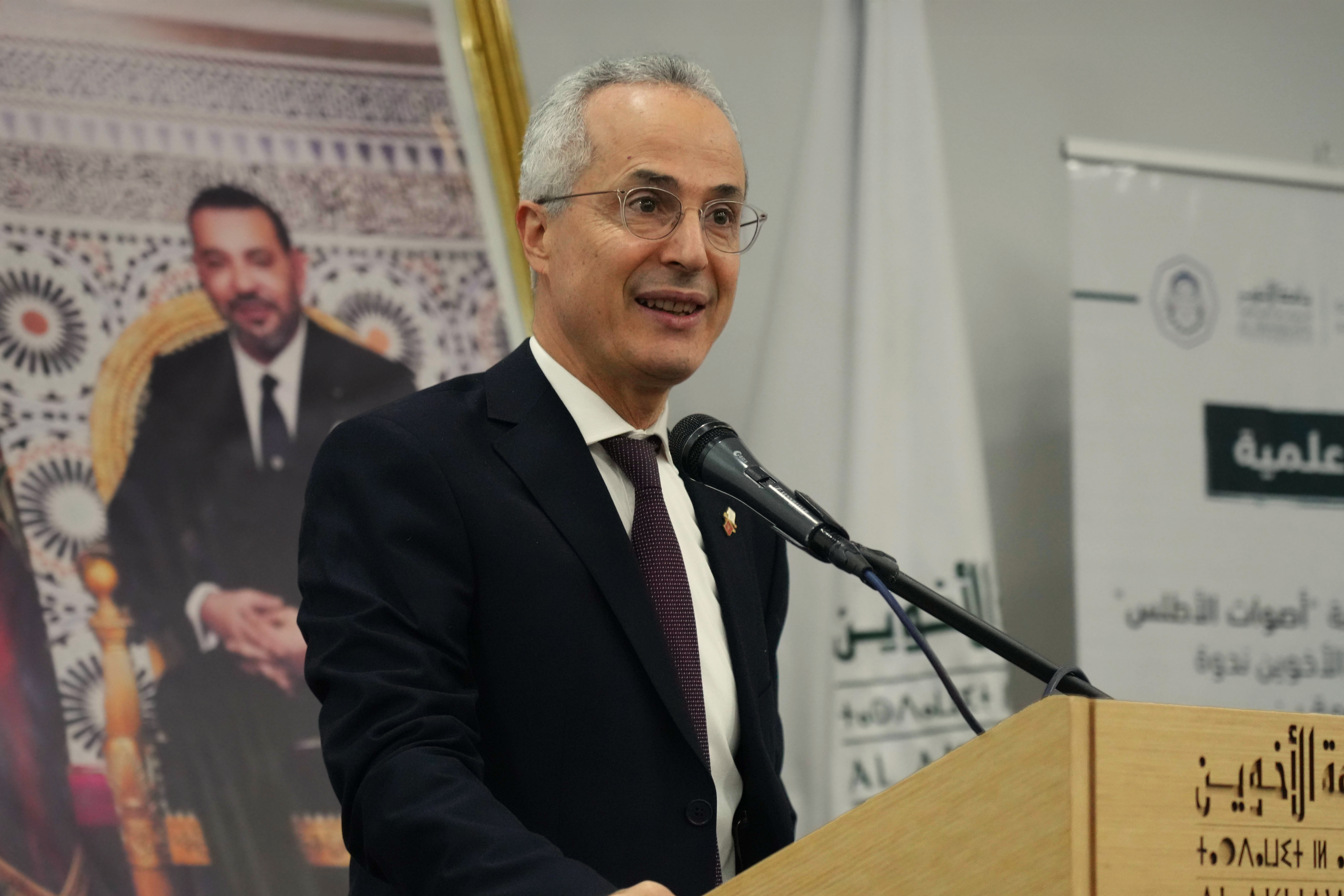
A Moroccan University Weaves Wellbeing into the Liberal Arts 

Visions of Morocco often conjure vast deserts and bustling cities. Al Akhawayn University, quietly tucked in among the Middle Atlas Mountains, is more likely to be covered in a dusting of snow than sand. The surprises don’t end there. 

Since 1995, A.U.I. has led with an American style of liberal arts education that is different from every other university in the country. The idea came out of a partnership between two monarchs — King Hassan II of Morocco and King Fahd of Saudi Arabia — who also inspired the university’s name “Al Akhawayn,” meaning “two brothers” in Arabic.

That founding emphasis on connection and mutual support — global and local — remains. Current President Amine Bensaid has been building out a particularly robust approach to student affairs based on helping students, struggling with wellbeing much like in the U.S., develop meaningful relationships with both each other and the world.

With LearningWell, Bensaid talks about pioneering and preserving the liberal arts core, while adapting to the unique needs of his students — and the country.

LW: I’m interested in how the liberal arts model came to A.U.I. and to Morocco. Could you tell us more about that?

AB: The vision for an American-model university in Morocco is something that late King Hassan II had, in the late 70s or 80s, I believe. The rest of the education landscape in Morocco is all modeled after the French system, so the general idea was to have a pilot, or just an experiment, in Morocco for an American-model university. And then when he finally got to do it — that was in the early 90s — it was clear that it would violate a number of things in Moroccan law on higher education with respect to pedagogical norms and governance. 

As a result, a separate law that would govern the university was created in the form of a Royal Dahir. In that royal decree, in the preamble, it was almost like he saw September 11th coming: He wanted the university to graduate a different breed of graduates who would be ready, willing, able to contribute to mutual understanding between different civilizations. We were not only going to do a university based on the American model but specifically a liberal arts and sciences kind of university. 

So that’s really where the whole thing came from. It felt like a little bit of a vision for a monarch that saw that there was this system that could give better results for the kind of transformation that he was imagining.

LW: And maybe with that, your work around student life is also really unique, right? What goes into that approach?

 AB: Historically, the model for student life in Moroccan public universities has been inspired by the model in French public universities, where it’s not designed to play a role in student success and identity. In Moroccan public universities, typical student life consists mostly of housing and meals, with housing provided to a relatively small percentage — maybe 10 to 20 percent of the student population. At A.U.I., about 85 percent of students live on campus; campus life and student activities make up a significant part of a student’s college years. By design, it is meant to be immersive and provide a transformational experience. A.U.I. also brings some of the learning even closer to the dorms through living and learning communities — for example, for first-year students. Today, many private universities in Morocco do offer student activities — in a way probably inspired more by A.U.I. than by the French model — in addition to housing and dining, although they’re still not on an immersive and transformational model where student life is at the heart of the university experience.

LW: How did you get so invested in the student affairs and residential life piece?

AB: The investment is really in the convergence between student affairs and academic affairs to provide an integrated transformational experience that makes a difference in the life of the student. So the short answer is we were looking to have an impact where it was most needed, which really is just being true to A.U.I.’s mission. The long answer has to do with A.U.I.’s history and journey.

A few years after A.U.I. started, it came to feel important to further institutionalize its practices and for some third party to make an external evaluation regarding A.U.I.’s mission of implementing the American liberal arts model in Morocco and the benefits it sought for its students. So A.U.I. embarked on NECHE’s process of accreditation, which was a process of seven years, and we received our first accreditation in 2017. In 2018, when the thinking started towards a new strategic plan, the reflection was: ‘Okay, well A.U.I. has now delivered on its mission because NECHE has certified that we have done what we were supposed to do.’ The question then became: ‘Okay, so what do we now do?’

Considering A.U.I.’s history and DNA, the answer came very naturally: ‘Let’s use what we’ve learned to contribute to Morocco’s human development efforts. Let’s capitalize on our experience to act as a living lab to address one of our country’s challenges.’ The colleagues who were working on this came back with a proposal: The economic situation in Morocco included a highly respectable G.D.P. growth of about 3.5 percent per year on average over 20 years. But socio-economically, it had not created enough jobs. 

And especially, there was a challenge of unemployment among young graduates. The team further suggested: ‘Considering the fast pace of change in the world of jobs and employers, shouldn’t we also be concerned at A.U.I. about what would happen to our graduates if employers start asking more for technical skills than for general education? So why don’t we extend our liberal arts and sciences model to extend our definition of student success as including career success?’

But then a group of faculty said, ‘Well, you guys want to take young Moroccans, and you want to work with them in order to adapt to the fast pace of change of the job market. But you don’t realize that for the past few years, we feel that these students of the new generation themselves have been changing!’ Some were saying, ‘Things I’ve done with my students that have worked well for 20 years now no longer work as well. I feel like they are different “breed” as students.’   

And so the team working on strategic planning went out and did some more desk research, and that’s when we — I, for one! — discovered the concept of Gen Z for the first time. So the team came back saying, ‘Yes, this generation may be different and what the colleagues are saying may be deeper than we think, and here are characteristics of this new generation. And by the way, there is an elephant in the room, which is the wellbeing mental health of this generation.’

“It was like, ‘Oh my God! We’re starting to see what was already happening in the U.S.!'”

So we decided then that we were going to further extend our model. In addition to augmenting our liberal arts model with a layer we refer to as career success — we called it, actually, R.O.I., return on investment — we’ll add another layer that we called V.O.I., value on investment, or student fulfillment. We decided to work with our student and find ways together that, by the time they graduate, will better equip them to pursue fulfilled lives. We became very excited about these strategic choices. The only trick is that our board approved this in February 2020 to go into effect starting fall 2020, and then we were hit by COVID in March 2020.

LW: Ah, so what ended up happening to life on campus? Were you fully remote during that time? 

AB: When we learned about the wellbeing challenges facing Gen Z, we were initially not seeing anything on campus in relationship to that. The only reason we started looking at this is because the faculty were saying they seem different in their teaching and learning. But we had no challenges with wellbeing whatsoever, and no challenges with mental health. A.U.I. is the only university in Morocco that, since 1999, hired a psychiatrist on a part-time basis for student support. But that was it; there was no mental health issue at all, and certainly not the issue we were reading about in the U.S. studies. 

But when COVID hit, yes, students were away for a semester, and then they came back in the fall of 2020. And when they came back, everything seemed to have changed. So what we were reading about that we were not seeing, we now started seeing. We had one student suicide, albeit not on campus. We had a waiting list to see psychologists that was about five or six weeks. So it was like, ‘Oh my God! We’re starting to see what was already happening in the U.S.!’

And so while our strategic project was forward-looking and aimed at ensuring that by the time our students graduate, they’re more resilient and better trained to pursue their fulfillment, they had a problem here and now! And we had to find the solutions, and the solutions that we discovered from universities in the U.S., we really did not think were adapted to us because they were just too expensive and not scalable for us. As we understood it at the time, the ratio of number of students to number of psychological counselors was key. For us, there were two or three challenges with that. One of them was that the Moroccan culture was such that it was a little bit taboo to actually go see a psychologist; two, it’s still too expensive. We were thinking, if we go the ‘American’ way, then by the time our students graduate, they would be dependent on a service they cannot afford once they leave the university.

So we started looking for something else. We decided to develop what we called the holistic strategy that is based more on prevention. (But, still, we hired two more psychologists ourselves and another part-time psychiatrist, and we brought down the waiting time on the waiting list to 48 hours. Now we don’t have any waiting list at all.) And we started working on this holistic strategy with sleep and sports and nutrition and substance abuse, thinking that we were going to speak to the emergency with the counselors but that we needed to do more work for a more fundamental solution. 

LW: Did you ever anticipate that student wellbeing would become such a big part of your work? How do you feel about it now?

 AB: I have an easy answer: No. I didn’t think at all that this was going to be a part of my work! But I believe that we have a critical mass of colleagues who are really passionate about the education that they try to offer. And as a result, from that perspective, I’m not surprised we got into this. Because with the parameters of the current equation, we believe we have to do this because it’s the right thing to do. In the same way that if there’s a problem with employment, you would do something about it, well, you have to do something about this challenge. And it’s deeper. And we feel it’s more in resonance with the spirit of the liberal arts tradition that, if you really want to make a difference — a meaningful difference — then you cannot afford to ignore this. And it’s a wicked problem. I mean, it’s not an easy one. So no, I did not expect it at all. But in retrospect, I believe it’s part of what we have to do if we’re sincere about the kind of difference that we want to make. 

LW: Post-pandemic, what does ensuring students get that “value on investment” look like? What are the priorities from the V.O.I. perspective?

AB: We have decided to work on four pillars. One is to work with our students on purposefulness.* You probably know about all the research that you’re more resilient when you have a purpose. Two is working on what we refer to as meaningful relationships. You know this long Harvard study on what makes a good life? So it turns out that the parameter that makes the biggest difference is these meaningful relationships or friendships. And so that’s our second pillar.

Our third pillar is about giving or generosity. Since 2004, A.U.I. has had service learning as a requirement. We were developing student skills and we were trying to give back, but we had not thought of it as really benefiting students’ mental health or wellbeing. We’ve now discovered we can also use it to loosen the grip of the ego and self-interest and shift the attention away from the self. 

“We decided that we were going to learn how to partner with our new generation of students.”

And the last pillar is about an observation, but then we were told that there was also some research for this: Our observation was that in Morocco, we were in a societal transition whereby parents did not seem to be as invested in educating their children. Traditionally, most moms did not work, but now both parents are working and have very little time for the children. And when they have some time for their children, they seem to spend it trying to become friends as opposed to educating. And similarly, when many of our faculty who are my age went to school, the neighborhood was also part of education — the neighbors would see behavior from a kid and would say, ‘No, you do this; you don’t do that.’ Similar things could be said about school.

So the feeling was that these components that went into a child’s education were weakening. And in parallel, our surveys of our students showed that on average, our students spent 40 to 60 percent of their time on social media. So it was like two phenomena happening in parallel — that on the one hand, they had weaker ties with their own environment and culture, and on the other hand, they were living in some kind of culture not tightly coupled with what they were living in physically. 

And so our assumption at the time was that, well, with this lack of cultural anchoring, one may be less resilient and more fragile. And as a result, we decided that we were going to offer an anchor, and that’s what we call the ‘cultural grounding.’ 

So these are the four pillars: purpose, meaningful relationships, giving, and cultural anchoring. Our assumption there — it’s a big assumption — is that if we work on these four things and our students get better on these four things during the four years or so that they spend with us, then that would improve their readiness for fulfillment.

LW: How do you go about helping them with those four pillars? Are there required activities? How do you tackle each one?

AB: So maybe there is one more element I should share with you. When we were finishing the work on our strategic plan in early 2020, we asked ourselves the question: What kind of relationship do we want to have vis-a-vis each stakeholder of the university? And the consensus was that vis-a-vis our students, we wanted to serve them the same way we serve our own children.

And so when we thought we were done, and we presented to students and said, ‘Here’s the kind of relationship we mean to have with you,’ then almost with one voice, consistently, they would say, ‘Oh, thank you. You’re so sweet, but no thank you.’ And we were like, ‘Okay, what kind of relationship would you like to have?’ They would say, ‘We already have a pair of parents, so thank you, but the relationship we would like a relationship is that of being a “partner.”’

So we decided that we were going to learn how to partner with our new generation of students. A.U.I. has had a student government from day one, but we decided to create another representative body of students that we call the Student Leadership Council, which is made up of the presidents of each club and association. We have over a hundred clubs, so it’s a large thing. The idea was that we were going to learn how to partner through that — through students who were closer to other students day to day. 

And the relationship to your question is that we took the entire V.O.I. strategy to this council. So we already had some ideas. For example, we started the work on purposefulness before we establlished this council. We adopted the human-centered design thinking. We started initially with the graduating cohort because we did not want them to leave without doing it. And then we included it in the work that we do for career preparation. And then we included it in our first-year experience and courses for academic success.

But at some point, we brought it to the students and we said, ‘Here’s our strategy. Here’re our four pillars. Here’s something that we’ve already done, but here is what we have not done.’ So they started working on the meaningful relationships. And so they made a plan, and they identified things that we had never thought about. So one of the things they came up with, for example, is that they feel that developing these kinds of relationships has happened for them more when they were working in teams on challenging academic projects. 

For the generosity and giving, we had almost 20 years of work on service learning, but now we were also trying to see how it could be used to contribute to wellbeing. And then for cultural anchoring, we found it more challenging. So we decided to move ahead with some actions while we keep working on the strategy for that. So the something that we did was, starting last year, we decided to offer our students an opportunity to discover our country through the different genres of music in different regions of Morocco. So we had a composer give a semester-long course on this, where over the course of the semester, he actually brought in different bands from different regions of Morocco, and they would talk about the history, the cultural aspect. But at the same time, they would actually play; they would perform. It was interesting, and it looks like the students liked it a lot. We’re now enriching that with a focus on deeper values in our culture and the way they can contribute to strengthening ethical leadership in our students.

LW: Have you been able to find partnership with other institutions along the way as your plans develop and change?

AB: Indeed! You know you sometimes think you’re the only one running into a challenge, and then you discover: ‘There are people like me out there.’ It’s so delightful and so exciting when you do! So just to say, our connections among colleagues and institutions in the U.S. who have similar passions and are acting on them, I believe, have been — I was going to say instrumental, but not just instrumental — a blessing. 

*The Path to Purpose initiative is A.U.I.’s four-year, campus-wide effort to help students reflect on and develop their sense of purpose. You can read more about it through the LearningWell Coalition

You can reach LearningWell Reporter Mollie Ames at mames@learningwellmag.org with comments, ideas, or tips.
“Beyond Silos”

Around 500 professionals across higher education logged on Thursday for a webinar focused on how to institutionalize a culture of wellbeing on college campuses. 

The virtual event, called “Beyond Silos: Bridging Academic and Student Affairs to Advance Student Wellbeing,” was a joint initiative of the LearningWell Coalition and U.S. Health Promoting Campuses Network, two national organizations dedicated to promoting health and wellbeing at colleges and universities.

The webinar was inspired by the understanding that the efforts of a few positive actors on campus, no matter how committed, can’t move the wellbeing needle alone; they need the support of each other and collective action of the wider institution to make meaningful change.

“What if our systems were designed so that without any external intervention, they produced wellbeing and flourishing just by the way that they function?” asked Kelly Gorman, one of the four panelists and the director of the office of health promotion at the University of Albany.

The other three experts included Jennifer Fee, the assistant director of curriculum and training development for the Skorton Center for Health Initiatives at Cornell University; Angela Lindner, the interim vice provost for undergraduate affairs at the University of Florida; and Joe Tranquillo, the associate provost for transformative teaching and learning at Bucknell University.

Marjorie Malpiede, the editor-in-chief of LearningWell magazine, moderated the session, which began with a discussion of why a whole-campus approach to wellbeing is the right one.

Several of the panelists described how implementing wellbeing efforts institution-wide creates a system of support for students that extends beyond bare-bones crisis management or clinical mental health care. The goal is not just to keep issues from worsening, they said, but to foster new heights of flourishing. 

“What if our systems were designed so that without any external intervention, they produced wellbeing and flourishing just by the way that they function?”

Jennifer Fee noted how these kinds of wrap-around supports are key to student academic performance. As for faculty and staff, she said, developing the whole-campus approach pushes them to practice creative problem solving and work across differences and between departments — that is, “beyond silos.”

On a higher level, Joe Tranquillo called out how the whole-campus approach, and ideally improving student wellbeing outcomes on a mass scale, might be influential in improving public trust in higher education as a whole. 

“I think that we need to show what transformations are occurring in our students — how they’re becoming these amazing citizen leaders that are going to go out into the world and do great things,” he said.

But the panelists weren’t shy about identifying the challenges that come with trying to unite different departments and disciplines under a common goal, even one as non-threatening as wellbeing. Institutions of higher education, they noted, are famously quick to factionalize and historically slow to change.

Angela Lindner called one foundational barrier to institutionalizing wellbeing a “challenge of the heart.” “This is less about how to do the work,” she said, “and it’s more about convincing folks that it’s important to do.”

Lindner described a steady struggle to inspire broad interest in an issue that faculty and staff may perceive to be outside their usual focus and adding to their already full plates. From there, sustaining any energy that does emerge is another battle.

Buy-in from top leadership is particularly key, given presidents’ ability to fund and promote a wellbeing agenda. But again, the panelists said, such a champion is not so easily won or kept.

Still, the spirit of the panel remained hopeful. All four experts are as familiar with the obstacles to institutionalizing wellbeing as they are the workarounds.

“One mistake is only paying attention to the coalition of the willing,” Tranquillo said he’s learned. “That feels good. It works great at first because you make really quick progress… But what it does is it means that there’s then a bunch of people who are not included in the change.”

Tranquillo urged the audience to be persistent in efforts to draw fresh support, but also to be patient with the process. “Sometimes the best you’re going to do is to get them to stop fighting you,” he said. 

Gorman added that bringing in new and diverse leadership for projects can help expand involvement as well as impact. “You can’t have just one person or one office leading everything,” she said. “You need leaders from all different areas to bring their perspective to the table.”

Most of Fee’s attention is directed toward helping faculty understand the importance of incorporating wellbeing in the classroom and then actually doing so.

“I have to make sure that they’re seeing the strategies that I’m sharing with them as not one more thing, but helping them do their jobs better, contributing to the academic success of students,” she said.

The online toolkit Fee developed, called WISE (Well-being in Scholarly Environments), includes evidence-based resources for instructors to, for example, write a wellbeing-forward syllabus or develop coursework that builds connections between students.

The need to develop ways of tracking and measuring student wellbeing was also a recurring theme. Clarifying the desired outcomes can reveal gaps in the work and roles that need to be built, Tranquillo said. 

“There should be dashboards,” Lindner added. “It should be open and available, and everybody can see how we’re doing in this agreed upon set of wellbeing metrics across the board.”

Meanwhile, buy-in may build with time and necessity. Faculty will come up against wellbeing’s impact on academic performance; residential life will see repercussions for social involvement; admissions will connect the dots to stop-outs and retention.

“At some point, when you get to a level of root cause analysis,” Gorman said, “you’re going to be on the same playing field. You’re going to be at that same table.”

You can reach LearningWell Reporter Mollie Ames at mames@learningwellmag.org with comments, ideas, or tips.
Relationship Rich Education with Peter Felten and Isis Artze-Vega

On this episode of LearningWell Radio, Marjorie Malpiede hosts Peter Felten of Elon University and Isis Artze-Vega, two experts on relational practices in higher education. They discuss why relationships are so important to the success and wellbeing of students, faculty, and staff, and how to build connections campus-wide. 

Listen now on Spotify or Apple Podcasts.

You can reach LearningWell Editor Marjorie Malpiede at mmalpiede@learningwellmag.org with comments, ideas, or tips.